A cat that has become withdrawn, quieter, less playful, or uninterested in food may be showing emotional distress, but the same signs are just as often caused by pain or illness. “Depressed” is a useful everyday description of a behavior change. It is not a diagnosis an owner can make from a checklist. The safest first step is to define what is different about your cat, then involve a veterinarian before assuming the cause is mood, especially when the change is new, persistent, or getting worse.
What “depressed” means in a cat
Most owners asking this question are describing a change in behavior rather than a named condition. No single sign establishes depression in a cat. What matters is a clear shift from that individual cat’s normal. A cat that always greets you at the door and now stays under the bed has changed, even if no generic checklist lists that behavior.
Illness is a common explanation. Cornell University’s Feline Health Center notes that illness in cats can first show up as quietness or withdrawal. VCA Animal Hospitals’ article “Recognizing the Signs of Illness in Cats,” by Malcolm Weir, DVM, MSc, MPH; Tammy Hunter, DVM; and Cheryl Yuill, DVM, MSc, CVH, puts the problem plainly: “Cats have evolved to hide signs of illness and pain.” Christine Bellezza, DVM, a former Cornell Feline Health Center consultant, makes the same point in Cornell’s “Is Your Cat Slowing Down?”: “Some of the signs are very subtle,” she points out.
Changes worth noting
The table below lists the changes that owners most often report with low mood and what each one can mean. Each change can have a medical cause, so none of them is proof of depression on its own.
#1 Best Overall

- A NEW CHOICE FOR INDOOR ENTERTAINMENT: Endless fun for your cat! Designed for indoor environments, this interactive toy ball rolls quickly across the carpet and emits an appealing cat-attracting chittering sound. Not only does it stimulate your cat's hunting instincts, it also allows them to enjoy outdoor chasing indoors while reducing the risk of furniture scratching
- INTELLIGENT INTERACTION AND FUN: This automatic cat toy is your pet's new playmate. It has two modes: ① Normal mode (green light), which runs for five minutes and then automatically shuts off. ② Intelligent mode (blue light), after running for five minutes the exercise ball automatically enters the dormant mode, when your cat touches it again, the exerciser will interact with your cat again. So whether it's a long game or a short interaction, this interactive cat ball meets the needs of both you and your pet, allowing your pet to entertain itself while you're busy
- TWO SPEEDS FREELY SWITCHING: The BABORUI interactive cat toy offers two speeds, fast and slow, which can be freely switched at any time. Even if your cat is cute and short-legged, it can still keep up with the pace of the exercise ball
- TRIPLE FUN, TRIPLE HAPPINESS: This cat toys for indoor cats comes with three fun tails that provide your cat with triple the fun. They can have endless fun chasing and catching the ball, while the sound of the bells on the tails will further stimulate their curiosity and desire to chase
- SAFE MATERIAL, LASTING AND DURABLE: We understand that your pet's safety is of utmost importance to you. The shell of this kitten toys is made of safe silicone material, so you don't need to worry even if your pet chews it. The durable design means it can withstand daily wear and tear, providing long-lasting companionship for you and your pet
| Change | Why it matters |
|---|---|
| Hiding or withdrawing | Can reflect pain, illness, fear, or a disrupted environment. Often the earliest visible change. |
| Less interaction with people or other pets | May signal reduced sociability from discomfort or stress, or a change in the household. |
| Less play or lower activity | Can come from joint pain, reduced energy, or loss of interest. Check whether the cat still responds to favorite toys. |
| Changes in sleep or vocalization | Increased sleep, restlessness at night, or unusual crying can accompany illness and cognitive changes in older cats. |
| Appetite changes | Eating less, skipping meals, or becoming selective is a health concern in its own right, not only a mood sign. |
| Grooming changes | Reduced self-grooming can reflect pain, reduced mobility, or stress. Matted or greasy coat is a visible sign. |
| Litter-box changes | Going outside the box, straining, or changes in frequency can indicate urinary or other medical problems and should be reported. |
| Altered movement | Reluctance to jump, stiff walking, or avoiding stairs may point to joint pain even when the cat seems emotionally flat. |
Contact a veterinarian promptly if the cat is not eating well, seems to be in pain, moves differently, has changes in elimination, or shows any other general health sign. A cat that stops eating for a day or more should be seen rather than monitored at home, because prolonged food refusal can cause serious liver problems in cats.
Common reasons a cat may seem low
Pain or other illness
Slowed or reclusive behavior is frequently a response to pain, especially joint pain. Changes in energy, sociability, appetite, litter-box use, or movement can all signal illness. Because cats conceal discomfort, a change that looks minor from the outside may be significant. Ask the veterinarian to examine for pain as well as for the illness that might explain the change.
Rank #2

- Doesn't every cat deserve an exciting chase? Your cats will love diving in and out of this tunnel, chasing each other and pouncing the dangling balls attached to both entrances. And they also can enjoy a variety of play experiences because the tunnel is available in round, S-shaped, or semi-circular shapes.
- Who wouldn't want a win-win tunnel for their cat? Our cat tunnel bed comes with 40 toys, keeping your baby happy and saving your time of shopping for more toys. It's not just a toy but also a stylish decor piece, as it can double as decor for modern, farmhouse and vintage styles.
- Which pet wouldn't want to nap on a cloud? Our 2-in-1 cat donut tunnel is not just a play zone, but also a cozy resting spot. The mat is filled with soft PP cotton, making your cat feel like lying on a fluffy cloud and drifting into sweet dreams. Even if you’re not home, it will cuddle with your kitten just like you do!
- Worried it might be too small? Don’t be! With a 10-inch diameter tunnel and a 15-inch mat, this product is perfect for pets under 30 pounds. It offers plenty of space for cats of all sizes to play and rest. Additionally, the product is foldable, and with just two simple steps, it can be easily set up or stored, saving space when not in use.
- What better way to show love than with a unique cat bed cave? Giving your fur baby with a special tunnel isn't just about enhancing playtime; it's your way of saying I love you. While they may not be able to say thank you, their joyful play is the happiest reply you could receive.
Age-related cognitive changes
Older cats can develop cognitive dysfunction, which is associated with changes in activity, sleep, social interaction, orientation, vocalization, or elimination. Cornell’s guidance also stresses that other medical conditions can produce very similar signs, so cognitive decline should be a diagnosis of exclusion rather than an assumption.
Stress or household disruption
A change in schedule, a move, a new person or animal in the home, construction, or changes in where the litter box or resting places are can all affect a cat’s mood and behavior. Behavior problems often involve medical and environmental factors together, so a stressful change and an underlying health problem can coexist.
Rank #3

- Interactive Level 2 Cat Puzzle Toy: 13" x 9.5" cat puzzle feeder that triggers hunting and foraging instincts. Level 2 adjustable difficulty for beginner to advanced cats.
- Indoor Cat Enrichment: Keeps indoor cats engaged, minimizes boredom, and delivers rewarding treat-finding play that supports daily stimulation.
- Level 2 Slow Feeder Puzzle: Holds 1/4 cup food or treats across 16 compartments. Promotes slower eating and positive feeding habits with adjustable challenge.
- Multiple Ways to Play (Level 2 Adjustable): Easy mode: treats in base compartments only. Hard mode: add treats into sliding cups via top holes so cats must push and move pieces to release rewards.
- Safe, Durable & Easy Clean: No removable parts. Made without BPA, PVC, lead, or phthalates. Wipes clean quickly for everyday use.
Loss of a companion
Behavior can change after a person or another animal dies or leaves the home. Routine, play, and social contact may shift for a time. Grief is a plausible explanation, but it should not be the only explanation for an individual cat. Health and recent context should be checked first, since pain or illness can look identical.
What to do now
- Record the pattern. Write down when the change started, whether it is getting worse, and the axes in the table below. A short video of an intermittent behavior, such as hiding or a change in gait, is useful for the veterinarian.
- Contact a veterinarian about new or persistent changes. Do not wait for a dramatic symptom. Subtle, ongoing shifts are exactly what cats show when they are unwell.
- Expect a medical assessment before a behavioral conclusion. The veterinarian will usually take a detailed history, examine the cat, and recommend diagnostic tests based on what is found. Only after medical causes are addressed does a behavioral diagnosis make sense.
- Keep life predictable. Keep regular meals, play sessions, and rest areas where possible. After a loss or a move, a consistent routine can help the cat adjust.
- Offer low-pressure enrichment. Short interactive play with a wand toy that ends with a catch, a cardboard box or hiding spot, a window perch, or a food-filled puzzle toy can give the cat choices and activity. Use food puzzles only if they suit the cat’s diet and health; a cat with diabetes or a feeding restriction needs the veterinarian’s guidance first. These activities support the cat. They do not treat depression.
- Consider a veterinary behaviorist if signs persist. VCA recommends evaluation by a veterinary behaviorist for persistent emotional depression or anxiety signs in an otherwise healthy pet. Coordinate with your regular veterinarian, particularly if medical contributors have not been fully assessed.
- Do not self-medicate. Discuss any medication or supplement with the veterinarian before giving it. Human medications are dangerous to cats, and no general owner-directed drug plan is appropriate for low mood.
Comparing the possible causes
These questions help organize your observations for the veterinarian. They are not a home diagnostic test, and a single answer does not settle the cause.
Rank #4
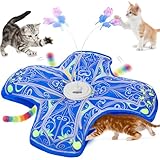
- Top-Tier Dual Interactive Fun: Qraxond's new indoor cat toy has dual motors, controlling random rotation of butterfly and plush tail swing rod accessories, bringing fun, exciting play for kittens and adult cats. Hide-and-Seek: The animal tail-shaped plush hides under the cover cloth, rotating irregularly to appear/disappear, creating a hide-and-seek game. It mimics real prey, bringing unpredictable chases to stimulate the cat's brain and senses. Irregular Rotating Butterfly: The top has an auto-rotating butterfly that rotates, pauses or swings to simulate real flight, keeping the cat engaged. Various interactions ensure the cat gets enough exercise to avoid obesity
- 3 Adjustable Speed Modes: Customize the excitement with separate buttons for the butterfly and tail. Choose from 3 settings: Steady (Blue Light), Active (Purple Light), and Random (Yellow Light). Suitable for high-energy cats to burn off steam or for calm cats to enjoy gentle play. Keep your feline entertained and prevent boredom, especially when they are home alone
- Touch-Sensitive Activation: Your Cat's in Control! With smart touch-sensor technology, just tap the device to fire up the fun mode, it will kick off a 5-minute automatic play session instantly. Right after the play session ends, it switches directly to touch-sensitive standby mode, where the purple indicator light flashes every 20 seconds. Simply tap again to reactivate it for another 5-minute cycle. This smart loop ensures your cat gets sufficient exercise and prevents overstimulation
- Large Rechargeable Battery: Enjoy long-lasting play with the built-in 2500mAh battery. It charges fully in just 2.5 hours via the included USB cable (use a 5V adapter only). The efficient auto on/off cycle extends battery life, making it convenient for busy pet owners while ensuring your cat gets healthy, moderate exercise
- Realistic Bird Chirping: Elevate the hunt with lifelike sound. The built-in speaker emits authentic bird chirps to attract your cat's attention and stimulate their prey drive. Combined with the random motions of the butterfly and tail, it creates an irresistible and engaging play experience that keeps your cat happily chasing even when they're by themselves
| Question | What to note | Why it helps the veterinarian |
|---|---|---|
| Onset and duration | Date the change started and whether it has been continuous or episodic | A sudden change often points toward illness or an event; a gradual change may suggest age or chronic pain |
| Appetite and physical changes | Eating, drinking, weight, litter-box habits, and coat condition | Physical changes shift the assessment toward medical testing |
| Mobility or pain clues | Jumping, stairs, stiffness, grooming of hindquarters, sensitivity when touched | Joint pain is a frequent cause of withdrawal in cats |
| Age and cognitive changes | Disorientation, nighttime vocalization, altered sleep, changes in recognizing people | Cognitive dysfunction is considered only after other medical causes are excluded |
| Recent household or routine disruption | Moves, new people or animals, schedule changes, a loss | Environmental stress can coexist with a medical problem |
| Improving or persisting | Whether the cat is recovering or the pattern is unchanged after several weeks | Persistent signs warrant a fuller assessment |
What the evidence does not establish
Current Cornell and VCA guidance does not establish how often cats experience depression or grief-like changes. No reliable percentage should be applied to your cat. The sources describe practical steps and warning signs, not a diagnosis for an individual animal, and they do not establish that any one symptom confirms low mood.
When to call a professional
Book a veterinary visit promptly for any appetite loss, pain signs, movement changes, or litter-box problems. Ask for a behavioral referral if the emotional signs continue after medical causes have been checked. When choosing a behaviorist, verify the professional’s credentials, location, and availability before booking, and confirm that the veterinarian agrees with the referral.
Quick Recap
Best Value

- Ball Cat Toy: Multi-level cat toy with 3 tiers and 6 spinning balls—keeps indoor cats active, curious, and entertained
- Enrichment: Encourages batting, swatting, and chasing to satisfy hunting instincts and enhance everyday enrichment
- Durable & Safe: Sturdy, non-slip base and a secure safety bar for hours of safe independent play
- Feline Favorite: Designed for older kittens and adult cats alike; great for multi-cat homes or gifting; not recommended for kittens under 12 weeks
- Expandable: Enjoy on its own or pair with Catstages Topper Toys (sold separately) for even more interactive chaos
Product prices and availability are accurate as of the date/time indicated and are subject to change. Any price and availability information displayed on Amazon at the time of purchase will apply.




