
What’s actually slowing this PC down?
Pick the symptom - the matching free tool is one click away.
The best-documented giant boa constrictor in the available scientific record is represented by a 445-centimeter dried skin, with an estimated whole-animal length of about 455 centimeters (14 feet 11 inches). Frank Glaw and Michael Franzen reported the specimen in a 2016 note in SPIXIANA. It is a museum-held skin from Brazil, not a live snake measured at capture, so no universally accepted record for the largest boa constrictor ever caught exists.
The often-repeated 18-foot-6-inch (about 5.64-meter) Trinidad story is weaker evidence. Its observer later acknowledged that he could not rule out an anaconda, and the 2016 assessment treats the animal as a misidentified green anaconda rather than a confirmed Boa constrictor. Understanding the difference between a measured specimen, an estimate and an anecdote is essential when judging giant-snake claims.
As an Amazon Associate I earn from qualifying purchases.
What is the largest boa constrictor supported by evidence?
There is no settled maximum-length record accepted by specialists. The strongest specimen-level evidence in the sources is catalog number ZSM 4961/2012 in the Zoologische Staatssammlung München, Germany. Its dried skin measured 445 centimeters (14 feet 7 inches) when Frank Glaw and Michael Franzen measured it with a tape and leveling staff.
Quick wins for a faster PC:
Scan for outdated or missing drivers - takes under a minuteDriver Scan →Repair Windows errors before they cause bigger problemsFix Now →Fix the driver behind crashes, sound loss and screen glitchesFind Drivers →The head was missing. Allowing approximately 10 centimeters for that section, the authors estimated that the living snake may have measured about 455 centimeters (14 feet 11 inches). That figure is an estimate of total length, not a direct measurement of a live animal. The distinction matters: a 445-centimeter skin and an approximately 455-centimeter snake are related measurements, but they are not interchangeable claims.
#1 Best Overall

- Size: 7,09 inch
- Suitability 3+
- Colorful hand painted
| Figure | What it represents | Evidence status |
|---|---|---|
| 445 cm (14 ft 7 in) | Measured dried skin, specimen ZSM 4961/2012 | Strongest retained specimen described in these sources |
| About 455 cm (14 ft 11 in) | Estimated total length after adding about 10 cm for the missing head | Scientific estimate, not a live-capture measurement |
| 18 ft 6 in (about 5.64 m) | Historical Trinidad account | Disputed species identification and no preserved remains |
| 5.5 m (18 ft 1 in) | Maximum repeated on a Toronto Zoo species page | No specimen or measurement method supplied on that page |
| 13 ft (3.9 m) | Adult-size ceiling on the Smithsonian National Zoo profile | General species guidance, not a record claim |
For a careful answer to “How big can a boa constrictor get?”, approximately 4.55 meters is the largest estimate tied to a documented Boa constrictor specimen in this evidence set. It should be described as a possible maximum represented by a museum skin, not as a formally ratified world record.
The museum specimen behind the 455 cm estimate
Origin and collection history
Glaw and Franzen examined skin ZSM 4961/2012 in the Munich state zoological collection. Klaus Konrad Voß obtained it in Brazil between 1962 and 1966, and the skin was later donated to the museum. A catalog number, a named collection and a documented geographic origin give this claim a level of traceability that ordinary stories about giant snakes usually lack.
The authors considered the animal likely female, based largely on its very large size. They measured the preserved skin at 445 centimeters and then added an estimated 10 centimeters for the absent head. The estimate is therefore transparent: readers can see which part was measured and which part was inferred.
Do these 3 things before closing this tab:
1Clear out junk files and repair common Windows errors2Fix the driver behind crashes, sound loss and screen glitches3Repair Windows errors before they cause bigger problemsWhy a dried skin is useful but imperfect
Preserved skins can retain valuable information when no live measurement was taken. They also introduce uncertainty. A skin may contract during drying, or it may be pulled lengthwise before or during preparation. Longitudinal stretching can make the original snake appear longer than it was.
Glaw and Franzen reported no visible signs that this specimen had been stretched longitudinally. That observation supports the measurement, but it does not convert the skin into a fresh, live measurement. The appropriate wording remains “445 centimeters of dried skin” and “approximately 455 centimeters estimated total length.”
The specimen’s condition also explains why the article should not call it proof of an absolute biological limit. It demonstrates that a boa of roughly that scale existed; it does not establish that no larger individual ever lived.
Rank #2
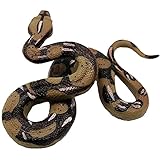
- 🐍【MARSH ANIMALS SERIES】:It's a new series of realistic animal figurines live in the swamp. Let children explore the mysterious marshes from home.
- 🐍【SAFE&HIGH QUALITY】: Our animal toys are made of high quality durable Rubber and ABS materials, Eco-friendly and child friendly. our production process are in strict compliance with the most reputable organizations of child safety standards, including ASTM, ICTI and more.
- 🐍【THE EDUCATIONAL ROLE OF TOYS】: The marsh animals series introduces children to the names of swamp animals, their habitats, and if they are dangerous. Inspire imaginative play and vocabulary development.
- 🐍【DURABLE】: Made of durable materials, it's a toy companies children's whole childhood.
- 🐍 【PERFECT GIFT】: The wild animal toys are great for birthday gift, Christmas celebration games, Halloween scary toys, can be used as cake topper, school rewards and party supplies.
Is the famous 18.5-foot boa real?
How the Trinidad story began
The familiar 18-foot-6-inch account traces back to a wartime snake in Trinidad. James A. Oliver’s Snakes in Fact and Fiction helped circulate the story, attributing the observation to Colin F. Pittendrigh, who was conducting malaria-control work. Pittendrigh recalled an immense snake of about 18 feet and said he had skinned it.
According to the account reviewed by Hans E. A. Boos in a 1992 article in The Herpetological Bulletin, the unprotected skin was later destroyed by dogs. No photograph, preserved piece or museum voucher remained. The claim therefore depends on recollection rather than an item that another researcher can remeasure.
The species problem
Trinidad has boas and anacondas. Boos followed up with Pittendrigh because the reported size was extraordinary for a boa and because the locality made an anaconda plausible. In correspondence quoted by Boos, Pittendrigh wrote: “I certainly cannot exclude the possibility that the snake I shot in Tamana was an Anaconda ("Huilla") because I am no herpetologist.”
Pittendrigh later indicated that an anaconda identification seemed reasonable. Glaw and Franzen’s 2016 note treats the 564-centimeter animal as a misidentified green anaconda. Even if the length was remembered accurately, the story cannot establish a record for Boa constrictor unless the species identification is secure.
This is why “Is the 18.5-foot boa real?” has two different answers. A very large snake may have been encountered, and a historical report does exist. But the evidence does not show that it was a boa constrictor, and it does not provide a preserved object or contemporary measurement record that can be independently checked.
Why popular maximums conflict
General-reference pages often repeat a single impressive number without explaining its provenance. The Toronto Zoo page says that the largest recorded boa reached 5.5 meters, but the page does not provide a specimen number, measurement procedure or preserved voucher for that figure. The Lee Richardson Zoo page repeats the reported 18.5-foot red-tailed boa claim. Those summaries help explain why the same numbers appear across the internet, but repetition is not independent confirmation.
Rank #3
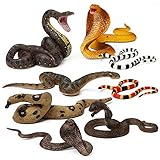
- Natural appearance and color, this snake figurines set is very lovely made, with lifelike shape. Excellent detail and craftsmanship. Each figure is finely hand painted and sculpted by experts which ensures authenticity.
- 8pcs Snake figurines: 1 x Cobra snake figurine; 1 x rattlesnake; 1 x Python; 1 x boa constrictor figurine; 1 x Green Anaconda; 1 x Coral Snake; 1 x California Kingsnake; 1 x King Cobra.
- With true-to-life detail, appealing color, and active poses, these models are designed for teachers, children, collectors, animal lovers, reptile lover and pastry cook everywhere.
- Great for miniature decorations, landscape scenes, imaginative play, Cake topper & reptile baby shower party theme decor etc. Also Can be used as child educational props, inspire their imagination and curiosity, let they know some snake knowledge, bring a lot of fun to them.
- The snake figurines set are phthalate-free and thoroughly safety tested to safeguard your child's health.
The specialist accounts apply stricter tests: identify the species, retain evidence, document where it came from and separate direct measurements from estimates. Under those tests, the 445-centimeter skin is more useful than an unsupported rounded maximum, while the Trinidad story remains unresolved.
| Claim | What is documented | How to report it responsibly |
|---|---|---|
| 445 cm | Skin ZSM 4961/2012 measured in a museum collection | Call it the measured length of the strongest documented specimen in these sources |
| About 455 cm | 445 cm skin plus an estimated 10 cm for the missing head | Call it an estimated total length |
| 5.5 m | Figure printed on a zoo species page without specimen details there | Attribute the page and note that its method and voucher are not stated |
| 18 ft 6 in | Historical recollection from Trinidad, with remains destroyed | Describe it as a disputed report that may concern a green anaconda |
| 545 cm skin | Historical report of a Brazilian institute specimen, probably destroyed in a 2010 fire | Do not treat it as a verifiable current record |
| 495 cm skin | Historical report from French Guiana with unclear reliability and whereabouts | Use only as an unverified historical claim |
How researchers judge a giant-boa claim
A record-length statement is only as strong as its chain of evidence. When you encounter a new claim, check the following in order.
- Confirm the species. Ask whether the snake was demonstrably Boa constrictor. Large green anacondas and other boas can be mistaken for one another, especially in photographs, recollections or older reports.
- Look for retained evidence. A cataloged skin, skeleton, photograph with scale, tissue sample or other voucher allows independent examination. A memory recorded years later is much harder to test.
- Identify the measurement method. Find out whether the animal was measured alive, freshly dead or after drying. A stretched skin can overstate the original length, while a missing head or tail requires an estimate.
- Check provenance. A credible account should identify the location, date, collector or observer and current repository. The Munich specimen has a catalog number and collection history; the Trinidad account does not have surviving remains.
- Separate precision levels. Do not turn 445 centimeters of skin into a 455-centimeter measured snake, or round an estimate into a definitive 5.5-meter record. State exactly what was measured and what was inferred.
These checks also explain why specialist literature may decline to name a single champion. The largest animal may have been encountered without being preserved, while the best-preserved specimen may not represent the biological maximum.
The Tool Desk
Outbyte Driver Updater FREEFix the driver behind crashes, sound loss and screen glitchesFind Drivers →Outbyte PC Repair FREERepair Windows errors before they cause bigger problemsFix Now →How big are boa constrictors normally?
The Smithsonian National Zoo describes adult boa constrictors as reaching up to 13 feet (3.9 meters). That is a general profile for the species, not a claim that every adult approaches that size and not a record designation. Body size and pattern vary across the species’ broad range, which extends from northern Mexico to Argentina.
The contrast with the museum estimate is useful. An approximately 455-centimeter individual would be substantially longer than the ordinary adult-size ceiling given in that profile, making careful documentation especially important. Exceptional size should not be used to imply that a typical pet boa will reach five meters.
Sex, locality, age, feeding history and overall health all influence an individual’s dimensions. A single unusually large female can expand the known size range without changing what is normal for the species. Conversely, a rounded number copied from one page can make an exceptional or uncertain observation look routine.
Rank #4

- Coiled up and ready to strike, this boa constrictor has its unsuspecting prey right where it wants it; Professionally sculpted and painted by hand to ensure accurate, lifelike detail, our wildlife figurines will turn your living room into an exotic ecosystem!
- Made up of ten different subspecies, the boa constrictor is a type of large, heavy-bodied snake endemic to North, Central, and South America; Boas are famous for their hunting methods, in which they kill prey by crushing and asphyxiating them with their bodies
- EVER GROWING - A familiar site in zoos and even household reptilian collections, boa constrictors adapt well to captivity and may even become tame enough to handle; Thankfully, boa constrictors are not faced with any immediate risk in terms of becoming endangered or threatened; In fact, their numbers are increasing at a dramatic rate in Florida after being introduced into the wild accidentally
- REALISTIC APPEARANCE FOR MULTIPLE USES - Realistic, educational, and fun, this XL figurine is suitable for a range of interests, including collectors, enthusiasts, teachers, and kids; Admire it on a shelf, use it in the classroom, or simply enjoy playing with it
What “ever caught” means in this case
The wording “caught” suggests a live capture followed by a direct measurement. The best-supported evidence here does not fit that simple format. The Munich record is a preserved skin acquired in Brazil in the 1960s, and its total length is reconstructed. The celebrated Trinidad animal was reportedly killed and skinned, but the skin was destroyed and the species was never secured.
Free tools Windows power users keep installed
One-click scans. No signup required.
That leaves three different questions that are often blended together:
- What is the longest retained Boa constrictor evidence? A 445-centimeter dried skin, with an estimated total length of about 455 centimeters.
- What is the longest reported snake associated with a boa story? The 18-foot-6-inch Trinidad account, although its species may have been a green anaconda.
- What is the largest boa ever alive? The available evidence cannot answer this with certainty because undocumented animals may have been larger.
Using the first question for a headline and then explaining the other two gives readers a more accurate answer than simply repeating the biggest number found on a zoo page.
What would be needed to confirm a larger record?
A stronger future claim would combine a secure species identification with contemporaneous documentation. Ideally, researchers would retain the animal or a properly prepared skin, record the exact measuring procedure, photograph the measurement with a scale and deposit the specimen in a recognized collection. Notes should state whether the body was straightened, whether the skin was stretched and whether any part of the head or tail was missing.
Independent remeasurement is particularly valuable. If two observers can examine the same voucher and obtain comparable results, the claim is more reproducible than a rounded figure recalled decades later. Genetic or anatomical confirmation could also resolve cases in which an unusually large boa might actually be an anaconda or another species.
Until such evidence exists, the scientifically honest position is not that boas cannot exceed 455 centimeters. It is that no larger, securely documented Boa constrictor record is established by the sources summarized here.
The evidence-based answer in one sentence
The largest boa constrictor supported by the strongest available specimen evidence is a Brazilian museum skin measuring 445 centimeters, corresponding to an estimated living length of about 455 centimeters; the famous 18-foot-6-inch Trinidad snake is not a confirmed boa record because its remains disappeared and its observer could not exclude an anaconda.
Quick Recap
Product prices and availability are accurate as of the date/time indicated and are subject to change. Any price and availability information displayed on Amazon at the time of purchase will apply.





Leave a Reply