
Do these 3 things before closing this tab:
1Clear out junk files and repair common Windows errors2Fix the driver behind crashes, sound loss and screen glitches3Repair Windows errors before they cause bigger problemsSome links on this page are affiliate links: if you buy through them we may earn a commission, at no extra cost to you.
The Newfoundland, often called a Newfie or Newf, is a gentle, devoted giant—but not a low-maintenance dog. A healthy adult may weigh roughly 100–150 pounds, shed a dense double coat, drool generously, require careful heat management, and need training before its strength becomes difficult to control. The breed can be an exceptional family companion for owners who want an affectionate, cooperative dog and can manage the grooming, space, exercise, transportation, and veterinary costs that come with giant-dog ownership.
Newfoundlands are usually patient and people-oriented, and many do well with children and other pets when properly socialized. But “nanny dog” is only a nickname, never a safety guarantee: children must be supervised, and a friendly puppy can still knock over a toddler or become unruly without training. The best match is an owner prepared for a large working dog that needs daily companionship—not someone seeking a clean, compact, heat-tolerant, inexpensive, or exercise-free pet.
As an Amazon Associate I earn from qualifying purchases.
Windows Errors? Fix Them Before They Spread
Repair common Windows errors and clear accumulated junk for a smoother, more stable PC - no reinstall needed.Free scan · no reinstallOutdated Drivers Are Slowing You Down
One free scan finds every outdated or missing driver and matches the right update for your exact hardware.Free scan · exact hardware matchNewfoundland quick facts
| Characteristic | What to expect |
|---|---|
| Other names | Newfie, Newf |
| Origin and purpose | The island of Newfoundland; historically used for hauling, draft work, fishing-related work, and water rescue |
| U.S. breed group | Working Group |
| Height | Average adult male: about 28 inches; female: about 26 inches |
| Weight | Standard ranges are approximately 130–150 pounds for males and 100–120 pounds for females |
| Coat | Flat, moderately long, water-resistant double coat with a dense undercoat and feathering |
| Recognized AKC colors | Black, brown, gray, and white-and-black, commonly called Landseer |
| Exercise | At least 30 minutes of moderate daily exercise is an AKC baseline for adults; individual needs vary |
| Grooming | Thorough brushing at least weekly, often daily during seasonal shedding |
| Drooling | Often substantial, although the amount varies between individuals |
| Typical lifespan | Published estimates vary; roughly 8–10 years is a cautious planning range, with some sources giving 10–12 years |
| Important health concerns | Hip and elbow dysplasia, subaortic stenosis, cystinuria, obesity, skin and ear disease, and gastric dilatation-volvulus |
These figures describe breed standards or broad published estimates, not promises about an individual dog. The AKC standard specifically warns that size should not come at the expense of balance, structure, soundness, or gait. A heavier Newfoundland is not necessarily a healthier Newfoundland.
What is a Newfoundland dog?
The Newfoundland is a giant working breed developed on the island of Newfoundland. Its ancestors and working counterparts were valued around fishing communities for strength, endurance, hauling carts and nets, and assisting people in the water. Webbed feet, a water-resistant coat, a powerful body, and a strong tail helped make the breed effective at swimming and water work. Historical accounts and the breed standard support this working heritage, but most Newfoundlands today are family companions rather than fishing or rescue dogs. Some still participate in water rescue, draft work, obedience, tracking, therapy work, and related activities through organized training. See the AKC history of the Newfoundland and the Newfoundland Club of America for more background.
Popular on Amazon

- DUAL-SIDED DESIGN: Our grooming brush is perfect for dematting and deshedding your pet's coat! With a dual-sided design, use the 9-teeth side to tackle stubborn mats and tangles and the 17-teeth side to thin out and deshed your pet's fur.
- HEALTHY COAT AND REDUCED SHEDDING: Our dog brushes are designed with sharpened but finely rounded teeth. The deshedder brush for dogs allows you to easily and safely remove mats, tangles, knots, and loose hair without irritation or scratching.
- EFFECTIVE DESHEDDING TOOL: Our dematting and deshedding tool gently removes loose hair and eliminates tangles, knots, dander, and trapped dirt. The perfect cat brush or dog grooming brush solution for pets with thick fur or dense double coats.
- COMFORTABLE TO USE: Keep your pet's coat clean and healthy with our undercoat rake for dogs. This dog brush is designed with a lightweight, comfortable, non-slip rubber handle to keep the brush from moving around as you groom your pet.
- PERFECT GIFT FOR PET LOVERS: Our dog and cat grooming brushes are must-have pet supplies for your furry friend. A great gift for pet lovers who want to keep their pets healthy and well-groomed!
The working history still matters. A Newfoundland is generally strong, cooperative, physically capable, and interested in being near its people. It may enjoy a purposeful activity more than an unstructured day alone in a yard. Its calm adult reputation should not be confused with a lack of training or exercise needs.
Appearance, size, coat, and colors
Newfoundlands have heavy bone, a broad head, a deep chest, powerful forequarters, small close-lying ears, webbed feet, and a strong tail that acts like a rudder in the water. Their bodies are slightly longer than tall. The coat is a functional, water-resistant double coat: the outer hair is flat and moderately long, while the undercoat is dense. Feathering appears on the legs, and the tail has substantial furnishings. These characteristics are described in the official AKC breed standard.
Quick wins for a faster PC:
Scan for outdated or missing drivers - takes under a minuteDriver Scan →Repair Windows errors before they cause bigger problemsFix Now →The standard’s average height is about 28 inches for males and 26 inches for females. In the U.S. standard, males are approximately 130–150 pounds and females approximately 100–120 pounds. Those are reference ranges, not a target to reach through overfeeding. Body condition, ease of movement, and sound joints matter more than maximizing size.
Newfoundland colors
For U.S. readers, the AKC standard recognizes:
- Black
- Brown
- Gray
- White and black, commonly called Landseer
Color recognition differs by registry. The FCI standard lists black, white-and-black, and brown, while the AKC standard includes gray. A color’s effect on show eligibility does not determine whether an individual dog can be a healthy, suitable companion.
Newfoundland temperament and family life
Sweetness is the hallmark of the breed standard. A well-bred, well-socialized Newfoundland is typically gentle, patient, devoted, intelligent, and responsive to its family. Many are calm or moderately quiet indoors once their needs are met. They may be socially welcoming rather than naturally suspicious, although a large dog can have a protective presence without being bred as a sharp guard dog.
Breed descriptions are ideals, not guarantees. Individual Newfoundlands vary in sociability, confidence, energy, water interest, trainability, tolerance of handling, and comfort around strangers or animals. Early socialization and positive training remain important. Fear, extreme shyness, or aggression should not be dismissed as an inevitable breed trait; the FCI standard treats aggression and excessive shyness as serious faults. The AKC also notes that temperament is shaped by both inherited traits and experience; see its explanation of canine temperament.
Are Newfoundlands good with children?
Often, yes—but only when the individual dog is suitable, socialized, trained, and actively supervised. Their patience and affection explain the popular “gentle giant” and “nanny dog” descriptions. Neither phrase means a Newfoundland can babysit children or should be left alone with them.
- Young children should always have an attentive adult present with the dog.
- Teach children not to climb on, hug tightly, disturb, chase, ride, or torment the dog.
- Do not allow children to take food, chews, toys, or resting places from the dog.
- Use gates, crates, or a separate room when the dog needs uninterrupted rest.
- Remember that a playful puppy can mouth, jump, pull a leash, or knock over a small child without intending harm.
Children and dogs need coaching in safe interaction; the AKC’s guidance on helping dogs live successfully with children is a useful starting point.
Newfoundlands and other pets
Many Newfoundlands are socially tolerant, but the breed is not guaranteed to be safe with every cat, dog, or small animal. Prey drive, fear, resource guarding, past experience, and play style vary. Introduce animals gradually, use barriers and leashes at first, and supervise until you know the relationship is stable. Even friendly rough play can injure a much smaller dog simply because of the Newfoundland’s size. Manage food bowls, beds, toys, doorways, and human attention to prevent avoidable competition.
Exercise needs: adults, puppies, and seniors
Adult exercise
The AKC recommends at least 30 minutes of moderate daily exercise for adult Newfoundlands. Treat this as a baseline, not a universal prescription. A fit young adult may enjoy more activity, while an older, overweight, cardiac, orthopedic, or heat-sensitive dog may need less. A practical routine can include:
Recommended Free Tools
- One or more moderate walks each day.
- Supervised movement in a secure area.
- Short training sessions, scent games, tracking, obedience, or rally.
- Swimming, if the dog enjoys it and the water is safe.
- Conditioned hikes or draft activities for an appropriate adult under suitable conditions.
Exercise should build fitness gradually. Avoid the “weekend warrior” pattern in which an unconditioned dog goes from sedentary weekdays to a long hike or intense swim. Watch for limping, stiffness after activity, reluctance to rise or continue, lagging behind, a changed gait, excessive panting, or fatigue that lasts unusually long. Sudden or persistent lameness needs veterinary assessment.
Exercise for a Newfoundland puppy
Growing giant-breed puppies need movement, but not forced impact. Choose short, voluntary play, sniffing, basic training, and rest over sustained running or repetitive jumping. Avoid roadwork, forced long walks, competitive agility, repeated high jumps, and long hikes while growth plates and joints are developing. Giant breeds may continue physical maturation until approximately 18–24 months, although the timeline varies.
Also popular on Amazon

- SAVE MONEY: Reduce expensive trips to the groomer. Our dog shedding brush works great as a dog brush for short haired dogs & dog brush for long haired dogs. It is an absolute essential for pet supplies, dog supplies, and a dog grooming kit.
- ALL HAIR & FUR TYPES: Our dog brushes for grooming safely removes loose hair without irritation. SleekEZ dog hair brush works great as a pet hair remover / dog hair remover for pets of all fur types and hair lengths.
- EASY AND FAST CLEANUP: SleekEZ also works great as a carpet rake, pet hair rake, & dog fur remover tool. It removes hair & fur from couches, cars, blankets, beds & more! Its innovative design ensures that hair is easily gathered and removed.
- PAINLESS AND ENJOYABLE: SleekEZ's patented design helps grab at the tips of the hair to extract from the skin without painful tugging. It is the perfect undercoat brush for dogs and deshedding dog brush. Works on all coat types and animal breeds!
- GREAT GIFT: A must have metal dog comb for any pet grooming kit. The perfect pet grooming metal comb for dogs & dog deshedding brush. Worlds best grooming brushes / dog grooming brush. Voted #1 dog brushes for shedding & deshedder brush for dogs.
The Newfoundland Club of America publishes “five minutes per month of age” as a rough walking guideline, but it is not a scientifically exact rule for every puppy. A safer principle is: keep activity short and voluntary, use forgiving surfaces, avoid repetitive impact, monitor for fatigue or lameness, and individualize the plan with your veterinarian. See VCA’s puppy exercise guidance and the NCA’s exercise information.
Older dogs or dogs with joint, heart, or weight problems may benefit from several short outings rather than one demanding session. Exercise is only one part of enrichment: calm training, scent work, food puzzles, and time with family can challenge the dog without overloading its joints.
Are Newfoundlands good swimmers?
They are unusually well adapted to swimming. Webbed feet, a water-resistant coat, a powerful body, and a strong tail support efficient movement in water. That does not mean every Newfoundland likes water, knows how to exit a pool, or can safely handle currents. Physical adaptation is not the same as trained water rescue.
- Introduce water gradually and positively; never throw a puppy into it.
- Use a properly fitted canine life jacket for early sessions, boating, deep water, strong currents, or a tired dog.
- Supervise constantly, even if the dog appears confident.
- Teach a pool exit, because a swimming dog may not find or use a ladder.
- Keep sessions short enough to prevent exhaustion.
- Rinse off chlorine or salt water and dry the coat and ears thoroughly.
The AKC’s swimming guidance and advice on canine life jackets cover introduction and flotation safety. A real water-rescue activity requires specialized training, a qualified handler, appropriate equipment, and controlled conditions.
Training a giant dog
Newfoundlands are often biddable and respond well to gentle, consistent guidance. They do not need harsh corrections. Begin training immediately because a small puppy that jumps, drags, steals food, or ignores its name can become a powerful adult with the same habits.
- Name response and recall.
- Loose-leash walking and safe stops.
- Four paws on the floor for greetings.
- Sit, down, stay, wait, leave it, and drop it.
- Calm greetings with visitors, children, and other dogs.
- Settling quietly indoors.
- Crate, vehicle, harness, and grooming-table acclimation.
- Cooperative handling of feet, ears, mouth, tail, coat, and body.
- Safe pool entry and exit if swimming is planned.
- Emergency behaviors around roads, food, water, wildlife, and other dogs.
Puppy classes and well-managed exposure to people, surfaces, household sounds, car travel, grooming, and calm dogs are valuable. Continue training through adolescence: a Newfoundland may look nearly adult before its coordination, judgment, and impulse control are mature. The AKC puppy-training guide emphasizes early socialization and positive handling.
Newfoundland grooming: the real workload
A Newfoundland is not a brush-occasionally dog. Plan for a large, dense coat that needs time, equipment, physical effort, floor space, and possibly professional grooming throughout the dog’s life.
Brushing
Brush thoroughly at least weekly. During seasonal coat blowing, brushing may need to become a daily task. Line-brush through the undercoat rather than brushing only the visible top layer. Pay particular attention to behind the ears, the neck, feathering, armpits, breeches, tail, and between the legs. A slicker brush and long-toothed comb are useful tools, as noted by the AKC breed guide.
Regular grooming is also an inspection routine. It can reveal mats, hot spots, parasites, wounds, ear problems, moisture, and skin changes hidden by the coat. The Newfoundland Club of America’s owner guidance explains why this inspection matters.
Bathing, drying, ears, and nails
Bathe when the dog is dirty or odorous, or as directed for a skin condition, using a dog-safe product. There is no single correct bathing interval for every Newfoundland. Thorough drying is essential because a dense, damp coat can mat and contribute to skin problems. Dry the dog after rain and swimming, inspect the ears routinely, and keep nails short enough to support comfortable movement.
Free tools Windows power users keep installed
One-click scans. No signup required.
Should you shave a Newfoundland?
Do not shave the double coat to the skin as a routine cooling or shedding solution. Shaving removes insulation and protection from sun exposure, can disrupt regrowth, and does not make a heat-intolerant dog safe in hot weather. Neatness trimming may be appropriate. Severe matting, skin disease, or a medical need should be handled by a professional groomer or veterinarian. The AKC explains the risks of shaving double-coated dogs.
Feeding and weight control
The central Newfoundland puppy nutrition rule is controlled growth, not maximum growth. Rapid growth and excess weight place additional stress on developing bones and joints.
Also popular on Amazon

- DUAL-SIDED DESIGN: Our Undercoat Rake Dog brush is perfect for deshedding your pet's coat. Designed with a dual-sided design, start with a 9-teeth side to tackle stubborn mats and tangles, and finish with a 17-teeth side to thin out and deshed after.
- HEALTHY COAT AND REDUCED SHEDDING: Our deshedding brush for dogs is designed with sharpened but finely rounded teeth that allow you to easily and safely remove mats, tangles, knots, and loose hair without irritation or scratching.
- EFFECTIVE DESHEDDING TOOL: This dematting and deshedding brush gently removes loose hair and eliminates tangles, knots, dander, and trapped dirt. The perfect cat grooming tool solution for pets with thick fur or dense double coats.
- COMFORTABLE TO USE: Keep your pet clean and healthy with our dog and cat brush for grooming. Designed with a lightweight, comfortable handle and a non-slip rubber base to keep the brush from moving around as you brush your pet.
- PERFECT GIFT FOR PET LOVERS: Our dog comb brush is a must-have grooming products for dogs and cats. A great gift undercoat rake dog for pet lovers who want to keep their fur buddies clean, healthy, and well-groomed!
- Feed a complete and balanced diet formulated for growth of large-size dogs.
- Look for the appropriate AAFCO nutritional statement for large-size growth, as explained in the Merck Veterinary Manual.
- Measure meals and adjust them according to body condition, growth, activity, and veterinary advice.
- Weigh the puppy regularly and keep it lean rather than roly-poly.
- Do not add calcium, phosphorus, vitamin D, or other mineral supplements unless prescribed.
- Keep treats below 10% of daily calories; include chews and table food in the calculation.
- Use measured meals rather than unrestricted free feeding.
For adults, choose a complete diet appropriate to age, activity, and health. Do not rely on a fixed number of cups: calorie density differs substantially among foods. Monitor body condition as well as weight and reduce portions if the dog becomes heavy. Keeping a Newfoundland lean helps protect joints and improves mobility and heat tolerance.
Newfoundland puppy care
Before pickup
- Choose a veterinarian and identify the nearest 24-hour emergency hospital.
- Prepare a giant-breed-appropriate crate, bed, collar, harness, food, grooming tools, and vehicle restraint.
- Use non-slip runners on slick floors and manage stairs, furniture, and jumping.
- Ask the breeder what food, parasite prevention, grooming, handling, and training the puppy already knows.
- Obtain vaccination, deworming, microchip, veterinary, and feeding records.
The first weeks
Arrange the first veterinary visit according to the purchase or adoption agreement and your veterinarian’s advice. Discuss vaccination, rabies requirements, parasite prevention for your region, diet, growth monitoring, and body condition. Begin short positive sessions for touching feet, opening the mouth, inspecting ears, brushing the coat, wiping paws, and standing calmly for examination.
Introduce household sounds, surfaces, visitors, car rides, grooming equipment, and calm, appropriately vaccinated dogs safely. Socialization should continue without putting the puppy into high-risk dog-contact settings before your veterinarian says its vaccination protection is adequate. At around four months, if water work is planned, the AKC recommends careful introduction to water; this means gradual exposure, not forced swimming.
Adolescence
Expect awkward growth, increased strength, temporary regression in training, and more independence. Keep reinforcing manners and recall. Avoid assuming that a large-looking adolescent is ready for adult-impact exercise. Slipping on smooth floors, rough play, falls, and repeated jumping are avoidable risks for a growing giant breed; the NCA provides joint-care guidance.
Newfoundland health concerns
No screening program eliminates risk, and a list of breed-associated conditions is not a prevalence ranking. Some conditions are relatively important, some are uncommon, some are difficult to predict, and some lack a simple definitive test. A Newfoundland owner should nevertheless understand the following concerns.
Hip dysplasia
Hip dysplasia is an inherited and developmental orthopedic condition involving abnormal hip development. It can lead to instability, arthritis, pain, lameness, and reduced mobility. Genetics, growth rate, body condition, environment, and injury all influence the outcome. The Orthopedic Foundation for Animals and NCA’s joint information explain evaluation and risk factors.
What’s actually slowing this PC down?
Pick the symptom - the matching free tool is one click away.
Elbow dysplasia
Elbow dysplasia is especially consequential in a dog carrying this much weight on its forequarters. It can cause pain, lameness, arthritis, and reduced willingness to exercise. Persistent stiffness, an altered gait, or reluctance to rise should not be written off as normal giant-breed clumsiness.
Subaortic stenosis
Subaortic stenosis, or SAS, is a congenital heart defect involving narrowing below the aortic valve. It may be detected in puppies, while more severe cases can cause exercise intolerance, breathing difficulty, fainting, or sudden death. A normal puppy heart screening is useful but is not a lifelong guarantee; the timing and type of evaluation matter. Review the NCA’s SAS information and discuss any murmur, fainting, unusual breathing, or exercise intolerance with a veterinarian.
Cystinuria
Cystinuria is a recessive inherited urinary disorder recognized in Newfoundlands. Cystine crystals or stones can obstruct the urinary tract. Males are at greater risk of life-threatening blockage because of their anatomy, although both sexes can be affected. Blood in the urine, repeated urinary infections, straining, repeated unsuccessful attempts to urinate, or inability to urinate require prompt veterinary attention. Inability to urinate is an emergency. See the NCA’s cystinuria fact sheet.
Gastric dilatation-volvulus, or bloat
As a large, deep-chested dog, the Newfoundland can develop GDV. The stomach fills and may twist, cutting off circulation. It can progress rapidly and requires emergency treatment.
Go to an emergency veterinarian immediately for possible GDV
- Repeated unproductive retching or attempts to vomit
- Sudden restlessness, distress, or inability to settle
- Excessive drooling
- A swollen, tight, or painful abdomen
- Rapid breathing
- Weakness, collapse, or inability to stand
Do not wait to see whether the dog improves. The American College of Veterinary Surgeons explains GDV.
Risk-reduction discussions may include feeding two or more measured meals rather than one very large meal, slowing a rapid eater, and avoiding vigorous exercise immediately around meals. These measures do not eliminate GDV, and no bowl, food shape, or home routine is guaranteed to prevent it. Ask your veterinarian about preventive gastropexy, sometimes performed during another abdominal surgery. Gastropexy attaches the stomach to the body wall and reduces the chance of twisting; it does not prevent every case of stomach dilation. See the ACVS guidance on preventive gastropexy.
Also popular on Amazon
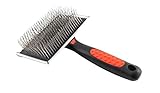
- EXTRA LONG PINS - Crafted from high-quality materials, this professional-grade "Tuffer Than Tangles" brush features extra-long stainless steel pins that easily penetrate deep into your pet's coat, removing dirt and debris from the undercoat.
- COMFORTABLE - The flat slicker design allows for gentle yet effective grooming, while the ergonomic handle ensures maximum comfort and control during use.
- ALL COAT TYPES - The Paw Brothers Extra Long Pin Flat Slicker Brush is suitable for all coat types and can be used on both dogs and cats. It's perfect for pet owners, as well as professional groomers.
- SIZE - Head 4.5in x 3in, Handle length 4.75in, Pins 1in length
- WHY RYAN'S PET SUPPLIES - Established in 1959, we have grown from humble beginnings as a family-operated four-page catalog to an international business featuring top quality products and services for pet professionals and pet lovers alike.
Other reported conditions
The NCA health center lists skin disease and hot spots, ear infections, thyroid disease, cruciate ligament injuries, osteochondritis dissecans, panosteitis, dilated cardiomyopathy, osteosarcoma and other cancers, ectopic ureters, eye conditions, neurologic disorders, and allergies among conditions reported in the breed. This should guide conversations with a veterinarian and breeder, not be read as a prediction that one Newfoundland will develop all of them. The NCA’s health fact sheets provide condition-specific material.
Health testing: what should a breeder provide?
For Newfoundlands, the NCA’s CHIC protocol includes:
The Tool Desk
Outbyte PC Repair FREEClear out junk files and repair common Windows errorsFree Scan →Outbyte Driver Updater FREEFix the driver behind crashes, sound loss and screen glitchesFind Drivers →- Hip evaluation through an OFA radiographic evaluation or PennHIP.
- Elbow evaluation through OFA radiographs.
- Cardiac evaluation, including an accepted examination such as a cardiologist-performed congenital, advanced, or basic cardiac exam.
- A cystinuria DNA test from an approved laboratory registered with OFA; qualifying offspring may be clear by parentage under the applicable rules.
The NCA also strongly recommends thyroid testing, an eye examination, and patella evaluation where indicated. Check the current NCA CHIC requirements, the NCA’s health-testing position statements, and the OFA database, since protocols and accepted evaluations can change.
Buyer checklist
Before putting down a deposit, ask for:
- The registered names and registration numbers of the sire and dam.
- Publicly verifiable hip and elbow results.
- The cardiac report, including who performed it and what type of evaluation was done.
- The cystinuria DNA result and whether it is a direct test or clearance by parentage.
- Health history for parents, siblings, grandparents, and previous offspring.
- Any family history of SAS, sudden death, urinary stones, orthopedic disease, cancer, seizures, or severe allergies.
- Vaccination, deworming, microchip, veterinary examination, and feeding records.
- A written contract, return policy, and explicit agreement that the breeder will take the dog back if necessary.
- A plan for ongoing breeder support.
Do not treat screenshots or a CHIC number alone as proof that a puppy is disease-free. A CHIC number means recommended screenings were completed and results were made publicly available; inspect the individual results and note whether each one is normal, abnormal, preliminary, or otherwise qualified. OFA’s prospective-owner breeder questions are useful when evaluating documentation.
Independent reader supportYour contribution helps us test, update, and keep practical guides available for everyone.Heat, cold, and climate management
A dense double coat is useful insulation in cold conditions, but it does not make a Newfoundland heat-proof. Heat and humidity, obesity, poor conditioning, stress, and inadequate airflow can all turn routine activity into an emergency.
- Exercise during the coolest part of the day.
- Provide shade, airflow, air conditioning when necessary, and fresh water.
- Avoid hot pavement and strenuous activity in heat or humidity.
- Never leave the dog in a parked car.
- Monitor breathing, coordination, behavior, and recovery after activity.
- Do not use shaving as a routine cooling strategy.
Heatstroke signs include hot skin, vomiting, heavy drooling, rapid or distressed panting, loss of coordination, collapse, or unconsciousness. Move the dog out of the heat, begin gradual cooling with cool—not ice-cold—water, wet towels, and airflow, and seek veterinary care immediately. The Merck Veterinary Manual’s summer-safety guidance and emergency guidance explain the response. There is no single safe temperature for every Newfoundland because humidity, sun, acclimation, coat, age, weight, exertion, and health change the risk.
Recommended Free Tools
In cold weather, the coat may provide useful protection, but a dog still needs a dry, sheltered place, and wet fur, wind, illness, age, and inactivity can reduce cold tolerance. Check paws for ice, salt, and irritation after winter walks.
Routine veterinary care
Plan veterinary care before bringing home a puppy. Routine care generally includes:
- Repeated puppy examinations during the rapid-growth period.
- Core vaccination and rabies compliance according to local law and veterinary guidance.
- Region- and lifestyle-appropriate parasite prevention.
- Regular weight and body-condition checks.
- Orthopedic evaluation for abnormal growth, gait changes, or lameness.
- Cardiac evaluation for a murmur, fainting, exercise intolerance, or abnormal breathing.
- Dental care and periodic oral examinations.
- Ear checks, particularly after swimming.
- Earlier and more attentive senior screening than many owners expect, because giant breeds generally have shorter lifespans than small breeds.
- A written emergency plan and the address and phone number of a 24-hour veterinary hospital.
Ask the practice whether it can safely examine, sedate, image, lift, hospitalize, and transport a dog weighing more than 100 pounds. Discuss spay or neuter timing individually rather than applying a universal age. Growth-plate maturity, orthopedic considerations, reproductive management, sex-specific risks, lifestyle, and whether preventive gastropexy could be appropriate during abdominal surgery all belong in that conversation with your veterinarian.
Can a Newfoundland live in an apartment?
Square footage alone does not answer this question. A Newfoundland may adapt to an apartment or smaller home if the owner provides daily outdoor activity, easy access to safe walking areas, reliable climate control, room for a giant dog to rest and turn without repeated collisions, and permission under the housing rules.
Consider the logistics before adopting:
- Can you manage elevators, stairs, narrow hallways, and emergency evacuation?
- Is the flooring slippery, and can you add runners or rugs for traction?
- Can you transport a dog that may be unable to walk after an injury?
- Is there enough room for a crate, giant bed, grooming equipment, and a wet dog?
- Can you dry the coat after rain or swimming without damaging the home?
- Does the vehicle accommodate the adult dog and a safe restraint?
A yard is helpful but does not replace walks, training, companionship, or climate control. A small home becomes impractical when the owner cannot provide movement, traction, cooling, or safe transport.
The overlooked costs and logistics of ownership
Do not budget only for food. Plan for giant-breed equipment, large crates and beds, heavy-duty harnesses, grooming tools or professional grooming, vehicle modifications or restraints, preventive care, insurance if available, orthopedic and cardiac evaluation, emergency surgery, and equipment for moving an injured dog. Costs vary too widely by region, food, insurance, grooming frequency, and medical history for one universal annual figure to be meaningful.
Also popular on Amazon

- 【Easy Desheding】: Swihauk self cleaning dog brush for long haired dogs with release bottom helps effortlessly reduce shedding. A must have dog brush for short haired dogs, cat brush for indoor cats, cat brush for shedding, slicker brush for dogs.
- 【Safe Design】: Soft and protective plastic round head bristles creating a comfortable feeling while deshedding without hurting your pet. Ideal puppy brush for small dogs, dog brush for shedding and grooming.
- 【Sturdy & Durable】: Premium stainless steel metal and compact design make our product sturdy and durable for long term use.
- 【Ergonomic Design】: Press bottom for easy cleaning, high-quality & lightweight TPR handle make your grooming effortlessly.
- 【Effective to Remove Loose Fur】: Swihauk pet grooming brush is effective to remove loose fur, suitable for dogs, cat with long and short hair, perfect for your lovely pet like puppies, golden retriever, rabbit, kitten, bunny, yokie and more.
Also plan for hot-weather outages, evacuation, boarding, travel, and a person physically capable of handling the dog safely. A Newfoundland should live as part of the family rather than primarily outdoors; its social needs, heat risk, and household size make outdoor-only ownership particularly unsuitable.
Should you choose a puppy, adult, or rescue Newfoundland?
A puppy offers the opportunity to shape socialization, handling, training, and household habits from the beginning, but it also brings months of rapid growth, chewing, accidents, grooming practice, enforced rest, and physically awkward adolescence. It is a demanding choice for a family with toddlers or an owner who cannot commit to careful giant-breed development.
Do these 3 things before closing this tab:
1Fix the driver behind crashes, sound loss and screen glitches2Repair Windows errors before they cause bigger problems3Scan for outdated or missing drivers - takes under a minuteAn adult Newfoundland may make its temperament, energy level, size, grooming tolerance, and relationship with children or animals easier to evaluate. An adult can still require substantial training and veterinary work, but the most chaotic puppy period has passed.
Rescue can be an excellent route for an owner who is prepared to accept incomplete history or prior training gaps. Ask the organization about behavior around children, dogs, cats, handling, food, water, leash walking, medical conditions, and whether the dog can be returned if the placement fails. In every case, match the individual dog to the household rather than choosing only by the breed’s reputation.
Is a Newfoundland right for you?
A strong match if you:
- Want a close family companion rather than an outdoor-only dog.
- Can tolerate substantial hair, drool, wet fur, muddy paws, and regular cleaning.
- Can brush thoroughly weekly or more often during coat blowing.
- Can provide daily moderate activity, companionship, and mental stimulation.
- Will train a giant dog from puppyhood through adolescence.
- Can manage hot weather with shade, cooling, and activity changes.
- Can afford giant-dog food, grooming, equipment, preventive care, and emergencies.
- Will verify breed-specific health clearances.
- Understand that friendliness does not remove the need for supervision or physical control.
A poor match if you:
- Want a low-maintenance, low-shedding, or drool-free dog.
- Live in a hot climate without dependable cooling.
- Work long hours without a companionship or midday-care plan.
- Want a jogging or high-impact sports partner from puppyhood.
- Cannot safely restrain, transport, or manage a very large dog.
- Expect a dog to raise, babysit, or guard children.
- Have a limited budget for giant-breed food and veterinary care.
- Are choosing only because a Newfoundland puppy looks like a teddy bear.
Emergency signs every Newfoundland owner should know
Contact an emergency veterinarian immediately for:
- Unproductive retching, a swollen abdomen, sudden distress, collapse, or severe drooling—possible GDV.
- Heatstroke signs such as distressed panting, vomiting, loss of coordination, collapse, or unconsciousness.
- Straining to urinate, repeated unsuccessful attempts, blood in the urine, or inability to urinate—possible urinary obstruction.
- Fainting, collapse, sudden exercise intolerance, or breathing difficulty—possible cardiac or respiratory disease.
- Severe, sudden, or non-weight-bearing lameness.
Have the emergency clinic’s number and route saved before you need them. Do not delay care while trying home remedies for these signs.
Frequently Asked Questions
Are Newfoundlands good first dogs?
A prepared first-time owner can succeed, but the breed is not easy simply because it is usually gentle. A first-time owner must be ready for giant-dog training, substantial grooming, drool, heat precautions, controlled puppy exercise, and higher medical and transport logistics.
Do Newfoundlands need to swim?
No. Swimming is a natural working ability and can be enjoyable low-impact exercise, but a Newfoundland can live well without access to water. If you introduce swimming, do it gradually, use supervision and suitable flotation equipment, and teach a safe exit.
How much does a Newfoundland eat?
There is no responsible universal cup measurement because foods vary in calorie density and dogs vary in age, activity, metabolism, and body condition. Measure a complete diet, follow its calorie guidance as a starting point, and adjust with veterinary guidance while keeping the dog lean.
Are Newfoundlands safe with toddlers?
They may be affectionate and patient, but no Newfoundland—or any dog—should be treated as a babysitter. Adult supervision, child education, barriers, and training are essential because a giant puppy can knock over or unintentionally injure a toddler.
Does a CHIC number mean a Newfoundland is healthy?
No. CHIC means recommended screenings were completed and the results were made publicly available. It does not mean every result is normal or guarantee that the dog will avoid all inherited disease. Inspect each result in the public database and discuss the family history with the breeder and veterinarian.
The Bottom Line
Bottom line: Choose a Newfoundland if you want a devoted, trainable family giant and can genuinely live with hair, drool, wet fur, heat management, controlled growth, and large-dog expenses. Choose another breed if you need low maintenance, hot-climate resilience, compact logistics, or a dog that can be left mostly alone. The right Newfoundland is a wonderful companion—but its gentle reputation never replaces supervision, training, health due diligence, or emergency preparation.





Leave a Reply