
No. The viral dog wall challenge does not measure canine intelligence. A person carries a dog toward a vertical surface and watches whether the dog extends its forelegs to touch it. Veterinary guidance identifies that action as a visual and tactile placing response used in neurological assessment, not a validated score of intelligence or an estimate of IQ.
A short social-media clip cannot establish that a dog is clever, unintelligent, neurologically abnormal, or healthy. If a dog consistently fails to place its paws when assessed appropriately, the useful next step is veterinary advice—not a label about the dog’s mind.
As an Amazon Associate I earn from qualifying purchases.
What the viral dog wall test actually is
The maneuver shown online
In the trend, someone holds a dog with its body facing a wall or other vertical surface, then moves the animal forward. Many dogs extend their forelimbs before contact. Videos often frame that movement as a pass and a refusal or delay as a fail, implying that the result reveals how smart the dog is.
That interpretation has no established canine-IQ scale behind it. The maneuver is a single, informal handling event. It does not provide a standardized score, a comparison group, or a defined threshold for intelligence.
#1 Best Overall

- 【PRODUCT SIZE】10 inch*10 inch*1.3 inch.
- 【3 WAYS TO PLAY, UPGRADE SLOW FEEDER】Our dog mental stimulation toys have a unique squeak button in the middle, which make it easier to attract the attention of dogs and cats. Three different difficulty designs and the 16-hole dog treat dispenser design maximize slow feeding time, even beyond 20 minutes.
- 【FUNNY STIMULATING TOYS】All kinds of dogs and cats love the puzzle game of Spin & Slide and the Seek & Hide with their smell sense and paw skills to find food. Combining circular orbit sliding game and linear orbit sliding game, smart dog and cat must move the slider correctly to get the food reward hidden in the maze.
- 【NON-REMOVABLE PARTS DOG PUZZLE】Our dog treat puzzle is made of non-toxic materials, very durable and suitable for pets to play for a long time. This dog toy has no removable parts because the design has built-in play parts that fold tightly and won't fall off easily.
- 【ANTI-SLIP & EASY TO CLEAN】: The four corners of the bottom are equipped with four anti-skid pads, which can be well fixed during the dog's slow food process; It is easy to clean, also dishwasher safe.
Visual and tactile placing responses
A 2026 letter in the Journal of Small Animal Practice explains the response as visual and tactile placing. Visual placing uses visual input and central nervous-system pathways to trigger a motor response, including protraction of the limbs. Tactile information can also contribute when the paws or other body surfaces contact the obstacle.
In a clinical setting, placing reactions help a veterinarian assess whether sensory and motor pathways are functioning. The letter notes that an abnormal response can be a warning sign associated with problems such as cortical blindness, a brainstem lesion, or loss of conscious proprioception—the ability to recognize limb position. Those possibilities require a neurological examination and, when indicated, further testing. A viral video cannot identify a lesion or diagnose a dog.
Why the wall response is not a measure of intelligence
It measures a response, not a broad mental ability
“Intelligence” is not one reflex. Canine cognition includes separable abilities such as learning, memory, inhibitory control, problem-solving, and social cognition. A placing response primarily asks whether sensory information can be converted into an appropriate postural movement at that moment. It does not test whether a dog can remember a rule, adapt a strategy, solve a novel problem, or communicate with a person.
Do these 3 things before closing this tab:
1Clear out junk files and repair common Windows errors2Fix the driver behind crashes, sound loss and screen glitches3Repair Windows errors before they cause bigger problemsThere is no validated scoring system
A useful cognitive measure needs a defined construct, standardized instructions, repeated trials, scoring rules, and evidence that the score means what researchers claim it means. The viral challenge supplies none of those safeguards. Different handlers may hold dogs at different heights, move at different speeds, approach at different angles, or give the dog different visual and tactile cues. Without a common protocol, two clips cannot be treated as comparable measurements.
Rank #2
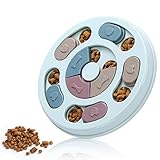
- 【Size】: L9.44" * W9.44"* H1.14" suitable for cats, puppies and small dogs.
- 【Interactive Dog Toys】This is a interactive puppy puzzle , which can easily become the closest companion and toy for your puppies and cats, and will release pressure for dogs. Find food by sliding parts to improve eating pleasure and IQ.
- 【Slow Feed Bowl】This encourages pets to eat at a slower speed, helps to slow down the feeding time to help the dog digest, and can provide your dog with a variety of healthy snacks.
- 【Slow Feede toys】 Use this educational game toy to exercise the dog’s brain, which will help meet the dog’s instinct needs, train the pet’s sense of smell, and let the dog enjoy feeding when using the nose or paw to move the slider, while providing spirit stimulate.
- 【Dog toys】No toy is indestructible. Do not leave toys with unsupervised pets. Remove and replace toy if damaged.
Video conditions can change the behavior
The veterinary letter identifies distraction, handling or movement effects, and sensory processing as possible explanations for a delayed or inconsistent response. A dog may be watching the handler, reacting to being lifted, adjusting its balance, or processing the approach differently from one trial to the next. Those explanations are not diagnoses; they illustrate why a momentary behavior should not be converted into a judgment about cognition.
The source is a clinical explanation, not a controlled intelligence experiment
The 2026 publication is a letter to the editor. It provides a current veterinary interpretation of the maneuver and its clinical significance; it does not report a new controlled experiment that ranks dogs. Its central point is captured by the author, M. S. Akosman: “The clinical significance of this test is to localise lesions and confirm neurological health, not to measure IQ.”
What canine cognition studies measure instead
Canine cognition research begins by defining the ability under investigation and then selecting a task that makes that ability observable. A result is interpreted within that protocol, not as a universal ranking of every aspect of a dog’s mind.
Learning and memory
Researchers may test whether a dog learns a cue, remembers a location, or retains a rule after a delay. The instructions, number of trials, delay interval, reinforcement, and scoring method all affect what the result means. A dog’s performance on a memory task is therefore evidence about that task and its conditions, not a single intelligence quotient.
Rank #3

- Four Challenges & Levels 1-3: Multiple games with a flip game and a linear track sliding game, all requiring dogs to learn steps and find treats. This puzzle is designed to be more fun and difficult, with more unique ways to play. It can enhance your dog's IQ and train their sense of smell
- Prolong the Feeding Time: The 14-hole food storage slow feeder has four ways to play, which is effective in slowing down the dog's eating speed. It is also beneficial to the dog's physical and mental health by increasing the time and difficulty of acquiring food, thus avoiding gastrointestinal issues caused by indigestion
- Safe Materials & Cleanable: Furry friends can safely play with this toy, which is made of food-safe and long-lasting materials. Additionally, it is easy to clean with warm water and soap after use
- Six Silicone Anti-Slip Pads: Six silicone anti-slip pads with high resistance ensure a firm grip and prevent the item from sliding to one side during feeding
- Warm Tips: When playing with the puzzle, please keep your dog with you to prevent any possible destruction of the toy. The toy has a tight design of built-in game components, so you don't need to worry about them being easily dislodged and swallowed by your dog
Inhibitory control: the transparent-cylinder task
In the transparent-cylinder task described in a 2023 Scientific Reports paper, food is visible behind a transparent barrier. A dog must inhibit the direct impulse to reach straight toward the food and instead move around the cylinder to obtain it. The task is used to examine inhibitory control, but performance can also depend on motivation, prior experience, motor skills, and how the trial is presented.
Spatial problem-solving: the V-detour task
In a V-detour task, a dog must navigate around a V-shaped fence to reach a visible treat. The detour requirement makes spatial problem-solving and response inhibition relevant. Success does not mean that the dog is globally smarter than a dog that takes longer; it is a score under particular materials, rewards, practice, and trial rules.
Persistence and communication: the unsolvable-task paradigm
An unsolvable-task setup gives a dog a problem that cannot be completed. Researchers can record how long the dog persists, whether it changes strategies, and whether it seeks help or communicates with a person. These observations address persistence, independent problem-solving, and dog-to-human communication. They are different outcomes from a placing reaction.
Windows Errors? Fix Them Before They Spread
Repair common Windows errors and clear accumulated junk for a smoother, more stable PC - no reinstall needed.Free scan · no reinstallOutdated Drivers Are Slowing You Down
One free scan finds every outdated or missing driver and matches the right update for your exact hardware.Free scan · exact hardware matchExecutive function is made of several components
Executive function commonly includes inhibition, working memory, and cognitive flexibility. A task intended to measure one component may also require the others. Dogs differ in how novel a test feels, how they respond to unfamiliar equipment, and how strongly they value the reward. For that reason, an isolated result needs cautious interpretation, and a battery of complementary tasks is more informative than one dramatic challenge.
Rank #4

- 【Product Size】10 inch*10 inch*1.2 inch.
- 【Interactive Dog Puzzle Toys 】This is a fun interactive puzzle toy,which can encourage and train your dogs or cats to seek foods by sliding the slider, helping pets to increase IQ by learning sequential steps and the challenging play.
- 【Squeaky Dog Toys】This dog puzzle toys is designed with a sounding device in the middle of the toy,which is to attract the pet's attention.Also,you would enjoy the fun of dog squeak puzzle toy with your pets, greatly improve relations with your pets and get fun during interactive dog games.
- 【Mental Excecise&Boredom Buster】Our memory training puzzle toy can keep smart dogs busy and engaged in more thinking and activities.Therefore,clot stimulation toys are great for reducing dogs’boredom,anxiety and destructive behaviors.
- 【Food-Safe PP Material】This dog treat puzzle is made with toxic-free, food-grade PP material. It is durable for interactive play and mental enrichment but not designed as a chew toy. Always supervise your pet during use.Easily washable with water or in the dishwasher.Note: No toy is indestructible. Remove and replace the toy if damaged.
CANID illustrates a multi-task assessment
CANID, a 2026 evaluation used in studies of cognitive aging in community-dwelling dogs, consists of three tasks covering aspects of memory and executive function. Its design illustrates why formal assessment uses multiple defined tasks rather than one physical maneuver. CANID does not validate the viral wall challenge, and its results should not be treated as a score for dogs in online videos.
Viral wall challenge versus formal cognition assessment
| Comparison point | Viral wall challenge | Research or clinical assessment |
|---|---|---|
| Construct measured | Visual or tactile placing and postural response | A defined cognitive ability, or neurological function, selected for a stated purpose |
| Protocol | Usually one informal handling event with variable speed, position, surface, and distractions | Specified equipment, instructions, trials, timing, rewards, and scoring rules |
| Interpretation | Often described online as “smart” or “not smart” | Task-specific behavioral data or a clinical finding interpreted with other examination results |
| What a result can establish | Nothing reliable about general intelligence from a clip | Evidence about the tested skill, or a reason for professional neurological follow-up |
| Expertise and welfare | Typically performed for entertainment without controls | Designed by researchers or performed by veterinary professionals with an appropriate purpose and safeguards |
How to interpret a dog’s response safely
Do not call a dog intelligent or unintelligent
Whether a dog reaches toward the wall is not a pass-or-fail intelligence result. Avoid comparing dogs, assigning a breed ranking, or presenting a clip as proof that one animal has a higher IQ. The same dog could respond differently when its posture, attention, handling, or surroundings change.
Do not diagnose from a social-media video
A video cannot show the complete neurological examination, confirm that the dog saw the surface clearly, or distinguish a sensory issue from handling and attention effects. Even an apparently unusual response has several possible explanations. The veterinary letter specifically cautions against treating the maneuver as a measure of intelligence.
Quick wins for a faster PC:
Fix the driver behind crashes, sound loss and screen glitchesFind Drivers →Clear out junk files and repair common Windows errorsFree Scan →Scan for outdated or missing drivers - takes under a minuteDriver Scan →When veterinary advice is appropriate
If you observe a failed or repeatedly unusual placing response and are concerned, stop the experiment and contact a veterinarian. Explain what happened, when it occurred, and whether the behavior was repeatable in ordinary circumstances. A veterinarian can decide whether a proper neurological examination is warranted. Do not attempt to locate a brain lesion or test the dog repeatedly at home.
Best Value

- 2 Levels in 1 Toy: start your pups off with a level 1 puzzle, add some treats in the base compartments and watch your dogs get their tasty reward by nudging the lids. For dogs who have mastered level 1, for added challenge in level 2, just put some treats in the top compartments, teach your dogs to press the top cover to dispense treats down into the base compartments and finally enjoy their reward
- Slow Feeder: The large capacity top transparent granary saves you the hassle to refill dog food frequently. The product can also be used as a slow feeder utensil for your dogs, which promotes healthy ingestion by slowing down eating speed by over 10x. Great for large and small dogs
- Not Easy to Tip Over: 4 non-slip rubber mats and weighted base hold the dog puzzle toy firmly in place when dogs eat and nudge and prevent the toy from tipping over
- We Prioritize Safety: the dog puzzle toys are designed with your pet’s health in mind, made of durable food-grade PP materials. Non-removeable parts make it safe and easy to clean. And you can give puzzles toy to your dog or directly out of the box, just no assembly!!
- Trains Dog’s Intelligence: interactive treat puzzle game challenges your puppies to get their reward of treats, works your dog's mind while reducing boredom and destructive behavior like chewing, digging and excessive barking. Size: 4.2 inch height
Why welfare and test design matter
A 2024 scoping review of canine behavioral testing emphasizes that validity depends on the intended test battery and context. A task that behaves acceptably as one part of a carefully designed battery may not be valid when isolated and used for a different purpose.
The review also recommends selecting stimuli consistent with contemporary welfare standards and balancing the challenge or invasiveness of a procedure against the value of the information it may provide. Lifting and moving a dog toward a wall for an online ranking offers no reliable intelligence result, so the burden has no clear scientific benefit.
If you want to learn about your dog’s abilities
- Use the right question. Ask whether you want to understand memory, trainability, impulse control, persistence, or social communication. Those are different abilities.
- Choose an appropriate protocol. Look for clearly described tasks, consistent instructions, humane rewards, repeated trials, and an explanation of how scores are interpreted. A single trick or reflex cannot stand in for a cognitive profile.
- Control obvious confounds. Attention, motivation, prior training, unfamiliar rooms, surface footing, and the handler’s cues can all affect behavior. Any comparison should keep these factors as consistent as possible.
- Protect the dog’s welfare. Use low-stress procedures, allow the dog to stop, and avoid forcing contact, frightening equipment, or repeated handling for entertainment.
- Separate cognition from health concerns. A suspected neurological abnormality belongs with a veterinarian. A cognitive question belongs in a properly designed behavioral assessment; neither is answered by the wall video.
The practical answer
The viral dog wall test does not tell you how smart your dog is. It elicits a placing response that veterinary medicine uses as part of neurological assessment. Formal canine cognition work instead measures specific abilities with controlled, welfare-conscious tasks, and each result must be interpreted within its protocol. Treat the clip as a misleading internet challenge—not an IQ test—and seek veterinary guidance if an unusual response raises a genuine health concern.
Quick Recap
Product prices and availability are accurate as of the date/time indicated and are subject to change. Any price and availability information displayed on Amazon at the time of purchase will apply.





Leave a Reply