
Quick wins for a faster PC:
Scan for outdated or missing drivers - takes under a minuteDriver Scan →Repair Windows errors before they cause bigger problemsFix Now →Nyctimantis pomba is a casque-headed tree frog known from a very small forest fragment in Minas Gerais, Brazil. Its conservation program combines protection of that wild habitat with an ex situ “insurance” population maintained by Brazilian institutions. Captive breeding succeeded for the first time in 2022, and a September 2025 report listed 280 frogs in human care. Those are important milestones, but they do not yet demonstrate a release of captive-bred frogs or recovery of the wild population.
The program illustrates why amphibian conservation is often a race against time: researchers first had to locate females, learn the species’ reproductive requirements and then expand a carefully managed population while in situ threats are addressed.
As an Amazon Associate I earn from qualifying purchases.
What is the casque-headed frog?
A narrowly distributed Brazilian tree frog
Nyctimantis pomba is a casque-headed tree frog from southeastern Brazil. The species’ name is associated with the Rio Pomba region, but the best documented occurrence in the official account is its type locality in Cataguases, Minas Gerais. ICMBio describes that site as a 1.36 km² forest fragment on a private rural property within a heavily fragmented Atlantic Forest landscape.
Outdated Drivers Are Slowing You Down
One free scan finds every outdated or missing driver and matches the right update for your exact hardware.Free scan · exact hardware matchPC Slower Than It Used to Be?
A free scan shows the junk files, broken settings and background clutter dragging Windows down - then fixes them in one click.Free scan · Windows 10 & 11That description matters more than a generic statement that the frog lives in the Atlantic Forest. The documented locality is a small, privately held fragment surrounded by a human-modified landscape, so the known distribution is geographically restricted. A tiny known range leaves little room for local disasters, disease, habitat change or a decline that goes undetected.
#1 Best Overall

- 【Acrylic Reptile Terrarium】Our small reptile cage measures 7.87" x 4.72" x 4.33", perfect size for kinds of baby reptiles or other small animals, providing sufficient room for reptiles pets to move around.
- 【360 Degree View】Our large breeding tank is all-round transparent, it's convenient to observe your slithery friends in the box and feed them in time. The top is clam-shell design, easy to open and close.
- 【Easy to Install】Tear off the protective film on the surface at first and the acrylic tarantula enclosure requires a simple installation , the rubber bands do well in holding everything together. It's also easy to disassemble when not use for saving storage space.
- 【Perfect Design】This reptile breeding box tarantula enclosure is designed with ventilation holes on the two sides, providing the reptiles with fresh air. And the locking handle keeps your pet safe.
- 【Reptile Tank for Insects】Provide a perfect home and a warm habitat for your small reptiles, amphibians and invertebrates. Ideal for spiders, lizard, small turtles, snails, frogs, snakes, tarantulas, hermit crab or any other insects.
How the frogs use the site
The first animals found at the locality were sheltering in cavities in stands of Bambusa vulgaris, an exotic bamboo. This observation is a field record of shelter use, not proof that the species depends on bamboo everywhere or that bamboo planting is a conservation prescription. It does show why detailed natural-history work is essential: a captive facility must reproduce the conditions that allow frogs to hide, thermoregulate and reproduce, while habitat managers must understand which features of the wild site are genuinely necessary.
Where does Nyctimantis pomba live?
The currently documented wild setting is a private-property forest fragment in Cataguases, in the state of Minas Gerais. The fragment covers 1.36 km² according to ICMBio’s 2025 program page. The source does not establish a broad, continuous range beyond that locality, and it does not provide a current estimate of the total number of wild frogs.
Researchers observed calling males and recaptured some males during field work, but those observations should not be converted into a population census. In particular, a chorus of more than twenty calling males on one night records a breeding event, not the size of the entire population or even the number of males present throughout the season.
Why are conservationists breeding Nyctimantis pomba in captivity?
Ex situ management is an insurance policy
ICMBio’s population-management program says its first priority is to establish and maintain a security population because of threats to the species in nature. In conservation terminology, this is ex situ management: animals are kept and bred under human care away from the wild site. The purpose is to reduce the chance that a single catastrophe or continuing decline will eliminate every living individual and to preserve the practical ability to produce frogs for future conservation work.
Captive work does not replace habitat protection
The same 2025–2035 program explicitly includes in situ conservation. Protecting and monitoring the forest fragment remains the only way to secure a self-sustaining wild population. Captive breeding can provide animals, husbandry knowledge and trained personnel, but it cannot by itself repair a fragmented landscape or remove threats at the type locality.
Rank #2

- ✅【Wide Application 】- The Reptile Terrariums is water tight and can hold water.Perfectly used as insect cage, small fish tank,tarantula enclosure,hermit crab tank, jumping spider enclosure, iguana cage,tortoise habitat,reptile cage ,bug cage ,bearded dragon tank,bug box,reptile carrier, reptile enclosure ,plastic terrarium,gecko tank ,plastic fish tank,lizard tank,snail terrarium,spider terrarium,hermit crab cage,frog cage, snake cage,turtle tank,frog tank,fish breeder box,bug container
- ✅【Provide Your Pet With a Comfy Home】 The top is made of metal screen to provide adequate ventilation and is safe for overhead heat sources and your pet can enjoy optimal airflow, UVB and infrared penetration, and dome lighting to meet the needs of the reptile keepers.
- ✅【Clear Crystal Explosion Proof PC with 360 Degree full View】Made with high quality thick and extremely high hardness crystal explosion proof PC base for more safety. The biggest feature of this terrarium tank is that it is explosion-proof and anti-drop, with a brightness of more than 98%, and it will not yellow after long-term use. The temperature of this reptile tank can withstand -20 °C to 120 °C. An ideal habitat for desert-dwelling animals.
- ✅【Compact Design and Easily Accessible For Feeding】The cover comes with specially designed feeding port that are designed to be functional and also visually appealing.Unique with super convenient feeding port, magnet spring double insurance, light push feeding, automatic closing to prevent escape.
- ✅【After-Sales Service】Not need install, easy to use.If you have problems when assembling the plastic screws, please carefully watch the video on the page. And a replacement or refund is guaranteed if the products are not up to the standard.
| Conservation approach | What it contributes | What it cannot establish on its own |
|---|---|---|
| In situ (in the wild) | Maintains the habitat, ecological interactions and natural selection that a wild population needs. | It does not provide a backup population if the locality suffers a sudden loss. |
| Ex situ (under human care) | Creates a managed security population and supports research, education, training and possible future reinforcement. | It does not prove that the wild population is increasing or that released frogs would survive. |
How did the captive program begin?
The 2019 launch
In 2019, ICMBio and the Association of Zoos and Aquariums of Brazil included N. pomba among 25 Brazilian species prioritized for captive breeding. Amphibian Ark reports that a private donor provided US$3,000 through the organization for the initial work. The team used that grant for field trips to locate founder animals and for basic laboratory equipment.
The founder-sex bottleneck
Early searches located four males and two juveniles, but no females. Without females, the team could not establish a breeding protocol, regardless of how suitable the enclosure or laboratory might be. This was a practical field problem rather than a simple shortage of effort: the animals had to be found during the right season, identified correctly and collected under an appropriate conservation plan.
The team intensified daily sampling during the species’ most active season. In late 2021, that effort located females and documented a chorus of more than twenty calling males on one night. The chorus observation helped confirm that the site still supported breeding activity, while the females made controlled reproduction possible.
Has the casque-headed frog been bred in captivity?
Yes. The first attempt, in December 2021, produced eggs that did not develop. The team could not determine whether the eggs were unfertilized or whether water conditions were unsuitable, so the result identified a problem without identifying its cause.
In November 2022, two females produced fertilized eggs. Tadpoles developed and completed metamorphosis, which Amphibian Ark identifies as the first reproduction of N. pomba in captivity. This is a documented husbandry milestone: it proves that the species can complete the egg-to-metamorph process under managed conditions. It is not evidence that captive breeding has already restored the wild population.
Rank #3
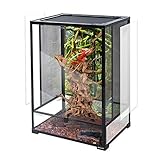
- [Patent Design] 1. Side Meshes and Side Glasses Switched Easily: Great for different needs, the side meshes and side glasses can be switched according to the environment, providing your reptile or amphibian with a long-lasting and comfortable environment.
- 2. Front and Top Opening: The front opening doors allow easy access for maintenance and feeding. A specially designed lock will prevent escape and the doors can be opened separately. Well-ventilated with a removable mesh top allows UVB and infrared penetration, optimum airflow and dome lighting, and easy access while decorating or cleaning.
- 3. Waterproof Base & Raised Bottom Frame: Water-tight base, every terrarium is tested for leaks; Raised bottom frame to fit a substrate heater.
- 4. Easy to assemble: Easy to install, we have installation notes, conveniently flat packed for safety and transport.
- 5.Size and Package : Size : 24 x 18 x 36 inch; Package include : 1pcs *REPTI ZOO reptile glass terrarium,reptile and other decorations not included.
| Date | Event | What the event demonstrates |
|---|---|---|
| 2019 | Species prioritized; grant-funded searches and basic laboratory setup began. | The program moved from planning to founder collection and husbandry development. |
| Early searches | Four males and two juveniles found; no females located. | Founder composition was the immediate constraint on breeding. |
| Late 2021 | Daily seasonal sampling found females and a one-night chorus of more than twenty calling males. | More intensive field work located the sex and seasonal activity needed for breeding. |
| December 2021 | Eggs failed to develop. | The first attempt exposed unresolved fertilization or water-quality questions. |
| November 2022 | Two females laid fertilized eggs; tadpoles metamorphosed. | First captive reproduction was achieved. |
| September 2025 | Newsletter reported 280 frogs across three institutions. | The managed population had expanded substantially, although the figure is a dated report rather than a live census. |
What is the current management plan?
ICMBio’s first management cycle runs from 2025 through 2035. The program group includes São Paulo Zoo/Reserva Paulista, the biodiversity department of São Paulo’s state environmental agency, Universidade Federal de Viçosa, ICMBio’s RAN center and Instituto Butantan.
The Tool Desk
Outbyte Driver Updater FREEScan for outdated or missing drivers - takes under a minuteDriver Scan →Outbyte PC Repair FREEClear out junk files and repair common Windows errorsFree Scan →The plan has four connected objectives:
- Establish and maintain a security population. This is the priority response to threats affecting the frog in the wild.
- Maintain a minimum breeding population. A viable managed group keeps open the possibility of future reintroduction or reinforcement, subject to evidence and formal decisions.
- Keep frogs under human care for public awareness and environmental education. Facilities can make the species visible to audiences who will never visit its remote or private locality.
- Promote in situ conservation. Captive work is linked to field protection rather than treated as a replacement for it.
The institutions’ roles are complementary. Zoos and specialized centers provide space, husbandry and public engagement; universities contribute research; government agencies coordinate conservation decisions and habitat action; and a research institute such as Butantan adds scientific and technical capacity.
How many Nyctimantis pomba are in the captive program?
Amphibian Ark’s September 2025 newsletter reports 280 individuals distributed among three institutions. The breakdown was:
| Institution | Individuals reported in September 2025 |
|---|---|
| CECFAU | 237 |
| São Paulo Zoo | 33 |
| Instituto Butantan | 10 |
| Total | 280 |
The population is managed through ZIMS studbooks, which record individual animals and their relationships so managers can plan pairings and avoid concentrating breeding in a small number of founders. The 280 figure should be read with its date and source attached: it is the number reported in September 2025, not a continuously updated public census. Births, deaths, transfers and changes in institutional holding can alter the total.
What does the population increase—and what does it not—tell us?
What it tells us
- The program moved beyond the initial founder-search stage and can now maintain a sizable managed group.
- Successful reproduction is repeatable enough to support population growth, rather than remaining a single unproductive trial.
- Several institutions share responsibility, reducing dependence on one facility and creating a broader base for husbandry, education and research.
What remains unproven
- No reviewed source documents a completed release of captive-bred frogs.
- No reviewed source provides a current wild-population abundance estimate.
- The available material does not show a measurable improvement in the frog’s wild conservation status caused by the captive program.
Those limits are important because a larger captive population and a healthier wild population are different outcomes. A security colony can be biologically valuable even while the original habitat remains at risk, but its success must ultimately be judged alongside field protection and the survival of wild animals.
Do these 3 things before closing this tab:
1Fix the driver behind crashes, sound loss and screen glitches2Repair Windows errors before they cause bigger problems3Scan for outdated or missing drivers - takes under a minuteRank #4
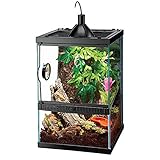
- A perfect reptile habitat for your small arboreal reptile or amphibian
- Front opening door on this reptile terrarium allows for easy access
- Glass terrarium hinged lid allows for additional access and the powder coated screen resists rust
- 5" Deep water tight bottom allows for unique water features, making this vertical terrarium the perfect mini paludarium
- Kit Includes: 12"x12"x18" glass front opening terrarium, Rock Like Foam Background, Front Locking Latch and Pin, Hinged Screen Top, Mini Halogen Dome with Bulb, Coconut Husk Bedding, Humidity and Temperature Gauge, Feeding Dish, and Setup Guide
What research is happening alongside breeding?
The September 2025 program update describes field monitoring and continuing thermal-ecology work. Thermal ecology examines how an animal interacts with temperature in its environment. For a frog, that information can guide enclosure gradients, shelter design, seasonal husbandry and decisions about whether a release site offers suitable conditions.
Ex situ facilities also provide controlled settings for studying reproductive biology that is difficult to observe in the forest. Amphibian Ark’s Brazil National Coordinator, Cybele Sabino Lisboa, describes the insurance population as supporting education, training and research while important aspects of reproduction remain poorly known. That knowledge can improve both captive care and the interpretation of field observations.
What is the conservation status of the species?
Status labels must be dated and attributed carefully. A conservation-needs assessment dated 30 April 2019 recorded the global IUCN status as “Not Evaluated” and Brazil’s national-list status as “Critically Endangered.” A 2020 summary report carried the same historical assessment context. ICMBio’s current population-management material, published in 2025, describes N. pomba as Critically Endangered.
| Statement | How to interpret it |
|---|---|
| Global status listed as Not Evaluated in the 2019 assessment | A historical assessment record; it should not be presented as a current global Red List result. |
| Brazilian national status recorded as Critically Endangered in the 2019 assessment | A national-list assessment tied to that date. |
| ICMBio describes the species as Critically Endangered in 2025 program materials | The agency’s current program framing and the reason it is implementing population management. |
What would a successful next phase require?
Keep the managed population demographically and genetically useful
Maintaining numbers is only one task. Studbook-based planning must retain representation from the available founders, document parentage and distribute animals among facilities in ways that support long-term care. Managers also need reliable records of breeding, development, health and mortality so that future decisions are based on more than a head count.
Continue field monitoring at the known locality
Seasonal searches, calling surveys and recapture work can reveal whether frogs remain present and when they breed. Such observations need consistent methods and repeated coverage before they can support a trend. A single chorus, even a large one, cannot substitute for that monitoring.
Best Value

- Clear plastic terrarium great for temporary housing or quarantine
- Ideal to transport terrarium animals or live foods
- Transparent plastic door for easy access
- Easy to clean and disinfect
- Medium plastic terrarium measures12 inches by 7.5 inches by 8 inches
Connect captive work to habitat decisions
The private-property fragment and its surrounding landscape require in situ attention. Protection agreements, habitat management and assessment of threats should proceed while the ex situ population is maintained. The program’s stated inclusion of in situ conservation recognizes that a release would have little value without a secure, suitable destination.
Set evidence-based criteria for any future reinforcement
ICMBio identifies potential reintroduction or population reinforcement as a reason to maintain a minimum breeding population. The available reports do not say that a release has occurred or specify a release date. Before such an action, managers would need evidence about disease screening, genetic suitability, habitat condition, post-release monitoring and the causes of decline. Keeping that distinction clear prevents a planned possibility from being mistaken for a completed conservation outcome.
Why this ex situ story matters
Nyctimantis pomba shows the practical sequence behind an amphibian insurance population. A species can be prioritized, yet breeding cannot begin until suitable founders—including females—are found. A first failed spawn can leave several explanations open. Intensive seasonal field work can then unlock a second attempt, and a successful 2022 metamorphosis can grow into a multi-institutional population by 2025.
The achievement is therefore twofold: Brazil now has a documented captive-breeding capability for this frog and a reported managed population large enough to support continued research and planning. The unfinished part is equally clear. The wild locality remains the foundation of conservation, and no available report yet demonstrates release or wild recovery. For this casque-headed frog, ex situ management is best understood as insurance that buys time for in situ protection—not as a substitute for it.
Quick Recap
Product prices and availability are accurate as of the date/time indicated and are subject to change. Any price and availability information displayed on Amazon at the time of purchase will apply.





Leave a Reply