What’s actually slowing this PC down?
Pick the symptom - the matching free tool is one click away.
Obelignathus septimanicus is a Late Cretaceous ornithopod dinosaur from southern France—but it was not newly discovered in 2025. That year, researchers reassigned an already named species to a new genus after studying its fossil jaw. The study places it in the upper Campanian to lower Maastrichtian; “72 million years” is a rounded headline age, not an exact date established for this specimen.
What is Obelignathus septimanicus?
It is a rhabdodontomorph ornithopod, a group of plant-eating dinosaurs, known from a partial lower jaw found at Montouliers in southern France. In a 2025 taxonomic study, Czepiński and Madzia created the genus Obelignathus and placed the previously named species Rhabdodon septimanicus in it as Obelignathus septimanicus. The paper appeared in Scientific Reports.
Was it really a new dinosaur species?
No. The species name Rhabdodon septimanicus dates to Buffetaut and Le Loeuff in 1991. The 2025 change was a reassignment to a new genus, not the discovery or first naming of a new species. Its earlier validity and classification had been discussed, including in a 2010 thesis on Rhabdodon from France (thesis record).
In biological taxonomy, a genus groups related species. Moving a species to another genus changes the combination of its scientific name; it does not mean a different fossil suddenly appeared or that the animal’s species was newly identified.
#1 Best Overall

- Resin Cast Replica
- 5.5 inches
What fossil supports the new classification?
The holotype—the specimen that anchors the name—is MDE D30, a partial right dentary, or lower-jaw bone, from the Grès à Reptiles Formation at Montouliers. Its frontmost portion is missing. It is a jaw fossil, not a complete skeleton, so the specimen cannot by itself establish the dinosaur’s full body appearance.
The authors distinguished it from other rhabdodontomorphs through a combination of jaw features, including:
Rank #2
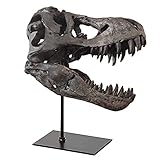
- 【Home Office Desktop Shelf Decor 】Dinosaur head sculptures skull model is hand cast from high-quality solid resin. The surface is made of antique craftsmanship, and the convincing colours and details make it look very realistic and eye-catching. Add some aesthetic to your room
- 【Supplement Your Collection】T-Rex is one of the most popular dinosaurs in the world. For dinosaur lovers or palaeontology lovers, the tyrannosaurus rex skull is a fantastic replica. It will also be a fun teaching tool for any child or teen
- 【Home Decor and Conversation Starter】A lifelike dinosaur skeleton decor. This impressive sculpture looks great on a table or bookshelf. It will be a great conversation starter and conversation piece for any family
- 【Suitable for Many Occasions】This Tyrannosaurus Rex skull replica comes with a metal base. There are 4 non-slip pads on the bottom of the stand to protect the surface of your furniture. It can be placed on various occasions such as office, hallway, TV cabinet, wine rack, living room, etc
- 【Perfect Christmas/Birthday Gift】10.2x 5.9x 11.8 inches.It only takes 2 minutes to complete the installation.Give it as a gift to children, adults, husbands, and friends, no one will refuse it
- an unusually robust dentary;
- a coronoid process rotated toward the side and rear (lateroposteriorly);
- a deep Meckelian canal, a groove along the inner side of the lower jaw.
The classification therefore rests on the anatomy preserved in this fossil and the authors’ comparative and phylogenetic analyses, rather than on a complete skeleton.
How old was the dinosaur?
The study gives the fossil an upper Campanian to lower Maastrichtian age context, stages within the Late Cretaceous. The available source does not establish a specimen-specific radiometric date. Calling it “72 million years old” is rounded popular framing, not a precise measured age for MDE D30.
Recommended Free Tools
Rank #3

- Utahraptor was a large theropod dinosaur that lived during the Early Cretaceous period, known for its sharp claws and hunting abilities
- This replica is based on a real Utahraptor fossil discovered in Utah, accurately capturing the shape and detail of the original claw
- The Utahraptor’s curved claw was used for gripping and slashing, making it a key tool for hunting prey
- Cast in durable resin, this 5.5-inch replica offers museum-quality detail and texture
- Made in the USA, this fossil reproduction is perfect for collectors, educators, and dinosaur enthusiasts
Why does the reassignment matter?
Separating Obelignathus from Rhabdodon adds evidence that rhabdodontomorph ornithopods in Late Cretaceous Europe were more diverse than some earlier classifications suggested. Europe at the time consisted of an archipelago, and the study examines diversity and evolutionary relationships across that setting. The reassignment is a change in how paleontologists interpret known material—not evidence that a new skeleton or species was unearthed in 2025.
Independent reader supportYour contribution helps us test, update, and keep practical guides available for everyone.Why is it called Obelignathus?
The genus name combines “Obélix,” the strong character from the French Asterix comic series, with the Greek gnáthos, meaning “jaw.” The name refers to the robust lower jaw. A 2025 summary from the Museum of Evolution of the Polish Academy of Sciences also describes the new genus and its French fossil.
Quick Recap
Rank #4

- IT FROM XUQCAH MATERIAL AND FOIMOJSK PAR ENT AND Thurder LOVER
- Museum Quality Replica
- Please thoroughly read discription
Product prices and availability are accurate as of the date/time indicated and are subject to change. Any price and availability information displayed on Amazon at the time of purchase will apply.




