Free tools Windows power users keep installed
One-click scans. No signup required.
A Patterdale Terrier is a small dog built for demanding work, not a small dog with low demands. Developed in Northern England from black, smooth-coated Fell Terriers, the breed was used to control vermin threatening sheep by pursuing quarry underground and bolting it from dens.
That history still shows in the modern dog: Patterdales are compact, athletic, persistent, courageous, and strongly prey-driven. They can be affectionate and highly trainable with the right owner, but chasing, digging, barking, and ignoring a recall when something moves are realistic management issues—not unusual exceptions.
As an Amazon Associate I earn from qualifying purchases.
The breed suits an active household prepared to provide secure exercise, structured training, and careful supervision around small animals. It is a poor choice for someone looking for an easygoing companion simply because the dog is small.
Quick wins for a faster PC:
Clear out junk files and repair common Windows errorsFree Scan →Fix the driver behind crashes, sound loss and screen glitchesFind Drivers →Patterdale Terrier at a glance
| Feature | What to expect |
|---|---|
| Origin | Northern England |
| Original work | Earth-working and vermin control, including pursuing quarry underground |
| Height | 10–15 inches at the withers |
| Weight | No fixed UKC range; it should be proportionate to height and the dog should be fit |
| Coat | Smooth, broken, or rough, with a short, dense undercoat |
| Recognized colors | Black, red, liver/chocolate, grizzle, black and tan, and bronze |
| Activity level | Very high; needs both physical activity and mental work |
| Prey drive | Strong and likely to require lifelong management |
| UKC recognition | Recognized January 1, 1995 |
The height and type information comes from the United Kennel Club breed standard. The standard does not support a universal adult weight such as 11–13 pounds. A healthy weight depends on the individual dog’s height, bone, muscle, and body condition.
#1 Best Overall
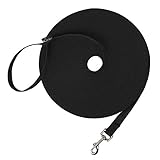
- DIMENSIONS - This dog leash measures 3/4in wide by 30 feet long. Great for hiking, camping, training, hunting, backyard, beach, recall training, outdoor play with tennis balls, and swimming!
- LONG LEASH: This training leash is great for teaching your dog recalls. It has the length needed to allow them to wander and ensure your command to come! is obeyed.
- NYLON TRAINING LEAD - This durable, long, nylon dog training leash will outlast cotton leashes. All stitching is reinforced and the nickel plated clip swivels to resist twisting. Our long dog leash is great for medium and large dogs. You'll love using it as a backyard dog leash, for off leash dog training, and more.
- Allows you to teach your dog recalls and other obedience skills.
- Swivel-style bolt snap resists twisting
History and breed recognition
Patterdales belong to the working-terrier tradition of Northern England. Their compact, flexible bodies allowed them to enter narrow underground passages, while their courage and persistence helped them confront or bolt quarry. The breed was developed for practical work rather than for a particular show-ring appearance.
The UKC recognized the Patterdale Terrier on January 1, 1995; its current standard is marked “Revised December 1, 2014.” The breed is not among the American Kennel Club’s 205 fully recognized breeds listed in the AKC’s January 1, 2026 update. It also does not appear on the AKC recognition materials’ current Foundation Stock Service or Miscellaneous breed lists.
It is also absent from the Royal Kennel Club’s current breed-standards page. That does not make a Patterdale less of a dog or prevent it from taking part in every canine activity, but it does affect which registries and competition routes are available. In the United States, owners may be able to use AKC alternatives such as a Canine Partners or PAL number, depending on eligibility and the activity.
What’s actually slowing this PC down?
Pick the symptom - the matching free tool is one click away.
For owners interested in earth work, the American Working Terrier Association includes Patterdales among the breeds eligible for den-trial competition. Its artificial earth is nine inches, and qualifying dogs may earn Working, Hunting, or Gameness certificates.
Appearance and size
The UKC describes a compact, balanced, sturdy terrier capable of compressing its body to work underground. The body is square or slightly longer than tall. The chest should be deep to the elbow but moderate in width and oval rather than barrel-shaped.
You may see references to “spanning” when Patterdale conformation is discussed. In working-type judging, spanning refers to assessing whether the chest can compress behind the shoulders, along with flexibility and size. It is not a home health test. The UKC standard gives no owner hand-span procedure and does not mean that every pet must fit a particular person’s hands.
The head is strong and wedge- or trapezoid-shaped when viewed from the front. The skull and muzzle are approximately equal in length, although the muzzle may be slightly shorter. The eyes should not protrude, the ears are triangular and folded, and the nose is generally black. Liver or chocolate dogs may have a brown nose.
Coat types
There are three UKC-recognized coat types:
- Smooth: coarse, dense, and stiff.
- Broken: longer, wiry guard hairs, sometimes with facial furnishings.
- Rough: longer overall, including around the face and ears.
All three should have a short, dense undercoat. The coat was functional: it helped protect a working terrier from wet ground, brambles, and underground conditions. Routine grooming is usually limited to brushing, bathing when necessary, nail trimming, ear checks, and dental care. A broken or rough coat may need occasional tidying, but this is not normally a high-grooming breed.
Rank #2
- Dimensions - This dog leash measures 3/4in wide by 20 feet long. Great for hiking, camping, training, hunting, backyard, beach, recall training, outdoor play with tennis balls, and swimming!
- Long Leash: This training leash is great for teaching your dog recalls. It has the length needed to allow them to wander and ensure your command to come! is obeyed.
- Nylon Training Lead - This durable, long, nylon dog training leash will outlast cotton leashes. All stitching is reinforced and the nickel plated clip swivels to resist twisting. Our long dog leash is great for medium and large dogs. You'll love using it as a backyard dog leash, for off leash dog training, and more.
- Allows you to teach your dog recalls and other obedience skills.
- Swivel-style bolt snap resists twisting
Colors and tail
Patterdales are not always black. The UKC standard lists black, red, liver/chocolate, grizzle, black and tan, and bronze. Some white is permitted on the chest and feet, while a white patch or spot on the body or head is a disqualification under the UKC conformation standard.
Both natural and docked tails are accepted by the UKC, with no preference between them in the standard. The standard describes the historical working tail as a possible means of pulling a dog from a burrow and specifies limited docking where docking is performed. Tail-docking and ear-cropping rules vary by location, so owners should check local law rather than treating breed-standard wording as legal guidance.
Temperament
The defining Patterdale temperament is working-terrier intensity. The UKC describes the breed as extremely courageous, very active, willing to work, eager to please, and strongly prey-driven. A Patterdale may be friendly and devoted at home while becoming highly focused when it sees a squirrel, rabbit, rat, cat, or other moving target.
Do these 3 things before closing this tab:
1Repair Windows errors before they cause bigger problems2Fix the driver behind crashes, sound loss and screen glitches3Clear out junk files and repair common Windows errors“Eager to please” does not mean automatically obedient. Many Patterdales learn cues quickly, but their persistence and independence can take over when the environment offers a more rewarding target. A dog that performs a recall in the garden may not respond with the same reliability when a rabbit crosses a field.
The standard describes an ideal dog as peaceful with people, livestock, and other dogs. That is a breed ideal, not a guarantee for every individual. Early socialization, careful breeding, training, and management all matter. Do not assume that a Patterdale will be safe with cats, poultry, rodents, livestock, unfamiliar dogs, or children simply because it was raised in a home.
They are not inherently unsuitable for families, but the adults must supervise interactions and teach children to respect the dog’s space. A Patterdale that is repeatedly chased, grabbed, cornered, or allowed to rehearse frantic behavior can become difficult to manage. Viciousness and extreme shyness are disqualifying faults in the UKC standard, but that should not be confused with a guarantee of universal sociability.
Exercise and enrichment
The breed standard does not prescribe a fixed number of daily exercise minutes. The appropriate amount varies with age, health, fitness, weather, and the individual dog. In practice, most Patterdales need substantially more than brief neighborhood walks.
A useful routine combines controlled physical exercise with activities that resemble parts of the breed’s original work:
Rank #3

- Various Size&Dia. Long Dog Leash: 10FT, 16FT, 30FT, 50FT,and 100FT , various sizes can meet different training purpose. Our Dog Leash available in diameter 1/3 inch, 3/8 inch, 1/2inch. The diameter of 1/3 inch can meet small dogs, cats or other small animals. The diameter of 3/8 inch and 1/2 inch is the best choice for training leashes for large dogs or medium dogs.
- Dog Tie Out Cable: Both ends of our rope dog leash leash have a heavy duty stainless steel swivel hook that can rotate 360 degree. You can tie one end of this training leash to your body or trees etc.,so that you can free your hands when traning, hiking,walking,etc.
- Reflective for Night Safety: We’ve added a reflective stitching around this strong training lead to make sure it is visible in low light. Your pup’s safety is always our highest priority.
- Durable and Lightweight Dog Rope Leash: This training Lead is made of high strenth wear-resistant polyeste which is lightweight and environmentally friendly, not easy to pull off, and has strength, will not be entangled with trees, grass, etc.The pull is up to 8-10 KN by professional tensile test which allow for total control of your dog and also allow it the freedom to do its business.
- Excellent Outdoor Dog Leash: Great dog leash for outside sports such as hiking, camping, training, hunting, backyard, beach, mountain climbing, walking, running, and so on.Any problem don't hesitate to contact with us.
- Brisk walks or hikes on lead or a long line.
- Scent games, tracking exercises, and supervised searching.
- Food puzzles and short problem-solving sessions.
- Retrieve, tug, and impulse-control games with clear rules.
- Earth-dog or den-work activities run by an experienced, reputable organization.
- Agility or other suitable dog sports, provided the dog is physically ready.
Exercise should not consist only of throwing a ball until the dog is exhausted. Repetitive high-arousal play can produce a fitter, more frantic dog rather than a calmer one. Build in sniffing, decompression, training, and rest.
Off-leash freedom requires particular care. A secure fenced area is safer than an open park, and a long line can provide exploration without giving a prey-driven dog unrestricted access to wildlife. A strong recall is worth teaching, but no recall is infallible. Do not test it by releasing the dog near roads, livestock, or known wildlife habitat.
Training a Patterdale Terrier
Start training early, keep sessions short, and use rewards the dog genuinely values. Food, toys, play, and access to sniffing can all be useful reinforcers. Teach behaviors that make daily management easier before expecting reliable off-leash obedience.
- Train name response and orientation: reward the instant the dog looks toward you.
- Build a recall indoors: call once, move away, and reward heavily when the dog follows.
- Add distractions gradually: progress from the house to a fenced garden, then to quiet outdoor locations on a long line.
- Teach “leave it” and an emergency turn: practise before the dog is fixated on prey.
- Reward calm behavior: reinforce settling on a mat, waiting at doors, and walking past distractions.
- Manage the environment: use gates, secure fencing, leads, and supervision so the dog cannot repeatedly practise chasing or escaping.
Harsh corrections are a poor substitute for management and can damage trust or increase defensive behavior. If the dog has injured another animal, repeatedly escapes, guards resources, or cannot disengage from triggers, seek help from a qualified reward-based trainer or veterinary behavior professional.
Health concerns and screening
The Patterdale Terrier Club of America encourages breeders to screen for patellar luxation, eye problems, and heart conditions, while also prioritizing sound temperament and general health. Ask for actual test results and veterinary records rather than accepting “healthy lines” as a sufficient answer.
Primary lens luxation
Primary lens luxation, or PLL, is an important breed-relevant eye concern. When the lens moves forward, it can obstruct fluid drainage, cause glaucoma and severe pain, and lead to blindness. The UC Davis Veterinary Genetics Laboratory lists Patterdale Terriers among the breeds appropriate for PLL testing.
The tested PLL variant is generally inherited as an autosomal recessive trait. Results are commonly reported as:
| Result | Meaning |
|---|---|
| N/N | No copies of the tested mutation detected. |
| N/PLL | Carrier of one copy; UC Davis notes a slight risk of developing PLL. |
| PLL/PLL | Two copies; at risk of developing PLL. |
UC Davis reports that PLL often appears spontaneously between 3 and 8 years, though the eyes may not be affected at the same time. A DNA result does not eliminate all eye risk: the tested variant is a common cause in several breeds but is not the only possible cause of lens luxation or eye disease.
Rank #4
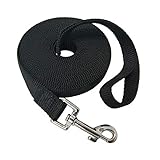
- Dog Leash Dimensions: training leash measures 3/4 inch width by 20 feet length, offering you dog for more wandering area and freedom.
- Nylon Long leash: long lead is made of strong wear-resistant nylon, available in Black, Blue, Red,Green color.
- Dog training leashes: suitable for teaching your dog/puppy recall and other obedience skills, great for small, medium, large dogs.
- Easy on and Easy off: Swivel-style bolt snap resists twisting. 360 degree tangle free swivel heavy duty clasp gives your dog best freedom.
- The dog training leash is built to last. If you have any question, please contact us, we will solve the problem until you are satisfied.
The PTCA recommends ophthalmologist monitoring for carriers every 6–12 months from age 2 and for genetically affected dogs every 6 months from age 18 months. These are club recommendations; your veterinarian should set the schedule for an individual dog.
Patellar luxation and other checks
Patellar luxation occurs when the kneecap slips out of its normal groove. It may cause intermittent skipping, lameness, pain, or later arthritis. Ask breeders how their dogs are evaluated and have your own dog examined if you notice a recurring skip, sudden hind-leg lameness, or reluctance to jump.
Heart evaluation and routine eye examinations are also worth discussing with a veterinarian. There is no universally accepted, authoritative Patterdale lifespan figure in the sources reviewed, so be wary of websites presenting a precise number as an established breed statistic.
Recommended Free Tools
Finding or buying a Patterdale Terrier
Before choosing a puppy or adult, assess the dog’s actual temperament and your ability to manage prey drive. A registry certificate does not prove health, working ability, or family compatibility. Even the UKC notes that breeders listed through its site are not endorsed by UKC.
Ask a breeder for:
- Verifiable PLL DNA results for the parents or puppy.
- Veterinary evaluations relevant to patellar, eye, and cardiac health.
- Details of how puppies were socialized to people, handling, household sounds, surfaces, and controlled novelty.
- An honest description of prey drive, dog-dog behavior, noise, escape behavior, and settling ability in the parents.
- A contract explaining health support, return provisions, and what happens if the placement fails.
Meet at least the mother where possible and look for clean, well-managed facilities, healthy dogs, and a breeder willing to discuss weaknesses as well as strengths. Be cautious of sellers promising that every Patterdale is guaranteed to be safe with cats, livestock, children, or off-leash wildlife.
When adopting, ask the rescue or foster home specific questions: Has the dog lived with cats? What happens when it sees squirrels? Can it settle indoors? Has it escaped? How does it respond to handling, visitors, food, and other dogs? A foster-based assessment can be more useful than a generic label such as “good with everyone.”
Is a Patterdale Terrier right for you?
A Patterdale may be a good match if you enjoy training, can provide secure exercise, are comfortable managing a determined terrier, and do not need the dog to be universally compatible with small animals. It can be an engaging companion for an active owner who appreciates a dog with a real job-oriented temperament.
Look elsewhere if you want a reliably off-leash dog, a quiet dog that is content with short walks, or a pet that can freely share a home with rabbits, hamsters, cats, poultry, and other small animals. The breed’s compact size makes it easier to handle physically, but it does not reduce the seriousness of its prey drive.
Best Value

- Dimensions - This dog leash measures 3/4in wide by 30 feet long. Great for hiking, camping, training, hunting, backyard, beach, recall training, outdoor play with tennis balls, and swimming!
- Long Leash: This training leash is great for teaching your dog recalls. It has the length needed to allow them to wander and ensure your command to come! is obeyed.
- Nylon Training Lead - This durable, long, nylon dog training leash will outlast cotton leashes. All stitching is reinforced and the nickel plated clip swivels to resist twisting. Our long dog leash is great for medium and large dogs. You'll love using it as a backyard dog leash, for off leash dog training, and more.
- Allows you to teach your dog recalls and other obedience skills.
- Swivel-style bolt snap resists twisting
FAQ
Are Patterdale Terriers good family dogs?
They can be affectionate family companions in a well-managed household, but they are not automatically suitable for every family. Adults must supervise children, provide substantial activity and training, and assess the individual dog carefully around other pets.
Are Patterdale Terriers always black?
No. The UKC standard recognizes black, red, liver or chocolate, grizzle, black and tan, and bronze. Some white markings on the chest and feet are permitted under that standard.
How much does a Patterdale Terrier weigh?
The current UKC standard specifies 10–15 inches in height but does not give a fixed adult weight range. Weight should be proportionate to the dog’s height and kept at a fit body condition.
The Tool Desk
Outbyte PC Repair FREEClear out junk files and repair common Windows errorsFree Scan →Outbyte Driver Updater FREEScan for outdated or missing drivers - takes under a minuteDriver Scan →Can Patterdale Terriers live with cats?
Some individuals may do so with careful introductions and lifelong management, but the breed’s strong prey drive makes a guaranteed answer unsafe. Never assume a Patterdale is safe with cats or other small animals without assessing that specific dog.
Do Patterdale Terriers need a lot of exercise?
Yes. They are highly active working terriers. Their routine should include physical activity, training, sniffing, searching, and problem-solving. The breed standard does not set one universal daily exercise quota.
Are Patterdale Terriers recognized by the AKC?
The Patterdale Terrier is not on the AKC’s current list of 205 fully recognized breeds and is not listed in the current Foundation Stock Service or Miscellaneous breed materials cited here. Other participation routes may be available for some AKC activities.
What health tests should Patterdale breeders provide?
Ask for verifiable PLL DNA results and veterinary evaluations relevant to patellar luxation, eye health, and heart health. A DNA test is useful but does not replace veterinary eye examinations or general health screening.
Windows Errors? Fix Them Before They Spread
Repair common Windows errors and clear accumulated junk for a smoother, more stable PC - no reinstall needed.Free scan · no reinstallCrashes, No Sound, or Screen Glitches?
Random freezes, missing sound and display glitches usually trace back to one bad driver. Find and replace yours safely.Free scan · under a minuteThe Bottom Line
The Patterdale Terrier is a compact working dog with a large-terrier temperament. Its strengths—courage, stamina, persistence, and enthusiasm for work—are exactly what can make it challenging in an ordinary pet home. Choose one for its character, not just its size or low grooming needs, and plan from the beginning for secure exercise, reward-based training, prey-drive management, and appropriate health screening.
Quick Recap
Product prices and availability are accurate as of the date/time indicated and are subject to change. Any price and availability information displayed on Amazon at the time of purchase will apply.




