
Quick wins for a faster PC:
Scan for outdated or missing drivers - takes under a minuteDriver Scan →Clear out junk files and repair common Windows errorsFree Scan →Fix the driver behind crashes, sound loss and screen glitchesFind Drivers →Some links on this page are affiliate links: if you buy through them we may earn a commission, at no extra cost to you.
Socialize a farm puppy by pairing livestock with calm, rewarding experiences while keeping every animal physically safe. Begin during the key 3–14-week developmental period with protected observation, then progress through controlled movement and brief, supervised proximity. Prevent chasing, stalking, barking, grabbing, and cornering at every stage; there is no universal distance, session length, or age at which a puppy is automatically safe to run loose with stock.
What livestock socialization is—and what it is not
Socialization is positive, controlled learning about animals, people, places, surfaces, sounds, handling and restraint. The goal is not to make a puppy greet every animal. It is to teach the puppy that livestock can be present without triggering frantic pursuit, fear or rough contact.
As an Amazon Associate I earn from qualifying purchases.
Do these 3 things before closing this tab:
1Clear out junk files and repair common Windows errors2Scan for outdated or missing drivers - takes under a minute3Repair Windows errors before they cause bigger problemsForced contact can create fear. A puppy that is held near a struggling goat, crowded by curious calves or chased by a protective hen may learn that livestock are threatening. The University of California, Davis School of Veterinary Medicine identifies approximately 3–14 weeks as the critical social-development period and reports that puppies should encounter about 90 different situations associated with pleasurable experiences by 14 weeks (2019). That is a guide to variety and positive emotion, not a quota that justifies overwhelming exposure.
Every puppy, herd and property differs. Breed tendencies, previous experience, confidence, health, fencing, livestock temperament and the animals’ ability to retreat all affect the safe pace. A puppy is not ready for unsupervised access merely because it has watched stock quietly a few times.
Popular on Amazon

- REAL CHICKEN FIRST: Baby BLUE Training Treats are made with delicious real chicken as the first ingredient, plus DHA for cognitive development, making them the ideal reward for your puppy’s best behavior
- MEATY TRAINING TREATS: For puppies that love a meaty treat, Baby BLUE training dog treats are tender, bite-sized morsels that make them perfect for training
- WHOLESOME INGREDIENTS: These dog treats contain NO chicken (or poultry) by-product meals and are free of corn, wheat and soy; Plus, they’re free of artificial preservatives and colors
- HEALTHY DOG TREATS: Blue Buffalo natural dog treats feature the healthy, wholesome ingredients you’ll love feeding as much as they’ll love eating
- Contains One (1) 4-oz bag of Blue Buffalo Baby BLUE Training Treats Natural Puppy Soft Dog Treats, Savory Chicken
Farm-puppy preparation checklist
Health and veterinary planning
- Ask your veterinarian when the puppy can safely visit livestock areas under your region’s vaccination schedule.
- Discuss parasite prevention, including risks associated with manure, standing water, rodents and wildlife.
- Ask about health limitations that could make exertion, heat, dust or rough ground unsafe.
- Raise any local livestock-disease concerns before visiting barns, yards or shared grazing areas.
Map the property before bringing the puppy in
- Identify species, herd or flock size, individual temperaments and animals that are protective, nervous, injured or unpredictable.
- Check gates, latches, fencing, electric-wire locations, machinery, wells, ponds, feed stores and manure pits.
- Locate every livestock escape route and confirm that animals can move away from the puppy rather than becoming trapped in a corner.
- Choose a secure pen, gate or second barrier for the puppy. A second adult is useful for opening gates or managing stock while the primary handler works the puppy.
Assemble management equipment
- Use a properly fitted collar or harness and a standard lead.
- Keep a long line available only where it cannot snag on machinery, fencing or vegetation.
- Carry small, highly palatable treats that fit the puppy’s diet and can be delivered quickly.
- Provide water and a quiet recovery area.
- Use a portable exercise pen or solid barrier when a fixed fence or gate is not dependable. These tools manage risk; they do not guarantee that a puppy or livestock animal will remain safe.
Select suitable livestock for the first sessions
Start with calm, experienced animals that are unlikely to charge, stampede, peck, kick or chase. Keep separation when animals are protective of young, highly reactive, unable to retreat or medically vulnerable. A quiet, steady cow may be a better first visual subject than a flighty group of sheep, even if sheep are the puppy’s eventual working stock.
The four-stage socialization plan
Advance only when the puppy repeatedly stays responsive and relaxed. Change one difficulty at a time, and return to an easier stage whenever either species becomes distressed.
Recommended Free Tools
Stage 1: Observe livestock from secure separation
- Place the puppy behind a secure fence, closed gate, pen or other reliable barrier. Begin far enough away that the puppy can notice the animals, eat a treat and respond to its name.
- Wait for quiet looking, a loose body, normal breathing, a glance back to you or a decision to rest. Mark or praise that behavior and deliver a treat.
- Allow the puppy to look away. Do not force eye contact with livestock or hold the puppy facing them.
- End while the puppy is still able to learn, before fatigue or excitement builds.
At this stage, the puppy is learning that livestock predict good outcomes and that disengaging is allowed. If the puppy cannot take food or answer its name, the setup is already too difficult; increase distance or improve the barrier.
Stage 2: Walk parallel to the livestock area
- Keep the puppy on a lead and walk parallel to the outside of the livestock area rather than heading directly toward the animals.
- Maintain enough distance to prevent staring, pulling, barking, lunging or attempts to chase.
- Reward check-ins, loose-lead steps, a soft body and voluntary looks away from stock.
- If arousal rises, turn away smoothly and create more distance. Do not drag the puppy toward the animals or wait for an outburst.
Parallel movement gives the puppy a job and reduces the pressure of a head-on approach. Keep sessions short enough that the puppy can recover quickly afterward.
Also popular on Amazon
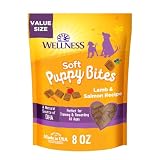
- GRAIN-FREE PUPPY TREATS: These bite-sized, soft puppy training treats are the perfect reward during training sessions or any time you want to thank your dog for good behavior. Puppy bites contain 6 calories per individual treat!
- SUPPORTS BRAIN DEVELOPMENT: Soft dog treats are crafted with salmon, a healthy source of DHA to promote healthy brain development.
- HEALTHY INGREDIENTS: These treats for dogs are made with minimal ingredients focused on quality proteins: made with lamb and salmon, with added vitamins specifically for puppies.
- NO CORN, WHEAT, OR SOY: Treats for dogs do not contain wheat, wheat gluten, corn, soy, or artificial colors.
- MADE IN USA: Our dog treats are quality-assured, made in USA, and crafted from the finest globally-sourced ingredients. Treats are tender, healthy, and bite-sized for small, medium, and large dogs of all lifestages, and activity levels.
Stage 3: Make one small change at a time
- After repeated calm responses, reduce distance in a small increment, then pause at the new position.
- Change only one variable per progression: species, animal movement, location, group size or proximity.
- Return to the previous distance if the puppy becomes fixed, vocal, tense or unable to respond.
- Keep a barrier in place when livestock movement is unpredictable or the animals cannot retreat.
For example, do not move closer to a moving herd while also switching from sheep to cattle and entering a new yard. Isolating variables lets you identify the trigger and prevents a single difficult experience from overwhelming the puppy.
Stage 4: Brief, supervised proximity
- Use calm, contained livestock and an open escape route. Keep the puppy on a lead and maintain control of gates.
- Allow a short approach only while the puppy remains responsive. Reward calm investigation and voluntary attention to the handler.
- Prevent chasing, cornering, fence running, tail or leg grabbing, feather pulling, jumping and rough play.
- Finish with an easy cue, move away and provide quiet recovery time.
Proximity is not a test of courage. If a livestock animal threatens, crowds or startles the puppy, increase separation immediately. The same rule protects stock: a puppy must never be allowed to rehearse predatory pursuit or make an animal defend itself.
Skills to teach away from livestock first
Practice these behaviors in low-distraction locations before expecting them near animals. Reliable responses give you alternatives to grabbing the puppy or chasing it across a yard.
- Name response: The puppy turns toward you promptly when its name is spoken.
- Come: The puppy moves to you for a reward, including away from an interesting smell or moving object.
- Leave it: The puppy disengages from a tempting item and accepts reinforcement from you.
- Stay or pause: The puppy can remain briefly in place while you manage a gate or reposition yourself.
- Loose-lead walking: The puppy can move without constant pulling.
- Collar and harness acceptance: The puppy calmly permits fitting, clipping and removal.
- Handling: Brief, rewarded touches of feet, ears and mouth prepare the puppy for veterinary care and injury checks.
- Turn-away cue: The puppy follows you away from a distraction without a confrontation.
Texas A&M AgriLife recommends rewards around livestock, leash training and distance observation when developing calm behavior and assessing prey drive. Deliver reinforcement promptly, while the puppy is still able to think, rather than after it has lunged.
Also popular on Amazon

- Lots of flavor, not fillers: Just three simple, all-natural ingredients mean low calories and high nutritional value, making a tasty but healthy treat that your pup will actually love
- Ready for training, wherever you are: The best training is consistent training. Our small treats are lightweight and perfectly sized for quick rewards so they are ready to go whenever there is a training opportunity
- Mess free treats: No oily, greasy, crumbly messes here, Pupford treats keep your hands and pouches clean. You can even keep some in your pocket for walks, classes, or mini adventures without worrying about them getting grimy or stale
- Motivate even the pickiest of pups: A wide range of flavors makes it easy to find the perfect fit for your pup’s tastes
- Pupford Promise: We strive to always provide simple, high-quality, healthy pup essentials. If you or your pup aren't happy with a purchase, let us know so we can help find the right fit!
Species-specific risk checks
| Livestock | What to monitor | Management priority |
|---|---|---|
| Chickens and other poultry | Rapid flight, wing flapping and small body size can trigger chasing or grabbing. | Use secure fencing or a pen; prevent feather pulling and fence running; keep birds’ retreat space open. |
| Sheep and goats | Flocking, sudden running, head movements and defensive reactions can raise arousal. | Start with calm individuals or a small steady group; prevent circling, nipping and cornering. |
| Cattle | Large bodies, rapid charges, protective mothers and narrow yards create serious injury risk. | Use substantial separation and an escape plan; never rely on the puppy’s size or a casual recall. |
| Horses | Kicks, striking, bolting and prey-animal flight responses can injure a puppy. | Use experienced horses, solid barriers and generous space; do not allow the puppy behind or under a horse. |
These are risk patterns, not guarantees. An individual chicken may be bold, a goat may be aggressive and a horse may be unusually tolerant. Judge the actual animals in front of you.
Reading the puppy and livestock
Signs the puppy can continue
- Loose muscles and ordinary breathing.
- Ability to eat, respond to its name and perform a familiar cue.
- Brief interest followed by looking away, sniffing, resting or checking in.
- Recovery within a short period after a movement or sound.
Stop or increase distance immediately when the puppy
- Freezes, hides, trembles, tucks its tail or repeatedly tries to escape.
- Repeatedly barks, growls, lunges or fixates.
- Ignores food and cannot respond to its name or an easy cue.
- Attempts to stalk, chase, bite, grab, jump on or run the fence with livestock.
Stop when livestock show distress or lose options
- Animals bunch tightly, charge, kick, stampede or vocalize distress.
- A mother becomes protective or an animal cannot move away.
- A gate, fence or route that was part of the safety plan fails.
Move the puppy behind a barrier and let the animals settle. Do not punish fear signals or wait for the puppy to “get over it.” Punishment can suppress warnings without changing the underlying emotion, while allowing pursuit teaches the puppy that chasing is rewarding.
How to decide whether to progress
Keep a simple log after each exposure: species and number of animals, location, starting distance, what moved, the puppy’s body language, food response, cues completed and the point at which you stopped. Progress when calm responses occur repeatedly under the same conditions, not after one unusually easy session.
Change one factor at a time. A puppy that is calm beside stationary sheep may need a new plan for running sheep, a larger flock, a narrow lane or a different property. Confidence can also vary with illness, pain, heat, fatigue or a developmental change, so return to an easier setup when performance deteriorates.
Also popular on Amazon

- High Value, Irresistible Flavor: Pups love the taste and aroma, making training sessions more effective and enjoyable
- High-Quality Ingredients: Made in the USA with clean, simple ingredients, starting with chicken - nothing artificial and no fillers
- Low-Calorie: Less than 2 kcal per treat and high in protein, perfect for frequent rewarding without worry
- Perfectly Sized: Small enough for one-bite rewards, which helps prevent overfeeding while keeping training sessions flowing smoothly
- Soft & Chewy: Perfect texture for quick rewarding during training, and great for pups with sensitive teeth like senior dogs
When a puppy can be off lead
There is no evidence-based universal release age, distance or session duration that makes every farm puppy safe. Off-lead access should be considered only after the individual puppy has demonstrated reliable disengagement, recall and calm behavior around the specific livestock, in the specific enclosures and under the specific handler’s supervision.
Even then, retain management for new animals, feeding time, births, injury, bad weather, unfamiliar visitors and any situation that changes livestock behavior. Texas A&M AgriLife warns that a puppy should not be left alone with livestock until you are sure none of the animals will behave badly toward the dog. A safe history is not a permanent guarantee.
Livestock guardian dog considerations
For a livestock guardian dog, bonding with stock is a working behavior developed through calm, supervised time rather than unrestricted play. The puppy should learn to settle near the animals, respect their space and accept routine human care. Friendly handling, collar acceptance and veterinary cooperation support safe management; they do not replace the developing relationship with livestock.
Texas A&M AgriLife Extension states that a guardian-dog puppy that stalks, chases or bites livestock should be corrected immediately. In practical terms, interrupt the behavior at once, create separation and reset at an easier level. Persistent predatory behavior is not something to solve by leaving the puppy with stock longer.
Common mistakes and safer alternatives
| Mistake | Why it fails | Safer alternative |
|---|---|---|
| Putting the puppy directly into a pen of animals | The puppy and livestock lose space to retreat, and arousal can escalate before the handler can respond. | Begin behind a secure barrier and approach gradually. |
| Allowing one “harmless” chase | Chasing can become self-reinforcing and can injure or panic stock. | Interrupt at the first orientation or acceleration and increase distance. |
| Using a long line around hazards | The line can snag on fencing, machinery or vegetation. | Use a shorter lead in cluttered areas and inspect the route first. |
| Reducing distance and adding a new species together | You cannot tell which change caused the reaction. | Change one variable at a time and return to an easier setup if needed. |
| Continuing after the puppy stops eating | Loss of food response often means the situation is too intense for learning. | Move farther away or end the session. |
| Assuming a tolerant animal represents the whole herd | Individual livestock differ in fear, aggression and protective behavior. | Assess each group and retain a barrier for unpredictable animals. |
When professional help is needed
Arrange a veterinary examination and seek a qualified veterinary behavior professional for persistent fear, predatory chasing, biting, aggression, repeated lunging or inability to recover after exposure. A reward-based trainer experienced with both dogs and livestock can help interpret body language and redesign the setup. Until the behavior is assessed, maintain physical separation and do not use the puppy as a live experiment with valuable or vulnerable animals.
A veterinarian can also reassess pain, illness, vaccination timing and parasite protection when a puppy’s behavior changes suddenly. Safety takes precedence over completing a socialization schedule.





Leave a Reply