What’s actually slowing this PC down?
Pick the symptom - the matching free tool is one click away.
Neither puzzle feeders nor treat balls are universally better for cats. Choose a rolling treat ball if your cat enjoys batting and chasing dry food; choose a stationary puzzle feeder if your cat prefers sniffing, reaching, or working through compartments. The best option is one your cat uses comfortably and safely, that suits its food, and that lets you keep track of its full daily ration.
What’s the difference?
Stationary puzzle feeders
A stationary puzzle feeder holds food in wells, compartments, or other features that a cat must investigate or manipulate to eat. Designs differ in difficulty and in the kinds of food they accept.
Rolling treat balls
A treat ball is a mobile feeder: a cat bats or pushes it to release food through an opening. These feeders are generally designed for dry kibble or treats, and some have adjustable openings. AAFP/ISFM guidelines include both puzzle feeders and feeding balls as ways to encourage active food acquisition; NC State Veterinary Hospital also lists food-dispensing toys as interactive feeding options.
How to choose between them
Start with how your cat likes to work
A ball calls for batting and moving an object. A stationary design calls for reaching, searching, or manipulating parts. Let your cat’s observed interest guide the choice: ignoring one style doesn’t mean a cat is lazy or unintelligent. Try an easier setup or a different format.
Recommended Free Tools
#1 Best Overall

- Interactive Level 2 Cat Puzzle Toy: 13" x 9.5" cat puzzle feeder that triggers hunting and foraging instincts. Level 2 adjustable difficulty for beginner to advanced cats.
- Indoor Cat Enrichment: Keeps indoor cats engaged, minimizes boredom, and delivers rewarding treat-finding play that supports daily stimulation.
- Level 2 Slow Feeder Puzzle: Holds 1/4 cup food or treats across 16 compartments. Promotes slower eating and positive feeding habits with adjustable challenge.
- Multiple Ways to Play (Level 2 Adjustable): Easy mode: treats in base compartments only. Hard mode: add treats into sliding cups via top holes so cats must push and move pieces to release rewards.
- Safe, Durable & Easy Clean: No removable parts. Made without BPA, PVC, lead, or phthalates. Wipes clean quickly for everyday use.
Match the feeder to the food
Rolling balls are generally for dry kibble or treats. Other puzzle designs vary, and some can accommodate canned food. Check the specific feeder’s instructions for food compatibility and cleaning, especially if you plan to use moist food.
Make food easy to get at first
Choose a beginner-friendly design and start with access at least as easy as your cat’s familiar bowl. Fill the puzzle or use an open setting so the food is easy to obtain. Increase the amount placed in it only after your cat succeeds consistently.
Rank #2

- Interactive Level 3 Cat Puzzle Toy: Cat puzzle feeder that triggers hunting and foraging instincts. Adjustable difficulty lets beginner cats start with an easier setup while advanced cats take on the full Level 3 challenge.
- Indoor Cat Enrichment: Keeps indoor cats engaged, minimizes boredom, and delivers rewarding treat-finding play that supports daily stimulation.
- Level 3 Slow Feeder Puzzle: Holds 1/4 cup food or treats across 14 base treat compartments plus 5 treat-filled pegs. Promotes slower eating and positive feeding habits with adjustable challenge.
- Adjustable Difficulty: Easier mode: place treats in base compartments and under spinning wheel, leave raindrops uncovered. Harder mode: also place treats inside pegs through top holes, cats must swivel the raindrops and slide the pegs to release rewards.
- Safe, Durable & Easy Clean: No removable parts. Made from a durable wood-and-plastic composite material; no BPA, PVC, or phthalates. Hand wash with warm soapy water and dry before refilling.
Consider movement, noise, and safety
Think about whether your cat can comfortably move the toy and whether it has parts the cat could chew or swallow. AAFP/ISFM cautions against hard plastic puzzle balls for cats in cages because they can strike the bars noisily, and advises avoiding toys with small parts that could be ingested.
Check cleaning and food monitoring
Pick a feeder you can clean as its instructions require, and make sure you can tell how much food remains. For example, the PetSafe Fishbowl feeder manual permits hand washing or top-rack dishwasher cleaning, and says to supervise use and remove the toy if it is damaged.
Free tools Windows power users keep installed
One-click scans. No signup required.
Rank #3

- PUZZLE MASTER: Turn snack time into playtime with this cat food puzzle that challenges your furry friend's brain and keeps them entertained as they hunt for treats
- LEVEL UP: This cat puzzle features five different compartments and difficulty levels that keep clever companions challenged and coming back for more
- SLOW & STEADY: This puzzle feeder turns mealtime into a fun challenge, encouraging slower eating habits and helping manage your cat's weight naturally
- STAYS PUT: Non-slip rubber pads keep this food puzzle securely in place while your cat explores and searches for treats without chasing it across the floor
- EASY CARE: After your cat's adventure with this treat dispenser, cleanup is quick and easy with handwashing or top rack dishwasher placement
What benefits can you expect?
Interactive feeders offer opportunities to forage, hunt, move, or solve a simple food-access problem. NC State Veterinary Hospital lists mental stimulation, slower consumption, and physical activity as potential benefits, while AAFP/ISFM recommends active food acquisition as part of feeding and play.
These recommendations support using feeders as enrichment; they do not establish that a specific design will treat anxiety, prevent destructive behavior, or cause weight loss in an individual cat. The peer-reviewed veterinary review “Food puzzles for cats: Feeding for physical and emotional wellbeing” notes that empirical studies of food-puzzle benefits in companion cats have been limited. Its practical guidance also draws on clinical cases and professional experience, so claims about outcomes should remain measured.
Rank #4
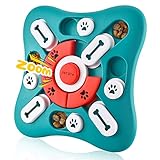
- 【PRODUCT SIZE】10 inch*10 inch*1.3 inch.
- 【3 WAYS TO PLAY, UPGRADE SLOW FEEDER】Our dog mental stimulation toys have a unique squeak button in the middle, which make it easier to attract the attention of dogs and cats. Three different difficulty designs and the 16-hole dog treat dispenser design maximize slow feeding time, even beyond 20 minutes.
- 【FUNNY STIMULATING TOYS】All kinds of dogs and cats love the puzzle game of Spin & Slide and the Seek & Hide with their smell sense and paw skills to find food. Combining circular orbit sliding game and linear orbit sliding game, smart dog and cat must move the slider correctly to get the food reward hidden in the maze.
- 【NON-REMOVABLE PARTS DOG PUZZLE】Our dog treat puzzle is made of non-toxic materials, very durable and suitable for pets to play for a long time. This dog toy has no removable parts because the design has built-in play parts that fold tightly and won't fall off easily.
- 【ANTI-SLIP & EASY TO CLEAN】: The four corners of the bottom are equipped with four anti-skid pads, which can be well fixed during the dog's slow food process; It is easy to clean, also dishwasher safe.
Introduce a feeder gradually
- Begin with familiar food and an easy setup. Use a simple design and make food easy to reach. If your cat seems uncertain, place it near the usual feeding spot.
- Show how it works. Demonstrate the mechanism, or let your cat find food next to and around the feeder. PetSafe’s manual suggests introducing its feeder gradually and putting only a few pieces inside at first.
- Watch your cat’s response. If your cat doesn’t engage or seems stressed, reduce the difficulty or return to the familiar bowl while trying another approach. Keep the experience positive.
- Keep the daily ration in view. When appropriate, use part of your cat’s usual measured food portion rather than adding extra treats. Make sure your cat eats its full daily portion.
- Increase the challenge only after success. Once your cat uses the feeder consistently, you can increase the amount offered in it or try a more challenging setup.
Safety and household considerations
Kittens and toys with small parts
AAFP/ISFM advises choosing puzzle feeders sized for kittens and putting away toys with parts that could be swallowed after play. Inspect feeders for damage and follow the product’s supervision guidance.
Medical conditions and prescription diets
If your cat has a medical condition, food allergy, or prescription diet, ask your veterinary care team before adding treats or changing food. Some treats may be unsuitable for particular conditions, and extra food can interfere with some veterinary diets.
Homes with more than one cat
Provide separate feeding resources and place them apart when needed to reduce competition and social tension. AAFP/ISFM recommends separate resources and toys in separate locations where necessary.
Quick Recap
Product prices and availability are accurate as of the date/time indicated and are subject to change. Any price and availability information displayed on Amazon at the time of purchase will apply.




