A 55-gallon saltwater tank can support a varied community, but there is no universally safe fish count or ready-made list of species that will all get along. Choose fish by adult size, swimming needs, temperament, diet, and reef compatibility—and treat any list of candidates as a starting point to check, not a shopping list.
Why 55 gallons does not determine your stocking plan
A typical 55-gallon aquarium measures about 48 inches long, 13 inches wide, and 21 inches high, according to Saltwater Aquarium Blog (August 31, 2026). Its length offers swimming room, but its relatively narrow front-to-back footprint limits space for fish that need broad territories or lots of open water. Two tanks with the same volume can therefore suit different communities.
Before selecting fish, consider the whole setup: each fish’s adult size and activity, whether it uses the open water or the bottom, how much territory it defends, what it eats, and whether it may harm corals or invertebrates. Also account for the fish already in the tank, the filtration system, and your ability to manage waste through maintenance.
Candidate fish groups—and the trade-offs to check
The following groups appear in the exact-title guide as possibilities for a 55-gallon saltwater tank. They are not a compatibility chart: the guide includes fish with very different space, behavior, and care needs, and it does not establish that every species in a group suits every 55-gallon aquarium.
What’s actually slowing this PC down?
Pick the symptom - the matching free tool is one click away.
#1 Best Overall

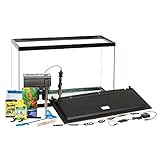
- COMPLETE GLASS AQUARIUM KIT*: The kit includes a 55-gallon glass tank with two hinged hoods for easy access, white LED lights, a Tetra Whisper PF60 Power Filter with two Tetra Large Bio-Bag Filter Cartridges, a 200-watt Tetra heater, a thermometer, a fish net, a Tetra AquaSafe water conditioner sample, a TetraCare brochure and an aquarium set-up brochure.
- ENERGY-EFFICIENT LEDS: The hinged hoods house energy-efficient white LEDs that create a natural underwater shimmer effect.
- FILTER SYSTEM INCLUDED: The quiet, powerful 3-in-1 Tetra Whisper PF60 Power Filter performs mechanical, chemical and biological filtration for cleaner water and healthier fish.
- WITH HEATER & THERMOMETER: The included 200-watt heater and thermometer are essential for tropical fishkeeping and help maintain water temperature.
- SIZE: The 55-gallon tank measures approximately 48.5 inches wide by 12.8 inches deep by 20.8 inches high.
| Candidate group | Examples named in the guide | What to check before choosing |
|---|---|---|
| Clownfish | Common clownfish types, including ocellaris and percula; larger types such as maroon, tomato, and Clarkii | Adult size and species-specific space needs. Pairing and group behavior also matter; see the clownfish section below. |
| Cardinalfish | Banggai and pajama cardinalfish | Adult requirements and social needs for the species you select. Do not infer from the group name that they can all be kept together. |
| Gobies, dartfish, and jawfish | Cleaner and fancy gobies, firefish, other dartfish, engineer gobies, and jawfish | Bottom space, substrate, cover, jumping risk, and overlap with other fish that use the same area. The guide specifically flags substrate or jumping cautions for engineer gobies and jawfish. |
| Blennies | Tailspot and Midas blennies, among others | Adult needs, diet, temperament, and whether their preferred space overlaps with existing fish. |
| Basslets and dottybacks | Royal gramma and other basslets; dottybacks | Territorial behavior. The guide flags possible conflict between dottybacks and basslets, so do not treat them as an automatic combination. |
| Wrasses | Carpenter’s, melanurus, yellow coris, McCosker’s, and six-line wrasses | Verify the chosen species’ adult requirements, activity, diet, and compatibility with the specific community. A shared label does not mean all wrasses have the same needs. |
| Dwarf angelfish | Cherub or pygmy and flameback angelfish | Verify adult space and reef compatibility for the particular fish and aquarium; the guide’s candidate listing is not a guarantee of coral safety. |
| Other specialized or predatory choices | Marine betta, dwarf lionfish, aiptasia-eating filefish, hawkfish, saddle or Valentini puffer, and chromis | These are not interchangeable community choices. The guide describes dwarf lionfish as predatory and cautions against keeping one with small tankmates; it notes hawkfish may eat small shrimp and filefish may nip corals. It also flags potential conflict between clownfish and chromis. |
The guide names 55 gallons as a minimum for dwarf lionfish, but that is a single hobby-source recommendation, not broad expert consensus. A minimum-volume claim alone does not establish that a lionfish suits a community tank with small fish.
How many fish can go in a 55-gallon saltwater tank?
There is no established safe maximum based only on the 55-gallon volume. Saltwater Aquarium Blog gives approximate estimates of about 6–9 small-to-medium fish for a mixed reef and up to 15–18 fish for a fish-only tank with robust filtration. These are that article’s estimates, not a general stocking rule or a target to fill. It also warns that heavier stocking makes nutrient management harder and can complicate coral keeping.
Rank #2

- GLASS AQUARIUM: Rectangular glass aquarium makes an ideal home for your fish.
- ADD ON ACCESSORIES: Mix and match with your favorite Tetra filtration, lighting and water care products (sold separately).
- EASY CUSTOMIZATION: Use assorted Tetra accessories (sold separately) to make your aquarium your own.
- 55 GALLON TANK: Measures 48 inches wide by 13 inches deep by 20 inches high.
- TETRA BRAND: Dedicated to helping seasoned hobbyists and beginners alike enjoy a successful, lifelong aquatic experience.
Use those estimates cautiously: a smaller, peaceful fish and a territorial or predatory fish do not impose the same demands, and counting fish does not account for adult size or waste. Plan around the needs of the most demanding inhabitant and leave room for the biological filter and maintenance routine to keep pace.
Clownfish: check the species and the pairing advice
Clownfish are not all the same size. OATA says common ocellaris and percula clownfish are unlikely to exceed 10 cm, while maroon, tomato, and Clarkii types grow larger than 10 cm. OATA recommends at least 60 litres for a pair of the smaller common or percula fish and 120 litres for larger species, with more volume when they are kept with other species. Its guidance prefers a pair over a group because groups can lead to bullying, and recommends letting two juveniles form a pair naturally. Clownfish do not require an anemone in an aquarium.
Recommended Free Tools
Rank #3
- GLASS AQUARIUM KIT: Glass aquarium with low-profile hinged hood houses energy efficient white LEDs to create a natural underwater shimmer effect
- EASY TO SET UP: Complete kit includes everything you need to get started
- FILTER INCLUDED: Comes with the Tetra Whisper PF 30 Power Filter with Tetra Large Bio-Bag Filter Cartridge
- WITH HEATER: Includes a 200-watt heater and thermometer, along with a fish net, Tetra AquaSafe water conditioner sample, TetraMin food sample and setup guide
- 29 GALLON TANK: Measures 30 inches wide by 12 inches deep by 18 inches high
PetMD’s veterinarian-authored clownfish care sheet recommends at least 29 gallons for one adult clownfish, with larger or multiple fish requiring more. These recommendations are framed differently from OATA’s pair guidance; do not combine them into a single universal minimum. Check the needs of the exact species and the other animals in the tank.
Cycle the aquarium before adding fish
The biological filter needs time to process fish waste. Chewy describes cycling as the conversion of ammonia to nitrite and then nitrate; zero ammonia and nitrite indicate that the cycle is complete. Its approximate six-week cycle time is not a promised schedule. OATA also calls for zero ammonia and nitrite before adding clownfish and warns that stocking too quickly can overwhelm nitrifying bacteria, contributing to new tank syndrome, illness, or death.
Rank #4
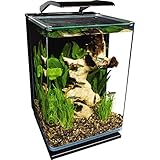
- SLEEK DESIGN: Rounded corners and clear glass canopy allow viewing from multiple angles.
- DAYLIGHT/MOONLIGHT LIGHTING: Bright white LEDs create a shimmering sunlight effect; blue LEDs produce a moonlit glow.
- HIDDEN FILTRATION: Advanced, 3-stage filtration is out of sight, enhancing aquarium viewing.
- EASY ACCESS: Hinged LED lighting and sliding glass canopy.
- SIZE: 5-gallon aquarium fits Marineland Rite-Size Z Filter Cartridges.
- Complete the cycle first. Do not use a calendar estimate alone as proof that the aquarium is ready; check that ammonia and nitrite are zero.
- Add fish gradually. The biological filter must grow with the added waste. Avoid adding the entire planned community at once.
- Test routinely. OATA recommends weekly water testing. Its clownfish guidance says nitrate should not exceed 50 mg/L; this is clownfish care guidance, not a universal target for every species or reef setup.
- Measure salinity with appropriate equipment. PetMD names a hydrometer or refractometer for measuring specific gravity. Confirm the target for the species and other inhabitants you keep.
Water parameters and setup are species-specific
For clownfish, PetMD lists 74–80°F and specific gravity 1.020–1.025. OATA gives clownfish guidance of 24–26°C, salinity 1.020–1.025, and pH 7.9–8.3. These are recommendations from those clownfish care sources, not substitutes for checking the requirements of other fish, corals, or invertebrates in the aquarium.
A setup also needs equipment and habitat suited to the selected animals. Chewy’s setup guide lists purified water or RO/DI filtration, substrate, live or dry rock, a filter, heater and thermometer, and circulation equipment. It recommends choosing the fish before designing the equipment and keeping a beginner setup simple. A saltwater test kit supports routine parameter checks; a refractometer or hydrometer supports salinity measurement.
Quick wins for a faster PC:
Clear out junk files and repair common Windows errorsFree Scan →Scan for outdated or missing drivers - takes under a minuteDriver Scan →Repair Windows errors before they cause bigger problemsFix Now →Best Value
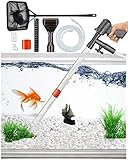
- Mufti-functional cleaning kit: Aquarium gravel vacuum cleaner kit is a mufti-functional aquarium cleaner that uses (adopts)the siphon design principle, which includes the aquarium, aquarium sand washing, algae scraping, fish excrement cleaning, aquarium residual debris, and aquarium water changing. Quick water change gives fish (provides)a clean and comfortable aquarium living environment.
- New safety design: new manual press design, no electricity required and silent while working. Fish tank cleaning tools uses a high-quality pressure resistant air bag, durable, super strong siphon pressure can quickly draw out the muddy water in the fish tank. The aquarium vacuum pipe has a filter net attached to the filter basket to block the blockage caused by the suction of gravel, while preventing your cute fish and the small gravel in the bathtub from being sucked out of the tank.
- Easy to install: This newly upgraded aquarium vacuum is easier to use than traditional fish tank vacuum. Simply hold the handle and press several times until you see water begin to flow out. You can also use a tube to agitate the gravel in the aquarium, causing fish manure, food debris, etc. to drain out of the aquarium with the current. The aquarium cleaning tools is securely attached to the aquarium so you can easily release your hands.
- A wide range of multi-combination accessories: aquarium cleaner vacuum crusher is suitable for different types and sizes of fish tanks, equipped with 2 water pipes and 1 joint, press pump, water flow clip, water pipe clip extended outlet hose, aquarium temperature stickers, fishing nets, plastic algae scraping plate, and detailed aquarium vacuum pump manual.
- Easy to use: The aquarium cleaning kit dust and water changer is hand-held, easy to use and operate, the aquarium cleaners can work stably and efficiently without electricity and without noise, which greatly saves your time and brings more convenience for fish tank cleaning.
A practical way to build a compatible list
- Decide whether the tank is a mixed reef or fish-only. Corals and invertebrates change which fish are suitable and how carefully nutrients must be managed.
- Write down the exact species, not just the group. “Wrasse,” “goby,” or “clownfish” is not specific enough to verify adult size, care, or compatibility.
- Check each fish’s adult needs. Confirm minimum tank dimensions, diet, activity, social requirements, cover or substrate needs, and reef or invertebrate compatibility before purchase. The available guide does not independently establish minimums for every species it names.
- Look for conflicts with the fish already chosen. Consider territorial overlap, similar niches, breeding behavior, and predation risk. The guide’s cautions about clownfish with chromis, dottybacks with basslets, small tankmates with dwarf lionfish, shrimp with hawkfish, and corals with filefish illustrate why a species-by-species check matters.
- Plan a conservative stocking order. Add fish slowly after cycling, test the water regularly, and reassess the plan as the biological filter adjusts.
For beginners, aquatics content creator Matthew Hayes, quoted by Chewy, recommends “tank-bred clownfish and small gobies like the neon goby or firefish … they’re hardy, adapt well to tank life, and don’t need special care compared to more sensitive species.” That is a general beginner-oriented suggestion, not a guarantee that those fish will fit every tank or be compatible with every other selection.
Quick Recap
Product prices and availability are accurate as of the date/time indicated and are subject to change. Any price and availability information displayed on Amazon at the time of purchase will apply.




