
Some links on this page are affiliate links: if you buy through them we may earn a commission, at no extra cost to you.
Sea turtles are wild marine reptiles, not household pets. They spend nearly their entire lives in saltwater, migrate across national borders, and depend on specialized diets, enormous swimming space, and protected nesting beaches. Keeping one as a companion animal is impractical, illegal in many places, and harmful to the turtle.
There are seven living sea-turtle species. They differ greatly in size, diet, range, and conservation status, but all share adaptations for life in the ocean—and serious threats from fishing gear, coastal development, pollution, boats, and climate change.
As an Amazon Associate I earn from qualifying purchases.
The Tool Desk
Outbyte Driver Updater FREEFix the driver behind crashes, sound loss and screen glitchesFind Drivers →Outbyte PC Repair FREEClear out junk files and repair common Windows errorsFree Scan →What is a sea turtle?
Sea turtles are marine reptiles in the order Testudines. Their streamlined shells and large front flippers help them travel through the ocean, while their smaller rear flippers help with steering. Unlike land tortoises and many freshwater turtles, sea turtles cannot pull their heads and flippers completely inside their shells.
They breathe air through lungs, so they must surface regularly. A resting turtle may remain underwater for about two hours, but an active animal needs to surface much more often. Sea turtles are adapted to saltwater and long-distance travel—not to life in a home aquarium or backyard pond.
Popular on Amazon

- This plush is approx. 7" x 7.5" x 1.5" in size
- Made from deluxe materials for a cloud-like softness!
- This light and fluffy sea turtle plush makes for a great cuddling partner
- Mini Flopsies are designed to lay resting on its belly for easy, fun play
- To ensure stability and quality, this plush contains bean pellets suitable for all ages
The seven sea-turtle species
| Species | Scientific name | Global IUCN status |
|---|---|---|
| Green turtle | Chelonia mydas | Least Concern |
| Loggerhead | Caretta caretta | Vulnerable |
| Leatherback | Dermochelys coriacea | Vulnerable |
| Hawksbill | Eretmochelys imbricata | Critically Endangered |
| Kemp’s ridley | Lepidochelys kempii | Critically Endangered |
| Olive ridley | Lepidochelys olivacea | Vulnerable |
| Flatback | Natator depressus | Data Deficient |
These are global species-level assessments. A species listed as Least Concern or Vulnerable globally can still have regional populations that are Endangered or Critically Endangered. The flatback is found primarily in Australian and nearby Papua New Guinean waters. The other six species occur in U.S. waters, where all six are protected under the Endangered Species Act.
How sea turtles differ from one another
Green turtles
Adult green turtles are primarily herbivorous in many populations, eating seagrasses and algae. Young green turtles may eat a wider range of foods. Their feeding helps maintain seagrass habitats, although their name refers to the greenish color of their body fat, not necessarily their shell.
Loggerheads
Loggerheads have large heads and powerful jaws suited to crushing hard-shelled prey such as whelks and conchs. They commonly spend their early years in open-ocean habitats before moving into coastal feeding areas.
Leatherbacks
The leatherback is the largest sea turtle and the only living species without a conventional hard shell. Its shell is made of small bones beneath tough, flexible skin and has seven noticeable ridges. Leatherbacks specialize largely in jellyfish, salps, and other soft-bodied prey. They can travel more than 10,000 miles in a year and have been recorded diving nearly 4,000 feet.
Hawksbills
Hawksbills have a narrow, pointed beak that helps them take sponges and other food from reef structures. Their feeding can influence the composition of coral-reef communities. They are Critically Endangered globally and are especially vulnerable to damage to reef habitat and illegal shell trade.
Ridley turtles
Kemp’s ridleys and olive ridleys eat varied marine prey, including invertebrates. Both can participate in an arribada, a synchronized mass nesting event. Solitary nesting also occurs, and not every nesting event is a mass arrival.
Where sea turtles live and migrate
Sea turtles occur in tropical and subtropical seas. Leatherbacks also travel into temperate and subpolar waters. An individual may migrate hundreds or thousands of miles between feeding grounds, breeding areas, and nesting beaches.
Also popular on Amazon

- Slightly Weighted Design: This adorable turtle stuffed animal features subtle weighted beads in its body and limbs, providing a realistic and comfortable touch.
- The Material: The turtle plush measures 6.5", crafted from premium plush fabric and filled with high quality PP cotton, not easy to deform.
- Wide Application: This turtle plushie can be a sweet gift, comfortable to hold while reading and watching TV. It can also be an charming ornament for your home, office, car and any other place you want to decorate.
- Gift-Ready Packaging: The perfect surprise gift for any occasion. Each stuffed turtle arrives in an elegant box, ready to delight on birthdays, Christmas, Valentine‘s Day, or Easter. It’s designed to make a stunning first impression.
- About Us: We create soft, high-quality plush toys that inspire imagination and foster connection, making every moment special. We hope every hug with our plush companions can bring joy and a touch of magic to you.
Females often return to the general region where they hatched and may use the same beach. However, the claim that every female returns to the exact beach every time is too simple: nesting-site fidelity varies among species and populations.
Young turtles can spend a poorly monitored “lost years” period in the open ocean. Loggerhead hatchlings and juveniles, for example, may remain offshore for roughly seven to 15 years before shifting toward coastal feeding areas.
What do sea turtles eat?
Diet depends on the species and life stage. A sea turtle should never be fed by people. Human food is inappropriate, and feeding can alter natural behavior or attract animals into dangerous areas.
Do these 3 things before closing this tab:
1Fix the driver behind crashes, sound loss and screen glitches2Repair Windows errors before they cause bigger problems3Scan for outdated or missing drivers - takes under a minute- Green turtles: mainly seagrasses and algae as adults in many populations.
- Loggerheads: hard-shelled animals such as conchs and whelks.
- Leatherbacks: jellyfish, salps, and other soft-bodied organisms.
- Hawksbills: largely sponges and other reef-associated prey.
- Kemp’s ridleys and olive ridleys: varied invertebrates and other marine animals.
Plastic bags and balloons can resemble jellyfish. Fishing line, rope, and abandoned nets can wrap around flippers or the neck. Ingested debris may block the digestive tract, cause internal injuries, or prevent the turtle from feeding normally.
Reproduction and nesting
Most sea turtles nest at night, although ridleys frequently nest during daylight. A female crawls above the high-tide line, digs an egg chamber with her rear flippers, deposits a clutch, covers it, and returns to the sea. A clutch often contains around 100 eggs, but the number varies by species.
Females usually lay several nests during one nesting season, commonly at intervals of about two weeks. They then return to feeding grounds and generally reproduce every few years rather than nesting annually. Eggs typically incubate for about two months, although temperature and species affect the timing. Hatchlings often emerge together, which can overwhelm some predators.
Temperature determines hatchling sex
Sea-turtle sex is primarily determined by the temperature of the developing eggs rather than by sex chromosomes alone. Cooler nests tend to produce more males, warmer nests tend to produce more females, and intermediate temperatures produce a mixture. Exact temperature thresholds vary by species, population, and nesting site.
Also popular on Amazon
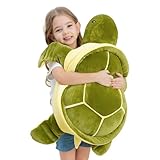
- 28-inch giant green sea turtle stuffed animal made of ultra-soft plush and high-density PP cotton, providing a cozy and huggable feeling.
- Adorable realistic design with vivid green shell and cute details, perfect for playing, snuggling and decorating.
- Multi-use as a body pillow, cushion, nap companion and room decoration for bedroom, living room and playroom.
- Safe and skin-friendly, no small parts or harmful chemicals, suitable for kids and people of all ages.
- Ideal gift for kids, boys, girls, girlfriend and sea animal lovers on birthday, Valentine’s Day and holidays.
Climate warming can create increasingly female-biased hatchling groups and, at extreme temperatures, kill developing embryos. A female-biased hatchling ratio does not by itself prove that an adult population cannot reproduce; adult survival, the number of males, migration, and breeding success also matter.
Why sea turtles are not suitable pets
A sea turtle is not an alternative to a red-eared slider, box turtle, or other legally kept turtle. It requires the open ocean, specialized veterinary and rehabilitation expertise, and conditions that a private owner cannot realistically provide. A home aquarium cannot replicate its migration, natural diet, depth, water quality, or access to suitable feeding habitat.
Wild sea turtles may also carry pathogens, suffer severely from improper handling, and become stressed when removed from the water. Buying, collecting, transporting, or keeping one may violate wildlife-protection laws. Rules vary by country and region, but protected status is widespread; do not take a turtle, hatchling, egg, or shell from a beach.
If you find a sea turtle for sale, contact the relevant wildlife authority rather than purchasing it. A legitimate rescue or rehabilitation center will not place a healthy sea turtle in a private home.
Major threats to sea turtles
| Threat | What happens |
|---|---|
| Fisheries bycatch | Turtles may drown in trawls, become hooked on longlines, or be trapped in gillnets and other gear. |
| Loss of nesting habitat | Construction, seawalls, erosion, rising seas, storms, and vehicles reduce safe nesting space. |
| Artificial light | Beach lighting can discourage females and lead hatchlings away from the ocean. |
| Marine debris | Plastic may be eaten, while fishing line and nets can cause entanglement. |
| Vessel strikes | Boats injure or kill turtles in shallow water, near inlets, and around marinas. |
| Direct harvest | In some regions, turtles or their eggs are collected for meat, eggs, shell, or other products. |
| Climate change | Warming beaches, sea-level rise, erosion, changing currents, and altered food supplies affect populations. |
Bycatch was identified as the highest-scored threat across marine-turtle regions in a 2025 global assessment. The risk is not identical everywhere: a nesting beach may be most affected by lighting and development, while an adult feeding population may face its greatest danger from fishing gear.
How to behave on a nesting beach
- Stay well away from a nesting turtle and never touch, chase, surround, or block her.
- Turn off flash photography and avoid shining a flashlight or phone light at the turtle or hatchlings.
- Keep dogs, children, chairs, umbrellas, toys, and other objects away from the nesting area.
- Fill in sand holes and flatten sandcastles before leaving; hatchlings and nesting females can become trapped.
- Remove fishing line and trash, but do not disturb marked nests.
- Do not “help” a hatchling reach the water unless an authorized wildlife responder instructs you to do so.
- Report an injured, entangled, dead, or abnormally behaving turtle to the local wildlife authority or stranding network.
When boating in areas where turtles are present, follow local speed restrictions, keep a proper lookout, and avoid cutting across groups of turtles at the surface.
Independent reader supportYour contribution helps us test, update, and keep practical guides available for everyone.Conservation: progress is real, but uneven
Sea-turtle conservation has produced measurable gains in some places. Protection of nesting beaches, reduced lighting, fishing-gear changes, turtle-excluder devices in shrimp trawls, and protection of seagrass beds and coral reefs can all improve survival. A 2025 review of nearly 300 population time series found significant increases more often than significant decreases, although Pacific leatherbacks and some Caribbean leatherback populations remain serious concerns.
Also popular on Amazon

- 6 Piece Combo: adorable turtles and baby family stuffed animals; A green mother turtle plush has a surprise in a zipper belly under the shell, 3 baby plushies and 1 cute baby turtle egg, plus 1 baby turtle that broke out of its shell; You and your little ones will love the mom and baby turtle plush, all 'babies' fit easily in zip pockets, ideal for everyday play
- Interesting Gift: it's so much fun helping a 12 inch mother turtle hatch her adorable eggs and get baby turtles about 4 inch; Let the child understand the entire life course of the turtle, the plush turtle plush toy set is suitable for sharing and playing together, encourages role cosplay, helps children improve fine motor and social skills, stimulates imagination, creativity, enhances self esteem, self confidence and learning love
- Soft Fabric: the mom turtle and baby turtle plush toys are made of soft short plush fabric, filled with PP cotton, and the smooth zipper has no small items that can easily fall off; Soft stuffed turtle plush toy is skin friendly, fadeless and reliable; Hand or machine washable, suitable for all ages
- Nice Choice: cute, realistic turtle gifts are popular with all ages; You can give them as a gift, family and ocean fanatics looking for a fun adventure, turtle decorations are ideal decorations for rooms, nurseries, parties and children's gifts, especially for ocean fanatics birthdays, baby showers, children's day, Valentine's Day
- Versatile Use: these soft stuffed animals can be applied as bedroom nap pillows, living room furniture decorations, toys, throw pillows, animal themed party decorations, animal themed activity rewards, school ocean, and more
Because sea turtles cross national boundaries, effective conservation requires cooperation among countries. Protecting one beach is not enough if turtles are later killed by fishing gear, vessel strikes, or pollution during migration.
Windows Errors? Fix Them Before They Spread
Repair common Windows errors and clear accumulated junk for a smoother, more stable PC - no reinstall needed.Free scan · no reinstallCrashes, No Sound, or Screen Glitches?
Random freezes, missing sound and display glitches usually trace back to one bad driver. Find and replace yours safely.Free scan · under a minuteFAQ
Can sea turtles be kept as pets?
No. Sea turtles are wild, migratory marine reptiles that need ocean habitat, specialized care, and protected conditions. Keeping one may also be illegal. Contact wildlife authorities if you encounter a captive sea turtle.
How long can a sea turtle stay underwater?
A resting sea turtle may remain underwater for about two hours, but an active turtle surfaces much more frequently. Sea turtles must breathe air and can drown if trapped in fishing gear.
Do sea turtles return to the exact beach where they hatched?
Females often return to the general region where they hatched and may use the same beach, but exact-beach fidelity varies. It is inaccurate to say that every turtle returns to the identical beach every time.
What should I do if I find an injured sea turtle?
Do not chase, feed, drag, or attempt to return it to the water. Keep people and pets back and contact the local wildlife authority, marine-animal stranding network, or authorized rehabilitation organization immediately.
Quick wins for a faster PC:
Fix the driver behind crashes, sound loss and screen glitchesFind Drivers →Repair Windows errors before they cause bigger problemsFix Now →Scan for outdated or missing drivers - takes under a minuteDriver Scan →The Bottom Line
Sea turtles belong in the ocean, not in homes. They are highly adapted to long migrations and specialized marine diets, but vulnerable to bycatch, beach disturbance, pollution, boats, and warming nesting sites. The best help is simple: leave wild turtles alone, keep beaches dark and clear, dispose of fishing line and plastic properly, and report animals in distress to trained wildlife responders.





Leave a Reply