
Some links on this page are affiliate links: if you buy through them we may earn a commission, at no extra cost to you.
A stressed or frightened cat may crouch, freeze, hide, flatten its ears, widen its eyes, twitch its tail, hiss, stop eating, or try to escape. The reliable way to judge what is happening is to look for a cluster of changes from your cat’s usual behavior—not one signal in isolation. Because pain and illness can look like fear, a sudden, severe, persistent, or physically accompanied change deserves veterinary attention.
How to recognize stress or fear in a cat
Cats communicate distress through their face, posture, tail, voice, breathing, activity, appetite, elimination, and willingness to interact. Compare the cat with its normal baseline: a naturally quiet cat may not become vocal when frightened, while a normally social cat may show stress mainly by withdrawing.
As an Amazon Associate I earn from qualifying purchases.
Recommended Free Tools
Watch what happens before, during, and after a suspected trigger. A single blink, ear movement, or large pupil can have many explanations. Several signals appearing together, especially after a change in the environment, are more meaningful.
Face and ears
- Pupils become very large.
- Ears flatten against the head or rotate sideways (“airplane ears”).
- Whiskers flatten against the face, point forward tensely, or are pulled back.
- The eyes become wide and fixed, with increased vigilance.
Cornell University College of Veterinary Medicine describes a fearful cat as having dilated pupils, ears flattened and held outward, whiskers flattened or pressed downward, and a tail wrapped closely around or tucked under the body. The head may be held up while the cat lies prone.
Popular on Amazon

- Pet Carrier: 17.5” L x 11” W x 11” H, Recommended max load of 16 lbs cats small dogs. Please do not choose your carrier based on weight--please reference your pet's length and height in selecting a pet carrier size.
- Fits for under-seat dimensions of most airlines. Every airline has a specific set of rules and regulations, please contact with airline before flying with your cats small dogs.
- Mesh windows for ventilation, top and side entry with locking zippers for safety. Carrying handles, adjustable shoulder strap which can also be used as seatbelt, and back strap can fasten the pet carrier to your luggage.
- Pet carrier comes with a removable base insert, which creates a solid surface for your pet to stand on, along with a removable & hand washable cozy fleece pet bed, which offers a cozy sleeping space for your traveling cats small dogs.
- "Toys for pets, of textile materials". Mostly used as a Toy of Fabric Pet Home for pets playing and relaxing.
Posture, muscles, and tail
- Crouching, crawling low, or trying to make the body look smaller.
- Freezing in place or becoming unusually rigid.
- Muscular tension, raised fur, or a lowered body.
- A low, tucked, or tightly wrapped tail.
- Tail flipping or twitching, sometimes with ear twitching, as distress rises.
A cat may instead arch, puff up, or turn sideways when it is preparing to defend itself. That display is still a request for distance, not an invitation to touch.
Voice, breathing, and activity
- Hissing, growling, spitting, yowling, or sudden silence.
- Rapid breathing or panting.
- Frantic fleeing, escape attempts, pacing, or hypervigilance.
- Unusual stillness, reduced exploration, or inability to settle.
Rapid breathing can accompany acute fear, but breathing difficulty is also a medical emergency. If breathing looks labored, the gums appear blue or gray, or the cat cannot rest comfortably, seek urgent veterinary care rather than assuming anxiety.
What’s actually slowing this PC down?
Pick the symptom - the matching free tool is one click away.
Everyday behavior
- Hiding more than usual or refusing to come out.
- Withdrawing from people or other animals.
- Eating less or refusing food.
- Changes in litter-box use, including accidents or lack of elimination.
- Vomiting or diarrhea.
- Defensive aggression, such as swatting or biting when approached.
AAFP/ISFM nursing guidance notes that stress can suppress normal rest and feeding and may be associated with anorexia, vomiting, diarrhea, or lack of elimination. These signs should not be dismissed as a personality issue.
Is the cat scared, stressed, or in pain?
Fear and pain overlap. A painful cat may hide, crouch, flatten its ears, become aggressive when handled, stop eating, breathe rapidly, or seem withdrawn. Stress can also produce digestive and elimination changes. You usually cannot distinguish the causes safely from body language alone.
Also popular on Amazon

- [PRODUCT DIMENSIONS] Pet travel carrier size : 17x11x11 inches, recommended up to 15 lb pets, it is suitable for large, medium cats and small dogs. Please don't choose your airline cat carrying case based on weight, please refer to your pet's length and height when choosing a pet carrier size.
- [AIRLINE APPROVED] This cat carrier is designed with airline approved, it can fit comfortably under most flight seats, we can take our pets wherever we want. Dog travel carrier offers two attachment loop handles that can be used as a dual harness or as a luggage strap for balanced carry and secure transport.
- [EXCELLENT MATERIAL] Collapsible cat carrier is made of polyester fabric, supported by a steel ring, washable, wear-resistant and durable. The three sides and the top of this pet carrier are nylon mesh, scratch-resistant and not easy to damage, it can not only check your pet in real time, but also ensure enough air circulation.
- [SAFE AND COMFORTABLE] Dog travel bag has metal zippers on the top and side entrances, durable and not easy to deform, it allows your pets to enter and exit easily. The cat carrying case is equipped with an anti-escape safety buckle, which can effectively prevent pets from accidentally falling. It is suitable for car rides and vet rides.
- [PORTABLE AND FOLDABLE] Pet travel carrier comes with a detachable and hand washable wool pet bed, it can provide a comfortable sleeping space for your traveling pet. The cat travel case comes with an adjustable shoulder strap and handle for easy portability. When not in use, you can fold it up for storage.
Arrange a veterinary assessment for a sudden behavior change, persistent hiding or withdrawal, refusal to eat, abnormal breathing, vomiting or diarrhea, elimination changes, suspected pain, or aggression that could injure someone. The American Society for the Prevention of Cruelty to Animals (ASPCA) advises that a complete veterinary examination is the first step in an aggression case so physical causes can be assessed.
Seek urgent care for breathing difficulty, collapse, severe weakness, repeated vomiting, major injury, inability to urinate, or an immediate bite or scratch risk. Keep handling to a minimum while arranging help.
What to do when your cat is frightened
1. Stop adding pressure
End the interaction or move farther away when the cat crouches, freezes, flattens its ears, hisses, swats, or tries to escape. Do not continue petting to “prove” that everything is fine. A frightened cat needs control over distance.
2. Create a safe retreat
Give the cat a quiet room, a covered hiding place, and a clear route away from people and other animals. Close doors or use barriers to keep children, visitors, and pets from following it. Never corner a cat, block its only exit, or pull it from a hiding place unless a veterinarian has instructed you to do so for an emergency.
Also popular on Amazon

- High Quality Design:Sturdy steel cage structure and wooden support board maintain good spatial stability and shape. Breathable mesh windows on four sides,which can ensure good air circulation and views,make pets have a comfortable and safe travel.It can also be easy for you to check on your pets.There is a front pocket to store pet toys,treats,etc.
- Dimension and Weight:Made of durable tear-resistant fabric.Four easy entrances for pets. Dimensions: 17 inch x 11 inch x 11 inch (L*W*H), suitable for pets up to 16 lbs.Please don't choose your carrier based on weight only,consider your pet's length and height when choosing a carrier.
- Airline Approved & Safty:Can be placed under the seats of most airplanes(Four non-slip feet on the bottom to prevent movement), and comfortably on the seat next to you in a car or bus.It has a adjustable shoulder strap.Can also be fastened to the car seat with a safety belt or shoulder strap to keep your pet safe.
- Easy to Clean :You can clean the stains and dirt on the surface with a soft cloth.Soft mat inside the pet carrier is removable and washable.You can take it out and wash it easily to solve all stains.
- Easy to Collapsible & Lightweight:When not in use,fold it into a flat,space saving and easy to store.Only 2.2lbs,it's easier to carry around.It can also used as a toy of pet house,allowing pets to play in a safe space to relax and rest.
3. Keep your response neutral
Do not punish, scold, spray, grab, or force contact. Cornell states that physical punishment can increase fear or anxiety and worsen aggression. The ASPCA likewise advises against touching, reassuring through forced contact, or punishing a cat showing a defensive posture. Speak softly if your voice is familiar, then allow the cat to choose whether to approach.
4. Remove or reduce the trigger
Identify what preceded the reaction: a visitor, another animal, loud equipment, a new smell, handling, a carrier, or a change in the home. If the stimulus can be removed, do so. If it cannot, increase distance, reduce its intensity, and stop exposure before the cat escalates.
5. Reward recovery, not panic
Once the cat is calm enough to eat or investigate, pair the trigger at a tolerable distance with a favorite food or another safe reward. Gradual exposure works only when the cat remains below its panic threshold. If it stops eating, freezes, hisses, or tries to flee, increase distance and try again later. Never use food to lure a cat into a situation it is already too frightened to tolerate.
6. Record the pattern
Write down the trigger, the first sign, how intense the reaction became, appetite, litter-box use, duration, and recovery time. A short video taken from a safe distance can help a veterinarian, provided recording does not prolong the distress. Patterns often reveal whether the problem is tied to handling, a location, a time of day, another animal, or a possible medical change.
Also popular on Amazon
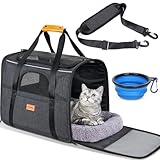
- 【 Spacious & Comfortable Cat Carrier 】The large cat carrier provides ample space for your feline friend to move, turn, and stretch during travel. Measuring 17.3 x 12.2 x 13.4 inches, it is wider and taller than most cat carriers, ensuring your pet feels comfortable and at ease while on the go.
- 【Balanced Mesh Design】Unlike other cat carrier hard, our cat carrier soft strikes the perfect balance with 40% mesh surface area. This ensures your pet can observe the surroundings and breathe easily while feeling safe and secure at the same time. The cat carrier large is suitable for pets in all kinds of situations.
- 【Built-in Dual-Sided Cushion】The detachable pad offers two distinct comforts: a cool side for summer and a super-soft, warm side for winter. You can easily flip it to match the season, providing the perfect temperature for your pet in any weather.
- 【Includes Foldable Bowl】Designed for on-the-go use, our foldable bowl carries 410g of food or 20oz of water. After use, simply collapse it and attach it directly to your pet's collar or leash, perfect for keeping your pet fueled and hydrated anywhere.
- 【Safe & Durable】Safety is our top priority, and the pet carrier for cat is equipped with a secure buckle to prevent your pet from escaping. The cat carrier soft is made of reinforced snow silk fabric and hard mesh material, ensuring durability and preventing any tearing during long-distance travel.
How to choose an immediate response
| Situation | First response | Safety priority | When to involve a professional |
|---|---|---|---|
| One-off fright from a noise or visitor | Reduce noise, provide a retreat, and leave the cat alone until it recovers. | Do not corner or handle the cat. | Call if recovery is unusually slow or physical signs appear. |
| Repeated reaction to a removable trigger | Prevent access to the trigger and change the environment. | Separate animals or people before contact escalates. | Ask your veterinarian if the pattern persists. |
| Trigger cannot be avoided | Use distance, brief exposures, and food rewards only while the cat remains calm. | Stop at the first escalation signal. | Seek behavior guidance for severe fear or aggression. |
| Sudden fear with appetite, breathing, digestive, or elimination changes | Arrange a veterinary examination. | Avoid assuming it is “just stress.” | Promptly; urgently if breathing or urination is impaired. |
| Defensive cat creating bite or scratch risk | Give space and use barriers rather than your hands. | Protect people and other animals from injury. | Veterinary examination first, followed by behavior referral if needed. |
Preparing a cat for transport and a veterinary visit
Preparation before the appointment can prevent a carrier from becoming a predictor of frightening events. The 2022 AAFP/ISFM guidelines recommend recognizing species-specific fear signals, preparing cats before visits, using food to cue positive emotions, and tailoring handling to each cat’s emotional state.
Before appointment day
- Leave a secure carrier open in a familiar room rather than bringing it out only for travel.
- Place comfortable bedding and occasional treats inside, allowing the cat to investigate voluntarily.
- Practice brief, low-pressure steps: approaching the carrier, entering, closing the door for a moment, and carrying it a short distance.
- Stop each practice session while the cat is still calm. Do not force the cat inside for training.
- Tell the veterinary practice about previous fear, aggression, motion sickness, or difficulty being handled when you book.
On the day
- Move the carrier to a quiet room and close doors so the cat cannot flee into the house.
- Use a secure carrier that cannot open accidentally. Carry it level with both hands and avoid swinging it.
- Keep the carrier covered or partially covered if that reduces visual stimulation, while maintaining adequate ventilation.
- Drive smoothly and keep the carrier secured so it cannot slide.
- At the clinic, ask whether you can wait in a quiet area or remain in the car until the examination room is ready.
Handling should be adapted to the cat’s emotional state. If the cat is already flattened, frozen, hissing, or attempting escape, more restraint may intensify fear and increase injury risk. Ask the veterinary team about a pre-visit plan for a cat that cannot be handled safely.
When ongoing fear needs behavior help
After medical causes have been evaluated and treated, persistent fear, avoidance, or aggression may require a structured behavior plan. Ask your veterinarian about referral to a certified applied animal behaviorist or a board-certified veterinary behaviorist. This is especially important when a cat repeatedly bites or scratches, cannot be examined safely, stops eating during stressful events, or remains distressed despite environmental changes.
A useful plan defines the trigger, the distance at which the cat can remain calm, the reward to use, the length of each exposure, and the exact signs that mean “stop.” Everyone in the household should follow the same plan. Progress is measured by calmer recovery and greater choice, not by forcing the cat to tolerate a situation quickly.
Quick Recap
Common mistakes that make fear worse
- Reading one cue in isolation: Large pupils may occur with excitement, low light, pain, or fear. Interpret them with posture, ears, tail, and context.
- Chasing a hiding cat: Pursuit removes the cat’s sense of safety and can turn avoidance into a bite or scratch.
- Using punishment: Physical or verbal punishment increases the perceived threat and does not teach the cat what to do instead.
- Forcing “socialization”: Holding, petting, or presenting the trigger at close range can push the cat beyond its coping limit.
- Ignoring bodily changes: Appetite loss, abnormal breathing, vomiting, diarrhea, and elimination changes can signal illness as well as stress.
- Waiting indefinitely: A persistent change from baseline warrants professional assessment even if the cat is not overtly aggressive.





Leave a Reply