Crashes, No Sound, or Screen Glitches?
Random freezes, missing sound and display glitches usually trace back to one bad driver. Find and replace yours safely.Free scan · under a minuteWindows Errors? Fix Them Before They Spread
Repair common Windows errors and clear accumulated junk for a smoother, more stable PC - no reinstall needed.Free scan · no reinstallSquid and octopuses are both cephalopods, but they are built for very different ways of life. The quickest reliable distinction is this: a typical squid has eight arms, two longer tentacles, fins, and a flexible internal support called a pen, while a typical octopus has eight arms, no tentacles, and a soft body without a substantial internal shell.
That comparison describes the familiar species most people see in aquariums, documentaries, and seafood markets. Nature has exceptions, especially among deep-sea cephalopods, so body shape and behavior are useful clues rather than absolute rules.
Squid and octopus: the differences at a glance
| Feature | Squid | Octopus |
|---|---|---|
| Appendages | Eight arms plus two specialized tentacles | Eight arms; no tentacles in the usual anatomical sense |
| Internal support | Usually has a flexible internal pen, also called a gladius | Most familiar species have no substantial internal shell |
| Body shape | Usually elongated and streamlined | Usually rounded or sac-shaped |
| Fins | Most species have fins on the mantle | Most adult species do not have fins, although deep-sea exceptions exist |
| Typical lifestyle | Active swimmer, often in open water | Usually bottom-dwelling and den-associated |
| Movement | Fins for routine swimming; jet propulsion for bursts of speed | Crawling with the arms; jet propulsion mainly for rapid escape |
| Prey capture | Long tentacles shoot outward to seize prey | Eight arms surround, grip, and manipulate prey |
1. Squid have arms and tentacles; octopuses have arms
This is the clearest anatomical difference.
A typical squid has eight arms and two longer tentacles, giving it ten appendages in total. The arms usually have suckers along much of their length. The two tentacles are specialized for rapid extension: they reach out to grab prey, often using suckers concentrated near the enlarged end, or club.
An octopus has eight arms and no tentacles in standard anatomical terminology. Its suckers run along the arms and help it crawl, grip surfaces, explore objects, and handle food. The arms also provide touch and chemical information, so an octopus can effectively “taste” what it touches.
What’s actually slowing this PC down?
Pick the symptom - the matching free tool is one click away.
#1 Best Overall

- Realistic Natural Environment: These fish tank decorations replicate the natural environment, and once placed in the tank, they are virtually indistinguishable from real plants. Your fish will enjoy the environment these plants provide, and they can play and hide in it
- Soft and Safe Design: The leaves are soft and lifelike without scratching the fish. They swing with the water waves in the fish tank, making them look very vivid and beautiful in the water. They can be planted in both freshwater and saltwater. Each plant has its own base for holding it in the gravel
- Low Maintenance Solution: Unlike live plants in fish tanks, plastic artificial plants do not need special lighting and other substrates. They neither die nor become wilted or unattractive. They remain beautiful all the time without any pruning
- Convenient Aquarium Setup:We provide the suitable aquarium products for different sizes of aquariums in order to save you time. Simply buy them according to your needs and place them in your fish tank to create a beautiful underwater world for your pet fish, making fish life more interesting and happier
- Complete Decoration Set: The set contains 1 rockery aquarium decoration, 3 short aquarium plants, 3 medium aquarium plants and 1 tall aquarium plant with a total of 8 different styles. Heights vary from 2 inches to 8 inches. Suitable for 5 gallon or larger fish tanks
People often call every cephalopod appendage a tentacle, and that is understandable in casual conversation. In precise terms, however, an octopus has eight arms, while a squid normally has eight arms plus two tentacles.
There is an exception: adult squid in the family Octopoteuthidae lose their tentacles during development. They remain squid even though they do not fit the usual ten-appendage pattern.
2. Squid usually have an internal pen
Most familiar squid have a thin, flexible internal structure called a pen, gladius, or quill. It is a leftover version of the external shell found in some ancestral mollusks. The pen supports and stiffens the squid’s mantle without making the animal rigid.
Most familiar octopuses, known as incirrate octopuses, have lost this internal shell. That loss gives them remarkable flexibility. An octopus can flatten its body, fold its arms into tight spaces, and squeeze through surprisingly small openings if its beak can pass through.
The simplified rule “squid have an internal shell and octopuses do not” needs one qualification. Finned deep-sea octopuses, called cirrate octopuses, retain a reduced internal supporting structure. They also have fins, unlike most shallow-water octopuses.
3. Their body shapes reflect how they move
Squid usually have an elongated, torpedo-shaped mantle. This streamlined form reduces resistance as the animal swims through open water. Fins near the rear of the mantle help with slow, controlled movement, turning, and hovering.
Rank #2
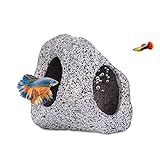
- Quality & Professional:The aquarium cave is made of ceramic with the function of filtering water, and it is environmentally friendly and odorless, imitating the natural stone texture to create a more natural visual effect.
- Visual feast:Aquarium decorative hiding cave provides you with a visual feast. It provides a "house" for your fish. The hollow caves provide shelter, hiding spots as well as spawning and privacy space for your fish.
- Multiple Placement:You can put it in the fish tank alone, or you can buy several fish tank caves of different sizes to put them together. In order to achieve the best aquarium decoration effect.
- Easy to clean: When you clean your fish tank, a simple rinse of the rock cave decorations with water is all you need.
- Make your Aquarium Vivid And Lively: Provide a natural environment feeling with vivid and detailed colors to add lively life to your aquarium.
Octopuses generally have a rounded mantle with eight arms radiating around the mouth. Their soft, flexible bodies are suited to crawling over rocks, entering crevices, and hiding in dens rather than cruising continuously through the water.
Shape is a useful first clue, but it is not a perfect identification test. Some squid have unusual proportions, and finned deep-sea octopuses do not match the familiar rounded, finless image.
The Tool Desk
Outbyte PC Repair FREEClear out junk files and repair common Windows errorsFree Scan →Outbyte Driver Updater FREEScan for outdated or missing drivers - takes under a minuteDriver Scan →4. Squid swim; octopuses usually crawl
Squid commonly use their fins for ordinary swimming. They can also contract the mantle and force water through a funnel, or siphon, to produce jet propulsion. Jet propulsion is especially useful when a squid needs to accelerate quickly or escape a predator.
Many octopuses spend most of their time on the seafloor. They crawl by pushing and pulling with their arms, climb across rocks, and can use their arms to anchor themselves in moving water. They also possess a siphon and can jet through the water, but many species reserve that method for rapid movement or escape.
Finned cirrate octopuses are an important exception: they use their fins as their main means of locomotion. Some squid also hover near or move along the seafloor, so neither swimming style applies to every species.
5. Habitat and social behavior
Many squid are pelagic, meaning they live in the open-water portion of the ocean. Their streamlined bodies and powerful swimming ability help them follow prey and avoid predators. Some species form large schools, while others are solitary or only gather during particular life stages.
Rank #3

- The ancient sunken ship has been meticulously hand drawn, with exquisite details and a smooth surface that can protect delicate fish fins from fading or breaking, requiring no maintenance - easy to clean, durable, and suitable for freshwater or saltwater environments
- 8Pcs Fish Tank Decorations Set: The sunken ship measures 5.3 x 2.5 x 4.5 inches, paired with simulated aquatic plants ranging in height from 2.3 to 4.7 inches. The proportions are coordinated and the layout is flexible, making it easy to adapt to various small, medium, and large fish tanks, creating a three-dimensional underwater landscape with a strong sense of hierarchy
- Safe and Durable: Made from high-quality eco-friendly resin, the leaves are soft and won't scratch fish fins. It is suitable for various aquatic organisms such as betta fish, shrimp, and fry, ensuring peace of mind when used.
- Ready to use, easy to clean: no installation tools required. Rinse with clean water before use and place into the fish tank. The bottom is flat and stable, not prone to tilting. The smooth surface is easy to clean, making daily maintenance both time-saving and effortless
- Enriching Fish Habitats: Designed specifically to provide gentle shelter and visual stimulation for fighting fish, lanternfish, peacock fish, and other small fish species
Most familiar octopuses are associated with the seafloor. They may shelter in holes, reef gaps, shells, rock crevices, or purpose-built dens. Many are solitary and defend a small area, although close gatherings and more social behavior occur in some species and populations.
It is therefore inaccurate to say that every squid lives in a school or that every octopus lives alone. These are common patterns, not universal rules.
6. They catch prey in different ways
Squid often hunt with speed. A squid can extend its two long tentacles rapidly, seize a fish or crustacean, and draw the prey toward its shorter arms. The arms then help hold and position the prey near the hard beak.
Octopuses usually hunt by exploring with their arms. They can reach into cracks, surround prey, pull apart shells, and restrain animals with their suckers. Their arms are not merely gripping tools: they continuously gather tactile and chemical information about the surfaces and animals they contact.
Do these 3 things before closing this tab:
1Clear out junk files and repair common Windows errors2Scan for outdated or missing drivers - takes under a minute3Repair Windows errors before they cause bigger problemsBoth are predators and both use a beak to bite food. Depending on the species, squid may eat fish, crustaceans, and other marine animals. Octopuses commonly eat crabs, shrimp, mollusks, fish, and other prey they can overpower.
7. Both use camouflage, ink, and other defenses
Squid and octopuses can change their appearance with specialized pigment cells called chromatophores. They may shift color or pattern to hide, communicate, attract a mate, or startle a predator.
Rank #4
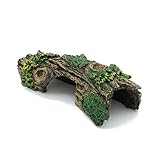
- The natural and detailed bark pattern resin hollow tree trunk ornament is great for nano beta fish and guppies.
- Made of durable resin material and natural brown colors are vivid and not washed out.
- Makes the tank look realistic and add much fun for the fish.
- There are 3 holes on the trunk fish decor, your lovely pet betta or other smaller fish would be super happy to go in and out the trunk cave to sleep, rest, hide, play, breed
- Measures 5.7" x 2.5" x 2.1" (L*W*H). Great for aquarium decorations, model making, terrarium, miniature garden and marine aquariums.
Octopuses are especially known for camouflage because many can also alter their skin texture and body shape. An octopus may imitate the appearance of rock, coral, sand, or another uneven surface while remaining almost motionless.
Many species in both groups can release ink as a defensive screen. The ink can obscure the animal’s escape and may interfere with a predator’s senses. Cephalopods are diverse, though, and not every species uses defense in exactly the same way. The vampire squid, for example, lives in the deep ocean and is known for releasing glowing mucus rather than behaving like a typical ink-squirting predatory squid.
Recommended Free Tools
8. Are octopuses smarter than squid?
Octopuses have a strong reputation for intelligence because they can solve problems, manipulate objects, learn from experience, and control their arms with impressive independence. Those abilities are real, but it is misleading to conclude that squid are unintelligent.
Squid also have complex nervous systems and eyes. Their hunting strategies, camouflage, communication, learning, and social behavior require sophisticated control. The two groups evolved for different environments and lifestyles, so their abilities should not be reduced to a simple “smart octopus versus basic squid” comparison.
What squid and octopuses have in common
Despite their differences, both animals belong to the cephalopod class of marine mollusks. They share several important features:
- A mantle, the muscular body region that surrounds many internal organs.
- A funnel or siphon used to direct water and, in many species, produce jet propulsion.
- Highly developed eyes and nervous systems.
- A hard beak for biting prey.
- Sucker-bearing appendages.
- The ability, in many species, to alter skin color or pattern.
- A fully marine lifestyle: squid and octopuses are not freshwater animals.
Common claims that need correcting
| Claim | More accurate explanation |
|---|---|
| “An octopus has eight tentacles.” | In standard anatomy, an octopus has eight arms. “Tentacle” is commonly used informally, but it is not the precise term. |
| “A squid has ten arms.” | A typical squid has eight arms and two tentacles. The two appendage types have different structures and jobs. |
| “Octopuses never have internal support.” | Most familiar octopuses lack a substantial shell, but cirrate deep-sea octopuses retain a reduced internal structure. |
| “All squid live in schools.” | Many school, but species and life stages vary. Schooling is not a universal squid trait. |
| “All octopuses are solitary.” | Solitary behavior is common, but some species and populations gather or tolerate close contact. |
| “The plural is octopi.” | Octopuses is the standard English plural used by major scientific institutions. “Octopi” is also used in general English. |
| “The vampire squid is just a typical squid.” | It belongs to a distinct deep-sea cephalopod lineage and feeds mainly on drifting organic material and mucus. |
Can squid or octopuses be pets?
For most pet owners, neither is a practical home aquarium animal. They need stable marine conditions, specialized filtration, appropriate food, and carefully designed enclosures. Octopuses are escape artists, while squid require substantial swimming space and are difficult to keep in ordinary home systems.
Best Value

- PROMOTES ROBUST PLANT GROWTH: Fluval Plant and Shrimp Stratum encourages strong root development by allowing plant roots to easily penetrate and spread throughout the substrate, helping aquatic plants absorb key nutrients for healthy growth
- SUPPORTS BENEFICIAL BACTERIA: The light, porous structure provides an ideal surface for beneficial nitrifying bacteria to colonize, helping support biological filtration and a healthy freshwater aquarium environment
- HELPS MAINTAIN IDEAL WATER CONDITIONS: Designed to support a neutral to slightly acidic pH range, making it ideal for planted aquariums with live aquatic plants, tropical fish, shrimp, and other freshwater species
- IDEAL FOR SHRIMP HABITATS: Creates a natural refuge for newborn shrimp, providing shelter and protection until they are large enough to safely explore the aquarium
- MADE FOR FRESHWATER PLANTED AQUARIUMS: Will not discolor water and helps manage organic discoloration commonly associated with natural driftwood; Includes one 8.8 lb bag of Fluval Plant and Shrimp Stratum aquarium substrate
Octopuses are also intelligent, active predators with short lifespans in many species. Keeping one responsibly involves more than providing a tank and frozen food. Anyone considering a cephalopod should first consult an experienced public aquarium professional or specialist marine-animal keeper and check local laws and welfare requirements.
The easiest way to tell them apart
- Count the appendages: eight arms plus two long tentacles usually means squid; eight arms with no long prey-catching pair usually means octopus.
- Look at the body: a streamlined mantle and fins suggest squid; a rounded, soft body suggests octopus.
- Watch the movement: steady open-water swimming suggests squid; arm-based crawling along the seafloor suggests octopus.
- Look for the habitat: open water and schooling behavior favor squid, while dens and bottom habitats favor octopuses.
One-sentence distinction: A squid is usually a streamlined, finned swimmer with eight arms, two prey-catching tentacles, and an internal pen; an octopus is usually a flexible, bottom-dwelling cephalopod with eight arms, no tentacles, and no substantial internal shell.
For further background, see the Smithsonian Ocean Portal, the Monterey Bay Aquarium’s cephalopod guide, and Animal Diversity Web’s Cephalopoda account.
FAQ
Do squid have eight arms or ten?
A typical squid has eight arms and two longer tentacles. Calling all ten appendages “arms” is common in casual speech, but it is not anatomically precise.
Does an octopus have tentacles?
Not in standard anatomical terminology. An octopus has eight arms, with suckers extending along the arms. The word “tentacle” is often used casually for them.
Which is bigger, a squid or an octopus?
It depends on the species. Some squid are much larger than most octopuses, but body size varies widely and cannot identify every individual.
Are squid and octopuses good pets?
Usually not for ordinary home aquariums. Both require specialized saltwater systems, and octopuses are particularly skilled at escaping. Squid also need considerable swimming space and expert care.
The Bottom Line
Squid are generally streamlined open-water swimmers with eight arms, two specialized tentacles, fins, and an internal pen. Octopuses are generally flexible seafloor animals with eight arms, no tentacles, and no substantial internal shell. Both are intelligent, color-changing marine predators, but their anatomy and lifestyles are distinctly different.
Quick wins for a faster PC:
Clear out junk files and repair common Windows errorsFree Scan →Scan for outdated or missing drivers - takes under a minuteDriver Scan →Repair Windows errors before they cause bigger problemsFix Now →Quick Recap
Product prices and availability are accurate as of the date/time indicated and are subject to change. Any price and availability information displayed on Amazon at the time of purchase will apply.




