
Recommended Free Tools
For a garden bed, the best-supported cat repellent is a physical barrier. Lay suitable netting close above the soil or use flat chicken wire so cats cannot dig while plants grow through. For an outdoor path or yard entrance, a motion-activated sprinkler is the strongest purchasable category supported by veterinary and extension guidance. Scent products are temporary and uncertain, while ultrasonic devices deserve caution. A cat spraying or urinating indoors needs a behavior and veterinary assessment, not simply a garden repellent.
There is no universally best product, and the available evidence does not justify ranking individual brands or models. The practical ranking below compares humane approaches by location, purpose and evidence quality.
As an Amazon Associate I earn from qualifying purchases.
Practical ranking: which cat deterrent fits your situation?
The ranking is by approach rather than by make or model. Extension and veterinary sources support the categories, but they do not provide independent tests of particular products or guarantee that every cat will respond.
Windows Errors? Fix Them Before They Spread
Repair common Windows errors and clear accumulated junk for a smoother, more stable PC - no reinstall needed.Free scan · no reinstallCrashes, No Sound, or Screen Glitches?
Random freezes, missing sound and display glitches usually trace back to one bad driver. Find and replace yours safely.Free scan · under a minute| Rank | Approach | Best-supported use | What the evidence says | Main trade-off |
|---|---|---|---|---|
| 1 | Physical barrier: netting, flat chicken wire or a carefully designed texture change | Protecting a defined garden bed from entry and digging | Oregon State University Extension identifies physical barriers as the most reliable long-term solution. | Installation, access for gardening and safe fitting around plants |
| 2 | Motion-activated sprinkler | Outdoor paths, borders and known yard entry points | Both Oregon State University Extension and Cornell Feline Health Center describe motion-triggered sprinklers as an outdoor deterrent. The sources do not compare models. | Needs a water connection, careful placement and monitoring for false activations |
| 3 | Citrus peels or other scent-based repellents | A small, localized perimeter where frequent maintenance is practical | Some cats may avoid scents, but odors fade and commercial repellents lack solid proof of consistent results. | Reapplication after rain or watering; uncertain response |
| 4 | Ultrasonic device | Only as a cautiously evaluated option for a specific outdoor entry point | OSU reports that cats respond differently and advises looking for objective evidence for the model. A UF/IFAS nuisance-wildlife publication cautions that outdoor ultrasonic noise makers are ineffective in most situations; that finding is not a cat-specific trial. | Uncertain efficacy, coverage and possible effects on other animals |
| 5 | Indoor access management and behavior care | Keeping a household cat away from a room, plant or other restricted area | Cornell recommends restricting access while investigating territorial, social, frustration-related or medical causes of house-soiling. | Requires changes to the cat’s environment and, when indicated, veterinary care |
This order answers two different problems that are often confused: stopping an outside cat from entering a garden, and treating a resident cat that is eliminating indoors. A device designed for the first problem cannot diagnose or resolve the second.
#1 Best Overall

- HELPS DISCOURAGE REPETITIVE SPRAYING: Formulated to deter cats from revisiting and spraying the same spot twice
- FOR INDOOR TRAINING: Ideal solution when trying to break cats’ spraying behaviors
- REPELLENT SCENT FORMULATED WITH ESSENTIAL OILS: Repellent scent deters cats from returning to the treated area
- SAFE FOR PETS AND HOME: Safe for pets and home when used as directed
- TRUSTED BRAND: From the maker of Nature’s Miracle products, the pet stain and odor removing brand you trust…because it works!
How to choose the right approach
For digging, defecating or urinating in a garden bed
Start by covering the bed rather than trying to make the soil smell unpleasant. A barrier addresses the physical behavior directly and remains in place instead of fading. Choose a design that follows the bed’s shape, leaves room for plants to grow and does not create exposed sharp edges, loops or snag points.
For a cat crossing a lawn, path or boundary
A motion-activated sprinkler is the most practical category to consider after barriers. It gives an immediate environmental consequence without trapping or injuring the animal. Use it at the route the cat actually uses, not simply in the middle of a large yard, and observe whether the cat changes its route.
For a narrow perimeter where installation is difficult
A scent product or citrus peel may be worth trying when you can inspect and refresh the area regularly. Treat it as an experiment with a defined test area, not as a guaranteed solution. Rain, irrigation and sun can remove or weaken the odor.
Do these 3 things before closing this tab:
1Clear out junk files and repair common Windows errors2Fix the driver behind crashes, sound loss and screen glitches3Repair Windows errors before they cause bigger problemsFor a household cat urinating or spraying indoors
Do not begin with an outdoor repellent. Cornell describes spraying and house-soiling as potentially territorial, social or frustration-related, and medical problems can also be involved. Restrict access to the affected area where appropriate, improve the cat’s environment and arrange a veterinary assessment when the behavior is new, persistent or accompanied by other signs.
Physical barriers: the best starting point for garden beds
OSU Extension’s October 2025 guidance states: Physical barriers remain the most reliable and long-term solution for preventing cats from entering and damaging garden areas.
The page is authored by Janhvi Pandey, Extension Horticulture Assistant Professor of Practice. Its examples include netting close above the soil and flat chicken wire, both arranged so plants can grow through while digging is inhibited. Read the full guidance at Oregon State University Extension.
Install a barrier around the actual access point
- Watch the bed first. Identify where paws enter, where soil is disturbed and whether the cat approaches from a path, wall or adjacent planting. Protecting only the center of a bed leaves the route open.
- Fit the material to the bed. Lay netting close above the soil or position flat chicken wire over the surface. Leave openings for stems and avoid loose sections that can move under a paw.
- Secure edges and corners. A cat can use a lifted edge as an invitation to dig. Anchor the perimeter so the material remains flat during watering and ordinary garden work.
- Check plant growth regularly. Lift or adjust the barrier before stems become trapped. Remove damaged sections and maintain a clear, safe working edge.
- Inspect for hazards. Do not leave protruding wire, loops or entanglement points accessible to cats, children or wildlife. The barrier should deter entry, not injure an animal.
When a barrier is preferable to a spray
Use exclusion when the area is defined and you want a solution that does not depend on a cat detecting a particular odor. It is also the better choice where rain, irrigation or wind would quickly remove a topical product. The cost is your installation time and the need to make gardening access convenient.
Rank #2
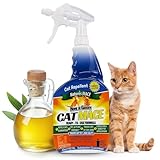
- 40 OZ READY-TO-USE FORMULA: This 40-oz ready-to-use cat spray deterrent requires no mixing or measuring. Apply directly from the bottle for coverage of targeted areas such as beds, furniture, trash bags, decks, or walkways. Great for home or garden use, it helps keep your space cat-free while reducing the effort needed for daily upkeep.
- TARGETED AREA APPLICATION: Shake thoroughly and apply our cat pee stopper to areas where cats are unwanted, covering up to 1,000 sq ft. Apply daily for the first 7-10 days, as these are the primary training days. Afterward, apply twice during the following week, and then once per week to maintain protection. Consistency is crucial in training cats to stay away from the treated areas.
- UTILIZES SCENT AVERSION: Formulated with essential oils that cats strongly dislike to keep them away from certain areas. It contains oils like peppermint and castor oil, which cats find unpleasant. Whether you need a cat spray deterrent for scratching, cat deterrent spray for unwanted behavior, or a cat spray repellent for targeted areas, it helps for all your cat training needs.
- INDOOR DETERRENT FOR HOME SURFACES: It can also be used indoors to keep away cats from scratching or clawing furniture and walls. Apply to common target areas such as sofa arms, chair legs, and door frames, creating a boundary that discourages repeat behavior. Our cat spray training formula is generally fabric-safe, but it is recommended to apply it to a hidden area first to see if it will stain the fabric. Helps protect furniture and maintain a scratch-free home.
- GENTLE CAT SPRAY TRAINING: Our cat scratch deterrent is a powerful training tool. Cats respond through repetition and consistency, so regular use helps reinforce learned behavior. This product gradually corrects habits by deterring unwanted scratching and marking actions, helping establish respectful boundaries within indoor and outdoor spaces.
Motion-activated sprinklers for outdoor entry points
A motion-activated sprinkler is a reasonable category for a yard, border or garden entrance. OSU Extension and Cornell both describe motion-triggered sprinklers as a way to deter outdoor cats. That support applies to the category, not to a named make, model, current price or guaranteed detection range.
What’s actually slowing this PC down?
Pick the symptom - the matching free tool is one click away.
Set one up at the route, not at random
- Map the route. Look for paw prints, flattened vegetation, disturbed mulch or the place the cat repeatedly jumps a boundary.
- Choose a defensible position. Place the sensor where it can see the approach while the spray is directed at open ground rather than a doorway, public walkway or delicate plant.
- Connect water and power exactly as the model’s instructions require. Use the listing’s stated connection, coverage and weather requirements; do not assume every device has the same range or operating mode.
- Test during the cat’s usual visiting period. Confirm that the sensor activates for movement on the intended path and does not repeatedly trigger on a road, swaying branch or your own routine.
- Reposition after observing real traffic. If the cat walks around the spray, move the unit to the new route or combine it with a physical barrier at the destination bed.
- Maintain the system. Check the hose connection, battery or power source, sensor window and seasonal weather exposure. Follow the manufacturer’s instructions for freezing conditions and storage.
What to compare when buying
- Detection and coverage claims: Treat the manufacturer’s stated range as a specification to verify, not as an independent performance result.
- Water connection: Confirm that your outdoor tap, hose and adapters match the device.
- Placement flexibility: A unit that can be aimed away from paths, doors and fragile plants is easier to use humanely.
- False activations: Check whether sensitivity or detection zones can be adjusted, and monitor triggers caused by people, pets or vegetation.
- Weather durability: Read the product’s outdoor-use and storage instructions rather than assuming all sprinklers tolerate the same conditions.
The evidence supports searching for a motion activated sprinkler for cats or a motion-activated animal sprinkler, but no cited source independently tests a particular listing. Avoid claims that a model is “proven,” “tested” or universally effective unless you have model-specific evidence.
Scent repellents: inexpensive to try, unreliable as a sole plan
Citrus peels and commercial scent repellents may deter some cats at a localized garden perimeter. OSU Extension notes two important limitations: scents fade and require reapplication, and there is no solid scientific proof that commercial repellents consistently work. That makes scent a maintenance-heavy supplement, not the foundation of a garden-protection plan.
If you try a scent product
- Read the label before applying anything near edible crops, ornamental plants, soil or areas used by children and pets.
- Test a small section first and watch the plant for damage.
- Record where and when you applied it so you can tell whether any change in cat activity coincides with the treatment.
- Refresh only according to the label and after conditions that remove the scent, such as heavy rain or irrigation.
- Stop if the cat, another pet or wildlife shows illness, irritation or unusual behavior, and seek professional advice.
Do not assume that a stronger smell is safer or more effective. Essential oils, concentrated products and household chemicals can create exposure risks, and a product’s label determines where it may legally and safely be used.
Why ultrasonic cat repellents need extra skepticism
Ultrasonic products are often marketed as a hands-off solution, but the evidence is weaker than for barriers and motion sprinklers. OSU Extension reports that cats respond differently and recommends objective efficacy evidence for the specific model. A broader UF/IFAS publication on nuisance wildlife says outdoor ultrasonic noise makers are ineffective in most situations. Because that publication is not a cat-specific trial, it should be treated as a warning about uncertainty rather than definitive proof about every cat device.
Free tools Windows power users keep installed
One-click scans. No signup required.
Questions to ask before buying
- Is there independent, objective evidence for this exact model rather than a general claim about ultrasound?
- What area, angle, power source and weather conditions does the listing specify?
- Could the sound affect your own cat, neighboring pets or other animals?
- What is your fallback if the cat simply ignores it?
If you cannot answer those questions, choose a barrier or a carefully placed sprinkler first. Do not escalate to louder, closer or repeated exposure in an attempt to force a response.
Rank #3

- LAB PROVEN TO KILL & REPEL BUGS. Plant powered pest protection with natural essential oils that works. This pest repellent spray is proven to protect your pets and family from mosquitoes, ants, ticks, fleas, and other common yard bugs. Meets the same effectiveness standards required for conventional flea and tick yard treatment and preventatives. An alternative to conventional pesticide sprays, baits, ant granules, zappers or foggers.
- SPRAY & PLAY CONVENIENCE! NO DRY TIME NEEDED. Safe around pets and the whole family when used as directed with no wait time for drying or reentry into sprayed yard areas. Pre mixed and ready to use. Just attach directly to a garden hose, spray your backyard, and enjoy. Keep the bottle & refill the sprayer with Wondercide Outdoor Pest Control concentrate.
- TREATS UP TO 5,000 SQUARE FEET. Treats up to 5,000 square feet to kill mosquitoes, ants, gnats, fleas, Japanese beetles, no-see-ums, and crickets. Treats up to 2,500 square feet to kill and repel ticks and repel mosquitoes. When used as directed, this bug control spray can be safely used on lawns, gardens, grass, patios, dog kennels, vegetables, flowers, siding, brick, paint, and more. Treat an existing pest infestation or use for prevention.
- PLANT POWERED INGREDIENTS YOU CAN FEEL GOOD ABOUT. No artificial colors, dyes, or fragrances. Made with plant based active ingredients like steam-distilled cedarwood essential oil. The residue is safe beneficial insects and pollinators like bees and butterflies when used as directed. Cruelty free.
- POWERFULLY EFFECTIVE. We know you will love our Outdoor Pest Control Spray, especially for flea, tick, and mosquito removal. Woman founded. Mom approved. USA Made with US and global components. Application coverage depends on water pressure and walking speed.
Outdoor cats and indoor house-soiling are different problems
A roaming cat that enters a flower bed is an access problem. A household cat that sprays or urinates indoors may be communicating territorial stress, social conflict or frustration, or may have a medical condition. Cornell’s guidance on feline house-soiling recommends identifying causes, restricting access where appropriate and seeking veterinary assessment.
Manage access while you investigate
- Close the door or use a secure physical divider for the room or plant that must remain off-limits.
- Remove attractants and clean affected surfaces using a method appropriate for the material; do not punish the cat for an accident.
- Provide acceptable places for normal scratching, resting, climbing and elimination behavior so the restricted area is not the only outlet.
- Arrange veterinary care when the behavior is new, recurring, painful-looking or accompanied by changes in drinking, appetite, mobility or mood.
An outdoor sprinkler or garden granule cannot address urinary pain, territorial conflict or frustration. Treating the wrong problem delays the useful intervention.
Safety: humane deterrence includes the plants and chemicals around it
Check plants before using them as “repellents”
Cornell lists lilies and other common plants as cat hazards. Even a small amount of lily ingestion can cause life-threatening kidney failure. Never plant or scatter vegetation as a deterrent until you have checked its toxicity for cats. The relevant Cornell safety guidance is Common Cat Hazards.
Control pesticide and fertilizer exposure
Pesticides, rodenticides, fertilizers, weed killers, slug baits and household chemicals can all pose risks. The National Pesticide Information Center advises removing pets from treated outdoor areas and keeping them away until the product has dried or for the longer interval stated on the label. Drying does not guarantee that every residue has disappeared, so prevent licking or chewing treated plants and surfaces.
Know what to do after a possible poisoning
Contact a veterinarian immediately if poisoning is suspected. Cornell advises not inducing vomiting unless a veterinary professional specifically instructs you to do so. Keep the product container or label available for the veterinarian, and move the cat away from the exposure without putting yourself at risk.
Troubleshooting: what to change when the first attempt fails
| What you observe | Likely issue | Next humane step |
|---|---|---|
| The cat digs beside the protected bed | The access route or an unprotected edge remains open | Extend and secure the barrier to cover the route, then inspect for lifted corners. |
| The sprinkler triggers constantly | The sensor sees people, pets, moving branches or an overly broad area | Adjust sensitivity or aim, clear the sensor’s view and test again during normal traffic. |
| The cat walks around the sprinkler | The device protects the wrong approach | Move it to the route the cat has selected or pair it with a barrier at the destination. |
| A scent works briefly, then stops | The odor has faded or the cat has habituated | Follow the label for reapplication; if the pattern continues, switch to exclusion rather than escalating concentration. |
| An ultrasonic device produces no visible change | The cat may not respond, or the coverage may not reach the route | Stop relying on it as the sole control and use a barrier or sprinkler with observable placement. |
| A household cat starts eliminating indoors | Possible medical, territorial, social or frustration-related cause | Restrict access, review the environment and arrange veterinary assessment. |
What the available figures do—and do not—tell you
OSU Extension’s October 2025 page says outdoor cats are associated with “billions of bird deaths each year” and compares cats’ noses with human noses as “about 40 times more sensitive.” Those are figures reported by OSU Extension; the page extract does not identify the underlying primary studies, so they should not be presented as independently verified estimates. They help explain why managing outdoor-cat access matters, but they do not establish that one commercial repellent will work for every cat.
A buying and installation checklist
- Define the target: garden bed, yard entry, path, room or indoor elimination site.
- Choose exclusion first where practical: a fitted net or flat chicken wire addresses a defined bed without relying on a smell or sound.
- Use a sprinkler for a route: verify the water connection, stated coverage, power source and weather instructions for the specific listing.
- Use scent only with realistic expectations: plan for fading and reapplication, and follow plant and pet safety directions.
- Demand model-specific evidence for ultrasound: general marketing language is not the same as an objective efficacy result.
- Inspect the environment: remove toxic plants and keep treated areas inaccessible for the label’s full interval.
- Escalate indoor problems to a veterinarian: a repellent is not a substitute for diagnosis.
The most defensible answer to “best cat repellent” is therefore conditional: barrier for a defined garden bed, motion-triggered water for an outdoor entry route, and behavior-focused veterinary care for indoor house-soiling. Humane environmental management is more dependable than promising that a single spray, sound emitter or product will solve every cat problem.
Quick Recap
Product prices and availability are accurate as of the date/time indicated and are subject to change. Any price and availability information displayed on Amazon at the time of purchase will apply.





Leave a Reply