
Some links on this page are affiliate links: if you buy through them we may earn a commission, at no extra cost to you.
The best low-sugar puppy training treat is tiny, soft, quick to eat, clearly labeled, and easy to fit into your puppy’s calorie budget. Keep treats and other extras to about 10% of daily calories; at least 90% should come from a complete and balanced puppy food. Your puppy’s measured kibble can be an excellent zero-extra-cost training reward. For allergies, medical conditions, or prescription diets, ask your veterinary team before introducing any treat.
What “low-sugar” should mean for a puppy treat
There is no universal veterinary sugar limit that defines a “low-sugar” dog treat. Treat the term as a screening goal rather than a regulated nutritional category. Read the complete ingredient list, look for added sugars or sweeteners, compare calories per piece, and choose a reward that can be divided into very small portions.
As an Amazon Associate I earn from qualifying purchases.
Crashes, No Sound, or Screen Glitches?
Random freezes, missing sound and display glitches usually trace back to one bad driver. Find and replace yours safely.Free scan · under a minutePC Slower Than It Used to Be?
A free scan shows the junk files, broken settings and background clutter dragging Windows down - then fixes them in one click.Free scan · Windows 10 & 11A product described as natural, high-protein, or grain-free is not automatically low in calories or nutritionally superior. Those marketing terms do not replace the information you need: calorie density, serving size, ingredients, life-stage suitability, and whether the reward fits your puppy’s daily diet.
Check every reduced-sugar or novel product for xylitol. Veterinary guidance identifies xylitol as toxic to dogs, so a treat containing it should not be given to a puppy. If you suspect your puppy has eaten xylitol, contact a veterinarian or emergency animal poison service immediately.
Popular on Amazon

- Lots of flavor, not fillers: Just three simple, all-natural ingredients mean low calories and high nutritional value, making a tasty but healthy treat that your pup will actually love
- Ready for training, wherever you are: The best training is consistent training. Our small treats are lightweight and perfectly sized for quick rewards so they are ready to go whenever there is a training opportunity
- Mess free treats: No oily, greasy, crumbly messes here, Pupford treats keep your hands and pouches clean. You can even keep some in your pocket for walks, classes, or mini adventures without worrying about them getting grimy or stale
- Motivate even the pickiest of pups: A wide range of flavors makes it easy to find the perfect fit for your pup’s tastes
- Pupford Promise: We strive to always provide simple, high-quality, healthy pup essentials. If you or your pup aren't happy with a purchase, let us know so we can help find the right fit!
Start with the 10% treat-calorie rule
The most important buying decision is not the word “sugar” on the front of the bag; it is whether repeated rewards can stay within your puppy’s daily calorie allowance. VCA and UC Davis guidance both place treats and other non-complete foods at no more than about 10% of total daily calories. UC Davis states that 90% or more should come from a complete and balanced food.
Calculate the daily treat allowance
- Find your puppy’s daily calorie target from the feeding directions for the complete puppy food and your veterinary team’s advice. Calorie needs vary with age, size, growth rate, activity, health, and the food’s energy density.
- Multiply that daily target by 0.10. If the target is 550 calories, the example used by VCA, the treat allowance is 55 calories for the day.
- Reserve part of that allowance for training rather than assuming every reward is “free.” Include table scraps, chews, pill pockets, toppers, and other extras in the same 10% category.
- Compare the allowance with the package’s calories per treat. If a treat has no stated calorie information, you cannot reliably budget it for frequent training; choose a product with a clear calorie statement or use measured kibble.
Turn one treat into several rewards
Training rewards only need to be large enough for your puppy to notice and swallow. PetMD’s veterinary panel recommends treats that are size-appropriate, soft, easy to digest, and low in calories; it also advises choosing high-value rewards that are small or easy to break apart. A treat that can be divided into several pieces lets you reinforce more repetitions without consuming the entire daily allowance.
Quick wins for a faster PC:
Repair Windows errors before they cause bigger problemsFix Now →Fix the driver behind crashes, sound loss and screen glitchesFind Drivers →Clear out junk files and repair common Windows errorsFree Scan →Do not use the 10% figure as permission to add 10% on top of an already generous food portion. If your puppy receives many treats, reduce the measured meal enough to keep the overall daily plan appropriate, and confirm the adjustment with your veterinary team when the puppy is very young, growing rapidly, underweight, overweight, or medically managed.
What to compare when you shop
| Reward option | What it does well | What to check | Best fit |
|---|---|---|---|
| Measured puppy kibble | Uses food already in the daily ration; avoids adding separate treat calories; pieces are usually quick for a puppy to eat. | Set aside the portion before the meal so training rewards are counted. | Everyday practice, puppies that already value their food, and owners who want the simplest calorie control. |
| Soft commercial training treat | Easy to break into tiny pieces and generally quick to swallow, which supports frequent repetitions. | Calories per piece, complete ingredient panel, puppy suitability, added sugars or sweeteners, and xylitol. | High-frequency training or puppies that need a more motivating reward than their regular food. |
| Dry biscuit | Petco’s veterinarian answer notes that dry biscuit treats usually have fewer calories and less salt than jerky or moist treats. | Harder or larger pieces may take longer to eat; check the actual calorie statement rather than assuming every biscuit is low calorie. | Occasional rewards when a puppy can chew the piece safely and training does not require rapid repetitions. |
| Jerky or moist treat | Some puppies find the smell and texture highly motivating. | Petco’s veterinarian answer notes that these formats tend to be higher in calories and salt than dry biscuits; portion them carefully. | Short, difficult training sessions when the puppy needs a higher-value reward, not unrestricted daily feeding. |
| Purina Puppy Chow Training Treats | Purina’s official product sheet identifies this named training product and states that it provides 100% complete and balanced nutrition for dogs of all life stages, including puppies. | Verify the current package, calorie statement, ingredient list, and availability before buying; the product sheet information does not establish a universal serving size for every package. | Owners specifically seeking a documented puppy training-treat product and willing to check the current label. |
Read the label in the right order
1. Find calories per piece or serving
Training often involves dozens of rewards, so calories per piece matter more than calories per bag. If the label lists calories per serving but not per piece, determine how many pieces make a serving and divide the serving calories accordingly. When pieces vary substantially in size, use the smallest practical pieces or weigh a batch and ask your veterinary team how to account for it.
2. Confirm the ingredient list is complete
Choose a package with a full ingredient panel rather than a vague front-of-pack claim. Prefer recognizable, named ingredients and a label you can read without guessing what a proprietary blend contains. A short ingredient list is not automatically better, but an incomplete list prevents you from screening for ingredients your puppy must avoid.
3. Screen for added sugars and sweeteners
Because no numeric low-sugar standard is established, look for added sugars or sweeteners in the ingredient list and compare otherwise similar products by calories and portion size. “Reduced sugar” on the front of a package is not enough; the ingredient panel and calorie statement are the evidence you can use.
What’s actually slowing this PC down?
Pick the symptom - the matching free tool is one click away.
4. Exclude xylitol
Check especially carefully when a product is marketed as reduced-sugar, dental, or unusually sweet. The veterinary-reviewed ingredient guidance identifies xylitol as toxic to dogs. Do not rely on a familiar-looking package or assume a human-style reduced-sugar formula is safe for puppies.
5. Check life-stage and medical suitability
Confirm that the product is suitable for puppies. A treat can be low in calories and still be inappropriate for a puppy with an allergy, disease, dietary sensitivity, or prescription diet. WSAVA warns that an unsuitable treat can contribute to obesity, trauma, obstruction, or death, and that conventional treats may not be appropriate for dogs with medical conditions or veterinary-prescribed diets.
Also popular on Amazon

- Ingredients & Nutrition: Two ingredients: chicken and mixed tocopherols (a natural preservative). 37% protein minimum, 28% fat, and under 1 calorie per bite. No grains, no fillers, no artificial flavors or colors. The full guaranteed analysis is printed on every bag.
- Freeze-Dried: Chicken is freeze-dried raw to retain natural nutrients and aroma. No cooking, no added preservatives.
- Piece Count & Size: 475+ uniform, bite-sized pieces per 4 oz bag. Each piece is under 1 calorie.
- No Grease, No Crumbs: Freeze-dried texture leaves no oily or greasy residue on hands or in pockets.
- Resealable Bag: Resealable packaging keeps treats fresh at room temperature. No refrigeration required.
Soft, tiny rewards usually work best for repetition
PetMD’s veterinary panel recommends puppy treats that are size-appropriate, soft, easy to digest, and low in calories. Soft pieces can generally be swallowed quickly, allowing the puppy to return attention to the handler instead of spending a long time chewing. Breakable treats are useful because the same piece can become several reinforcers.
Dry biscuits may have a calorie and salt advantage over jerky or moist treats, according to Petco’s veterinarian answer, but that does not make every biscuit the best training tool. A large or slow-to-eat biscuit can interrupt the sequence you are trying to teach. Choose texture based on the exercise: rapid repetitions favor tiny soft pieces, while a slower reward may be acceptable when you are not asking for many behaviors in succession.
The puppy’s preference still matters. PetMD’s guidance emphasizes that veterinarians recommend treats according to their purpose and nutritional value, with beneficial ingredients rather than empty calories. As Molly Price, DVM, a Chewy veterinarian quoted by PetMD, explains: “Vets recommend certain treats according to their intended purpose and their nutritional value‚ with beneficial ingredients rather than empty calories.” A less exciting reward that the puppy reliably accepts may be more useful than a calorie-dense reward reserved for special situations.
Using puppy kibble as a training reward
VCA’s puppy guidance explicitly supports using a puppy’s own kibble as treats. This approach removes the need to add a separate food and lets the puppy eat quickly before refocusing on the handler.
A simple kibble routine
- Measure the entire day’s ration of complete and balanced puppy food according to the feeding plan.
- Set aside a portion in a training container before serving meals. Do not estimate by handfuls.
- Use individual pieces for easy behaviors and split the ration across several short sessions.
- At the end of the day, serve any unused training portion as part of the regular meal rather than adding it on top.
- Monitor body condition, growth, appetite, stool quality, and training motivation. Ask your veterinary team to adjust the feeding plan if any of these change.
Kibble is most useful when your puppy already finds it rewarding. If distractions are stronger than the food, use a more motivating but still carefully portioned treat for difficult moments and keep kibble for calm indoor practice.
How to portion commercial treats for training
Prepare before the session
Read the calorie statement and count or weigh the amount you plan to use. Break soft treats into pieces before training so you are not tempted to hand over a whole treat for every response. Put the remaining daily ration out of reach and keep the session’s allowance separate.
Match reward value to task difficulty
Use the least calorie-dense reward that your puppy will reliably work for in the current environment. Kibble may be enough for a familiar room; a tiny soft piece may be more effective around new sounds or smells. Reserve the highest-value option for the hardest behavior or greatest distraction rather than using it for every repetition.
Record what was used
If multiple family members train the puppy, agree on the day’s allowance and mark how much has been taken. Untracked handfuls make the 10% limit meaningless. A small container filled once for the day is easier to monitor than an open bag.
Also popular on Amazon
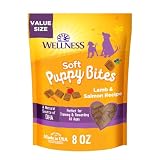
- GRAIN-FREE PUPPY TREATS: These bite-sized, soft puppy training treats are the perfect reward during training sessions or any time you want to thank your dog for good behavior. Puppy bites contain 6 calories per individual treat!
- SUPPORTS BRAIN DEVELOPMENT: Soft dog treats are crafted with salmon, a healthy source of DHA to promote healthy brain development.
- HEALTHY INGREDIENTS: These treats for dogs are made with minimal ingredients focused on quality proteins: made with lamb and salmon, with added vitamins specifically for puppies.
- NO CORN, WHEAT, OR SOY: Treats for dogs do not contain wheat, wheat gluten, corn, soy, or artificial colors.
- MADE IN USA: Our dog treats are quality-assured, made in USA, and crafted from the finest globally-sourced ingredients. Treats are tender, healthy, and bite-sized for small, medium, and large dogs of all lifestages, and activity levels.
Stop when the puppy is no longer engaged
A reward is not useful if the puppy is too full to care about it. End the session while the puppy is still responsive, and account for unused treats rather than offering them simply because they were prepared.
When a puppy needs veterinary guidance first
Ask the veterinary team before adding treats if your puppy has a known or suspected food allergy, chronic digestive signs, another medical condition, a weight-management concern, or a veterinary-prescribed diet. WSAVA specifically cautions that conventional treats may not be appropriate for dogs with medical conditions, dietary sensitivities, or prescribed diets.
For a puppy on a therapeutic diet, the safest reward may be a portion of the prescribed food, but the veterinary team should confirm that choice. Do not substitute a “healthy” commercial treat because the ingredient list looks simple; even a small amount can interfere with a restricted diet or make it harder to identify the cause of a reaction.
Seek prompt veterinary advice for vomiting, diarrhea, facial swelling, hives, marked lethargy, choking, or other concerning signs after a new treat. If xylitol exposure is possible, treat it as an emergency rather than waiting to see whether symptoms develop.
A practical shopping checklist
- Is the product explicitly suitable for puppies or all life stages?
- Does the package state calories per treat or provide enough information to calculate them?
- Can each piece be broken into several small rewards?
- Is the texture soft enough for quick eating during repeated training?
- Is the full ingredient panel present and readable?
- Are added sugars or sweeteners present?
- Is xylitol absent?
- Does the product fit your puppy’s allergies, health conditions, and prescribed diet?
- Can you keep the day’s amount within about 10% of total calories?
- Will your individual puppy actually work for it?
Common mistakes and how to correct them
Choosing by the front label alone
Problem: “Natural,” “high protein,” “grain-free,” or “reduced sugar” sounds reassuring but does not establish calorie density or suitability.
Correction: Turn the package over and check calories, the complete ingredient panel, life-stage information, and xylitol before considering marketing language.
Do these 3 things before closing this tab:
1Clear out junk files and repair common Windows errors2Scan for outdated or missing drivers - takes under a minute3Repair Windows errors before they cause bigger problemsGiving whole treats for every repetition
Problem: A treat that seems tiny can consume the daily allowance quickly when used dozens of times.
Correction: Break it into smaller pieces, choose a product with a stated low calorie count per piece, or use measured kibble.
Also popular on Amazon

- High Value, Irresistible Flavor: Pups love the taste and aroma, making training sessions more effective and enjoyable
- High-Quality Ingredients: Made in the USA with clean, simple ingredients, starting with beef - nothing artificial and no fillers
- Low-Calorie: Less than 2 kcal per treat and high in protein, perfect for frequent rewarding without worry
- Perfectly Sized: Small enough for one-bite rewards, which helps prevent overfeeding while keeping training sessions flowing smoothly
- Soft & Chewy: Perfect texture for quick rewarding during training, and great for pups with sensitive teeth like senior dogs
Using high-value moist or jerky treats as the default
Problem: These formats tend to be higher in calories and salt than dry biscuits, according to Petco’s veterinarian answer.
Correction: Keep them for difficult training and use lower-calorie options for routine repetitions.
Ignoring the puppy’s complete diet
Problem: Treats gradually displace the food supplying balanced puppy nutrition.
Correction: Keep at least 90% of calories from complete and balanced food and count every extra in the remaining allowance.
Assuming a product is safe because it is sold for dogs
Problem: WSAVA notes that the wrong treat can contribute to obesity, trauma, obstruction, or death, and some products are unsuitable for medically managed dogs.
Correction: Inspect the label, use an age-appropriate portion and texture, and ask your veterinary team when health or dietary restrictions are involved.
Free tools Windows power users keep installed
One-click scans. No signup required.
How to choose between the main options
Choose kibble when calorie control is the priority
Use the puppy’s regular measured food when it is motivating enough and you want the clearest connection between meals and training. This is the simplest option for puppies that respond well to their normal diet.
Choose a soft training treat when speed and motivation matter
Select a product that can be divided into tiny pieces and has a clearly stated calorie value. This is useful for rapid repetitions, distracting environments, or puppies that ignore kibble outside the home.
Also popular on Amazon

- PUMPKIN DOG TREATS FOR EVERYDAY MOMENTS: Simple nutrition without the guesswork. Human-grade, vegan, and crafted with real pumpkin, a natural source of fiber that aids digestion and soothes sensitive tummies. A healthy way to reward that motivates even the pickiest pups. (~36 cookies per 5 oz bag.)
- REAL INGREDIENTS, EXCEPTIONAL FLAVOR: Double-baked to bring out the aroma of natural pumpkin puree, Bob's Red Mill garbanzo bean flour, peanut butter, molasses, and cinnamon: ingredients good enough for your own kitchen. Grain-free and gluten-free, with 3 other flavors and mixed variety packs available so snack time is always wag-worthy.
- LIMITED INGREDIENTS, ONE EASY DECISION: Tasty treats made with 5 wholesome ingredients. No wheat, dairy, chicken, preservatives, BHT, BHA, or artificial flavors, built for dogs with allergies, sensitive stomachs, or picky eaters and parents who read every label. At just 12 kcal per treat, these low-calorie dog snacks let you reward freely without the guilt.
- ONE BAG. EVERY SIZE. EVERY STAGE: Light, crunchy biscuits slip easily into a pocket or treat pouch and snap into bite-sized pieces for puppy training, small dogs, senior dogs, or pups who struggle with hard chews, or stay whole as a full reward for large breeds. One bag works for every size, age, and stage, for generous treating you can feel good about.
- RESEALABLE, BPA-FREE, READY FOR ANYWHERE: Our travel-friendly pouch reseals to lock in freshness between walks, car rides, training sessions, or trips to the dog park — so treats stay fresh without hunting for a separate container.
Choose a dry biscuit only when the format fits the exercise
A dry biscuit may offer fewer calories and less salt than jerky or moist treats, but it must still be appropriately sized and easy for the puppy to manage. It is less suitable when chewing would interrupt a fast sequence of rewards.
Choose a documented product only after checking the current label
Purina Puppy Chow Training Treats is a named product whose official sheet states complete and balanced nutrition for dogs of all life stages, including puppies. Package formulations, calorie statements, and availability can change, so verify the current label before relying on that information for portion planning.
The Tool Desk
Outbyte Driver Updater FREEScan for outdated or missing drivers - takes under a minuteDriver Scan →Outbyte PC Repair FREERepair Windows errors before they cause bigger problemsFix Now →Frequently asked questions
Is there a specific number of grams of sugar a puppy treat must contain to be low-sugar?
No universal numeric limit is established in the available veterinary guidance. Use ingredient screening, calorie comparison, and very small portions instead of treating “low-sugar” as a regulated threshold.
Can I use my puppy’s food instead of treats?
Yes. VCA specifically supports using a puppy’s own kibble as a training reward. Set aside the amount from the daily ration so it is not added on top of meals.
How many treats can a puppy have in one day?
The answer depends on total daily calories and the product’s calorie density. Keep treats and other extras to about 10% of daily calories; VCA’s example allows 55 treat calories in a 550-calorie daily plan.
Are dry biscuits always better than soft treats?
No. Dry biscuits usually have fewer calories and less salt than jerky or moist treats, according to Petco’s veterinarian answer, but soft, breakable pieces are often easier to use for rapid training. Choose based on calories, texture, and your puppy’s response.
Recommended Free Tools
What should I do if my puppy eats a treat containing xylitol?
Contact a veterinarian or emergency animal poison service immediately. Xylitol is toxic to dogs, and waiting for symptoms is unsafe.
Can I give conventional treats to a puppy on a prescription diet?
Ask the veterinary team first. WSAVA warns that conventional treats may not be appropriate for dogs with medical conditions, dietary sensitivities, or veterinary-prescribed diets.





Leave a Reply