
What’s actually slowing this PC down?
Pick the symptom - the matching free tool is one click away.
The “cat smile” is a slow blink, not a mouth movement. When a cat is calm and looking your way, soften your gaze, narrow your eyes as if smiling gently, close them briefly, then reopen them. It is a low-pressure invitation to interact—not a guaranteed way to make an individual cat fall in love.
What people mean by a “cat smile”
People use “cat smile” as a friendly name for a sequence of eye movements that feline-behavior researchers call slow blinking or eye narrowing. It usually consists of several half-blinks followed by a longer narrowing of the eyes or a short eye closure. The peer-reviewed paper The role of cat eye narrowing movements in cat–human communication, published in Scientific Reports on 5 October 2020, defines slow-blink sequences this way: “a series of half-blinks followed by either a prolonged eye narrow or an eye closure.” Read the full study in Scientific Reports.
As an Amazon Associate I earn from qualifying purchases.
The label is useful because it captures the relaxed appearance of the gesture, but it can also create false expectations. A human smile uses the mouth; a cat’s version is an eye signal. The available evidence indicates that cats can respond positively to a person’s slow blink on average. It does not establish that every cat will respond, that a cat understands the gesture exactly as a human does, or that the gesture produces love.
How to slow-blink at a cat
Professor Karen McComb of the University of Sussex gives the clearest practical instruction: “Try narrowing your eyes at them as you would in a relaxed smile, followed by closing your eyes for a couple of seconds.” Follow that advice with the low-pressure sequence below.
#1 Best Overall
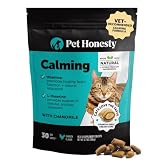
- RELAX INTO BENEFITS: Help your feline companion maintain a peaceful, balanced disposition during stressful moments. These dual texture cat calming treats offer targeted behavioral support by promoting deep relaxation and providing real cat anxiety relief. Perfect for scary car rides, loud holiday storms, vet visits, and grooming, our crunchy and creamy bites reduce environmental panic so your cat can enjoy a calm and happy life.
- THE INSIDE STORY: We formulate our premium healthy cat treats with high performance natural ingredients. Thiamine supports essential brain and cognitive function, while l-theanine amino acids offer deep systemic support in stressful and anxious situations. Combined with soothing chamomile herbs and omega rich fish oil, these cat relaxing treats help calm hyperactive tracking, excessive hiding, and nervous tension from the inside out.
- LOVED BY CATS: Feline companions are uniquely sensitive creatures and can be highly particular about flavors, smells, and textures. That is why our calming chews for cats are designed specifically around specialized feline taste palates. You can feel completely confident choosing our advanced anxiety support formula, which stands as a top rated cat relaxing supplement proudly engineered by passionate cat lovers. In fact, our cat anxiety relief is the #1 calming chew supplement on Amazon.* Based on Amazon Stackline data from Dec 2023 - Nov 2024
- DROOL-WORTHY TASTE: Our dual texture cat calming chews combine clinical behavioral efficacy with an irresistible savory chicken flavor. Featuring an enticing crunchy outer shell and a smooth creamy core, 9 out of 10 cats absolutely love the taste based on independent feeding studies. This premium recipe makes daily stress management easy, transforming wellness into a delicious treat your pet natively craves. **Based on an independent feeding study. Individual results may vary
- THE HONEST DIFFERENCE: Give your faithful companion the elite, uncompromised standard of premium clinical care. This Vet-Recommended cat calming treat is proudly manufactured in the USA using clean, science backed ingredients with no fillers or artificial preservatives. Because we are proudly NASC certified, we adhere to the most rigorous quality and safety benchmarks in the industry, delivering real results you can completely trust.
- Choose a settled moment. Try when the cat is resting, sitting comfortably, or calmly observing you. Do not begin while it is eating, hiding, playing intensely, grooming a sore area, or reacting to a noise.
- Stay at a comfortable distance. Remain where the cat already seems at ease. Moving closer to force a response changes the interaction from an invitation into pressure.
- Face the cat without fixing it with a hard stare. Keep your head and shoulders loose. A rigid posture or unbroken direct gaze can be intimidating even when your eyes are meant to look friendly.
- Soften and narrow your eyes. Let your eyelids lower gradually, like a relaxed smile. You are not trying to squeeze your eyes shut or make an exaggerated expression.
- Close your eyes briefly. After the gentle narrowing, close your eyes for about two seconds, then open them normally. The brief closure is part of the signal described by McComb.
- Give the cat time. Return to a neutral, relaxed face and wait. The cat may narrow its eyes, half-blink, look away, remain still, or do nothing. All of those responses are information; none requires you to repeat the gesture immediately.
- End on the cat’s terms. If the cat turns away, moves off, flattens its ears, tucks its body tightly, or shows another sign of discomfort, stop and allow more space.
You do not need a toy, treat, clicker, special light, or other product. The behavior being tested is the person’s eye and facial movement, so adding an object is not part of the evidence for slow blinking.
What the cat may be communicating back
A cat that returns a slow blink, narrows its eyes, or gives a series of soft half-blinks may be participating in the same visual exchange. It may also simply be relaxed or responding to the interruption of a direct stare. The gesture is best treated as an opportunity to observe, not as a code with one guaranteed translation.
Looking away is not automatically rejection. Cats often break eye contact while remaining comfortable, and a cat may acknowledge you later. Conversely, a blink-back is not proof that the cat wants to be touched. Read the whole body: loose muscles, a natural tail position, forward or neutral ears, and the choice to remain nearby are more useful than the eyes alone when deciding whether to continue.
What the two experiments actually found
The 2020 study tested whether cats’ eye-narrowing behavior changed after a human delivered a slow-blink stimulus. It used two experiments, each with a different interaction. The sample was small, and the final analyses excluded statistical outliers, so the results describe group patterns rather than a promise for every household.
Rank #2
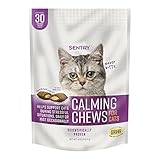
- Supports Cats During Stressful Situations: Whether your cat copes with stress daily or is triggered occasionally by external stressors, help your cat manage their stress levels using the Sentry Calming Chews for Cats
- Clinically tested: Working with top universities and leading pet experts in the field, Sentry Calming Chews for Cats uses clinically tested ingredients to keep your cat calm, cool, and collected in one tasty chew
- We Understand Cats: Make sure your cat’s emotions are heard and understood. Sentry Calming Chews for Cats provides your cat with the support they need to manage normal stress in a healthy way
- Crunchy Outside: Sentry Calming Chews for Cats helps your cat maintain a normal relaxed disposition with a crunchy and tasty exterior that will have your cat feeling good
- Creamy Interior: A pawsitively delicious chew with a creamy interior that helps reduce the effects of normal environmental stress
| Experiment | Cats and setting | Comparison | Observed result |
|---|---|---|---|
| 1 | 21 cats from 14 households were recruited; three dyads were excluded as outliers, leaving 18 cat–human dyads for analysis. Cats were filmed in their homes. | Owners delivered a slow-blink stimulus or stayed present without interacting. | Eye narrowing and half-blinking were higher during the slow-blink condition than during the no-interaction condition. |
| 2 | 24 additional cats were recruited; six were excluded as outliers, leaving 18 for the final analysis. An unfamiliar experimenter interacted with each cat. | The experimenter either slow-blinked or used a neutral face without direct eye contact, then offered a flat, palm-up hand. | Cats showed more half-blinks and eye narrowing after slow blinking. Their approach score toward the offered hand was also higher. |
In the second experiment, the mean approach score was 2.78 (standard deviation 0.43) after the slow-blink condition and 2.39 (standard deviation 0.70) after the neutral-face condition; the reported statistical test gave p = 0.035. Those numbers describe the study’s scoring system and sample, not a percentage chance that your own cat will approach you.
The unfamiliar person in experiment 2 matters. The cats’ greater approach score was observed after a human they did not already know used the slow blink, which suggests the behavior can influence an interaction beyond an established owner–cat routine. It still does not show that a cat has formed an emotional bond with that particular stranger.
Why the result is encouraging—but not a love spell
The findings are consistent with slow blinking functioning as a potentially positive form of cat–human communication. A relaxed narrowing of the eyes may make a human face less threatening, invite a cat to respond, or interrupt an intense, unbroken stare. The authors also discuss learning and reinforcement as possible explanations. Those possibilities are not settled mechanisms, and the paper says further work is needed before firm conclusions can be made about the emotional state associated with slow blinking.
Windows Errors? Fix Them Before They Spread
Repair common Windows errors and clear accumulated junk for a smoother, more stable PC - no reinstall needed.Free scan · no reinstallOutdated Drivers Are Slowing You Down
One free scan finds every outdated or missing driver and matches the right update for your exact hardware.Free scan · exact hardware match“Make cats fall in love with you” is therefore a catchy promise rather than a scientific outcome. The study did not measure love, attachment, trust over time, or a cat’s preference for one person. It measured eye movements and, in the second experiment, approach toward a presented hand. A positive average response can coexist with an individual cat that ignores the signal, dislikes eye contact, or responds differently in a new environment.
Rank #3

- Helps manage stress from separation, thunderstorms, travel & vet visits: daily calming chew promotes relaxation without heavy sedation
- Formulated with melatonin, ashwagandha, GABA, theanine to help block stress signals and support calm, balanced behavior
- Chicken-flavored soft chew made in the USA: made without fillers, gums, or artificial sweeteners for a supplement your cat will actually enjoy
- Fits into a daily routine: supports normal stress response management for cats facing recurring stressful situations
- Veterinarian-recommended: a trusted daily supplement, and backed by our satisfaction guarantee: if your pet's results aren't what you expected, we'll make it right
Important limits on the evidence
- Small final samples. Experiment 1 analyzed 18 dyads after three outliers were removed; experiment 2 analyzed 18 cats after six outliers were removed. Small samples can reveal a useful pattern while giving an imprecise picture of how widely it applies.
- Naturalistic conditions. The first experiment took place in the cats’ homes, which makes the interaction realistic but less tightly controlled than a laboratory test.
- A specific population. The participants were cats living in homes with outdoor access. The results should not automatically be generalized to indoor-only cats, shelter cats, kittens, feral cats, or cats with medical or sensory problems.
- Different neutral-condition cues. In experiment 2, the neutral-face condition also differed in gaze direction. That means the comparison was not only slow blinking versus no slow blinking; the visual behavior differed in another way as well.
- Unresolved meaning. Increased eye narrowing shows a behavioral response. It does not, by itself, identify a single emotion or prove that the cat interpreted the gesture as affection.
These qualifications do not make the technique useless. They tell you how to use it responsibly: offer the blink, observe the cat’s choice, and avoid treating one response as a diagnosis of the cat’s feelings.
When and where to try it
At home with a familiar cat
Use ordinary quiet moments, such as when the cat is resting on a chair or watching you from across a room. Keep the rest of your behavior predictable. If the cat approaches after the exchange, let it decide whether to sniff your hand or settle nearby rather than reaching over its head immediately.
With a new or shy cat
Increase distance and reduce your movements. Sit sideways instead of leaning over the cat, keep your hands still, and let the cat control whether the interaction continues. A slow blink cannot compensate for loud voices, blocked escape routes, forced handling, or a person who repeatedly follows the cat.
Recommended Free Tools
At a veterinary clinic or shelter
Stress can change eye contact and body language, so do not use the gesture as a pass–fail test of temperament. Offer it only when staff consider the animal settled and when the cat has room to withdraw. A cat that does not blink in a kennel or examination room may be overwhelmed rather than unfriendly.
Rank #4

- Effectively Calm and Relieve Stress: Our cat calming treats are formulated with natural plant extracts to help your feline friend stay relaxed during stressful situations like travel, vet visits, or boarding. These calming cat chews reduce anxiety, prevent scratching and biting, and promote a sense of calm. Perfect for calming care for cats, these calming cat treats are safe with no side effects, making them ideal for cat calming treats for indoor cats
- Delicious Chicken Flavor, Easy to Feed: Cats love the tasty chicken flavor of our calming cat treats, making feeding a breeze. No need to force-feed—simply add these calm treats for cats to your cat’s daily diet. Whether for cat calming treats for travel or calming cat treats for anxiety, these cat calming chews make the calming process enjoyable and stress-free
- Veterinary Recommended, Safe and Reliable: This calming cat chews is made from safe ingredients such as flax seed oil and chamomile. Each cat calming chews is precisely measured to ensure your cat’s health and safety. Follow the weight-based feeding guidelines for cat calming treats for indoor cats to keep your cat relaxed and comfortable. These calming care for cats are a trusted solution for anxiety and better sleep
- Quick Onset, Suitable for Various Situations: This cat calming treats takes effect within 30-45 minutes and provides up to 12 hours of relaxation. These calming treats for cats are perfect for various scenarios, including travel, vet visits, or sudden stress spikes. Use cat calming treats for travel to ease your cat’s nerves or give calming cat chews before a vet appointment. Adjust the dosage of cat calming chews as needed to provide calming care for cats in high-pressure moments
- Bigger Particles, Long-Lasting Value: Each calming cat chews is 1.5 g, larger than standard cat calming treats, ensuring your cat gets the full benefits. Meanwhile, soft chews are also very easy to consume. With 140 pieces cat calming chews per bottle (210 g total), calming treats for cats offer long-term emotional balance and mental health support. Perfect for calming cat treats for anxiety and maintaining a serene environment for your furry friend
Troubleshooting common responses
The cat does nothing
Do not escalate by moving closer, staring longer, or repeating the signal rapidly. The cat may be focused on another stimulus, may not be comfortable with the distance, or may simply have no observable response at that moment. Keep your face neutral and let the interaction end.
The cat looks away
Allow the break in eye contact. Looking away can reduce social pressure, and forcing the cat to look back defeats the low-pressure purpose of the gesture. You can remain quietly present without trying again.
The cat narrows its eyes but leaves
Record both parts of the event: an eye response occurred, and the cat chose to leave. The eye movement alone does not authorize petting or pursuit. Respect the departure and try another day from farther away.
The cat approaches your hand
Keep the hand low, flat, and still, as in the second experiment’s approach test. Let the cat sniff or pass by. Do not convert an approach into an attempt to pick the cat up, restrain it, or touch a sensitive area.
Best Value

- CREATURE COMFORTS: Even the coolest cat can experience new and unfamiliar situations. That’s why our Cat Squeezables Behavior Support is specifically made with a science-backed formula that helps support a relaxed disposition during everyday situations – and that means more enjoyable moments for both of you.
- THE INSIDE STORY: We’ve got other lickable treats licked, because ours are made with clean ingredients that help support everyday wellness. L-tryptophan helps support a relaxed disposition. L-theanine helps support normal behavior during everyday situations, while chamomile complements this thoughtfully crafted formula. Our puree is also made with real salmon and boosted with omega-3s for skin, brain, and heart health. Plus, they provide extra moisture to help your little one stay hydrated.
- FILLER-FREE: Unlike other pet purees that contain by-products and fillers like cellulose, corn, soy, wheat and palm oil, our science-backed squeezables are formulated with clean, powerful ingredients, like real salmon, to help support everyday wellness.
- PICKY CAT-APPROVED: Our Squeezables are loved by 100% of cats,* because we formulate them with their specific needs top of mind. With a creamy texture and flavor felines crave, they’ll think it’s a treat, but you’ll know better.
- THE HONEST DIFFERENCE: Our products are made with clean ingredients and science-backed formulas pets love. With no fillers, artificial preservatives, colors, or flavors, you'll have no doubt your cat is getting the best. Proudly supporting pets in need nationwide & using recycled plastic in our packaging, there's also no doubt that we're committed to doing our best.
The ears flatten, pupils become very large, the tail lashes, or the body tightens
Stop the exercise and create space. Those signs indicate that the interaction is not comfortable enough to continue, whatever the eyes are doing. If a sudden change in eye appearance or behavior persists outside social situations, seek veterinary advice because pain and illness can affect facial expression and interaction.
How to build trust around the slow blink
The blink works best as one small part of a consistent relationship. Give the cat reliable access to food, water, resting places, hiding options, and a route away from people. Move predictably, handle only what the cat accepts, and stop contact when the cat signals that it has had enough. These practices are general welfare measures, not components tested by the slow-blink experiments, so they should not be presented as a formula proven to produce a blink-back.
Use the cat’s choices to set the pace. A cat that repeatedly remains near you, initiates contact, or relaxes in your presence is providing broader behavioral information than a single eye movement. A cat that avoids interaction may need environmental changes, a slower introduction, or professional help rather than more attempts at the “cat smile.”
The Tool Desk
Outbyte Driver Updater FREEFix the driver behind crashes, sound loss and screen glitchesFind Drivers →Outbyte PC Repair FREEClear out junk files and repair common Windows errorsFree Scan →Why researchers care about the gesture
Because eye narrowing can be observed without asking a cat to perform a trained behavior, it may become useful for assessing welfare in settings where cats encounter unfamiliar people. Dr Tasmin Humphrey, the study’s first author, said: “Our findings could potentially be used to assess the welfare of cats in a variety of settings, including veterinary practices and shelters.” The University of Sussex summary provides the quoted guidance and context.
That is a potential application, not a validated welfare scale. Staff would need to consider the cat’s full posture, environment, health, and previous behavior rather than scoring a blink in isolation. Dr Leanne Proops, a comparative psychologist and ethologist at the University of Portsmouth, captured the difficulty of studying spontaneous interactions: “It’s definitely not easy to study natural cat behaviour so these results provide a rare insight in to the world of cat-human communication.” Read the University of Portsmouth account.
A practical decision rule
- Is the cat already calm? If not, wait.
- Can the cat leave freely? If not, do not initiate the exchange.
- Can you soften your gaze without staring? If yes, give one slow blink and pause.
- What does the whole body say? Continue only while the cat remains loose and able to choose distance.
- Are you expecting proof of affection? Replace that expectation with observation. The gesture is an invitation, not a test the cat must pass.
The bottom line on making cats “fall in love”
Try the cat smile by gently narrowing your eyes, closing them for a couple of seconds, and reopening them when a cat is relaxed and looking toward you. The 2020 study found more eye-narrowing responses after human slow blinks in both experiments, and a higher average approach score after an unfamiliar experimenter’s slow blink. That is promising evidence for a friendly communication signal, not proof that the gesture creates love or works for every cat. The most respectful result is the one in which the cat remains in control of whether the interaction continues.
Quick Recap
Product prices and availability are accurate as of the date/time indicated and are subject to change. Any price and availability information displayed on Amazon at the time of purchase will apply.





Leave a Reply