
The hyacinth macaw is the longest parrot, reaching about 1 metre from bill to tail, while the kākāpō is the heaviest, with males reported at up to 4 kilograms. Those are different records: a long tail can make one species longest without making it the heaviest. A reliable list of ten largest parrots requires the same measurement, units and type of statistic for every species, and the available published figures do not provide that consistent ten-species dataset.
Why there is no single “largest parrot”
“Largest” can mean total length, body mass, wingspan or even overall body volume. These measures do not produce the same winner. Total length usually includes the bill and tail, so a slender bird with exceptionally long tail feathers may outrank a heavier, compact bird. Body mass reflects weight, but it varies with sex, age, season, health and whether a source reports a typical value or an upper limit.
As an Amazon Associate I earn from qualifying purchases.
For a fair ranking, every species would need to be measured in the same way. A list that mixes a maximum length for one parrot with an average weight for another is not a meaningful ranking, even if every individual number is genuine. The most defensible statements from the available specialist sources are therefore two separate records:
Quick wins for a faster PC:
Clear out junk files and repair common Windows errorsFree Scan →Scan for outdated or missing drivers - takes under a minuteDriver Scan →- Longest by total length: hyacinth macaw.
- Heaviest by body mass: kākāpō.
The two measurements supported by specialist sources
| Parrot | Measure | Reported figure | Source and qualification |
|---|---|---|---|
| Hyacinth macaw | Total length | Up to 1 m | BirdLife International, 2025; maximum reported length |
| Hyacinth macaw | Total length | 90–100 cm | World Parrot Trust; range given on its species information |
| Hyacinth macaw | Body mass | Up to 1.7 kg | BirdLife International, 2025; maximum reported mass |
| Hyacinth macaw | Body mass | 1,200–1,450 g | World Parrot Trust; stated mass range |
| Kākāpō male | Body mass | Up to 4 kg | New Zealand Department of Conservation; male upper figure |
| Kākāpō | Body mass | Up to 3 kg | San Diego Zoo Wildlife Alliance; independent educational reference |
The table shows why a source and statistic must stay attached to every number. BirdLife’s 1.7-kilogram figure is an upper value, while the World Parrot Trust gives a 1,200–1,450-gram range. The New Zealand Department of Conservation’s 4-kilogram figure is specifically for males; a zoo reference gives a lower upper value. These are not necessarily contradictions: organizations may use different samples, sexes, age classes or definitions of the species’ maximum.
#1 Best Overall

- Spacious Bird Cage for Small/Medium Birds: With dimensions of 24"L x 12"W x 46"H and 1/2″ bar spacing, this upgraded encrypted parakeet cage is expertly crafted from sturdy powder-coated metal with hammered paint finish, ensuring enhanced strength, durability and excellent water resistance, making this bird cages a secure and cozy home for parakeets, parrot, lovebirds, cockatiels, cockatoo, conure, canary, budgerigar, finches, myna, pigeon and other feathered friend.
- Detachable Design For Easy Cleaning:VISCOO bird cage is equipped with a plastic slide-out tray at the bottom of this parrot cage that can be removed for easy cleaning, and with removable panels for better convenience, so as to keep a clean and tidy environment. Our birdcage can also be easily assembled with our hammer but no other tools required. Spend less time scrubbing or assemble, but more time interacting with your pets.
- Easy to Move as a Whole Smoothly: 6pcs universal 360-degree caster wheels with locks are equipped, so you can effortlessly relocate the cockatiel cage quickly and safely, it provides portability for outdoor use for fresh air and sunshine.
- Thoughtful Accessories Included: Our bird cage includes 4 wooden perches, 1 plastic food box and 1 water bottle which can be fixed outside the parakeet cage, so you can add the food without disturbing your bird friends, especially for shy or sensitive birds. Provide a cozy home where your birds can perch, snack, and play.
- Ideal for Bird Lovers: Designed for small to medium-sized birds, the flight cage with 2 doors enable close interaction and door locks prevent escapign while maintaining ventilation. Its spacious design and convenient features make it an ideal choice for home, pet stores and pet hospitals. This bird cages for parakeets provides a comfortable and secure living environment.
Unit conversion does not remove those qualifications. One metre is 100 centimetres, and 1,700 grams is 1.7 kilograms, but converting the units cannot turn a maximum into an average or a male measurement into an all-sexes figure. The wording beside a number is part of the evidence, not optional decoration.
Hyacinth macaw: the longest parrot
How long is a hyacinth macaw?
BirdLife International reports that a hyacinth macaw can reach 1 metre in length. The World Parrot Trust gives a 90–100-centimetre range. Both descriptions place the species at the top end of parrot length, with the long tail making a substantial contribution to the measurement.
These figures describe total length, not the length of the torso alone. When you compare a hyacinth macaw with another parrot, check that the other source also measures from the bill to the end of the tail. A body-only measurement or wingspan cannot be substituted without changing the ranking question.
What’s actually slowing this PC down?
Pick the symptom - the matching free tool is one click away.
Is the hyacinth macaw also the heaviest?
It is very heavy for a flying parrot, but the available figures do not make it the heaviest parrot overall. BirdLife International gives a maximum of 1.7 kilograms, and the World Parrot Trust lists 1,200–1,450 grams. The kākāpō’s reported male maximum of 4 kilograms is substantially greater, although the two sources are not presenting identical kinds of statistics.
Kākāpō: the heaviest parrot
Why kākāpō can weigh more
New Zealand’s Department of Conservation identifies the kākāpō as the heaviest parrot species and reports males reaching up to 4 kilograms. The kākāpō is a large, green, flightless and nocturnal parrot. Because it does not need to fly, its body is built differently from that of a large flying macaw; comparing mass and length as though they were the same record obscures that important distinction.
Rank #2

- Large Durable Wrought Iron Construction: Parrot Bird Cage with Perch Stand Play Top Ladder featuring parrot safe non toxic powder coated finish
- Optimal Bar Spacing and Secure Entry: Features 5/8 inch bar spacing with large front swing-out door measuring 10 inches by 18.5 inches height equipped with improved safety metal lock
- Play-Top Ground Area: Includes natural wooden stand perch, walk ladder, two stainless steel feeder bowls, and long lasting top slide-out metal tray for easy cleaning
- Heavy Duty Mobility System: Four heavy duty swivel casters with 2 lockable wheels for easy mobility and durability
- Swivel Solid Metal Feeder Doors: Prevent spillage with two 4 inch stainless steel feeder cups and inside natural wooden stand perch included
The 4-kilogram value should be read as a reported male upper figure, not as the weight of every kākāpō. San Diego Zoo Wildlife Alliance gives an upper figure of 3 kilograms. Keeping both values attributed is more accurate than selecting one number and presenting it as a universal limit.
Other features that make kākāpō unusual
The Department of Conservation describes kākāpō as the world’s only lek-breeding parrot. Males gather at display sites called leks, where they compete to attract females. The species is active at night and now lives only on protected offshore islands and in a fenced mainland sanctuary in New Zealand.
Free tools Windows power users keep installed
One-click scans. No signup required.
That restricted distribution is important context when a size record is discussed. The kākāpō is not simply a large cage bird that can be compared with any pet-store parrot; it is a wild species managed in specific protected places. Its unusual flightless lifestyle and conservation history also mean that a current government account is more useful than an undated listicle repeating a single number.
Why a ten-species ranking would be misleading
The evidence supports two well-attributed comparison points, not an ordered list from first to tenth. Several problems prevent a defensible ranking:
- Different measures: length, mass and wingspan answer different questions.
- Different statistics: one source may give a maximum, another a typical range and another a value for males only.
- Different units and methods: centimetres and metres are easy to convert, but a measurement from bill to tail is not interchangeable with body length.
- Sex and age effects: males and females can differ, and immature birds may not have adult dimensions.
- Scope differences: a family-level statement about macaws does not establish the size of each macaw species.
- Incomplete coverage: reliable, comparable figures are not available here for eight additional species.
Los Angeles Zoo Wildlife Alliance illustrates the scope issue by describing macaws as a group ranging from about one foot to more than three feet. That broad family range is useful context, but it is not a species-by-species table from which to calculate the world’s ten largest parrots.
Rank #3
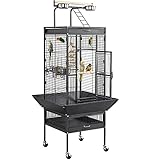
- Playground on top: The ladder and the wooden dowel on the cage roof give your feathered friends a comfortable place to stand and stretch wings. There are 2 feeding bowls for seeds and water and a slide-out tray for catching spilled seeds and droppings
- Lockable Doors & Easy Feeding System: Both the front door and the feeding doors are secured with locks to prevent your beloved bird from escaping. The external feeding doors let you refill food and water without opening the main cage door, avoiding disturbing your birds
- Designed for small/medium birds: With dimensions of 18''L x 18'W x 30.5''H (cage only) and 0.6'' bar spacing, this birdcage can accommodate small to medium-sized birds like cockatiels, conures, parakeets, lovebirds, canaries, finches. The overall dimension including play top & stand & seed guard is 26"L x 26"W x 61.5"H
- Effortless cleaning: Slide-out tray and detachable mesh bottom grate can be removed for easy cleaning. The mesh grate between birds and the tray can prevent birds from walking/perching directly in their excrement, which ensures your pets' health and the tidiness of the cage
- Smooth Indoor & Outdoor Mobility: This parrot cage sits on four 360-degree ball casters that ensure its free and smooth movement. You can effortlessly roll this birdcage anywhere—from your living room to the patio, backyard or balcony
It also would not be sound to fill the missing places with familiar names from memory. A species can be widely described as “large” without having a published measurement collected under the same method as the hyacinth macaw or kākāpō figures. An exact tenth-place claim therefore creates false precision, even when the general impression is plausible.
What a rigorous top-ten list would require
A future ranking can be useful if it follows a transparent method. The researcher should:
- Choose one primary measure. Decide whether the list ranks total length, body mass or another metric. If two records are presented, keep them in separate tables.
- Define the endpoints. For length, specify whether the measurement runs from bill tip to tail tip. For mass, state whether values are typical, average or maximum.
- Use comparable sources. Gather the same type of statistic for every species, preferably from national wildlife agencies, specialist conservation organizations or consistently edited field references.
- Record sex and age. A male maximum should not be compared silently with an all-sexes average.
- Keep units consistent. Convert grams to kilograms or centimetres to metres only when the conversion is exact, and preserve the original qualification.
- Show uncertainty. If two reputable sources give different upper figures, publish both with attribution rather than inventing a single blended number.
- Date the information. Conservation pages and species accounts can be revised, so readers should be able to tell when a figure was current.
The resulting table should include a citation or link for each row, the measurement definition, the sample scope and the date checked. A footnote can then explain whether “maximum” means the largest recorded individual or an authority’s stated upper limit. Without those details, a neat ranking may look scientific while hiding incomparable inputs.
How to read “largest” claims online
Check what was actually measured
A headline may call a bird the largest while the accompanying text means longest. Look for the words “total length,” “body mass,” “weight” or “wingspan.” If the metric is missing, the claim cannot be compared fairly with a measured value.
Separate a maximum from a normal size
“Up to” describes an extreme reported value, not the size a keeper or field observer should expect from every adult. A range such as 1,200–1,450 grams communicates something different from a 1.7-kilogram maximum. Neither should be silently rewritten as an average.
Crashes, No Sound, or Screen Glitches?
Random freezes, missing sound and display glitches usually trace back to one bad driver. Find and replace yours safely.Free scan · under a minuteWindows Errors? Fix Them Before They Spread
Repair common Windows errors and clear accumulated junk for a smoother, more stable PC - no reinstall needed.Free scan · no reinstallRank #4

- 2 Extra Birdcage Covers -Keep Clean & Protect Birds: Black birdcage cover blocks 90% sunlight & UV rays, creating a dark, cozy rest space for parakeets, cockatiels, and parrots
- Parrot-Proof Lock-No Escape, Even for Smart Birds: Glossy secure lock specially designed for parakeets, cockatiels, and parrots - smarter than traditional latches! No way to open it, ensuring your feathered friends stay safe inside
- Slide-Out Tray & Wrought Iron Wire-1-Minute Cleanup: Large slide-out tray catches bird droppings and food scraps - just pull, dump, and wipe! Durable wrought iron wire resists rust and stains, no more scrubbing hard-to-reach corners.
- For 2-3 Birds: Extra-large flight space for budgies, parakeets, lovebirds, cockatiels, or small parrots to stretch wings! Ample room for perches, and feeders-happy birds-quieter, less destructive pets
- 360° Swivel Wheels + Storage Rack-Move & Organize Effortlessly: 4 universal wheels glide smoothly on any floor-relocate your bird cage in seconds! Built-in storage rack holds bird food, and supplies-no more cluttered pet space
Look for the source’s population and sex scope
The kākāpō example demonstrates why scope matters: the Department of Conservation’s 4-kilogram figure is for males, while another educational source gives 3 kilograms for the species. A careful article keeps the qualification beside the number so readers can see what is being compared.
Distinguish a family range from a species record
Macaws are a group, and Los Angeles Zoo’s estimate of roughly one foot to more than three feet describes that broad group. It does not identify which species occupies either endpoint or establish a complete order. A family-level range is background, not a substitute for ten species accounts.
Independent reader supportYour contribution helps us test, update, and keep practical guides available for everyone.Conservation context behind the record holders
Kākāpō recovery
Historic hunting, introduced predators and habitat loss caused severe kākāpō declines. The species now survives on protected offshore islands and in a fenced mainland sanctuary. New Zealand’s recovery work includes moving birds to predator-free locations and managing breeding in protected areas.
Threats facing parrots more broadly
BirdLife International identifies habitat destruction, hunting, capture for the pet trade and introduced predators as major pressures on parrots. Its March 2025 conservation overview reports that 16 parrot species have already gone extinct and that nearly half of cockatoo species are threatened. Those figures are broad conservation statements, not evidence for the size of any particular species, but they explain why the largest parrots should be discussed as wild species rather than novelty pets.
Conservation figures should be date-stamped because assessments and management programs can change. Older population totals, including figures from earlier BirdLife DataZone entries, should not be presented as current counts unless the relevant authority has updated and confirmed them.
Best Value

- 11 PIECES BIRD TOYS: The bird toys include 11Pieces parrot toys to meet most bird's needs.Crisp bells' sounds and colorful wooden toys will catch the attention of your birds,they will spend most time to play with their interesting new toys. they are suitable for bird sports,standing,climbing, playing, chewing, resting,etc. It's the perfect gift for your bird friends.
- FOR VARIOUS BIRDS:Our bird toys provide your birds a good elevated place to meet your birds' natural needs; Make most birds do exercise ,strengthen their muscles, exactly suit for small parakeets, cockatiels, conures, macaws, parrots, love birds, Mynahs, finches ,pineapples ect.
- SAFE: These small interesting Bird toys are made of natural wood that dyed with edible color,which ensure the health and safety of your pet birds. They are completely handmade, very durable and bite-resistant. They can easily draw the attention of your pet parrots in a short time,climbbing and exploring.
- EASY TO INSTALL: All bird cage toys come with an hook which can attaches to the top of the bird cage easily.With these interesting bird toys attached in their cage,saving space and decorating the cage, your birds will have fun every day.
- GUARANTEE: If you are not satisfied with our products, just return it and a refund will do; we provide 24 hours customer services, please feel free to contact us.
What readers can conclude with confidence
- The hyacinth macaw holds the strongest source-backed claim for greatest total length, at about 90–100 centimetres and up to 1 metre.
- The kākāpō holds the strongest source-backed claim for greatest body mass, with males reported at up to 4 kilograms by New Zealand’s Department of Conservation.
- The hyacinth macaw’s reported mass reaches 1.7 kilograms in BirdLife International’s account, while the World Parrot Trust gives 1,200–1,450 grams.
- A precise first-to-tenth ranking cannot be responsibly stated without comparable measurements for every listed species.
- Whenever you see “largest parrot,” ask whether the claim means longest, heaviest, a maximum or a typical adult measurement.
The clearest answer is therefore not one species with an unqualified superlative. The hyacinth macaw is the longest by total length; the kākāpō is the heaviest by body mass. Treating those as separate records is more accurate than forcing unlike measurements into a fictional ten-place ranking.
Frequently Asked Questions
What is the largest parrot in the world?
It depends on the measurement. The hyacinth macaw is the strongest source-backed answer for greatest total length, reaching about 90–100 centimetres or up to 1 metre. The kākāpō is the answer for greatest body mass.
What is the heaviest parrot?
New Zealand’s Department of Conservation identifies the kākāpō as the heaviest parrot species and reports males weighing up to 4 kilograms. San Diego Zoo Wildlife Alliance gives an upper figure of 3 kilograms, so the source and qualification should stay with the number.
How big is a hyacinth macaw?
BirdLife International reports up to 1 metre in total length and up to 1.7 kilograms. The World Parrot Trust gives 90–100 centimetres and a mass range of 1,200–1,450 grams.
Why do sources give different weights for the same parrot?
They may use different samples, sexes, age classes, measurement methods or definitions of a maximum. A 4-kilogram male upper figure is not directly interchangeable with a 3-kilogram species figure or a typical range.
Can you list the ten largest parrots in exact order?
Not responsibly from the figures available here. A defensible top ten would need comparable length or mass measurements, identical definitions, sex and age scopes, and reliable attribution for all ten species.
Does the longest parrot have the greatest wingspan or weight?
Not necessarily. Total length, wingspan and body mass are different measures. The hyacinth macaw leads on the supported length claim, while the kākāpō leads on the supported mass claim.
Do these 3 things before closing this tab:
1Clear out junk files and repair common Windows errors2Fix the driver behind crashes, sound loss and screen glitches3Repair Windows errors before they cause bigger problemsThe Bottom Line
Bottom line: “Largest parrot” is not one record. The hyacinth macaw is longest at roughly 90–100 cm, with BirdLife International reporting up to 1 m; the kākāpō is heaviest, with New Zealand’s Department of Conservation reporting males up to 4 kg. Until every candidate is measured and sourced consistently, an exact ten-species ranking would be misleading.
Quick Recap
Product prices and availability are accurate as of the date/time indicated and are subject to change. Any price and availability information displayed on Amazon at the time of purchase will apply.





Leave a Reply