
What’s actually slowing this PC down?
Pick the symptom - the matching free tool is one click away.
The “giant frogs of Lake Titicaca” are Titicaca water frogs (Telmatobius culeus), an entirely aquatic species found only in Lake Titicaca and a few nearby Peruvian waters. Exceptional adults can reach about 20 centimetres (7.9 inches) from head to rump, but that is a maximum reported length—not the size of every frog. A more typical published range is about 3 to 5½ inches.
The frog’s loose, deeply folded skin is a life-support system rather than a deformity. Those folds greatly increase the surface available for absorbing oxygen underwater, an adaptation that helps the species live in the cool, high-altitude waters of the Andes. The species remains in serious trouble: a 2020 assessment reported an Endangered status and a 50–70% decline over roughly 40 years, while older pages may still call it Critically Endangered.
As an Amazon Associate I earn from qualifying purchases.
What is the giant frog of Lake Titicaca?
A species found nowhere else
The animal is the Titicaca water frog, Telmatobius culeus. It is endemic to the Lake Titicaca basin, meaning its natural range is confined to this region. Lake Titicaca straddles Bolivia and Peru, and the frog also occurs in a small number of adjacent water bodies on the Peruvian side.
Unlike most familiar frogs, this species is fully aquatic. It does not simply enter the water to hunt or escape predators; its entire life cycle is tied to the lake environment. The frog is most often recorded in shallow water, although observations have been made at depths of up to 100 metres.
#1 Best Overall

- FUNNY FROG FIGURINES - This adorable frog will leap right into your heart! The frogs statue lights combine the charming elements of the animal with the beauty of light. The simple , modern design blends unobtrusively into the living room etc and provides cozy light for an individual living ambience . The lamp completes the living area as a pretty accent light.
- SAFE SOLAR POWERED LIGHT - Brighten up an entryway or bedroom with these charming handmade coffee loving frog statue decor that are also great conversation pieces. Simply place it at a location with direct sunlight during the day, the solar panel will charge within 4-6 hours during the day and light up automatically at night for 6-8 hours. This is good for the environment and your wallet.
- DURABLE OUTDOOR LAWN DECOR - This chic Lawn Frog Ornaments light will stay with you for a long time and will give you a lot of pleasure. Our mini fairy garden accessories yard decor are made of high quality resin material, waterproof,cracking and fade resistant could work well even in heavy rain or snowstorms.
- HIGH-QUALITY - This Solar Lights Garden Decorations is made for your home. You can use In your flat, office, classroom or in your car. It ensures that your surroundings shine in the most beautiful lights and warm your heart. So you can enjoy mild summer nights or cool autumn evenings outside and sit inside in the cold season with cosy light.
- REST ASSURED SHOPPING - Size of the mini frog sculpture is 3.89 x 2.36 x 3.93 inches, small and not bulky. Packaged safely in the polyfoam to prevent damage during transportation. In addition, the solar garden ornament is the perfect present for birthdays, Easter, Mother's Day, Father's Day, anniversaries, or any celebration! Especially for kids love little frog!
Why it is called “giant”
Zoo Berlin describes the Titicaca water frog as the world’s largest fully aquatic frog and reports a maximum length of up to 20 cm (about 8 inches) from the head to the rump. That measurement is an upper limit. A Princeton University Press frog reference gives a 3–5½-inch length range, so an eight-inch frog should be understood as an unusually large individual, not an average adult.
| Figure | What it means | Source and qualification |
|---|---|---|
| Up to 20 cm (about 7.9–8 inches) | Maximum head-to-rump length reported for some individuals | Zoo Berlin species account; not a typical size |
| 3–5½ inches | Published size range used in a frog reference | Princeton University Press excerpt indexed in 2026 |
Length comparisons are easily distorted by photographs, perspective and whether a measurement includes the legs. When identifying the species, check that a claimed “eight inches” refers to head-to-rump length and is presented as a maximum.
How does the Titicaca water frog breathe underwater?
Loose skin that functions like respiratory equipment
The frog’s most conspicuous feature is its baggy appearance. Large folds hang along the body and limbs, giving the animal a wrinkled silhouette. These folds increase the amount of skin exposed to the surrounding water. Oxygen can then diffuse through the skin into a network of capillaries close to the surface.
A 1976 study by Victor H. Hutchison, Howard B. Haines and Gustav Engbretson documented the relationship between the folds, enlarged skin area and superficial cutaneous capillaries. In practical terms, the frog has more gas-exchange surface than a smooth-skinned frog of similar body size. Zoo Berlin also identifies the folds as an adaptation for absorbing oxygen.
An adaptation to cold, high-altitude water
Lake Titicaca lies high in the Andes, where water is cold and conditions differ from those experienced by lowland amphibians. The 1976 work describes the skin and blood-vessel arrangement as adaptations to life in cool, high-altitude water. The folds do not make the frog “inflated,” and they are not a sign that the animal is sick; they are part of its normal respiratory anatomy.
Rank #2
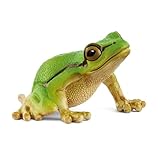
- SO REALISTIC IT MIGHT JUST CROAK - Beautiful detailing brings this green frog to life. Renowned worldwide for attention to detail, discover why children and adults choose schleich's true-to-life models.
- BIG ADVENTURES WITHOUT THE SCREEN - What adventure will this jumping frog figurine go on today? Nurture imagination and watch stories unfold as your child unleashes their creativity with montessori, screen free toys
- SCHLEICH FIGURES TURN FACTS INTO FUN - Make learning fun and transform your home or classroom into any habitat when you share lessons and inspire children's minds with our lifelike creatures.
- STEP INTO THE WILD SIDE OF WILD LIFE - Adventure awaits! Swing through the jungle with the monkeys, spot the lions on safari, hear the howl of the wolf through the trees. Our Wild Life play sets include grassland, woodland, forest creatures and more.
- IMAGINATION WITHOUT LIMITATION - Schleich toys come in all shapes and sizes to bring every story to life. We value sustainability which is why we have created diverse worlds of durable toys built-to-last that can be treasured for generations to come.
Because the frog relies so heavily on its skin, anything that degrades water quality can affect a basic physiological function. Pollution is therefore more than a nuisance in this species’ habitat: contaminated water can interfere with the environment through which it obtains oxygen.
Where in Lake Titicaca does it live?
A large lake with very different sampling conditions
The 2016 IUCN/TRAFFIC CITES proposal describes Lake Titicaca as approximately 8,500 square kilometres. In that account, the Minor Lake covers about 2,100 square kilometres and the Major Lake about 6,450 square kilometres. These are figures reported by the proposal, not a newly measured lake area.
The Tool Desk
Outbyte Driver Updater FREEScan for outdated or missing drivers - takes under a minuteDriver Scan →Outbyte PC Repair FREERepair Windows errors before they cause bigger problemsFix Now →| Lake section | Approximate area reported in the 2016 proposal | Why the distinction matters |
|---|---|---|
| Lake Titicaca overall | 8,500 km² | A basin-wide figure; it does not provide a frog census |
| Minor Lake (Lago Menor) | 2,100 km² | Some mortality reports refer specifically to this section |
| Major Lake (Lago Mayor) | 6,450 km² | Deep and geographically extensive; difficult to survey uniformly |
Why a lake-wide population number is elusive
Frogs are easier to count near shore than in deep water. The CITES proposal notes that some density surveys were brief, close to the shoreline and limited to shallow depths. Other observations have reached 100 metres, but no single survey covers the entire lake’s geography and depth profile. Estimates made in 2002 differed substantially, and the proposal cautions against treating a localized density measurement as a total-population estimate.
This is why a report from one bay, shoreline or lake section cannot automatically describe the status of all Titicaca water frogs. Comparisons are meaningful only when the location, depth, season, survey length and method are stated.
What is the frog’s conservation status?
The 2020 reassessment
The IUCN SSC Amphibian Specialist Group’s July 2020 account reports that a recent IUCN assessment changed the frog’s category from Critically Endangered to Endangered. The change reflected a revised estimate of the rate of decline over approximately 40 years; it was not evidence that the threats had eased or that the population had recovered.
Rank #3

- This Animal Doll House Miniature created by Thai artist is best quality & special design with handmade & Handmade painted work. This figure has as adorable action. It is also made with high quality glass and outstanding detail as you can see on picture above. Since it is handmade work so it may has a little different detail from picture. The items are not come from china. All of them are made by artisan of Thailand.
- Material : Glass, "It is a handmade product and may vary slightly."
- Great gift for your friend's birthday, holiday greeting gift or decoration stuff, 3D High Quality 100% Handmade Thailand Product
- Special design with handmade & handpainted work. The items are not come from china. All of them are made by artisan of Thailand.
- The glass handmade by Thai Artisan hand blown Animal figurines would be a great art craft decoration stuff for anywhere, any occasion, a lovely gift for your special person, lovely for mini fairy garden, perfect gift for animal lovers, collectible, centerpiece, living room, bedroom, dining room, your friend's birthday, your mothers fathers birthday, your girl fiend birthday, your boy fiend birthday, office desk, study club, etc.
| Status wording | How to interpret it | Date or source context |
|---|---|---|
| Endangered | Status reported after a reassessment based on the estimated long-term decline rate | IUCN SSC Amphibian Specialist Group account, 2020 |
| Critically Endangered | An older or unrevised label still displayed on some institutional pages | Zoo Berlin page continues to use this wording |
The specialist-group account reports an estimated 50–70% decline over roughly 40 years. A less severe category does not mean the frog is safe; it means the assessment’s criteria and decline estimate produced a different classification at that review.
Free tools Windows power users keep installed
One-click scans. No signup required.
Why different pages can show different labels
Conservation pages are not all updated at the same time. The 2020 account is the dated reassessment source, while Zoo Berlin’s undated species page retains the older Critically Endangered wording. When quoting the status, include the source and date rather than presenting the labels as if they were simultaneous, current measurements.
In 2020, Arturo Muñoz, regional co-chair of the Bolivian branch of the Amphibian Specialist Group, said: “But the reality on the ground is unchanged—or even worse than it was 16 years ago when the last assessment was conducted.” The statement is a contemporaneous warning that the category change should not be mistaken for an improvement in field conditions.
What threatens the Titicaca water frog?
Pollution and sewage runoff
Water pollution is one of the documented pressures on the species. The 2020 specialist-group account reports that more than 10,000 dead frogs were found on the Peruvian side in 2016, with the deaths likely associated with increased sewage runoff. This is a dated, place-specific report, not a current lake-wide mortality count.
Introduced fish
Introduced trout and silverfish can prey on tadpoles. Predation at the larval stage can reduce recruitment even when adult frogs are still visible. The effect should be evaluated alongside habitat and water-quality conditions rather than inferred from an isolated sighting.
Rank #4
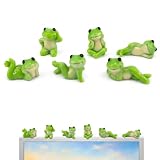
- 【Adorable Monitor Topper Set】 6PCS Cute Frog Monitor Figurines with Assorted Playful Poses – Perfect mini resin frog decorations designed to sit on your computer monitor, adding instant charm and a relaxing vibe to your workspace.
- 【Premium Quality Resin Material】 Crafted from high-quality, non-toxic durable resin with smooth glossy finish and vibrant colors. These lightweight yet sturdy frog figurines are fade-resistant, easy to clean, and built to last for years of cheerful decoration.
- 【Versatile Multi-Scene Decor】 Ideal for computer monitor, car dashboard, office desk, bookshelf, TV stand, windowsill, and home decor. Also great as creative accents in potted plants, terrarium, moss garden, or micro landscape displays.
- 【Easy to Display & Secure Placement】 Each cute frog figurine features a flat stable base for instant display. Comes with strong double-sided adhesive tape for secure attachment on monitor, desk, or car dashboard – no tools needed, easy to move or remove.
- 【Perfect Stress-Relief Gift】 A heartwarming and fun gift for friends, family, coworkers, students, or yourself! These charming frog decor pieces bring smiles, reduce work stress, and brighten any space – ideal for birthdays, housewarmings, or office companions.
Collection, food use and trade
The frog has been collected for food and traditional products, and illegal trade is listed among its threats. The 2016 CITES proposal gives an estimate of around 55,000 frogs harvested per year, but it also acknowledges uncertainty about the scale and nature of use and trade. That figure should therefore be labeled as a proposal-era estimate, not a verified current annual harvest.
The species was included in CITES Appendix I in 2016. Appendix I listing signals the highest level of international trade control under CITES and reflects concern about the impact of commercial exploitation on wild populations.
Disease and mass die-offs
Disease is another documented concern. The specialist-group account describes mass die-offs nearly every year from 2009 through 2016. It reports an 80% loss in Lago Menor in 2015 and more than 10,000 dead frogs on the Peruvian side in 2016. These figures describe specific reported events and should not be converted into a precise estimate of the frog’s present population.
Independent reader supportYour contribution helps us test, update, and keep practical guides available for everyone.How scientists should read population claims
Numbers about this frog often look precise while measuring very different things. A short shoreline transect, a mortality event in one lake section and a basin-wide trend estimate cannot be compared as though they were interchangeable.
Quick wins for a faster PC:
Scan for outdated or missing drivers - takes under a minuteDriver Scan →Clear out junk files and repair common Windows errorsFree Scan →- Check the geography: identify whether the figure covers Lago Menor, the Peruvian side, a particular bay or the entire basin.
- Check the depth: shallow-water counts may miss frogs living in deeper habitat.
- Check the time period: a 2015 die-off and a 40-year decline estimate answer different questions.
- Check the method: survey duration, visibility and sampling design affect density estimates.
- Keep estimates qualified: the CITES proposal itself says total population estimates are difficult because deep parts of the lake are hard to observe.
This caution is especially important for a species whose range includes a very large, deep lake. A dramatic local loss can be real without proving that the same percentage was lost everywhere.
Best Value

- A thoughtful gift perfect for home, garden or terrariums
- This product measures h: 1.75" W: 2"
- Cast in quality designer resin
- Hand painted and sculpted in amazing detail
What conservation measures are in place?
Binational cooperation
Bolivia and Peru signed a bilateral agreement in 2018 aimed at recovering Lake Titicaca and protecting the Titicaca water frog and Titicaca grebe. Because the lake crosses an international boundary, coordinated action is important for pollution control, monitoring and enforcement; a project in only one country cannot cover the full habitat.
International trade controls
The 2016 CITES Appendix I listing provides an international framework for restricting trade in wild-caught specimens. It does not, by itself, restore habitat or eliminate local collection, so it works alongside national enforcement and field conservation.
Handling confiscated frogs
Peru’s Ministry of Environment lists a 2025 protocol for the sanitary management, care, handling and release of confiscated frogs. The listing verifies the existence and purpose of an official protocol. It does not, without consulting the protocol itself, establish detailed release locations, survival rates or rehabilitation outcomes.
Recommended Free Tools
Jennifer Luedtke, manager of IUCN Red List assessments at Global Wildlife Conservation, said in the 2020 account: “We applaud the conveners of the binational action plan for balancing the need for action with the need for research.” That balance matters because conservation decisions require both immediate protection and better information about animals in deep or poorly sampled water.
How to interpret a photo or headline about an “8-inch” frog
- Confirm the name. Look for Telmatobius culeus or “Titicaca water frog,” not a generic claim about a large aquatic frog.
- Ask what was measured. The useful comparison is head-to-rump length. A photograph may exaggerate size through perspective or extended limbs.
- Separate maximum from typical. “Up to 20 cm” describes the largest reported individuals; it does not mean most frogs are eight inches long.
- Date the conservation label. The 2020 reassessment reports Endangered, while older pages may retain Critically Endangered.
- Locate the statistic. A mortality number or density estimate needs its lake section, date and survey method to be meaningful.
Why this frog matters
The Titicaca water frog combines an exceptionally specialized body plan with a very restricted range. Its skin folds, superficial capillaries and fully aquatic life show how an amphibian can evolve around a particular environment rather than merely tolerate it. That specialization also creates vulnerability: a species that absorbs oxygen through its skin is tightly connected to water quality, and an endemic species cannot shift to a distant lake when local conditions deteriorate.
The most accurate picture is therefore two-part. Some individuals really can approach eight inches, making the species unusually large among aquatic frogs. At the same time, the headline size should not overshadow the documented long-term decline, recurring die-offs, exploitation, introduced predators, disease and unresolved uncertainty about how many frogs remain across the whole lake.
Quick Recap
Product prices and availability are accurate as of the date/time indicated and are subject to change. Any price and availability information displayed on Amazon at the time of purchase will apply.





Leave a Reply