
Do these 3 things before closing this tab:
1Fix the driver behind crashes, sound loss and screen glitches2Clear out junk files and repair common Windows errors3Scan for outdated or missing drivers - takes under a minuteSome links on this page are affiliate links: if you buy through them we may earn a commission, at no extra cost to you.
Understanding the octopus and its relationships with humans starts with a careful verdict: octopuses can learn, remember, explore, distinguish between individual people, and respond differently to repeated experiences, but evidence does not show human-style friendship, language, or consciousness. Their relationships with keepers, researchers, filmmakers, aquariums, and fishermen are real interactions shaped by species, context, and welfare.
The most defensible language is familiarity, recognition, repeated interaction, or learned association. Octopuses are behaviorally complex animals whose minds evolved along a very different path from human minds, so compelling behavior should be taken seriously without being translated automatically into human emotions.
As an Amazon Associate I earn from qualifying purchases.
What’s actually slowing this PC down?
Pick the symptom - the matching free tool is one click away.
Key takeaways
- Octopuses learn, explore, remember, solve problems, and habituate to familiar objects, but their intelligence evolved independently from vertebrate intelligence.
- In a 2010 study of eight giant Pacific octopuses, researchers found different responses to two individual humans associated with feeding and an aversive handling experience.
- Octopus behavior is not simply solitary: a 2011 study found behavior consistent with remembering a familiar conspecific, while a 2024 study documented flexible octopus–fish hunting groups.
- A 2022 review of more than 300 studies found strong evidence relevant to cephalopod sentience, but sentience does not establish human-like language, friendship, or self-awareness.
- Human relationships with octopuses include care, research, documentary observation, aquariums, food systems, and fisheries, and each relationship creates different welfare and ecological responsibilities.
Can octopuses recognize individual humans?
Yes, the best direct evidence says that at least some octopuses can discriminate between individual humans and respond differently according to their previous experiences. The finding is more precise than saying that an octopus recognizes an owner in the same emotional or conceptual sense that a dog might recognize a family member.
The clearest evidence comes from Anderson, Mather, Monette, and Zimsen’s 2010 study of eight giant Pacific octopuses, Enteroctopus dofleini. The researchers exposed the octopuses to two unfamiliar people over two weeks. One person consistently fed the animals; the other touched them with a bristly stick. At the end of the exposure period, the octopuses showed significantly different body patterns and behaviors toward the two people. The larger octopuses also showed different respiratory responses. The 2010 individual-human recognition study is the strongest evidence for this claim.
Popular on Amazon

- Material: PP cotton polyester, made of durable short plush fabric, very soft and comfortable, realistic plush for kids to hug.
- Size: Perfect size 16"/40cm, the cute style means it will look great wherever you put it without taking up too much space
- Style Design: Electro-embroidery craftsmanship, cute expression, big eyes and lively, tight stitching, inner cotton will not be exposed, this octopus can be used as any ocean theme pie, take you on a journey to the ocean.
- PERFECT GIFT: Birthday gifts, Christmas gifts, boys and girls birthday room decorations, or as a gift for family or loved ones, perfect for sofas and beds.
The responsible conclusion is that the octopuses learned that two people predicted different kinds of experiences. Their responses may have used visual, contextual, and associative information. The study supports individual discrimination; the study does not prove that octopuses form an abstract human-style concept of personal identity or experience the relationship as friendship.
What does recognition mean for keepers?
Recognition can affect approach, avoidance, and stress-related behavior even when the animal’s inner experience remains uncertain. Professional cephalopod-care guidance therefore recommends, where possible, separating staff who perform aversive procedures from staff responsible for routine feeding or inspection. A keeper should treat a change in an octopus’s behavior toward a particular person as a welfare-relevant observation, not as proof that the octopus loves or hates that person. The professional guidelines for cephalopod care and welfare in research provide the relevant context.
Quick wins for a faster PC:
Clear out junk files and repair common Windows errorsFree Scan →Scan for outdated or missing drivers - takes under a minuteDriver Scan →Repair Windows errors before they cause bigger problemsFix Now →Are octopuses intelligent?
Octopuses are behaviorally sophisticated animals. Smithsonian Ocean describes octopuses learning from experience, opening jars, escaping enclosures, exploring unfamiliar objects, and becoming accustomed to objects that remain harmless and familiar. These behaviors demonstrate flexible learning, memory, exploration, and problem-solving; they do not demonstrate that octopuses reason in the same way humans do.
Octopus intelligence evolved along a separate route from human and other vertebrate intelligence. An octopus solves problems with eight flexible arms, distributed neural control, highly developed tactile and chemical sensing, camouflage, and a body adapted to an aquatic environment. Asking whether an octopus is close to a human is therefore less useful than asking what problems an octopus can solve with its own body and sensory system. Smithsonian Ocean’s cephalopod explainer describes the specialized nervous system and behavior that make this comparison important.
Jonathan Birch, a professor and researcher associated with the London School of Economics and Political Science, captures the evolutionary distance without calling octopuses primitive: Cephalopods are extremely interesting because they’re separated from us for over 500 million years of evolution.
The point is that complex behavior arose independently in cephalopods and vertebrates, not that octopuses are unchanged relics. The statement appears in the LSE discussion of animal welfare legislation and animal sentience.
Also popular on Amazon
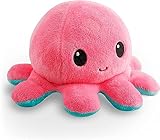
- Compact Reversible Plushie: This 4-inch octopus plush flips between two expressive sides for quick, playful mood changes. Its small size makes it a fun companion for your desk, shelf, backpack, or travel bag.
- Delightfully Soft Companion: An ultra-soft, reversible plush with smooth flipping motions that make it fun to handle. Its expressive two-sided design offers a simple tactile experience for everyday play.
- Premium Materials for Collectors: Crafted with embroidered details, soft fabric, and durable stitching, our plush toys are safe for all ages, and easy to clean.
- Adorable Gift for Any Occasion: Our cute plushies make an ideal present for birthdays, Christmas, Valentine’s Day, Easter, baby showers, graduations, or as a thoughtful gesture to show you care.
- Original TeeTurtle Design: The TikTok viral reversible plushie sensation-collect every adorable color and character for all your moods. These plushies are ideal for collectors, fans, and anyone who enjoys a cozy, huggable companion.
For a deeper philosophical and biological look at octopus minds, read Other Minds by Peter Godfrey-Smith. Penguin Random House’s reading guide lists the book as relevant nonfiction. The book is useful for thinking about evolution and consciousness, but no book can turn an unresolved question about octopus experience into controlled experimental evidence.
Recommended Free Tools
Do octopuses have feelings or consciousness?
There is strong scientific evidence that cephalopods are sentient, meaning that they may have experiences that matter to them, including potentially positive and negative experiences. Sentience is not the same as proving human-like self-awareness, human language, or a human emotional bond.
The London School of Economics review by Birch, Browning, Burn, Schnell, and Crump examined more than 300 scientific studies of cephalopods and decapod crustaceans. The 2022 LSE review of evidence for cephalopod sentience considered neurological, behavioral, physiological, cognitive, and welfare evidence. The review supports taking pain, distress, enrichment, and other welfare questions seriously while leaving the exact character of an octopus’s subjective experience unresolved.
The Scottish Animal Welfare Commission reached a related conclusion in its 2021 cephalopod case study: the evidence threshold for sentience had been exceeded for cephalopods. In November 2021, the UK government also announced that octopuses, lobsters, and crabs would be recognized as sentient beings within the scope of its animal-welfare legislation. These policy conclusions support precaution and better treatment; they do not settle every philosophical question about consciousness. The Scottish Animal Welfare Commission report and the UK government announcement explain those developments.
| Question | What the evidence supports | What the evidence does not establish |
|---|---|---|
| Can octopuses learn? | They can explore, solve novel problems, learn associations, and habituate to familiar harmless objects. | They think through problems using human-like reasoning. |
| Can octopuses recognize people? | Some octopuses can respond differently to individual humans linked with different experiences. | They understand ownership, family membership, or friendship as humans do. |
| Are octopuses sentient? | Multiple reviews find strong welfare-relevant evidence for cephalopod sentience. | Every detail of octopus consciousness or selfhood is known. |
| Do octopuses use human language? | Octopuses communicate and respond through their own species-specific signals and behavior. | They share a symbolic human language with people. |
Are octopuses really solitary?
Many octopus species are commonly described as solitary, but solitary does not mean socially incapable. Octopuses can encounter, recognize, tolerate, avoid, compete with, mate with, and sometimes coordinate around other animals, with the exact pattern depending on species and context.
Also popular on Amazon

- ●Lifelike eight-legged Octopus plush toy, soft plush fabric, big eyes, like the real octopus in the depths of the ocean, vivid and lovely.
- ●The stuffed marine animals toy is perfect for everyone, birthdays, Valentine's Day, Christmas, Easter and other important holidays; it is also perfect for any maritime theme party or water party.
- ●Giant stuffed octopus is the perfect animal pillow, sleeping, can be held while resting, leaning, very soft and comfortable.
- ●Length is 55 cm from forepaws to hindpaws. Suitable for children over 3 years old.
- ●Large octopus stuffed animal is recommended for warm water washing and hand washing. Do not dry or bleach.
Tricarico, Borrelli, Gherardi, and Fiorito’s 2011 study tested whether Octopus vulgaris could distinguish familiar from unfamiliar members of its own species. The octopuses appeared able to recognize a conspecific and remember that individual for at least one day. The authors appropriately noted that additional research was needed to determine whether the behavior represented true individual recognition or a form of habituation. The 2011 study of individual recognition in Octopus vulgaris is therefore evidence consistent with recognition, not final proof of a human-like social identity concept.
A 2024 study of Octopus cyanea examined multispecies hunting groups involving fish. The researchers analyzed leadership, social influence, group composition, and aggressive displacement. An octopus may benefit from fish that flush prey into reach, yet punish or displace a fish that takes food or interferes. The result looks cooperative in one moment and competitive in another. The 2024 study of octopus–fish hunting groups shows flexible interaction, not human morality or teamwork in the ordinary sense.
What kinds of relationships do octopuses have with humans?
Human–octopus relationships are real in the sense that repeated interactions can shape behavior, but the word relationship covers very different situations. A laboratory keeper, filmmaker, aquarium visitor, and fisherman do not have the same relationship with the same animal, and the evidence for familiarity should not be used to imply affection in every setting.
| Human setting | What may be observed | What it means responsibly | Main responsibility |
|---|---|---|---|
| Keeper or aquarist | An octopus may approach one person, avoid another, or react differently after repeated feeding and handling. | Familiarity and learned associations can influence behavior; affection is an interpretation, not an established conclusion. | Keep routine care predictable and avoid combining aversive procedures with all positive care when staffing allows. |
| Research institution | Learning, memory, exploration, problem-solving, and responses to people can be studied directly. | Research can produce strong evidence, but procedures must account for cephalopod welfare and possible sentience. | Use expert husbandry, minimize distress, and design enrichment and procedures around the animal’s needs. |
| Public aquarium | Visitors may observe denning, camouflage, exploration, feeding, and species-specific behavior. | Captive observation can educate people without proving that an animal wants to be handled. | Provide secure, species-appropriate housing, water quality, shelter, flow, and welfare-focused enrichment. |
| Documentary observation | Long-term observation can reveal individual habits, repeated encounters, mortality, and human interpretation. | A personal narrative can be meaningful without functioning as a controlled experiment. | Prioritize non-invasive observation and distinguish cinematic interpretation from scientific evidence. |
| Fishery or food system | Octopuses become sources of food, income, and trade in relevant coastal communities. | The relationship is economic and ecological rather than a claim about the animal’s feelings toward people. | Manage species and regions specifically so livelihood needs do not encourage over-exploitation. |
Is My Octopus Teacher scientifically accurate?
My Octopus Teacher is best understood as a personal documentary narrative about long-term observation, not as a controlled experiment proving human–octopus friendship. Netflix’s official materials describe a filmmaker repeatedly visiting a South African kelp forest and developing an unusual relationship with a common octopus. Netflix’s 2020 production information says the project was filmed over eight years and involved 3,000 hours of footage. The official Netflix Media Center description supplies those production details.
The Tool Desk
Outbyte PC Repair FREEClear out junk files and repair common Windows errorsFree Scan →Outbyte Driver Updater FREEFix the driver behind crashes, sound loss and screen glitchesFind Drivers →The film can accurately communicate the emotional power of attention, familiarity, mortality, and human interpretation. The film cannot by itself establish what the octopus subject felt, whether the animal understood the relationship as friendship, or whether the behavior generalizes to octopuses as a group. Netflix’s U.S. title page identifies My Octopus Teacher as a 2020 documentary set around a South African kelp forest.
Also popular on Amazon

- Delve into the depth of Octopuses: Celebrated for their intelligence, flexibility, and mesmerizing beauty, octopuses are true wonders of the marine realm. The Pocketkins Eco Octopus encapsulates this marine marvel’s elegance and intrigue, offering a plush peek into the underwater universe.
- A plush with purpose: The Pocketkins Eco Octopus is more than just a cuddly companion. Made from the finest recycled materials, it ensures softness that lasts, while championing a future where playtime and planet care go hand in hand. Dive into responsible comfort today!
- This stuffed animal makes a great gift: perfect for baby showers, birthday gifts, holiday gifts, room decoration, and themed parties. This is also perfect for teaching children about wildlife.
- Toy Safety: Exceed the requirements set by CPSIA (USA) and EN71 (EU) for safety standards and specifications.
- Wild Republic is the global leader in designing and manufacturing realistic and whimsical plush and toy for kids of all ages since 1979. The company was founded on the principle of fostering the curiosity of wildlife and the wonders of nature.
For a personal and cinematic perspective, watch My Octopus Teacher. Pair the film with the recognition studies and welfare reviews rather than treating the documentary as experimental proof of human–octopus friendship.
Independent reader supportYour contribution helps us test, update, and keep practical guides available for everyone.Are octopuses good pets?
For most ordinary pet owners, an octopus is not a suitable casual pet. Octopuses are escape-prone, highly curious, sensitive to their surroundings, difficult to house, and associated with serious welfare obligations. A public aquarium or experienced research institution may have the staff, systems, and expertise to care for one; a home aquarium should not be assumed to meet those standards simply because an octopus is small or intelligent.
What does responsible octopus care require?
Professional care guidance emphasizes a secure enclosure, species-appropriate space, suitable water flow, shelter, and conditions that allow normal locomotion and behavior. A den is essential for octopuses, and enclosure security matters because an octopus can exploit small weaknesses and escape. The UK’s advisory standards for animals used in science describe the relevant housing and accommodation expectations.
Enrichment should give the animal opportunities to explore and express species-appropriate behavior without damaging water quality or creating new hazards. A 2023 study of Octopus vulgaris in a recirculating aquaculture system considered physical, cognitive, nutritional, social, and occupational enrichment, while also acknowledging that cephalopod enrichment research remains comparatively limited. The 2023 environmental-enrichment study does not justify the idea that a few toys automatically satisfy an octopus’s needs.
| Claim | More accurate interpretation |
|---|---|
| An octopus is intelligent, so it will be easy to keep. | Intelligence can increase the need for secure housing, stimulation, observation, and specialized care. |
| An octopus approaches a hand, so it wants to be touched. | Approach may reflect curiosity, feeding history, or another learned association; it is not consent to handling. |
| A tank contains enrichment, so captivity is automatically humane. | Enrichment can support welfare, but it does not erase demands involving space, water quality, shelter, escape prevention, and expert care. |
| A small species is suitable for a home aquarium. | Size alone does not establish that a home system can meet the species’ behavioral and welfare needs. |
The practical conclusion is not that humans must never observe or interact with octopuses. The conclusion is that interaction must remain subordinate to animal welfare. Readers considering an octopus should consult species-specific guidance from qualified aquarium or cephalopod-care professionals rather than relying on casual pet-store advice.
Also popular on Amazon

- Soft plush fabric ; Huggable and super cute ; Comes with its own story
- This plush stuffed animal is securely sewn from high quality polyester fabrics and filled with white polypropylene plush filling
- Recommended for ages 3+ ; No phthalates, lead, BPA, or heavy metals ; We have our products and components tested in accredited labs for compliance with CPSIA and ASTM F963-11 safety standards ; Please hand wash with light soap and cold water and let air dry
- Size and weight ; Product measures 18 x 12 x 6 in inches ; 45.8 x 30.5 x 15.3 in centimeters ; Product weighs approximately 2 pounds or 1 kilograms
- Manufacturer warranty ; 90 day manufacturer warranty for all manufacturer's defects
What is the relationship between octopuses and fishermen?
Octopus fisheries connect animal welfare and ecology with human income. FAO Fisheries and Aquaculture Report No. 990 describes octopus sales as important to fishing livelihoods in relevant coastal communities, while also documenting over-exploitation, the capture of small or immature animals, declining catches, and low catch rates in some settings. The FAO fisheries report supports a regional, species-specific discussion rather than a claim about every octopus fishery.
FAO’s broader material on sustainable small-scale fisheries explains why conservation decisions can affect food systems and coastal livelihoods. The issue is not simply octopus protection versus fishermen’s interests. Seasonal rules, size limits, local knowledge, enforcement, fair access, and evidence-based management can influence both the persistence of octopus populations and the welfare of people who depend on fishing. The FAO overview of sustainable small-scale fisheries provides that wider livelihood context.
Free tools Windows power users keep installed
One-click scans. No signup required.
Because fisheries evidence varies by species, stock, and region, statements such as all octopuses are endangered or octopus populations are healthy everywhere are not responsible. A conservation claim should name the species and location, identify the fishery or population being discussed, and distinguish a local decline from a global conclusion.
How should humans interpret octopus behavior?
The safest approach is to separate observation from interpretation. A behavior can be real and meaningful without carrying the human meaning that people instinctively assign to it.
- Recognition is not friendship. An octopus can learn that different people predict different experiences without forming a human-style emotional bond.
- Curiosity is not consent. An octopus approaching a person or object may be exploring, feeding, or responding to a learned association; approach is not permission to touch or handle the animal.
- Intelligence is not human reasoning. Flexible problem-solving reflects an octopus’s own evolutionary and sensory architecture rather than an incomplete version of a human mind.
- Sentience is not human self-awareness. Evidence that experiences may matter to an octopus supports welfare protection but does not answer every question about selfhood or consciousness.
- Social flexibility is not human morality. Cooperation-looking behavior with fish can coexist with aggression, competition, and displacement.
- Anecdote is not a species-wide result. Individual behavior can be compelling while still failing to generalize across octopus species, populations, or settings.
What do we know, and what remains unknown?
The evidence supports a carefully bounded picture. Octopuses are capable of complex behavior and can form learned patterns of interaction with people and other animals. The evidence does not justify filling unresolved questions with anthropomorphic certainty.
| Established or strongly supported | Still unresolved or unsupported |
|---|---|
| Octopuses learn, explore, remember, habituate, and solve novel problems. | Whether octopuses possess human-like reasoning or a human-like concept of self. |
| At least some giant Pacific octopuses respond differently to individual humans. | Whether an octopus experiences that discrimination as love, dislike, friendship, or ownership. |
| Behavior in Octopus vulgaris is consistent with remembering a familiar conspecific for at least one day. | Whether that behavior is true individual recognition rather than habituation. |
| Some octopus–fish hunting groups show flexible social influence and changing cooperation and competition. | Whether those interactions represent human-style teamwork, morality, or communication. |
| Scientific reviews support serious welfare obligations because cephalopod sentience is strongly evidenced. | The exact subjective character of octopus consciousness and the extent of self-awareness. |
| Octopuses are involved in aquarium care, research, media, food systems, and fisheries. | A single global conclusion about the conservation status or welfare needs of all octopus species. |
The Bottom Line
Octopuses can learn who people are in the practical sense that different individuals may predict different experiences, and octopuses can develop complex patterns of interaction with humans. The evidence supports familiarity, discrimination, flexible behavior, and serious welfare consideration—not human-style friendship, language, or a settled explanation of octopus consciousness.





Leave a Reply