Outdated Drivers Are Slowing You Down
One free scan finds every outdated or missing driver and matches the right update for your exact hardware.Free scan · exact hardware matchPC Slower Than It Used to Be?
A free scan shows the junk files, broken settings and background clutter dragging Windows down - then fixes them in one click.Free scan · Windows 10 & 11Your cat’s vaccine plan is set by its age, vaccination history, health, lifestyle, likely exposure to disease, and the rules where you live. The AAHA/AAFP Feline Vaccination Guidelines (2020) name four core vaccines for pet cats: feline herpesvirus-1 (FHV-1), feline calicivirus (FCV), feline panleukopenia virus (FPV), and rabies. Feline leukemia virus (FeLV) is also core for kittens and cats under one year. These are consensus recommendations, not a single mandatory schedule, so the practical answer is an individualized plan from your veterinarian built on your cat’s records.
What “core” means, and what it does not mean
Core vaccines protect against diseases that are serious, widespread, or both. Core does not mean that every cat gets every core vaccine on an identical timetable. The guideline asks veterinarians to base the plan on life stage, lifestyle, location, exposure, clinical history, and health, and to review each cat’s risk at least once a year. Travel, boarding, a multicat household, or time outdoors can all change that assessment.


| Vaccine | Category in AAHA/AAFP 2020 guidance | Who it applies to |
|---|---|---|
| FVRCP (FPV, FHV-1, FCV) | Core | All pet and shelter cats |
| Rabies | Core, with schedule set by product label and local law | All cats, where required or advisable |
| FeLV | Core through age one; non-core after that | Kittens and cats under one year; older cats based on exposure |
| Chlamydia felis | Non-core | Case-by-case; used in control programs for confirmed infection |
| Bordetella bronchiseptica | Non-core | Not routine in pet cats; may be used in control programs for confirmed infection in multicat households |
| FIP | Not generally recommended | Guideline states field protection is not sufficiently supported |
The kitten series
Kittens need a series of doses rather than one shot. Maternal antibodies from the queen can interfere with a vaccine if it is given too early, and they wear off at different rates in different kittens. For injectable FVRCP (attenuated-live and inactivated products), the 2020 schedule starts no earlier than 6 weeks of age and repeats every 3–4 weeks until 16–20 weeks. The exact schedule depends on the vaccine type and route, so ask your veterinarian which product is being used and when the final kitten dose falls.
Why a dose at 6 months is recommended
The AAHA/AAFP FAQ explains that maternally derived antibodies can still blunt the final kitten dose. It summarizes studies suggesting that up to one-third of kittens may not respond to a final core dose given at 16 weeks, and that maternal antibodies may still block response at 20 weeks. This figure comes from that summary of earlier studies and should not be read as a rate that applies to every kitten or every vaccine. The guideline therefore recommends considering an additional FVRCP dose at about 6 months of age, a recommendation the AAHA/AAFP FAQ links to World Small Animal Veterinary Association (WSAVA) guidance.
What’s actually slowing this PC down?
Pick the symptom - the matching free tool is one click away.
#1 Best Overall

- Impressive Quantity and Appropriate Size: the package includes 25 cat health records, offering a generous quantity for pet owners with multiple cats or veterinary practices; The unfolded size measures 7.87 x 10.63 inches/ 20 x 27 cm, and the folded size is 7.87 x 3.54 inches/ 20 x 9 cm, making it ideally suited for easy storage and convenient access of your pet's vital health information
- Distinctive Color and Reliable Material: presented in aesthetically pleasing shades of blue and white, these cat shot record booklets ensure that your pet's health data stands out; Crafted from durable 120 g offset paper, these records offer long lasting quality, ensuring the preservation of critical information for an extended period
- Ideal for Multiple Users and Various Occasions: from individual pet owners to professional veterinarians, these cat vaccine record books cater to a wide range of users; Their practicality makes them equally suited for various occasions, ranging from regular vet appointments to emergency visits
- Meaningful Gift for Pet Lovers: a thoughtful gift for any cat owner, these kitten health records not only indicate care for the pet but also understanding of the owner's responsibility; Gift these records to promote responsible pet ownership and foster better pet health
- Tri Fold Design for Enhanced Convenience: with a practical tri fold design, these animal health records provide an organized structure, making it easy for users to track the health history and vaccination records of their pets
Kitten vaccine checklist
- FVRCP series starting no earlier than 6 weeks, repeated every 3–4 weeks through 16–20 weeks
- Consider an extra FVRCP dose around 6 months
- Rabies vaccine timed to the product label and local law
- FeLV: test antigen status first, then give the initial doses described below
- Written record of the date, product, route, and injection site for every dose
Adult boosters and revaccination
For the FVRCP vaccines after the kitten series, the guideline suggests revaccination every three years for the parenteral schedules it lists. That interval is tied to specific products and schedules, so it is not a universal rule for every vaccine on the market. Your veterinarian should confirm the interval against the label of the product your cat actually received.
Rabies is handled differently. A three-year interval is recommended only where local regulations permit it and only with a vaccine labeled for three years. Otherwise, follow the label and your local requirement, which may be annual. Adult cats do not all need the same boosters, which is why an individualized plan matters more than a fixed calendar.
Rank #2
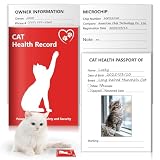
- 1.You’ll Get:When you choose our cat vaccines records tracker, you'll receive one notebook.This 12-page Kitty health journal has 8 dedicated pages for tracking your pup’s health, vet visits, and key details, with 4 blank pages at the end for jotting down extra notes, pet cat-related info, or anything else you want to record.
- 2.Ideal Size for Record Keeping:Each cat vaccine record book measures 5x3.5 inches folded; 5x7 inches unfolded, allowing for easy portability and storage.These handy health records notebook for cats with double sided printing, featuring enough space for all your pets important information,plus, it has dedicated spots for sticking on vaccine stickers and adding cute kitten photos.They offer a stylish and organized approach to pet health documentation, a must have addition to your pet supplies.
- 3.Premium Quality: The cat health record tracker’s cover features 300gsm coated paper with vibrant full-color printing and a protective laminate finish. Inside, 80gsm high-quality offset paper pages are durable and ink-resistant, ensuring no bleeding from pens or markers—so your records stay neat and easy to read.
- 4.Essential for cat owners: This kitten health record book is designed for vet clinics & owners. Track key health info (vaccines, exams, treatments) easily. When you’re away, pet sitters/family can quickly check medical history for seamless care. Kitten record book with photo, vital signs & ID sections, it helps in emergencies—even if your kitten gets lost.
- 5.Effortlessly Track Vaccinations and More:The cat canine health record booklets pages include:owner and cat information,medical history and hospitalizations,vaccination record and sticker,cat service providers,fecal examinations and de-worming,heartworm screening, prevention and treatment etc.This record keeping tool will ensure every important detail is accounted for and make this task easy, organized, and straightforward.Add this essential tool to your pet supplies for a happier, healthier pet.
FeLV: an age and exposure decision
FeLV recommendations depend on age and risk. For kittens and adults without an initial series, the guideline lists two initial doses given 3–4 weeks apart. Before vaccinating, the cat should be tested for FeLV antigen status, because the guideline calls for testing first. A booster is recommended 12 months after the last kitten-series dose. After that, cats with ongoing high exposure to FeLV-positive or unknown-status cats generally receive annual revaccination, while low-risk adults may not need continued FeLV vaccination. Outdoor access, shared housing with cats of unknown status, and contact with stray or shelter cats are the kinds of exposure to discuss.
Non-core vaccines and why they are optional
Non-core vaccines are chosen on the basis of exposure and local disease patterns rather than given to every cat. For Bordetella bronchiseptica, the guideline says the vaccine is not routinely used in pet cats, offers incomplete protection, and may be used within a control program in a multicat household where infection has been confirmed. For Chlamydia felis, the vaccine also offers incomplete protection and may be used in a control program for confirmed infection. The guideline notes possible adverse effects such as lethargy, limb soreness, and reduced appetite.
Quick wins for a faster PC:
Fix the driver behind crashes, sound loss and screen glitchesFind Drivers →Clear out junk files and repair common Windows errorsFree Scan →Scan for outdated or missing drivers - takes under a minuteDriver Scan →Rank #3

- COMPLETE HEALTH RECORDS FOR CATS & SMALL PETS: Comprehensive veterinary record booklets designed to track vaccinations, exams, deworming, and treatments. Perfect for maintaining organized, up-to-date medical histories for cats, kittens, and small animals."
- 25 INDIVIDUAL BOOKLETS PER PACK: Includes 25 separate records—ideal for multi-pet households, shelters, rescues, breeders, or veterinary clinics that manage multiple animals. Each booklet provides structured documentation for easy organization."
- CLEAR, CUSTOMIZABLE FORMAT FOR EASY RECORDING: Each page features clearly labeled sections for vaccines, dates, treatment details, and veterinarian notes. The user-friendly layout allows for quick, legible recordkeeping at home, during exams, or on the go."
- PORTABLE AND CONVENIENT DESIGN: Compact and lightweight, these cat health record booklets fit easily into folders, travel bags, or adoption packets. Keep vital health information accessible during vet appointments, travel, or transfers."
- IDEAL FOR PET OWNERS, BREEDERS & PROFESSIONALS: Perfect for breeders, shelters, veterinarians, and pet owners who want a professional way to document a cat’s medical care. Simplifies communication between caregivers, adopters, and clinics."
The guideline does not generally recommend the FIP vaccine, because there is insufficient evidence that it provides clinically relevant protection in the field. Products aimed at the same pathogen should not be assumed to be equivalent, so ask which product is being proposed and why.
Cats with unknown or overdue vaccine history
If you adopted a cat and do not know what it has received, the plan depends on its age and the environment. The AAHA/AAFP FAQ describes, for a cat over 16 weeks with an unknown core-vaccine history in a low-risk environment, either one attenuated-live core dose or two inactivated doses given three weeks apart. High-risk situations, the product label, medical history, and local rabies law can change this approach. Likewise, a cat overdue for core vaccines (rabies excepted) is handled according to the FAQ’s guidance on overdue cats, so bring whatever records exist rather than guessing.
Independent reader supportYour contribution helps us test, update, and keep practical guides available for everyone.Injection-site sarcoma and post-vaccination swelling
Injection-site sarcoma is uncommon but serious. The guideline recommends giving vaccines in the distal limb or tail, so that a tumor that develops at the site can be surgically removed more completely. Your veterinarian may record the exact site and route of each injection for this reason, and you should ask for that record to be kept with your cat’s file.
Mild, temporary swelling at the injection site can occur after vaccination. The guideline’s “3-2-1 rule” is the tool for deciding when a lump needs an examination: a swelling that persists beyond about three months, grows after about one month, or is larger than about 2 cm should be evaluated by a veterinarian. A lump that is firm, enlarging, or still present months later should be checked promptly rather than watched at home. The guidance does not provide emergency triage instructions for every possible reaction, so contact your veterinarian about any sudden illness after a vaccine.
Do these 3 things before closing this tab:
1Repair Windows errors before they cause bigger problems2Scan for outdated or missing drivers - takes under a minute3Clear out junk files and repair common Windows errorsWhat vaccination cannot promise
Vaccination lowers risk but does not guarantee protection. The AAHA/AAFP guideline states that accurate prediction of the outcome of vaccination, or of the likelihood of exposure to a pathogen, is impossible. Immune response varies between individual cats. For that reason, vaccines work best alongside other sensible steps such as limiting contact with unknown or stray cats, keeping litter and food areas clean, and reducing exposure during travel or boarding.
The guideline also describes the decision to vaccinate, even for core vaccines, as a risk-benefit assessment made for each cat and for each vaccine antigen.
What to bring to your veterinarian
- Any previous vaccine records, including dates, product names, and injection sites
- Your cat’s age, indoor, outdoor, or mixed lifestyle, and any boarding or travel
- Information about other cats in the home or regular contact with cats of unknown status
- Your local rabies requirements and any licensing rules where you live
- Any past vaccine reaction or ongoing medical condition
Ask your veterinarian to explain the reason for each vaccine, the dose interval, the product, and the injection site. A good plan should be able to answer those four questions for every vaccine on the schedule.
Vaccine rules and product labels can change, and local requirements differ by jurisdiction, so use the AAHA/AAFP guidelines (2020) as the reference point and confirm the current local rules with your veterinarian or local authority.
Quick Recap
Product prices and availability are accurate as of the date/time indicated and are subject to change. Any price and availability information displayed on Amazon at the time of purchase will apply.




