If your dog growls or barks at a guest, calmly create distance and prevent contact. Ask the guest not to stare, reach toward, lean over, or approach your dog. Do not punish the growl or force a greeting: the immediate goal is safety and space, not making the dog interact.
If your dog has bitten or tried to bite, lunges or snaps at visitors, or you cannot safely keep everyone apart, put the dog behind a secure barrier and seek in-person help. A veterinarian can check for health-related causes and help you find an appropriate behavior professional.
What barking or growling at a guest may mean
Barking and growling are signals, not a diagnosis. A dog may be afraid or uncomfortable around visitors, but the sound alone does not tell you why the dog is reacting. Look at the whole situation: the dog’s posture, what the guest is doing, how close they are, and whether the dog has room to move away.
Signs of distress can include trying to retreat, crouching, turning away, lip licking, yawning, stiffening, staring, or raised hair along the back. If the dog feels threatened and cannot escape, distress may escalate. A growl is useful information that the dog is uncomfortable; punishing it may suppress the warning without changing the underlying feeling.
Do these 3 things before closing this tab:
1Repair Windows errors before they cause bigger problems2Fix the driver behind crashes, sound loss and screen glitches3Clear out junk files and repair common Windows errors#1 Best Overall

- New communication tool about you and your puppy.
- Pet Dog Training Clickers for Puppy, Cat, Potty, Bird, Horse, Pet, Trainer Training Tools, Behavior Aids
- Just press to mark desired behavior, then reward for faster learning.
- The spring wrist length : 16cm/6.3inches and can strength to 25cm/9.84inches.
- Package include : Black + Blue,each color 1 pcs.
If the behavior is new or getting worse, arrange a veterinary check. Pain, illness, or other health changes can affect a dog’s tolerance of people.
What to do when a guest arrives
- Set up before opening the door. Tell guests how to behave around the dog. If knocking or the doorbell triggers a reaction, ask visitors to call or text when they arrive instead. If your dog has a bite or lunging history, or you are unsure you can manage the arrival safely, put the dog in a quiet room with the door closed before guests enter.
- Ask the guest to give the dog space. Have them ignore the dog: no direct staring, calling, reaching, leaning over, petting, hugging, or coaxing the dog closer. Children and anyone who cannot follow those directions should stay separated from the dog.
- Choose a safe arrangement. Use a closed room or suitable gate when you need reliable separation. In a lower-risk situation where you can handle the dog safely, a leash and enough distance may let the dog notice the guest without being forced into contact. Choose based on the dog’s history, your space, the guest’s ability to follow directions, and whether your dog can relax and retreat.
- Only use treats if the dog can stay comfortable at a distance. For a dog without a bite or attempted-bite history, a calm guest may toss small, high-value treats away from themselves. Do not hold out a treat to draw the dog within reach. The dog should be free to stay back or move away.
- End or change the setup if distress increases. Add distance, use a barrier, or put the dog in a separate room. The dog does not have to greet or enjoy every visitor; relaxing safely at a distance or in another room is a reasonable outcome.
Choosing between separation, a barrier, and a leash
| Setup | When it may fit | What to check |
|---|---|---|
| Closed, quiet room | When the dog has a bite or lunging history, arrival activity is difficult, or safety is uncertain. | Can the door stay securely closed, and can the dog settle with space from guests? |
| Suitable physical barrier | When you need to keep the dog and guests apart while managing the visit. | Is the barrier secure for this dog and home? Can guests, especially children, reliably stay on their side? |
| Leash with distance | Only in a lower-risk situation where the dog can be handled safely and kept far enough away to avoid forced contact. | Can the dog retreat and remain comfortable? If not, increase distance or use secure separation instead. |
No one setup is right for every dog or home. If you are not confident that a setup will keep guests safe, separate the dog securely and get professional advice rather than testing the situation.
Rank #2

- ▼Come in 4 pack button clickers with wrist strap in 4 different colors:Black, Green, Orange, Yellow, each color 1 PCS
- ▼Can be used to train the dog basic obedience, small trick, and correct the bad behavior; Scientific method of training your pet safely and easily.
- ▼Stop barking and dog obdeience. Train your dog quiqly just by simply pressing the clicker and command.
- ▼Well constructed and durable, metal clicker will not rust or break.
- ▼Big button for easy clicking and loud sound. Easy to use in any position.
When to get veterinary or behavior help
Seek prompt individualized help if your dog has bitten or attempted to bite, lunges or snaps at guests, cannot be safely separated, or is becoming more reactive. Start with your veterinarian to assess possible health contributors and discuss referral to a veterinary behavior specialist or another qualified behavior professional.
Get help as well if a careful safety plan is not leading to improvement or you are unsure how to protect people. The American Veterinary Society of Animal Behavior’s position statements identify its 2021 humane-training position as its current authoritative position and recommend reward-based methods for behavior modification. Avoid physical or psychological punishment and aversive tools.
Rank #3
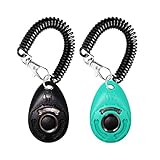
- EASY TO USE - Simple push button with distinct clicking sound.
- Comes with an elastic wrist band so you can leave it on your wrist or clip it to the leash or your pants.
- Not only train the dog but also the cat, bird, chicken, sheep a new behaviors like sit, fetch, roll over, lie down.
- For effective pet training ALWAYS reward with a treat after clicking.
- Can be used to train the dog basic obedience, small trick, and correct the bad behavior; Scientific method of training your pet safely and easily.
Why progress may take time
There is no single timetable or social outcome that fits every dog. In AVSAB’s visitor guidance, veterinarian Dr. Jen Summerfield wrote, “The end point is different for every dog, and so is the timeframe for getting there.” Aim for safety and reduced distress rather than a required greeting or a deadline.
Quick Recap
Best Value

- Stronger Bark Control with 3X Ultrasonic Emitters: Unlike single-emitter devices, our upgraded dog bark deterrent features three synchronized ultrasonic heads—delivering 3X the coverage to quickly stop barking, biting, and jumping behaviors. Ideal for anti barking training, safer than bark collar, more effective than a dog whistle, offers a humane, high-performance dog training solution
- 6-in-1 Safe & Humane Training Modes:Our dog bark deterrent device features dual ultrasonic frequencies (fixed 25kHz and variable 20-30kHz), combining 4 ultrasonic modes plus an audible beep and LED flashlight for versatile training. Whether for daily training or stubborn, persistent barking, this anti bark device adapts to different dogs providing effective bark control without causing pain or distress. Perfect for training at home or to stop neighbors dog bark that disturbs your peace
- 23 FT Extended Range & Night Safety: Bark Control Anytime, Anywhere: Stop barking and bad behavior from up to 23 feet away with our powerful dog bark deterrent device — perfect for your yard, neighbor’s yard, outdoor walks, and off-leash areas. Whether you're relaxing at home or out for a stroll, enjoy safe, long-distance control to correct disruptions quickly. The built-in LED flashlight adds safety for evening walks, and low-light training
- Fast Charge & Long Battery Life – Always Ready for Training:With a Type-C fast charging port, our dog bark deterrent device reaches a full charge in just 2 hours and provides up to 30 days of regular use on a single charge, along with 180 days of standby time. Whether you're correcting anti barking behavior or training your dog in public places, you’ll always be prepared for any situation. Forget the hassle of frequent charging and enjoy reliable, long-term barks no more support
- Ultra-Compact Design for Everyday Convenience:50% smaller than standard dog bark deterrent devices, our anti barking device is ultra-compact and lightweight, fitting effortlessly into your pocket, bag, or hand. Whether you're on daily walks, outdoor adventures, or dealing with unexpected situations in public places, this portable design helps you stop barking and encourage good behavior anywhere, anytime. Say goodbye to constant noise and enjoy a barks no more experience with your dog
Rank #4

- MANUAL AUDIBLE CLICKER: Produces an audible click when manually pressed. The clicker contains no electronics, batteries, remote-control functions, or Electronic Stimulation features.
- INDIVIDUAL RESPONSE TO SOUND MAY VARY: Dogs and other animals may respond differently to audible clicker sounds. Introduce the clicker gradually and discontinue use if the animal shows discomfort or fear.
- COMPACT HANDHELD DESIGN: Small finger-clicker design is intended to be carried and operated by the user. Review the product images and compact size before ordering to confirm it meets your expectations.
- 5-INCH VELCRO FINGER STRAP: Includes an approximately 5-inch adjustable Velcro strap designed to position the clicker on the user's finger or hand. The strap is worn by the user and is NOT intended to be worn by the pet.
- TEAL CLICKER ACCESSORY: Includes one Teal manual finger clicker and training instructions. Remote transmitter, receiver collar, batteries, and other training-system components are NOT included.
Sources and further guidance
- AVSAB: “Scaredy Dogs and Strangers – Part 1”
- AVSAB: “Scaredy Dogs and Strangers – Part 2”
- San Francisco SPCA: “Fear or Aggression with House Guests”
- RSPCA UK: “Aggression in Dogs”
- RSPCA UK: “How To Stop Your Dog Barking Too Much”
- RSPCA Australia: “My dog is being aggressive, what should I do?”
- AVSAB: “Position Statements and Handouts”
Product prices and availability are accurate as of the date/time indicated and are subject to change. Any price and availability information displayed on Amazon at the time of purchase will apply.




