
Some links on this page are affiliate links: if you buy through them we may earn a commission, at no extra cost to you.
Why and how house spiders spin cobwebs has a practical answer: house spiders release liquid protein silk through abdominal spinnerets, where it hardens into threads that form irregular indoor tangles. The web intercepts insects and carries vibrations to the spider, while different silk types provide structure, prey retention, safety, retreats, and egg protection.
In a home, the word “cobweb” may describe either a fresh tangle web or an old web made conspicuous by dust. Understanding that distinction explains why webs appear in corners, why several can accumulate, and why cleaning alone may not stop new ones.
As an Amazon Associate I earn from qualifying purchases.
Key takeaways
- House spiders spin cobwebs mainly to intercept insects and detect their movements through vibrations in the silk.
- Indoor house-spider webs are usually irregular three-dimensional tangles, not the symmetrical spoke-and-spiral webs made by many outdoor orb-weavers.
- Spider silk begins as a protein-based liquid and hardens into different kinds of thread as it leaves the spinnerets at the abdomen’s tip.
- “Cobweb” can mean either an irregular tangle web or, in everyday household language, an old web covered with dust and lint.
- Common house spiders may abandon one web and build another nearby, which allows several dusty webs to accumulate indoors.
- Removing an existing web and preventing new ones are separate tasks: cleaning removes silk, while sealing gaps and reducing insects address the conditions that support spiders.
How do house spiders spin cobwebs?
House spiders spin cobwebs by releasing liquid protein silk through spinnerets at the end of the abdomen. The silk becomes a solid fiber as it is drawn out and exposed to air, while the spider attaches and stretches strands between nearby surfaces. By repeating that process, a spider turns a quiet corner, window angle, basement, crawl space, or floor joist into a three-dimensional tangle that can intercept prey.
Spider silk is not one uniform material. Depending on the species and the job, a spider may produce structural lines, nonsticky support threads, prey-retaining silk, safety lines, retreat material, prey-wrapping silk, or silk for an egg sac. The University of Minnesota Extension’s overview of spiders explains that silk has several functions beyond making a prey-catching web.
A house-spider web is also not necessarily built once and left untouched. The spider can repair, extend, abandon, or replace sections as conditions change. A web may therefore look like a loose accumulation of threads rather than a precisely finished pattern.
Popular on Amazon
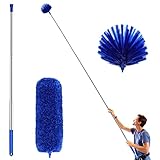
- Versatile Cleaning Kit: This ceiling fan duster set includes 1 cobweb duster, 1 microfiber duster, and 1 aluminum telescopic rod. This feather duster kit is ideal for cleaning furniture, ceilings, ceiling fans, stairs, windowsills, and cobwebs
- Convenient and Safe Cleaning: With the feather duster attached, the telescopic pole extends up to 100 inches, eliminating the need for a ladder or footstool to clean hard-to-reach areas like ceilings, ceiling fans, and corners. The duster pole features a soft sleeve on its head, ensuring walls and surfaces are protected from scratches during cleaning
- Flexible Design for Hard-to-Reach Areas: The long microfiber duster is equipped with a built-in, bendable metal rod, allowing you to adjust its shape to clean hard-to-see areas, such as the top of desks or the back of ceiling fans. Its microfiber material carries a slight positive charge, which allows it to easily grab and capture hair and dust
- Washable and Easy to Store: The cleaning brush of the ceiling fan duster is detachable and can be washed by hand or in a machine. Once dried, it is ready for reuse. The duster's handle features a hole at the end, allowing it to be hung or conveniently stored in the corner of a storage room or garage
- Customer Service: This set of 2 cleaning brushes and 1 telescopic rod ceiling fan duster is a useful bundle that we have thoughtfully assembled as a skilled maker of cleaning dusters. Please contact us with any questions you may have about this product, and we will be happy to provide you with an adequate response
Why do house spiders make cobwebs?
House spiders make cobwebs primarily to catch small insects and to sense what is happening around them. The web extends the spider’s effective reach: an insect does not need to touch the spider directly to alert it. When prey contacts or struggles against the silk, vibrations travel through the web to the spider.
Outdated Drivers Are Slowing You Down
One free scan finds every outdated or missing driver and matches the right update for your exact hardware.Free scan · exact hardware matchPC Slower Than It Used to Be?
A free scan shows the junk files, broken settings and background clutter dragging Windows down - then fixes them in one click.Free scan · Windows 10 & 11The spider can wait in or near the web, detect those vibrations, approach the trapped insect, immobilize it, and feed. The web also gives the spider a place to rest or retreat while keeping the animal connected to activity in the surrounding space. This is why a web is both a trap and a sensory network, rather than merely a sticky barrier.
Not every spider uses silk in the same way. Some spiders actively hunt away from a capture web, while others use silk mainly for shelter, movement, safety lines, egg protection, or wrapping prey. “Spiders spin webs to catch food” is a useful explanation for house-spider cobwebs, but it is not a rule that applies identically to every spider species.
What do house-spider webs look like?
House-spider webs are usually irregular, tangled webs built in protected indoor locations. Common sites include corners, window frames and angles, basements, crawl spaces, barns, floor joists, and other areas with little disturbance. The University of Minnesota Extension’s common house spider profile describes the common house spider, Parasteatoda tepidariorum, as strongly associated with sheltered building locations.
Unlike an orb web, a tangle web does not have a neat outer frame, radiating spokes, and a regular spiral. The three-dimensional arrangement is effective in cluttered corners because strands can run between walls, ceilings, furniture, pipes, and other nearby surfaces.
Do these 3 things before closing this tab:
1Scan for outdated or missing drivers - takes under a minute2Clear out junk files and repair common Windows errors3Fix the driver behind crashes, sound loss and screen glitches| Web or strategy | Typical architecture | Common setting | Primary function |
|---|---|---|---|
| House-spider tangle web | Loose, irregular three-dimensional tangle | Indoor corners, windows, basements, crawl spaces, barns | Intercepting prey and transmitting vibrations |
| Orb web | Radiating lines crossed by a spiral | Often vegetation, gardens, porches, or other outdoor spaces | Capturing flying or moving insects |
| Sheet web | Flat or slightly curved sheet of silk | Species-dependent; may occur outdoors or in sheltered sites | Supporting a capture strategy or retreat |
| Funnel web | Sheet leading into a tubular retreat | Species-dependent; often sheltered or ground-level locations | Capture, shelter, and rapid retreat |
| Active-hunting strategy | No permanent capture web required | On surfaces or among vegetation, depending on species | Finding and pursuing prey directly |
The University of Georgia’s web-architecture guide contrasts recognizable web forms such as orb, sheet, and funnel structures. Web shape can help with identification, but location and the spider’s behavior matter too.
Also popular on Amazon

- CLEANING FOR HEIGHTS BECOMES EASY: Stay off the ladder to stay away from the danger! No more stepping on stools or shaky ladders, our telescopic handle will do the trick. It can reach up to 20 feet while being held, meaning you can sweep the top of the wardrobe or even the ceiling fan effortlessly. Lightweight yet durable aluminum pole with Eva foam at handheld provide comfort and a non-slip grip, along with buckles to help lock the required length.
- 2-IN-1 WINDOW SQUEEGEE DUSTER: A window squeegee and a chenille scrubber on one head. After using wet chenille to clean the window, use the blade on the other side to scrub water directly without replacing heads and no streaks. The swivel head can rotate to 7 positions within 180 degrees, compatible with all shapes of windows and glass.
- BENDABLE MICROFIBER FAN DUSTER: Long fibers on the duster makes it the perfect tool for removing dust. It uses static electricity to absorb dust and hair which are difficult to clean by other tools. It has good flexibility and can be bent to fit all kinds of weird angles and uneven surfaces. Soft feathers leaves no scratches and protect surfaces.
- COBWEB DUSTER: This spider web brush with a full structure and big puffy bristles is designed to remove cobwebs on hard-to-reach corners. Especially in the corners of some eaves, connections between equipments, and gaps on lamps and lights. With the extendable rod, the webs and dirt can be swept away easily.
- MULTIPLE USES: This cleaning kit covers all cleaning needs from indoor to outdoor, from high to low, from roof to garage. You can use it to clean ceiling fans, cabinet top, chandeliers, frames, vents, countertop, shelves, steering wheel, dormer window, bay window, skylight, windowsill, gutter, eaves, soffit, roof beam and balcony.
Are cobwebs old spider webs?
Sometimes, but not always. In everyday household language, a cobweb usually means an old, abandoned, or dust-covered spider web. Technically, “cobweb” can also describe the irregular tangle web made by cobweb spiders, including a fresh web that has not collected visible debris.
A fresh web may be almost invisible because the silk is extremely fine. After a spider leaves or dies, airborne dust, lint, and other particles cling to the strands. The web then becomes much easier to see. The University of Maryland Extension’s guidance on spiders specifically notes that abandoned cobwebs become conspicuous as they collect dust.
Dust does not create the web. Dust makes the underlying spider silk visible. A clean-looking corner may still contain a fresh, fine web, while a heavily dusty corner may contain an abandoned web that is no longer serving as an active trap.
What’s actually slowing this PC down?
Pick the symptom - the matching free tool is one click away.
Why are there so many cobwebs in my house?
Several cobwebs can appear because spiders choose quiet, sheltered locations and because common house spiders may abandon one web and build another nearby. An old web can remain in place and collect dust while a newer web is added elsewhere.
Penn State Extension reports that the common house spider’s egg sacs are approximately 6–9 millimeters in diameter and contain 140–380 eggs; those figures are reported for Parasteatoda tepidariorum in Penn State Extension’s January 19, 2026 common house spider profile, not for every spider found indoors. A sheltered home can consequently provide repeated opportunities for web building, especially where small insects are available.
Also popular on Amazon

- 2 PCS Duster Kit: This microfiber hand duster set includes 170in/14 feet Extension Pole(Stainless steel poles can be installed according to requirements), 1 pcs Bendable Microfiber Duster Head and 1 pcs Spider web Duster Head.Replacing different types of duster brush heads can handle different cleaning scenarios, keeping your home away from dust.
- Threaded Pole Connection: our duster has an extra long extendable pole from 34 inches to 170 inches/14feet (Not included the height of duster head and human), According to the length you need, they can help you safe clean everywhere you want, avoid ladder to climb anymore.which can be easily cleaned regardless of height(The cleaning height can reach 20 feet).
- Comfortable to Grip: Ergonomic design, plastic material at the end of the handle, non-slip, more comfortable to grip with suspensible design
- Washable Duster: Our duster is easy to disassemble and wash.Just remove the duster head from the pole, wash it with water, then hang it in a ventilated place for next use.
- Farewell to spider webs and dust:You can use it to clean high ceilings/glass, exterior walls, fans, air conditioning vents, lampshades, household appliances, molds, walls, shutters, cars, picture frames, bookshelves, sofas, etc
Webs are more likely to recur when a building offers three things: protected harborages, insect entry or indoor insect activity, and undisturbed surfaces on which silk can be attached. Removing visible silk addresses the first symptom, but it does not necessarily change those conditions.
How does a spider avoid getting stuck in its own web?
Spiders do not necessarily walk across every part of their webs, and not every strand is sticky. Capture webs can combine adhesive and nonadhesive threads, with structural lines arranged differently from prey-retaining lines.
Free tools Windows power users keep installed
One-click scans. No signup required.
Research summarized by the Smithsonian Institution found that orb-weaving spiders have branching leg hairs and a nonstick chemical coating, and that their leg movements can reduce adhesive forces when they contact sticky silk. The Smithsonian’s research summary concerns orb-weaving species, so the finding should not be treated as a universal explanation for every spider and every web architecture.
For house spiders, the important practical point is that the spider’s movement routes, silk types, and body and leg surfaces are adapted to its own web environment. A person should not assume that all strands feel equally adhesive or that all spiders navigate webs in exactly the same way.
How can I get rid of cobwebs in ceiling corners?
For ordinary visible cobwebs, remove the silk with a duster, dry mop, vacuum hose, shop vacuum, or crevice attachment. Start at ceiling corners, window frames, behind stored items, and other sheltered edges; move slowly so the tool collects the web instead of scattering dust.
- Use a long-handled tool or vacuum attachment for ceiling corners and high window angles.
- Clear the web from adjoining walls, trim, joists, and nearby surfaces where attachment strands may remain.
- Vacuum or wipe accumulated dust and lint after removing the silk.
- Check the area again later rather than assuming one cleaning prevents another web.
An extendable cobweb duster is a practical option for high corners, ceiling edges, window frames, basements, and other hard-to-reach areas. A dry mop can serve the same basic purpose, and a vacuum hose or crevice attachment is a sensible alternative if you already have a vacuum. The University of Maryland Extension recommends routine cleaning or dusting for areas frequented by cobweb spiders, and Penn State Extension also identifies household dusters and vacuum cleaners as normal removal tools.
The Tool Desk
Outbyte PC Repair FREERepair Windows errors before they cause bigger problemsFix Now →Outbyte Driver Updater FREEScan for outdated or missing drivers - takes under a minuteDriver Scan →Small numbers of webs do not automatically justify specialized equipment or chemical treatment. Use ordinary cleaning methods first, particularly in homes with children or pets where unnecessary pesticide exposure is an avoidable concern.
Also popular on Amazon

- EXTENDABLE CONVENIENCE: Discover our duster kit with a telescoping 100-inch pole. Swap heads for flexible indoor and outdoor use. Effortlessly clear high areas like ceilings and fans, plus tough spots like vents
- TWO-HEAD CLEANING: Our Duster Kit combines a spider web brush and bendable microfiber duster. Tackle cobweb removal and angle-clean fans with ease
- REUSABLE & FURNITURE-FRIENDLY: Our feather duster features a silicone-tipped for furniture-safe cleaning. The entire head is washable & reusable, offering eco-friendly solutions
- EFFORTLESS DUST REMOVAL: The dense and flexible bristles of the spider web brush effectively clear cobwebs from tight spaces. The kit's telescoping handle makes cleaning ceilings, fans, and vents an effortless task
- COMPLETE CLEANING: The extendable stainless steel pole allows you to reach every nook and cranny, while the spider web brush and microfiber duster head ensure efficient and thorough cleaning. This kit is your go-to solution for a dust-free and cobweb-free environment
How can I reduce new house-spider cobwebs?
Reduce new cobwebs by combining cleanup with exclusion and insect reduction. Cleaning removes existing silk; prevention makes the building less attractive or accessible to spiders and the insects they hunt.
- Reduce clutter in basements, crawl spaces, garages, storage areas, and other potential retreats.
- Maintain window screens and repair openings that allow insects to enter.
- Seal relevant gaps around doors, windows, utility penetrations, and other building edges.
- Use door weather stripping or a window screen repair kit where damaged barriers are contributing to insect entry.
- Monitor recurring web locations and look for the insects that may be supporting spider activity.
Window screen repair and door weather stripping address entry points rather than the web itself. The U.S. Environmental Protection Agency’s integrated-pest-management guidance frames pest management around prevention, monitoring, exclusion, and control methods selected according to need.
Independent reader supportYour contribution helps us test, update, and keep practical guides available for everyone.Should I use pesticide for house-spider cobwebs?
A visible cobweb alone is not a good reason to apply pesticide. For ordinary webs, removal, cleaning, exclusion, and reducing insect access can address the problem without chemical treatment.
Quick wins for a faster PC:
Repair Windows errors before they cause bigger problemsFix Now →Scan for outdated or missing drivers - takes under a minuteDriver Scan →The EPA states: “Preventive pesticide application is limited because the risk of pesticide exposure may outweigh the benefits of control, especially when non-chemical methods provide the same results.” Read the EPA’s urban integrated-pest-management technical guidance for the broader prevention-first framework.
If a pesticide is considered for a persistent problem, use only a product currently labeled for the intended location and pest, and follow the label exactly. Product labels, permitted uses, ventilation requirements, re-entry instructions, and pet-safety directions are product-specific and can change. Do not spray a web simply because it is visible.
Also popular on Amazon

- 【Medium Stiff PET Bristles: Sticky Webs & Thick Dust Cobweb Gone in 1 Swipe】Indoor & Outdoor sticky cobwebs, thick ceiling dust & cobwet mix—cheap dusters either can’t scrape tough webs or can’t hold it, making you clean the same spot 3 times! Our spider web brush with pole ‘s medium stiff PET bristles strike the perfect balance—scrapes off old eaves webs easily and traps ceiling dust web without dropping. 98% one-pass cleaning rate, no more repeat work! Outdoor porch eaves, indoor ceiling corners—pair with our duster’s extension pole to clean high spots safely, no ladders needed.
- 【Multi-Scene Use for All Ways Clean】Cleans cobweb or dust web from indoor ceiling corners, ceiling fan blades, air vent grilles, crown molding crevices, bookshelf tops, window casings, and chandelier fixtures or AC outdoor unit grilles, garage door tracks, pool cage tops,—one duster for all hard-to-reach spots, whether indoor or outdoor. The cobweb duster head is large and full, the domed head flexible enough allows easy brushing of every crevice and corner and sweeps every areas easily.
- 【10-Second Assembly: Easy to Use Even By Seniors】This extendable duster with extendable pole,easy to assemble & easy to use.Just screw cobweb brush twisted onto the extension pole and use screw to reinforce. Also it easy to disassemble and storage. The long handled dusters are very good at cleaning cobwebs and dust from under the house eaves, porch, walls, blinds, windows, house ceiling fan, garage, pool cage and lanai, etc.
- 【Multi-Scene Use for All Ways Clean】Cleans cobweb or dust web from indoor ceiling corners, ceiling fan blades, air vent grilles, crown molding crevices, bookshelf tops, window casings, and chandelier fixtures or AC outdoor unit grilles, garage door tracks, pool cage tops,—one duster for all hard-to-reach spots, whether indoor or outdoor. The cobweb duster head is large and full, the domed head flexible enough allows easy brushing of every crevice and corner and sweeps every areas easily.
- 【Lightweight & Durable Pole: Lasts 3+ Years, Eco-Friendly】Plastic poles crack in sun/rain, wooden poles mold in humidity—you replace 2-3 dusters yearly, wasting money and creating waste! Our stainless steel pole; ABS plastic head frame (-20℃ to 60℃ temperature resistance)—safe for all seasons use. PET bristles pass 500 friction tests without falling—use for over 3 years.Crafted by lightweight stainless steel for laborsaving yet super durable for long last time use,the dusters for cleaning proved to be more energy save for you and more eco-friendly for your environment.
When should a recurring spider problem be escalated?
Consider a licensed integrated pest-management or pest-control professional when web activity persists after cleaning and exclusion, when a substantial recurring infestation is suspected, or when you cannot safely identify a spider that concerns you. Ordinary cobweb removal generally does not require professional treatment.
A professional can help identify the spider, inspect likely entry and harboring sites, assess the insect activity supporting the webs, and recommend controls proportionate to the problem. Ask for an approach based on inspection, monitoring, exclusion, and targeted treatment rather than automatic preventive spraying.
For households with pets, keep animals away from any treatment area and follow the product label or professional instructions about application, ventilation, and re-entry. A web’s presence by itself does not establish that the spider is medically significant or that chemical control is necessary.
Frequently Asked Questions
Why do house spiders make cobwebs?
House spiders spin cobwebs mainly to capture small insects and detect their movements. Vibrations from an insect contacting or struggling against the silk travel through the web to the nearby spider, which can then approach and immobilize the prey.
Are cobwebs old spider webs?
A cobweb can be an irregular tangle web by definition, but householders commonly use “cobweb” for an old or abandoned spider web covered in dust and lint. Dust makes the silk visible; dust is not the material that creates the web.
How do I get rid of cobwebs in ceiling corners?
Remove ordinary cobwebs with an extendable duster, dry mop, vacuum hose, shop vacuum, or crevice attachment. Clean recurring locations, then reduce new webs by limiting clutter, maintaining screens, sealing gaps, and reducing insect entry.
Recommended Free Tools
How does a spider not get stuck in its own web?
Not every web strand is sticky, and spiders use different silk types for structure, capture, safety, retreats, and other purposes. Research on orb-weaving spiders links their branching leg hairs, nonstick coating, and leg movements with reduced adhesion, but that finding should not be generalized identically to every spider species.
The Bottom Line
House spiders spin cobwebs because silk helps them catch prey and detect vibrations from insects in protected indoor spaces. Their irregular tangle webs may be fresh, abandoned, or dusty. Remove visible webs with ordinary cleaning tools, then reduce recurrence by limiting clutter, sealing entry points, maintaining screens, and addressing indoor insects before considering pesticide.





Leave a Reply