
Some links on this page are affiliate links: if you buy through them we may earn a commission, at no extra cost to you.
A bull’s nose ring is mainly a livestock-management and control device. It passes through the sensitive nasal septum so trained handlers can guide the bull during breeding management, veterinary work, transport, or exhibition. It is not decorative jewelry—and fitting one is painful, invasive, and not necessary for every bull.
What is a bull’s nose ring for?
A bull’s nose ring is primarily a livestock-management and control device, not decorative jewelry. The ring passes through the nasal septum—the sensitive tissue between the nostrils—so a trained handler can attach a nose lead and redirect the bull’s head when the animal must be moved, examined, treated, transported, bred, or exhibited.
As an Amazon Associate I earn from qualifying purchases.
Recommended Free Tools
Mature bulls are powerful animals. Even a normally calm bull can become difficult or dangerous to handle, particularly during breeding work, veterinary procedures, or unfamiliar situations. A nose ring can give a handler more precise control than a halter alone, but it is only one part of a safe handling system. It does not make a bull tame, eliminate the danger of working around one, or replace suitable yards, chutes, training, and an escape plan.
How the ring controls the bull
The ring is placed through the nasal septum, rather than through the outer edge of the nostril. This area is sensitive, so pressure applied through a properly attached nose lead can influence the position of the bull’s head. Redirecting the head can make it easier to lead or position the animal for routine management.
Popular on Amazon

- Farm essential tools - Bull Nose Rings for ensuring the safety and control of bulls and cattle. This cattle nose ring helps maintain proper animal management, handling, and restraint on any farm or ranch.
- High Quality - Made from premium stainless steel, this bull nose ring / cattle nose ring is sturdy, rust-resistant, and built to withstand long-term use in any farm environment.
- Easy to Use - This bull nose ring can be easily opened or closed using a screwdriver, making installation and removal simple, efficient, and safe.
- Smooth Surface- Smooth surface with no sharp edges prevents accidental injuries to the livestock during use, promoting safety and care.Ensuring the comfort of animals
- A good helper tool for the farmer.
In practice, the nose lead is generally used with a halter, not as the only point of restraint. Pulling directly or sharply on the ring can injure the nose. A halter spreads control over the head and gives the handler a safer, more stable system than relying on the ring by itself.
That distinction is important: the ring is best understood as a control interface. It does not control the bull by magic, and it does not change the animal’s temperament. Calm movement, experienced handlers, good facilities, and a plan for what to do if the bull resists remain essential.
Quick wins for a faster PC:
Fix the driver behind crashes, sound loss and screen glitchesFind Drivers →Repair Windows errors before they cause bigger problemsFix Now →When are bulls’ nose rings used?
Breeding-bull management
Breeding bulls may need to be moved, separated, examined, or positioned while they are sexually mature and physically powerful. A nose ring can provide an additional way to guide the head during these tasks. It is not evidence that every ringed bull is aggressive; it usually indicates that handlers consider direct head control useful for that animal or management system.
Veterinary examinations and treatment
Veterinary references describe nose leads as useful when routinely handled cattle need examination, identification procedures, or minor medical or surgical work. The ring may help keep the head positioned while the animal is restrained with appropriate equipment.
It should not be treated as a substitute for veterinary judgment or proper restraint. The animal’s size, temperament, procedure, facility, and the risk to people and cattle all affect the appropriate handling plan.
Also popular on Amazon

- ✿Premium Plastic: Made of high quality material, sturdy and durable, can be used for a very long time, which is easy to clean.
- ✿Safe to Use: All finishes are non-toxic, safe and Eco-friendly, very safe for young cows cattles to use.
- ✿Avoid Hurts: All parts are rounded smooth, avoid hurting the mouth of the cattles, can protect them effectively.
- ✿Package Include: There are total 10pcs wanner in 1 set, a good value for money, you can use to replace and also can use for 10 cows.
- ✿Function: Effective wanner for cattle and baby animals anti sucking, and reduce the stress of weaning, prevent calves licking each other and avoid infection.
Moving and transporting cattle
A nose ring can help trained handlers lead or position a bull during movement and transport. However, loading areas, gates, races, chutes, and trailer arrangements are at least as important as the ring. A powerful animal can still injure someone if the facility creates a pinch point or leaves people without a clear escape route.
Crashes, No Sound, or Screen Glitches?
Random freezes, missing sound and display glitches usually trace back to one bad driver. Find and replace yours safely.Free scan · under a minutePC Slower Than It Used to Be?
A free scan shows the junk files, broken settings and background clutter dragging Windows down - then fixes them in one click.Free scan · Windows 10 & 11Agricultural shows and exhibitions
Some agricultural exhibition rules require or recognize nose rings or nose clips for bulls above a specified age. Requirements differ by jurisdiction, show organization, and animal age, so a ring should not be assumed to be legally required everywhere. Anyone exhibiting cattle should check the current rules for the particular event and location.
Does putting a nose ring in a bull hurt?
Yes. Nose ringing is painful and invasive. The nasal septum is sensitive tissue, and inserting a ring pierces it. It is misleading to describe the ring as a painless ornament or to suggest that its practical purpose cancels out the pain involved in fitting it.
Veterinary guidance on invasive procedures recommends secure restraint and appropriate pain mitigation, which may include sedation or local anesthesia and systemic analgesia. The exact approach should be determined by a qualified veterinarian and must comply with local animal-welfare and livestock regulations.
The ring also creates a continuing management responsibility. Poor technique, an unsuitable or rough ring, an incorrect fit, inadequate hygiene, or forceful handling can cause inflammation and injury. A published case report documented severe inflammation of a breeding bull’s muzzle and nose associated with a nose ring. That example illustrates why the animal must be monitored rather than simply ringed and forgotten.
Also popular on Amazon

- [1]Easy to Use- This spring loaded nose ring works perfect. It is easy to open yet the spring is stiff enough to keep it closed.
- [2] Lightweight for Cattle-the cow nose ring is made of carbon steel which is light in weight, of punch, and installed on the nose of the cow will not cause too much load on the cow.
- [3]Safe Use for bulls- The left and right jaws are spherical, which will not cause damage to the cow
- [4]Light and sturdy Material-this nose ring is made of carbon steel which is light and hard and have a long time in your farming.
- [5]Wide Use- This cattle nose clamp is very suitable for dairy cows and bulls, Bulls and is widely used in farm breeding.
Responsible use: what good practice involves
A nose ring may be a legitimate management tool, but responsible use requires more than installing hardware. Key safeguards include:
- A real management purpose: The ring should be needed for breeding, exhibition, veterinary handling, or another legitimate animal-management task—not fitted merely for appearance or convenience when safer, adequate alternatives exist.
- Competent personnel: The procedure should be carried out by someone properly trained or experienced, with the ability to recognize pain, distress, infection, swelling, discharge, and abnormal behavior.
- Appropriate equipment: Equipment should be smooth, suitable for cattle, correctly fitted, and maintained. Local rules may restrict materials or methods; for example, New Zealand guidance prohibits inserting wire into the nose.
- Pain relief: Restraint, sedation or local anesthesia, and analgesia should be considered through veterinary guidance, particularly because this is an invasive procedure.
- Post-procedure observation: The bull should be checked during recovery and afterward for swelling, inflammation, bleeding, discharge, rubbing, altered eating or drinking, and other signs of injury or illness.
- Combined restraint: A nose lead should generally be used with a halter and appropriate handling facilities. It should not become an excuse for sharp pulling, twisting, or casual work around a dangerous animal.
Rules vary considerably by country and region. For example, some regulations define when nose rings may be inserted and distinguish them from clips that do not pierce the skin. Local livestock, welfare, veterinary, and exhibition requirements should take priority over general online advice.
Permanent nose ring versus removable nose clip
A permanent or inserted nose ring is not the only way to attach control equipment. A removable cattle show-lead nose clip, sometimes called a bulldog, grips the nose without piercing the skin. Educational livestock guidance identifies this as an alternative to an inserted ring, and some rules distinguish non-piercing cattle clips from nose rings.
| Option | How it works | Important limitation |
|---|---|---|
| Inserted nose ring | Passes through the nasal septum and accepts a nose lead. | Invasive and painful to fit; requires competent application, monitoring, and careful handling. |
| Removable nose clip | Attaches to the nose without piercing the skin. | Still requires correct fit, trained handling, and a suitable task; it is not automatically safe for every bull. |
| Halter and other handling equipment | Provides broader control of the head and body. | Equipment alone cannot compensate for poor facilities, inadequate training, or unsafe stockmanship. |
A clip may be preferable where a non-piercing option meets the task and the applicable rules. It is not a universal replacement: its effectiveness depends on the animal, the job, the equipment, and the handler. In some operations, gradual halter training, low-stress handling, improved yards and chutes, or selecting naturally polled cattle may reduce the need for invasive control procedures. These approaches address different management challenges and cannot be substituted in every situation.
What equipment belongs in a safe handling plan?
If a nose ring is used, the relevant purchase is a bull nose ring or cattle nose ring matched to the animal and the applicable rules. This is livestock-handling equipment, not a general-purpose piercing product, and choosing or fitting one should not be treated as a do-it-yourself project.
Also popular on Amazon
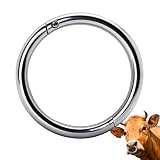
- Farm essential tools - Bull Nose Rings for ensuring the safety and control of bulls and cattle. This cattle nose ring helps maintain proper animal management, handling, and restraint on any farm or ranch.
- High Quality - Made from premium stainless steel, this bull nose ring / cattle nose ring is sturdy, rust-resistant, and built to withstand long-term use in any farm environment.
- Easy to Use - This bull nose ring can be easily opened or closed using a screwdriver, making installation and removal simple, efficient, and safe.
- Smooth Surface- Smooth surface with no sharp edges prevents accidental injuries to the livestock during use, promoting safety and care.Ensuring the comfort of animals
- A good helper tool for the farmer.
More broadly, professional cattle restraint equipment may include a suitable cattle halter with a bull nose lead, secure handling facilities, and task-specific restraint equipment. A bull staff or bull pole may be used by trained professionals in some difficult-bull situations, but such equipment carries its own risks and should not encourage inexperienced people to approach or challenge a dangerous animal.
The best equipment choice depends on the animal and the work. Before buying anything, confirm the rules that apply, ask a veterinarian or experienced livestock professional about the handling plan, and make sure the facility provides safe separation and escape routes.
Independent reader supportYour contribution helps us test, update, and keep practical guides available for everyone.Common misconceptions about bull nose rings
“The ring means the bull is aggressive.”
Not necessarily. A ring indicates that direct head control has been considered useful or necessary. It does not reliably reveal the bull’s temperament. At the same time, a ring should remind observers that the animal is large, strong, and being managed for a reason—not that it is safe to approach.
Free tools Windows power users keep installed
One-click scans. No signup required.
“Every bull needs one.”
No. Requirements and practices differ between farms, countries, and exhibitions. A permanent ring should be justified by a genuine management need and should be weighed against non-piercing equipment, better handling facilities, training, and other alternatives.
“It is just livestock jewelry.”
No. Its practical function is control. Calling it jewelry obscures both its purpose and the welfare responsibility created by piercing sensitive tissue.
Also popular on Amazon

- 【Self-Locking Design & Secure Hold】Our bull nose ring features an innovative automatic self-locking mechanism. It securely fastens to prevent accidental loss, providing peace of mind during livestock management and handling. This design is trusted by farmers and veterinarians for its reliability.
- 【 Superior Stainless Steel Material】Crafted from high-quality stainless steel, this cattle nose ring is built to last. It boasts excellent resistance to rust and corrosion, ensuring durable performance through tough daily use on the farm.
- 【Ideal Size for Bulls and Cattle】With an inside diameter of 2.68 inches (6.8cm) and a thickness of 0.276 inches (0.7cm), this 3.5-inch class bull ring offers a comfortable yet secure fit for most bulls and cows. It's an essential piece of cattle equipment.
- 【Essential Veterinary & Farming Tool】This robust ring serves as a critical veterinary tool for animal care and treatment. It is also indispensable farming livestock equipment for leading and controlling animals safely and effectively.
- 【Simple Installation & Silver Finish】Designed for easy installation with appropriate bull ring pliers. The silvery finish ensures high visibility and a professional look. Sold as a single piece (1-Pack), perfect for your needs.
“Once the ring is fitted, the bull is safe to handle.”
No. The ring does not eliminate the risk of crushing, charging, trapping, or sudden movement. It must be used within a broader safety plan by people who understand cattle behavior and can get clear if the animal reacts unexpectedly.
Bottom line
Bulls wear nose rings mainly so trained handlers can control and move them more safely during breeding management, veterinary work, transport, and exhibition. The ring works because it passes through a sensitive part of the nose—which is also why fitting it is painful and why misuse can cause injury.
Do these 3 things before closing this tab:
1Repair Windows errors before they cause bigger problems2Scan for outdated or missing drivers - takes under a minute3Clear out junk files and repair common Windows errorsA responsible handler uses a ring only for a justified management purpose, has it fitted and managed competently, addresses pain and hygiene, monitors the bull afterward, and combines it with a halter and safe facilities. A removable nose clip or improved low-stress handling may be a better option in some situations. The ring is a tool, not a guarantee of safety and not a requirement for every bull.
Frequently Asked Questions
Why do bulls have rings in their noses?
A bull nose ring passes through the sensitive nasal septum so a trained handler can attach a nose lead and redirect the animal’s head. It is used for management and control, especially during breeding, veterinary procedures, transport, and agricultural exhibitions.
Does putting a ring in a bull’s nose hurt?
Yes. Inserting a ring pierces the nasal septum and is painful. Veterinary guidance recommends secure restraint and appropriate pain mitigation, such as local anesthesia, sedation, and analgesia when appropriate.
Does a nose ring make a bull safer?
No. A nose ring does not make a bull tame or guarantee safe behavior. It should be used with a halter, suitable facilities, trained handlers, and a plan for safely managing unexpected movement.
What’s actually slowing this PC down?
Pick the symptom - the matching free tool is one click away.
Is there an alternative to a permanent bull nose ring?
A removable cattle show-lead nose clip, sometimes called a bulldog, can provide nose control without piercing the skin. Its suitability depends on the animal, task, handler, equipment fit, and local rules.
The Bottom Line
In short: a bull’s nose ring is a control device, not decoration. It can help trained handlers manage a powerful animal, but insertion is painful and invasive, so its use must be justified, carried out competently, monitored afterward, and supported by safe restraint and handling practices.





Leave a Reply