Veterinarians recommend FVRCP as a core vaccine because it targets feline panleukopenia, feline herpesvirus type 1, and feline calicivirus. The kitten series helps ensure a dose takes effect as maternal antibodies decline, and adult boosters depend on the vaccine’s formulation and route, the cat’s health and exposure risks, and its records. Indoor cats have lower exposure risk, but indoor status alone does not settle whether vaccination is appropriate.
The AAHA/AAFP feline vaccination guideline classifies these as core vaccines. Core status is not a requirement for every cat to receive an identical product on the same date: the veterinarian should assess the individual cat and the specific vaccine.
What does feline distemper mean?
Feline distemper is commonly another name for feline panleukopenia, also called feline infectious enteritis. It is caused by feline panleukopenia virus, or FPV, a parvovirus. It is not canine distemper; canine distemper virus is unrelated. A cat’s “distemper shot” usually refers to the panleukopenia component of FVRCP.
FPV can cause severe illness, including fever, weakness, loss of appetite, vomiting, diarrhea, and a reduction in white blood cells. Kittens are especially vulnerable. FVRCP vaccination reduces the risk of disease, but it cannot guarantee that a cat will never become infected.
#1 Best Overall

- Adjustable Dosage: Offers five semi-adjustable dose settings (1/2/3/4/5ML) for precise, efficient, and rapid injections, catering to various livestock injection needs.
- One-Handed Operation: Designed for continuous, automatic injection after setting the dose, reducing effort and increasing efficiency. The needle interface meets international standards for easy compatibility (Note: Needles not included).
- Durable Construction: Made with thickened polymer materials and a medical-grade plastic syringe, ensuring resistance to high temperatures and high-pressure sterilization at 134℃/273℉.
- Leak-Proof Design: Features internal rubber seals that prevent liquid backflow and leakage, ensuring a clean and safe injection process.
- Versatile Use: Ideal for administering vaccines and medications to cattle, cows, goats, sheep, pigs, and other livestock, making it a reliable tool for veterinarians and farmers.
Why treatment is not an easy alternative
There is no simple routine treatment that removes FPV from a seriously ill cat. Veterinary care focuses on supportive treatment and managing complications. Vaccination is recommended because the disease can be severe and vaccination is an important preventive measure.
What does the FVRCP vaccine protect against?
FVRCP is a combination vaccine. The letters refer to:
- FVR: feline viral rhinotracheitis, generally associated with feline herpesvirus type 1
- C: feline calicivirus
- P: feline panleukopenia virus
| Component | Targets | What vaccination can and cannot do |
|---|---|---|
| FPV | Feline panleukopenia, also called feline distemper | Provides strong protection against an important, potentially severe disease, but is not an absolute guarantee. |
| FHV-1 | Feline viral rhinotracheitis | Helps reduce the impact of an important cause of upper respiratory disease; it does not prevent every infection or all recurrent respiratory problems. |
| FCV | Feline calicivirus | Helps reduce disease risk and severity, but does not protect against every strain or infection. |
AAHA/AAFP lists FPV, FHV-1, and FCV among core vaccines for cats. “Core” reflects the significance and distribution of the diseases; it does not mean vaccination is legally required everywhere or that every cat needs the same schedule. The guideline says the decision to vaccinate, even with core vaccines, should be based on a risk-benefit assessment for each cat and vaccine antigen.
Why indoor cats are still considered for vaccination
An indoor-only lifestyle can reduce exposure, but it does not by itself establish that a cat has no risk. The possibility of exposure, disease severity, vaccine characteristics, the cat’s immune status, and its environment all belong in the discussion. AAHA/AAFP advises assessing the individual cat rather than using indoor status as the sole reason to skip a core vaccine.
Discuss relevant circumstances with the veterinarian, including contact with other cats, boarding, fostering, shelter or cattery exposure, and the cat’s health and vaccination history. Vaccination is one part of risk reduction; it does not replace appropriate exposure-control measures.
Rank #2
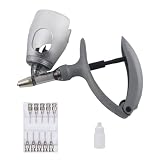
- 【AUTOMATIC SELF‑REFILLING DESIGN】:This livestock auto injector syringe features a bottle‑insertion design with an automatic self‑refilling mechanism that continuously draws vaccine from the bottle. Ideal for high‑volume livestock vaccination, it reduces manual operation and improves overall efficiency on farms and feedlots
- 【ADJUSTABLE & ACCURATE DOSING (0.5–5ML)】:Designed with a clear, easy‑to‑read scale, this cattle syringe gun allows precise dose adjustment from 0.5ml to 5ml per injection. Accurate dosage control helps prevent vaccine waste while ensuring consistent and reliable injections for different animals
- 【LEAK‑PROOF & ANTI‑BACKFLOW SYSTEM】:Built with a secure sealing structure and an internal anti‑backflow steel ball, this veterinary syringe effectively prevents liquid reflux and leakage during use. The tightly connected needle, bottle adapter, and barrel ensure clean, safe, and efficient injection every time
- 【DURABLE CONSTRUCTION & COMPLETE ACCESSORIES】:Made of high‑quality, durable PP (polypropylene) plastic with a transparent barrel for easy visibility, this livestock vaccination injector is built for long‑term use. The set includes 2 sealing rings, 1 vaccine bottle, 1 accessory kit, lubricant oil, and 10 replacement 12×25mm 304 stainless steel needles for dependable performance
- 【ERGONOMIC DESIGN & WIDE LIVESTOCK USE】:Featuring an ergonomic curved handle and a lockable anti‑release Luer connection, this syringe gun supports comfortable one‑handed operation and secure needle fixation. Suitable for cattle, goats, pigs, sheep, chickens, ducks, geese, horses, rabbits, dogs, and more—an essential vaccination tool for farms and breeding operations.
Why kittens need several FVRCP doses
Kittens receive maternal antibodies that can protect them early in life, but the amount and duration of those antibodies vary. They may decline below a protective level while still being high enough to interfere with vaccination. AAHA/AAFP calls this the “window of susceptibility.” Repeated doses increase the chance that one is given after maternal antibody interference has declined.
AAHA/AAFP recommends considering a revaccination at six months rather than waiting until one year. This may help reduce a susceptibility gap if maternal antibodies interfered with the last kitten-series dose. It is a guideline recommendation to discuss with a veterinarian, not an identical calendar for every cat.
General FVRCP schedules
These are guideline recommendations, not a prescription. The vaccine formulation and route, product directions, age, previous doses, health, exposure, and local circumstances matter. Ask the veterinarian to reconcile the cat’s records with the exact product being used.
Free tools Windows power users keep installed
One-click scans. No signup required.
Kittens receiving a parenteral vaccine
- Begin at no earlier than six weeks of age.
- Repeat doses every three to four weeks.
- Continue through 16–20 weeks of age, as directed for the cat and vaccine.
- Ask whether a revaccination at six months is appropriate.
The range in the final kitten-series age reflects guideline recommendations and individual circumstances; the veterinarian should determine the timing.
Kittens first presented after 16 weeks
For parenteral attenuated-live vaccine, the AAHA/AAFP table gives one or two doses. For an inactivated vaccine, it gives two doses three to four weeks apart. The veterinarian should select the appropriate plan based on the product, records, and patient.
Rank #3

- Adjustable Dosage Control: Features a 5ml capacity with adjustable and continuous injection settings, allowing precise control over medication dosage for various livestock including cattle, chickens, sheep, and pigs, ensuring accurate administration for different animal sizes and treatment requirements
- Automatic Self-Refill Design: Equipped with a continuous automatic refilling mechanism that draws medication directly from the source, eliminating the need for manual refilling between injections and improving efficiency during mass vaccination or treatment sessions
- Durable Construction: Built with a separable syringe tube and handle design that allows for thorough cleaning and maintenance, featuring a piston ring system that can be lubricated with olive oil or edible oil to maintain smooth operation over extended use
- Easy Maintenance Process: Simple disassembly by turning the knob to separate components for comprehensive cleaning in warm soapy water, with straightforward flushing procedures to remove residue and ensure hygienic operation between uses
- Veterinary Application: Designed specifically for livestock vaccine and medication administration, suitable for farm and veterinary use with multiple animal species, providing a practical solution for routine animal health management tasks
Adult boosters and route
For parenteral formulations in its table, AAHA/AAFP recommends considering revaccination at six months after the kitten series and then revaccination every three years. Intranasal products have a different schedule, including annual revaccination in the table. Do not assume that the interval for one route or formulation applies to another.
There is no universal rule that every cat needs an annual FVRCP vaccine or that indoor cats never need boosters. The veterinarian should consider the cat’s records, health, likely exposure, vaccine route and formulation, and product directions.
Recommended Free Tools
Vaccine formulation and route
FVRCP products are not interchangeable in every respect. The schedule and suitability depend on formulation and route as well as the cat’s circumstances. This comparison is for discussion with a veterinarian, not a recommendation for owners to choose or administer a product themselves.
| Type or route | Schedule considerations | What to discuss |
|---|---|---|
| Parenteral attenuated-live | For kittens, begin no earlier than six weeks and repeat every three to four weeks through 16–20 weeks. The table gives one or two doses for cats first presented after 16 weeks. | Age, health, prior doses, product directions, and exposure risk. |
| Parenteral inactivated | For kittens, begin no earlier than six weeks and repeat every three to four weeks through 16–20 weeks. The table gives two doses three to four weeks apart for cats first presented after 16 weeks. | Age, health, prior doses, product directions, and exposure risk. |
| Intranasal | The table gives a different adult revaccination schedule, including annual revaccination. | Route-specific product directions and the cat’s circumstances; do not apply parenteral intervals automatically. |
Is the FVRCP vaccine safe?
AAHA describes currently available feline vaccines as having an excellent safety record, while noting that no biological product is entirely free of risk. Commonly reported reactions include a few days of lethargy, reduced appetite, or fever, and local inflammation at the injection site.
In a Banfield Pet Hospitals survey of U.S. cats vaccinated from 2002 through 2005, adverse reactions within 30 days were reported in 0.52% of vaccinated cats, as reported by the AAHA/AAFP guideline. This is a historical figure, not a current product-specific rate; underreporting may mean the true prevalence was higher.
Rank #4

- ACCURATE DOSING: Our veterinary syringe is precisely marked to reduce liquid waste and ensure accurate dosing for poultry and livestock
- SAFE TO USE: Made from high polymer material with non-toxic and harmless, bottle inserting design, continuous injection can be achieved without manual inhalation
- LEAK-PROOF DESIGN: Our continuous injection tool is tightly sealed to avoid liquid leakage, ensuring a clean and efficient injection process
- EASY TO USE: With a comfortable grip design, our syringe can be operated with one hand, making it convenient and labor-saving; Plus, it comes with a plastic bottle cap for longer service life
- WIDE APPLICATION: Suitable for poultry and livestock; Widely used in small animals such as geese, dogs, chickens, rabbits, donkeys, horses, pigs, sheep, ducks, cows
AAHA describes postvaccination adverse events as rare. Possible signs of anaphylaxis include vomiting, diarrhea, breathing difficulty, facial or generalized itching, facial swelling, or collapse. Contact a veterinarian promptly about serious or rapidly worsening symptoms.
The Tool Desk
Outbyte PC Repair FREERepair Windows errors before they cause bigger problemsFix Now →Outbyte Driver Updater FREEFix the driver behind crashes, sound loss and screen glitchesFind Drivers →Monitor injection-site lumps
AAHA/AAFP recommends veterinary evaluation for a mass if any one of these conditions applies:
- It persists for three months after vaccination.
- It is larger than two centimeters.
- It is increasing in size one month after vaccination.
These are follow-up thresholds, not a diagnosis of cancer. Do not wait for all three conditions before contacting the veterinarian.
Keep reliable vaccine records
Ask the clinic for a copy of the official vaccination record and keep it with the cat’s health documents. AAHA recommends that the veterinary record include the vaccine name, serial number, expiration date, manufacturer, administration date, administrator, injection site, and route. Complete records help the veterinarian assess which doses are due and avoid unnecessary repetition.
Independent reader supportYour contribution helps us test, update, and keep practical guides available for everyone.How effective is FVRCP?
Vaccination reduces disease risk but does not guarantee that a cat will never become infected or ill. The strength of vaccine-induced immunity depends on factors including the cat’s environment, the vaccine and pathogen, and the cat’s immune competence. Exposure-control measures remain important alongside vaccination.
Crashes, No Sound, or Screen Glitches?
Random freezes, missing sound and display glitches usually trace back to one bad driver. Find and replace yours safely.Free scan · under a minutePC Slower Than It Used to Be?
A free scan shows the junk files, broken settings and background clutter dragging Windows down - then fixes them in one click.Free scan · Windows 10 & 11Best Value

- PRECISION 5-STAGE ADJUSTABLE DOSING: Features a reliable dosage dial adjustable in 1mL increments (1mL, 2mL, 3mL, 4mL, 5mL). Allows for accurate volume control when processing animals of different weights, from calves to mature stock, ensuring consistent application of livestock injectables.
- SEMI-AUTOMATIC AUTO-REFILL MECHANISM: Built for high-volume herd processing. The spring-loaded plunger automatically refills the chamber after each injection, significantly reducing hand fatigue and operational time compared to manual draw syringes. Ideal for branding and weaning seasons.
- SECURE METAL LUER LOCK TIP: Equipped with a durable metal needle fitting that firmLy locks the needle in place. This screw-on design helps prevent needles from detaching or fluid leakage when livestock move or struggle in the chute.
- PREMIUM BUILD QUALITY: One-piece aluminum alloy handle via precision investment casting, paired with rugged high-molecular plastic parts, delivers exceptional durability, wear resistance, and easy cleaning—engineered to perform reliably in harsh, complex farm environments for long-term use.
- EASY MAINTENANCE & UNIVERSAL UTILITY: Compatible with standard feed tubes and aspiration needles. The unit disassembles easily for thorough cleaning with hot water. Includes durable O-rings to maintain vacuum pressure for leak-free performance during continuous use.
The vaccine’s three components do not make identical promises: vaccination is particularly important for protection against FPV, while FHV-1 and FCV vaccination helps reduce disease risk and severity but may not prevent every respiratory infection.
Questions to ask your veterinarian
- Which FVRCP product and route are appropriate for my cat?
- How many doses are needed based on my cat’s age and existing records?
- When should the kitten series end, and should we consider a six-month revaccination?
- What adult booster interval applies to this product and route?
- Do my cat’s health, environment, or contact with other cats affect the risk-benefit decision?
- What reactions should I monitor for, and what should I do if they occur?
- Can I have a copy of the complete vaccination record, including the product and injection site?
Frequently Asked Questions
Is feline distemper the same as canine distemper?
No. Feline distemper usually means feline panleukopenia, caused by FPV, a parvovirus. It is unrelated to canine distemper virus. Panleukopenia protection is usually included in FVRCP.
Does an indoor-only cat need FVRCP?
Indoor status can reduce exposure risk, but it does not settle the decision by itself. AAHA/AAFP recommends an individual risk-benefit assessment that considers the cat’s environment, health, and vaccine history.
How often do cats need FVRCP boosters?
It depends on the vaccine formulation and route, the cat’s age and history, and the product directions. AAHA/AAFP recommends considering a six-month revaccination after the kitten series; its table gives every three years for parenteral formulations and annual revaccination for intranasal products.
Do these 3 things before closing this tab:
1Scan for outdated or missing drivers - takes under a minute2Repair Windows errors before they cause bigger problems3Fix the driver behind crashes, sound loss and screen glitchesWhat should I do about a lump after vaccination?
Contact your veterinarian if it persists for three months, is larger than two centimeters, or is increasing in size one month after vaccination. Any one of these is a reason for evaluation under the 3-2-1 rule.
Recommended, but individualized
Vets recommend FVRCP because it targets three significant feline diseases, including panleukopenia. Kittens need repeated doses because maternal antibodies can interfere with vaccination, and adult intervals vary with formulation, route, records, health, and exposure.
The practical approach is to review the cat’s history and circumstances with a veterinarian, follow the directions for the specific product, and keep complete vaccination records. A core recommendation does not mean every cat needs an identical schedule.
Quick Recap
Product prices and availability are accurate as of the date/time indicated and are subject to change. Any price and availability information displayed on Amazon at the time of purchase will apply.
What’s actually slowing this PC down?
Pick the symptom - the matching free tool is one click away.




