
Free tools Windows power users keep installed
One-click scans. No signup required.
Hair ties are tiny, springy, easy to move and often carry a familiar household scent. Those features can make one irresistible to a cat that enjoys batting, chasing, mouthing or carrying small objects. The attraction is usually a mix of curiosity and prey-like play, not proof that your cat believes the elastic is a real animal.
The cute behavior has a serious limit: a hair tie is not a cat toy. Some cats chew one without swallowing it, while others ingest elastic or fabric and risk a gastrointestinal obstruction. Understanding the five likely attractions—and knowing when to replace the tie with supervised enrichment—lets you preserve the fun without gambling on an emergency.
As an Amazon Associate I earn from qualifying purchases.
The five reasons cats are drawn to hair ties
No study establishes five universal causes for hair-tie fascination. Cats differ by age, temperament, past experience and preferred style of play. The explanations below are plausible behavior patterns described by feline-veterinary guidance, so treat them as clues to your individual cat rather than a checklist every cat must fit.
1. Curiosity turns a household object into an investigation
Cats learn about unfamiliar things through their paws, eyes, nose and mouth. A hair tie is small enough to pin under a paw, flick across the floor or pick up between the teeth. It changes position when touched, which gives the cat immediate feedback: a tap produces movement, a bite changes its shape and a push may send it under furniture.
#1 Best Overall
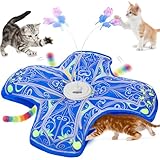
- Top-Tier Dual Interactive Fun: Qraxond's new indoor cat toy has dual motors, controlling random rotation of butterfly and plush tail swing rod accessories, bringing fun, exciting play for kittens and adult cats. Hide-and-Seek: The animal tail-shaped plush hides under the cover cloth, rotating irregularly to appear/disappear, creating a hide-and-seek game. It mimics real prey, bringing unpredictable chases to stimulate the cat's brain and senses. Irregular Rotating Butterfly: The top has an auto-rotating butterfly that rotates, pauses or swings to simulate real flight, keeping the cat engaged. Various interactions ensure the cat gets enough exercise to avoid obesity
- 3 Adjustable Speed Modes: Customize the excitement with separate buttons for the butterfly and tail. Choose from 3 settings: Steady (Blue Light), Active (Purple Light), and Random (Yellow Light). Suitable for high-energy cats to burn off steam or for calm cats to enjoy gentle play. Keep your feline entertained and prevent boredom, especially when they are home alone
- Touch-Sensitive Activation: Your Cat's in Control! With smart touch-sensor technology, just tap the device to fire up the fun mode, it will kick off a 5-minute automatic play session instantly. Right after the play session ends, it switches directly to touch-sensitive standby mode, where the purple indicator light flashes every 20 seconds. Simply tap again to reactivate it for another 5-minute cycle. This smart loop ensures your cat gets sufficient exercise and prevents overstimulation
- Large Rechargeable Battery: Enjoy long-lasting play with the built-in 2500mAh battery. It charges fully in just 2.5 hours via the included USB cable (use a 5V adapter only). The efficient auto on/off cycle extends battery life, making it convenient for busy pet owners while ensuring your cat gets healthy, moderate exercise
- Realistic Bird Chirping: Elevate the hunt with lifelike sound. The built-in speaker emits authentic bird chirps to attract your cat's attention and stimulate their prey drive. Combined with the random motions of the butterfly and tail, it creates an irresistible and engaging play experience that keeps your cat happily chasing even when they're by themselves
Kittens are especially exploratory. Cornell University’s Feline Health Center explains that young cats commonly chew as they investigate their environment; play and investigation can also continue into adulthood. A tie that appears beside a sink, on a bedside table or after you remove it from your hair becomes a novel object in an otherwise familiar room.
Curiosity explains why a cat may inspect a tie for a few seconds and then lose interest, or why the same tie becomes fascinating again after it has been moved. The behavior is normal exploration when the cat paws or sniffs and then moves on. It becomes a management issue when investigation consistently progresses to chewing or swallowing.
2. Its movement activates hunting play
When batted, a hair tie skitters, flips and stops unpredictably. That sequence resembles the parts of a hunt that domestic cats still practice during play: orienting, stalking, chasing, pouncing and grabbing. The tie’s elastic recoil can make it spring away just as the cat reaches it, rewarding another chase.
This does not mean your cat mistakes the tie for prey. Instead, the object supplies movement that engages predatory motor patterns. A cat that ignores a stationary tie but races after one you slide across a hard floor is responding to motion, not necessarily to the material itself.
Movement preferences vary. Some cats like a fast chase, some prefer a short hop followed by a pounce, and others want to trap an object beneath both front paws. Observing which stage your cat repeats helps you choose a safer toy that delivers the same kind of action without relying on an elastic loop.
Rank #2

- A NEW CHOICE FOR INDOOR ENTERTAINMENT: Endless fun for your cat! Designed for indoor environments, this interactive toy ball rolls quickly across the carpet and emits an appealing cat-attracting chittering sound. Not only does it stimulate your cat's hunting instincts, it also allows them to enjoy outdoor chasing indoors while reducing the risk of furniture scratching
- INTELLIGENT INTERACTION AND FUN: This automatic cat toy is your pet's new playmate. It has two modes: ① Normal mode (green light), which runs for five minutes and then automatically shuts off. ② Intelligent mode (blue light), after running for five minutes the exercise ball automatically enters the dormant mode, when your cat touches it again, the exerciser will interact with your cat again. So whether it's a long game or a short interaction, this interactive cat ball meets the needs of both you and your pet, allowing your pet to entertain itself while you're busy
- TWO SPEEDS FREELY SWITCHING: The BABORUI interactive cat toy offers two speeds, fast and slow, which can be freely switched at any time. Even if your cat is cute and short-legged, it can still keep up with the pace of the exercise ball
- TRIPLE FUN, TRIPLE HAPPINESS: This cat toys for indoor cats comes with three fun tails that provide your cat with triple the fun. They can have endless fun chasing and catching the ball, while the sound of the bells on the tails will further stimulate their curiosity and desire to chase
- SAFE MATERIAL, LASTING AND DURABLE: We understand that your pet's safety is of utmost importance to you. The shell of this kitten toys is made of safe silicone material, so you don't need to worry even if your pet chews it. The durable design means it can withstand daily wear and tear, providing long-lasting companionship for you and your pet
3. Texture gives the mouth and paws something to explore
Rubber-like elasticity, a slightly ridged surface or the resistance of a stretched loop can feel different from fur, feathers or hard plastic. A cat may mouth the tie, pull it between the incisors or knead it with a paw simply to test that tactile feedback. Texture is a plausible attraction, not a demonstrated reason for every cat.
Mouthing does not automatically mean the cat is hungry or deficient in a nutrient. It can be part of play, sensory exploration or self-soothing. Cornell notes that fabric chewing may sometimes serve a comfort-seeking function as well as play and investigation. If the behavior is occasional and the tie is removed before pieces come off, redirecting to an appropriate chewable cat toy is the sensible response.
What’s actually slowing this PC down?
Pick the symptom - the matching free tool is one click away.
Texture becomes more concerning when the cat seeks out many non-food materials—such as fabric, plastic or paper—and persistently consumes them. That pattern is different from briefly tasting a novel object and deserves veterinary attention.
4. Familiar or unusual scents may add interest
A tie worn in your hair can carry your familiar scent, while a new elastic can have a noticeable rubber or manufacturing odor. Cats use smell as part of object investigation, so either scent could make a particular tie worth examining. This is a possible explanation rather than a universal finding, and there is no reliable basis for assigning a fixed “times more sensitive” comparison between feline and human noses.
Scent may also explain why your cat selects ties from a laundry basket or bathroom counter instead of identical unused ones in a package. The choice does not prove affection for the owner’s scent; it simply shows that odor can be one cue among several. Washing a tie will not make it a safe toy, because the loop and any loose fibers remain a swallowing hazard.
Rank #3

- [Trending Interactive Entertainment]: Potaroma's new indoor cat toys provide an engaging, stimulating play experience for kittens and older cats alike. This automated toy features a rotating butterfly on the top, a removable cover, an enticing feather wand hidden under the cover, consisting a hide-and-seek game. This interactive toy is a great birthday gift for enriching your pet's daily life. Even when left at home alone, your cat can play by itself independently like having a party
- [Advanced Electronic Irregular Motion]: Powered by a smart motorized system, this electric cat toys deliver irregular movements to keep your cat entertained. The play experience includes spinning, chasing, and hunting elements that mimic real-life prey, especially the chasing feather that pops out unpredictably, stimulating your kitty's brain and senses
- [Multi Modes for Indoor Fun]: Features a range of captivating movement modes that stimulate cat's natural instincts to chase, pounce, and play. 3 rotating modes of chasing feather; Simultaneous or seperate working of chasing feather and spinning butterlfy; What's more, the cover can be removed to expose the chasing feather completely for more fun. The diverse play options ensure your cat gets the mental and physical stimulation and enough exercise to eliminate boredom
- [Durable]: Built to withstand even the most aggressive play sessions, thanks to its durable design and high-quality materials. The motors inside the toy are designed to move smoothly and resist wear and tear. Whether your cat loves to chew, scratch, or paw at their toys, Potaroma's cat toy can handle it all. Experience the magic of Potaroma's interactive cat toy, making it a must-have for cat owners seeking a durable and entertaining option for their pets
- [Rechargeable & Large Capacity Battery]: Provide hours of fun for your furry friend. With a built-in rechargeable battery that offers a long-lasting charge, your kitten can enjoy uninterrupted self playtime for up to several days. No need for frequent recharging, making it a convenient choice for busy pet owners. Keep your cat entertained and happy with our innovative cat toys, featuring a battery that's as powerful as your cat's curiosity
5. Carrying and stashing can look like hoarding
Some cats pick up a hair tie, carry it to another room and leave it beside a food bowl, bed or hiding place. A prey sequence commonly ends with transporting or securing an object, so this behavior can be an extension of hunting play. Others carry objects because they enjoy the sensation of walking with something light in the mouth or because the routine has become rewarding.
“Hoarding” is a useful description of what you see, not proof that the cat is saving ties for later. Cats do not all stash objects, and a pile of ties does not establish a special emotional meaning. The practical risk is that a hidden tie may be chewed or swallowed when nobody is watching, so finding a collection is a reason to improve storage and inspect the cat’s play area.
Chewing is not the same as swallowing
A cat can chew, lick or carry a tie without consuming it. UC Davis School of Veterinary Medicine defines pica as persistent chewing and consumption of non-food substances; not every cat that mouths an inedible item has pica. The distinction matters because occasional exploratory bites call for supervision and redirection, while repeated consumption needs a veterinary plan.
Swallowed fabric or elastic can lodge in the stomach or intestines. Cornell’s Feline Health Center warns that swallowed fabric may cause a life-threatening gastrointestinal obstruction, and a 2020 University of Illinois College of Veterinary Medicine handout lists hair ties among common objects cats swallow that can lead to medical complications. The danger is not limited to a whole loop: a tie that is chewed apart can create multiple pieces.
Signs that require prompt veterinary contact
Contact a veterinarian promptly if you know or strongly suspect that your cat swallowed a hair tie. Seek urgent advice if any of these signs appear:
Rank #4

- 🐱 Trigger Natural Hunting Instincts - Concealed feather wand mimics real prey with unpredictable pop-up motion + realistic mouse squeak. Satisfies your cat's predator drive even when you're away
- 🤖 3 Smart Modes for Every Personality - Normal/Active/Interactive modes adapt to lazy loungers or energy balls. Motion sensor auto-activates on touch; auto-sleep saves battery
- Beat Boredom & Anxiety - Mental stimulation + physical exercise in one. Reduces destructive scratching, over-grooming, and midnight zoomies. Perfect for solo play while you work
- ⚡ 2-Hour Charge = Weeks of Fun - Built-in 1200mAh battery eliminates disposable battery costs. USB-C charging (cable included) - eco-friendly & travel-ready
- 🛡️ Built for Rough Play - Thickened padded mat withstands pouncing & clawing. Replaceable feather wand extends toy lifespan. Rounded edges protect paws
- Repeated vomiting or retching
- Reduced appetite or refusing food
- Unusual lethargy, hiding or weakness
- Abdominal pain, a tense belly or discomfort when handled
- Changes in normal bowel movements alongside the other signs
These symptoms can have causes other than an obstruction, but waiting to see whether they disappear can allow a blockage to worsen. Do not try to make the cat vomit, give laxatives or offer other home treatment unless a veterinarian specifically instructs you. Tell the clinic what the object was, when it may have disappeared and whether any vomiting or appetite change has occurred.
How to prevent a hair-tie accident
Management is simplest when the cat cannot rehearse the risky behavior. Use this routine:
- Collect every loose tie. Check bedside tables, bathroom surfaces, laundry, under furniture and the places where your cat carries objects.
- Store them in a closed drawer, box or holder. An open dish is not secure if your cat can reach it, knock it over or fish a tie out with a paw.
- Supervise any object the cat mouths. Remove it as soon as chewing begins, before the loop stretches, frays or breaks.
- Offer a replacement immediately. Move a catnip toy, fleece ball or crinkle ball in the same way your cat was using the tie—skittering for a chaser, short hops for a pouncer or gentle resistance for a kicker.
- End the interaction calmly. Avoid turning removal into a tug-of-war. Trade for the replacement, praise engagement with it and put the tie out of sight.
- Increase structured enrichment. Add short interactive play sessions, climbing opportunities, food puzzles or supervised object games so the cat has regular outlets for stalking, chasing and batting.
Cornell recommends acceptable alternatives, more play and environmental enrichment for habitual inappropriate chewing. The goal is not to punish the cat for finding a tie interesting; it is to make the desired option more rewarding and the dangerous option unavailable.
Independent reader supportYour contribution helps us test, update, and keep practical guides available for everyone.Choosing a safer play substitute
No toy is risk-free for every cat. Inspect any item for loose threads, detachable parts and damage, and remove it when the cat starts tearing pieces away. The following comparison focuses on how an option can match the behavior you observed, not on a tested ranking of products.
The Tool Desk
Outbyte PC Repair FREEClear out junk files and repair common Windows errorsFree Scan →Outbyte Driver Updater FREEFix the driver behind crashes, sound loss and screen glitchesFind Drivers →| Option | Best match for | How to use it | What to monitor |
|---|---|---|---|
| Fleece ball | Batting, carrying and short chases | Roll or toss it during supervised play | Stop play if fabric frays or pieces detach |
| Catnip toy | Kicking, grabbing and scent-driven investigation | Offer it for interactive play, then store it away if your cat chews it | Check seams and filling regularly |
| Crinkle ball | Sound-and-motion interest | Slide or bounce it across an open floor | Replace it if the covering splits or the internal material becomes accessible |
| Interactive wand toy | Chasing, stalking and pouncing | Move the toy in prey-like bursts while holding the handle | Keep the wand stored and never leave strings or attachments out unattended |
| Food puzzle | Investigation and persistent manipulation | Use an appropriate portion of the cat’s regular food | Choose a design the cat cannot break apart or swallow |
Catnip toys, fleece balls and crinkle balls are commonly suggested alternatives by feline-care sources, including Cats.com and Catster. A catnip kicker is a product category, not a guarantee that a particular item is indestructible or swallow-proof. Match the substitute to your cat’s behavior and supervise the first sessions.
Best Value

- Ball Cat Toy: Multi-level cat toy with 3 tiers and 6 spinning balls—keeps indoor cats active, curious, and entertained
- Enrichment: Encourages batting, swatting, and chasing to satisfy hunting instincts and enhance everyday enrichment
- Durable & Safe: Sturdy, non-slip base and a secure safety bar for hours of safe independent play
- Feline Favorite: Designed for older kittens and adult cats alike; great for multi-cat homes or gifting; not recommended for kittens under 12 weeks
- Expandable: Enjoy on its own or pair with Catstages Topper Toys (sold separately) for even more interactive chaos
When hair-tie interest signals a bigger problem
Persistent consumption of non-food objects
If your cat repeatedly eats hair ties, fabric, plastic or other inedible items, schedule a veterinary evaluation even when the cat seems well. UC Davis identifies avoidance of triggers, veterinary guidance, enrichment and exercise as management considerations for pica. A clinician can help determine whether the pattern is behavioral, medical or a combination and can design a prevention plan suited to your home.
A sudden change in chewing
New or intense chewing in an adult cat deserves attention, especially if it appears with weight loss, changes in appetite, mouth discomfort or altered energy. Keep a brief record of what is chewed, how often it happens, whether anything is swallowed and what was occurring immediately beforehand. That information gives the veterinarian a clearer starting point than the label “likes hair ties.”
Play that becomes frantic or unsafe
Some cats become over-aroused when a toy moves rapidly. Flattened ears, hard tail lashing, growling or biting hands indicate that the session should pause. Use a longer-handled toy, slow the movement and let the cat finish with a successful catch. Hands, fingers and hair should not be the substitute for a tie or a wand attachment.
Do these 3 things before closing this tab:
1Clear out junk files and repair common Windows errors2Scan for outdated or missing drivers - takes under a minute3Repair Windows errors before they cause bigger problemsWhat your cat’s hair-tie habit can teach you
The behavior is a useful window into your cat’s preferences. A tie that is chased reveals a love of fast, ground-level movement; one that is carried suggests an object-retrieval game; a tie that is mouthed points to a texture or sensory interest. Record those preferences and recreate them with purpose-made cat toys during supervised sessions.
Enjoy the funny stalking routine, but treat every hair tie as a household hazard rather than a free toy. Secure storage, quick redirection and prompt veterinary advice after suspected ingestion protect the part that matters most: your cat’s health.
Quick Recap
Product prices and availability are accurate as of the date/time indicated and are subject to change. Any price and availability information displayed on Amazon at the time of purchase will apply.





Leave a Reply