Free tools Windows power users keep installed
One-click scans. No signup required.
If your kitten is straining to urinate but producing little or no urine, seek emergency veterinary care now: a urinary blockage can be life-threatening. Otherwise, a new or persistent litter-box problem deserves a call to your veterinarian before you assume it is a training issue. Pain, box access, litter, location, and stress can all play a part, and more than one cause may be involved.
When a litter-box problem is an emergency
Go to a veterinarian immediately if your kitten repeatedly tries to urinate but little or nothing comes out, strains without producing urine, cries while posturing, or seems painful around the lower abdomen. Cornell describes urethral obstruction as an absolute emergency; do not wait to try a different box or litter. Cornell’s guidance on feline lower urinary tract disease explains the warning signs and urgency.
Blood in the urine, painful or unusually frequent urination, repeated accidents, or a sudden change in habits warrants prompt veterinary contact, even if your kitten otherwise seems well. Cats can have a medical problem without looking generally ill. VCA advises contacting your care team when a cat eliminates outside the box to rule out medical causes. VCA’s kitten-specific guide discusses possible causes and signs.
Why kittens stop using the litter box
Medical discomfort or urgency
Urinary or digestive problems can make elimination painful, frequent, or difficult to control. Conditions affecting the urinary tract are among the possibilities; only a veterinarian can assess your kitten and decide whether an examination, urinalysis, or other tests are appropriate. Painful elimination can also lead a kitten to associate the box with discomfort and avoid it later. Cornell’s house-soiling overview describes medical and environmental causes.
What’s actually slowing this PC down?
Pick the symptom - the matching free tool is one click away.
#1 Best Overall

- PREMIUM QUALITY: A combination of premium texture and granule size made with 100% bentonite clay for maximum clumping creates litter particles that are just the right size.
- HARD CLUMPING: Hard clumping medium grain clay helps prevent moisture from reaching the bottom of the tray and forms hard clumps that won't break down, making it easier to scoop.
- LOW DUST & LOW TRACKING: Ideal for cats and owners who suffer from allergies with a 99% dust-free and hypoallergenic litter formulation that helps keep litter in the box where it belongs.
- SUPERIOR ODOR CONTROL: Formulated for single or multi-cat households with natural ingredients to keep your home smelling clean and fresh between litter box cleanings.
- NATURAL HERBAL ATTRACTANT: Blended with a natural herb attractant, the ideal texture and particle size combine to solve litter box problems by bringing cats back to their litter box.
A box that is hard to reach or unpleasant to use
A tall-sided box can be difficult for a small kitten to enter. A covered box, an unclean box, or a box in a noisy or exposed spot may also put a kitten off. If another pet can block the entrance, ambush the kitten, or leave it with no easy escape, the location may not feel safe.
Litter or location preference
Cats can prefer particular litter textures or places to eliminate. A sudden change in litter may contribute to avoidance, while a surface or location used in an accident can become a repeated preference. If you need to change litter, transition gradually where possible and watch how your kitten responds. Cornell’s new-cat guidance covers box and litter preferences.
Rank #2

- ATTRACTS TO LITTER BOX: World’s Best Cat Litter Boosters Good Habits is a natural and sustainable cat litter additive that encourages cats to use the litter box and helps avoid accidents. Simply sprinkle it on to your usual litter to release a natural scent that safely attracts cats and supports going in the box every time.
- NATURAL AND SUSTAINABLE: World’s Best Cat Litter Boosters Good Habits is made from natural and sustainable whole kernel corn and other plant-based ingredients. It is naturally safe for cats when used as directed.
- PLANT-BASED ATTRACTANT: The attractant in World’s Best Cat Litter Boosters Good Habits is a patented, natural plant-based material that is safe and effective to encourage litter box usage
- EASY TO USE: Evenly sprinkle ½ cup of World’s Best Cat Litter Boosters Good Habits over your cat’s usual litter. Add more World’s Best Cat Litter Boosters Good Habits each week and as needed to encourage your cat to use the box. Scoop daily for best results.
- WORKS WITH MOST LITTER TYPES: Effortlessly compatible with most cat litters, our additive integrates seamlessly into your cat’s routine. Whether you use clumping, non-clumping, crystal, or natural litter, simply sprinkle it on to attract your cat to the litter box. Perfect for all cat households.
Stress or disruption
Moving, a new person or animal, a disrupted routine, or tension with another pet may affect litter-box use. These factors can contribute, but they should not replace veterinary assessment when the problem is new, persistent, painful, or accompanied by urinary signs. VCA’s guidance on behavioral urination in kittens addresses behavioral factors after medical causes are considered.
How to troubleshoot after urgent signs are ruled out
- Contact your veterinarian about a new or concerning pattern. Describe when the accidents began, whether your kitten is urinating or defecating outside the box, how often it happens, and any changes in urine, stool, posture, or behavior. Your veterinarian can determine whether an examination or tests are needed.
- Make the box easy to enter. Use a stable box with a low entry for a small kitten. If the current box is covered, consider trying a simple, uncovered one. Put it somewhere quiet and keep it accessible.
- Keep the box clean. Scoop at least once a day; some cats need more frequent scooping. Clean the box regularly and avoid strong-smelling products that may make the area unattractive.
- Adjust litter carefully. Many cats prefer unscented, finer-textured litter, but preferences differ. If you test a new litter, change one feature at a time so you can see what your kitten accepts; avoid an abrupt switch when possible.
- Check the route to the box. Make sure your kitten can reach it without passing through a noisy or frightening area. In a multi-pet home, choose a spot where another animal cannot trap or ambush the kitten.
- Clean accidents without punishment. Use an enzymatic cleaner labeled as suitable for the soiled surface, following its directions. Do not scold your kitten or rub its nose in the mess; punishment does not teach the location of the box and can add stress. VCA’s kitten litter-training guide covers accident cleanup.
Helping a new kitten learn where the box is
Give a newly arrived kitten a calm settling area with food, water, a resting place, and a nearby litter box. Supervise exploration or limit access to parts of the home until the kitten is using the box consistently, then expand its space gradually. Keep the box easy to find and reach as your kitten explores. VCA’s housetraining guide discusses supervision and routine.
Rank #3

- LITTER BOX ATTRACTANT ENCOURAGES CATS TO USE THE LITTER BOX: Herbal attractant additive encourages cats and kittens to use the litter box by adding a familiar scent, helpful during new-cat introductions, box moves, and retraining.
- WORKS WITH ALL LITTER TYPES CLUMPING CLAY CRYSTAL AND NATURAL: Compatible with clumping and non-clumping clay, crystal, paper, and natural litters, sprinkled and mixed into clean litter for scent distribution in single- and multi-cat homes.
- NO-MESS SHAKE BOTTLE FORMAT FOR CONTROLLED EASY APPLICATION: The 9-ounce bottle is designed for controlled shake-and-pour use, helping reduce mess and over-application when refilling or topping off litter before mixing in lightly.
- HERBAL BLEND SCENT CUES GUIDE CATS BACK TO THE LITTER BOX: Pet-friendly herbal formula uses scent cues to guide cats to the litter box as an additive, not a deodorizer or disinfectant, intended for use with clean litter regularly.
- FOR CATS AND KITTENS LEARNING OR REESTABLISHING BOX HABITS: Suitable for kittens learning litter box habits and adult cats that need a refresher when adding a second box, switching locations, or after stress-related routine changes.
A basic open box with low sides, unscented fine-textured litter, and an enzymatic cleaner suitable for the accident surface are practical supplies to consider—not treatments for illness or guaranteed fixes. Before choosing a self-cleaning or robotic box, check its age and weight restrictions; VCA cautions that some are not appropriate for young kittens.
Quick Recap
Best Value
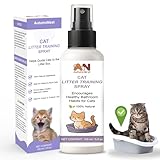
- TARGETED CAT LITTER ATTRACTANT – This litter box attractant spray combines catnip extract, geranium extract and centella asiatica extract in a purified-water base, creating a scent cue that helps attract cats to the intended litter box
- FOR KITTEN LITTER TRAINING AND RETRAINING – Use this litter attractant for kittens, newly adopted cats or adults relearning a routine after a move, a litter-box change or another household transition
- FITS YOUR CURRENT LITTER-BOX SETUP – This cat training spray works with your existing box and litter. Keep the box, litter type and location consistent so your cat can focus on one clear location cue at a time
- SHAKE, SPRAY AND REINFORCE – Use as a cat potty training spray by applying on or near the intended litter-box area 2–3 times daily. Let your cat investigate, then reinforce successful use with calm praise or a treat
- 150ML FOR A CONSISTENT ROUTINE – The 5 fl oz bottle supports repeated training for kittens, adult cats, new adoptions and multi-cat homes. For external use only; do not spray directly on pets. Individual responses can vary
Rank #4

- PREMIUM QUALITY: A combination of premium texture and granule size made with 100% bentonite clay for maximum clumping creates litter particles that are just the right size.
- HARD CLUMPING: Hard clumping medium grain clay helps prevent moisture from reaching the bottom of the tray and forms hard clumps that won't break down, making it easier to scoop.
- LOW DUST & LOW TRACKING: Ideal for cats and owners who suffer from allergies with a 99% dust-free and hypoallergenic litter formulation that helps keep litter in the box where it belongs.
- SUPERIOR ODOR CONTROL: Formulated for single or multi-cat households with natural ingredients to keep your home smelling clean and fresh between litter box cleanings.
- NATURAL HERBAL ATTRACTANT: Blended with a natural herb attractant, the ideal texture and particle size combine to solve litter box problems by bringing cats back to their litter box.
Product prices and availability are accurate as of the date/time indicated and are subject to change. Any price and availability information displayed on Amazon at the time of purchase will apply.




