
Wyandotte hens lay brown eggs, with shell shades ranging from light brown to richer or darker brown. They are dual-purpose birds rather than specialized commercial layers, so their production is best understood through broad breed ratings—not a guaranteed number of eggs per year. A general hen may begin laying at about six months, but an individual Wyandotte’s timing depends on age, daylight, nutrition, strain, and management.
This guide explains what Wyandotte eggs look like, what the available production ratings mean, how to prepare a coop, and how to keep laying hens productive and healthy.
As an Amazon Associate I earn from qualifying purchases.
Wyandotte eggs at a glance
- Shell color: Brown, ranging from light to rich or dark brown depending on the hen’s inherited genetics.
- Production: Qualitative ratings range from “fair” for Wyandottes generally to “Good” for Golden Laced and “Very good” for Silver Laced in one backyard-breed guide.
- Purpose: Dual-purpose birds raised for both eggs and meat.
- Typical laying age: Around six months is a general benchmark for hens, not a Wyandotte-specific guarantee.
- Climate: Generally cold hardy, but reported to perform poorly in hot conditions.
- Housing: Plan for weather and predator protection, ventilation, roosts, and 3–5 square feet of indoor space per bird.
Wyandotte varieties include Black, Blue, Buff, Columbian, Golden Laced, Partridge, Silver Laced, Silver Penciled, and White. The University of Wisconsin Extension breed guide lists brown eggs and a standard hen weight of 6½ pounds; another extension reference gives an adult range of about 5.5–8.5 pounds.
PC Slower Than It Used to Be?
A free scan shows the junk files, broken settings and background clutter dragging Windows down - then fixes them in one click.Free scan · Windows 10 & 11Outdated Drivers Are Slowing You Down
One free scan finds every outdated or missing driver and matches the right update for your exact hardware.Free scan · exact hardware matchWhat color eggs do Wyandotte chickens lay?
Wyandottes lay brown eggs. Texas A&M AgriLife’s 2022 breed table describes them as “Light to rich brown,” while Mississippi State University Extension gives the broader range “light to dark brown.” In practice, expect a brown spectrum rather than one fixed chocolate shade.
#1 Best Overall
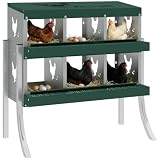
- Spacious Nesting Area: Featuring six roomy and private nesting boxes for chickens, these nesting boxes ensures excellent airflow, providing hens a secure and calming space to boost egg production and reward your daily chicken care efforts
- Effortless Egg Collection: The angled chicken nesting boxes let eggs gently roll into the front tray, keeping them clean and intact for quick retrieval, suitable for active farmers who value both time and egg protection
- Stable Metal Construction: Built from galvanized steel, these robust chicken laying boxes withstand weather and resist rust, promising years of reliability and peace for your flock in any backyard chicken coop setting
- Easy-Clean Design: Featuring metal bases and vented design, these laying boxes allows dirt and debris drain easily, you can quickly clean with a hose, keeping your hens healthy and giving you more time to enjoy raising them instead of scrubbing
- Quick Installation: Comes with all screws, nuts, and a clear guide, making assembly fast even for beginners, choose wall mount or ground use to enhance your mini farm with high-efficiency hen nesting boxes today
Why the shade varies
Shell color is inherited. Texas A&M explains that “the genetic background of the hen (the hen’s ‘mother and father’) determines the inherited egg color produced.” That means two Wyandotte hens can lay noticeably different browns, even when they share the same named variety. Age, individual genetics, and the particular breeding line can also make the color look lighter or deeper from one hen to another; the cited breed tables establish the range, not a formula for predicting an individual egg’s exact shade.
Does a brown shell mean a more nutritious egg?
No. The University of Florida IFAS guide states that “eggshell color is based on the breed of the bird and does not affect the nutritional value of the egg.” Nutrition is related to the hen’s diet and overall nutrition, not whether the shell is brown, white, or another color. Choosing a Wyandotte for brown eggs is therefore a preference about appearance and breed, not a way to obtain a nutritionally superior egg.
How many eggs does a Wyandotte lay?
There is no consistent, authoritative Wyandotte-specific annual total in the extension references cited here. Instead, the sources use broad ratings that can vary by variety, strain, age, season, feed, housing, and management. Treat those labels as comparisons among backyard breeds, not as promises for every hen.
What’s actually slowing this PC down?
Pick the symptom - the matching free tool is one click away.
What the published ratings mean
The UF/IFAS backyard-breed comparison rates Silver Laced Wyandotte production as “Very good” and Golden Laced Wyandotte production as “Good.” Mississippi State’s common-breed table categorizes Wyandotte production as “fair.” Those apparently different labels do not create a precise contradiction: they come from different guides and may reflect different strains, criteria, and comparison groups.
| Bird or category | Rate-of-lay information | What the rating supports | What it does not establish |
|---|---|---|---|
| Silver Laced Wyandotte | “Very good” (UF/IFAS) | Can be a productive backyard dual-purpose choice relative to breeds rated lower in that guide. | A guaranteed annual egg count for an individual hen. |
| Golden Laced Wyandotte | “Good” (UF/IFAS) | Generally useful egg production within a dual-purpose breed. | A fixed weekly or yearly total. |
| Wyandotte, general category | “Fair” (Mississippi State Extension) | A moderate, broad comparison in that source’s table. | A universal rating for every variety or breeding line. |
| White Leghorn and several sex-link breeds | “Excellent” (UF/IFAS) | These entries rank higher for rate of lay in that comparison. | That every flock will outperform every Wyandotte under all conditions. |
Because the ratings are not standardized annual measurements, do not convert them into an invented number. The UF/IFAS reference also emphasizes that breeds vary considerably in annual output.
Rank #2
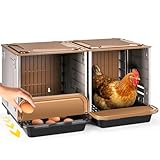
- This package contains 2 nesting boxes.
- [Chicken Nesting Box]This nesting boxes for chicken provide a safe, comfortable, and private environment for hen on nest to lay eggs, making collection easy for you while keeping eggs clean and intact. The chicken laying boxes solve the problem of hens laying eggs anywhere, which can lead to eggs becoming dirty, broken, or difficult to find.
- [Roll Away Nesting Box]With its sloped design, the hen nesting box allows eggs to automatically roll into a front collection area, away from the hen's activity zone. This chicken laying boxes prevents eggs from being crushed or pecked by hens, while enabling you to easily collect clean, intact eggs by simply opening the lid from the outside.
- [Spacious & Private Nesting Box]Thoughtfully designed with spacious, private compartments, this chicken nest boxes comfortably fits medium to large hens. Built-in vents promote airflow to keep the interior dry and fresh, providing with a more comfortable living environment.
- [Bottom Drainage Holes]The base features drainage holes to prevent liquid accumulation, keeping the interior dry. Crafted from durable, all-weather plastic, this lightweight nest box is built to last—no rust. And it supports wall-mounted installation or drill-free placement, which can be easily done whether installed horizontally or vertically. Additionally, compartments can be stacked infinitely.
A general benchmark, not a Wyandotte promise
The University of Minnesota Extension gives about six eggs per week as a general benchmark for hens. That figure is not presented as a Wyandotte-specific rate, so use it only as broad context. A particular Wyandotte may lay more or less depending on her genetics, age, molt, daylight, nutrition, health, and environment.
Why production changes through the year
Hens generally peak during their first two years. Laying declines during molt and when daylight decreases. UMN says hens need at least 12–14 hours of light daily to continue laying; natural day length may therefore produce a seasonal drop. A lower winter tally does not automatically mean the hen has stopped permanently.
Quick wins for a faster PC:
Fix the driver behind crashes, sound loss and screen glitchesFind Drivers →Repair Windows errors before they cause bigger problemsFix Now →When do Wyandotte hens start laying?
Hens commonly begin laying at around six months, according to UMN’s general guidance. This is a benchmark for hens overall, not a guaranteed schedule for Wyandottes. Some birds mature earlier or later because of inherited traits, growth rate, season, nutrition, and day length.
What to expect after the first egg
Production usually builds as a pullet settles into lay, reaches its strongest period during the first two years, and then gradually declines. UMN notes that hens may continue laying for five to ten years, although the rate is not expected to remain at the early peak throughout that entire span. A hen’s age and recent molt are therefore essential context when evaluating her output.
Signs that timing is seasonal rather than a permanent failure
- A young pullet has not yet reached the general six-month benchmark.
- An adult hen is molting, when laying commonly declines.
- Daylight has shortened below the 12–14-hour range associated with continued laying.
- The hen’s feed, water, calcium source, housing, or protection from weather and predators is inadequate.
These signs do not diagnose illness. If a hen appears unwell, loses condition, or stops laying abruptly outside these normal patterns, consult a poultry veterinarian or another qualified local professional.
Rank #3

- HAPPY CHICKENS: Eggluuz chicken nesting boxes is specifically designed to create clean, comfortable, safe and sheltered space for hens to lay eggs, provide them plenty of room of comfort to increase the egg production rate
- UNIQUE EGG COLLECTION DESIGN: This nesting box has a unique designed with a slight inclination to allow the eggs to roll in the tray, so you can easily find the fresh eggs and you don’t even have to reach into the nesting box. Keep your precious eggs safe
- DESIGNED FOR LASTING: The side and roof are made with galvanized steel for strong construction, with ventilation holes to provide fresh air for hens and keeps the nesting box dry and cool. The trays are made with plastic that won’t rust and are easy to clean
- QUICK INSTALLATION: All the screws and nuts required for assembly are included and comes with clear instructions.The key-shaped hanging holes make it easy to hanging and disassembly
- EASY TO CLEAN: The nesting box bottom is designed with many small holes to prevents water retention, debris and other excess can be cleaned with water by removing the tray
Are Wyandottes good egg layers?
They can be good backyard egg layers when your priority is a balanced bird that also provides meat, attractive plumage, and a generally docile temperament. They are not the clearest choice if your sole objective is the highest possible commercial-style egg output. The source ratings illustrate why: some Wyandotte varieties receive “Good” or “Very good” scores, while specialized laying breeds in the same comparison receive “Excellent.”
Choose a Wyandotte when you value
- Brown eggs in a naturally variable light-to-dark range.
- A dual-purpose body type rather than an egg-only type.
- A medium-weight bird suited to small flocks.
- Cold-weather resilience and a rose comb that is less prone to freezing than a single comb.
- A relatively docile breed for a mixed backyard flock.
Consider another type when you need
- A standardized, very high annual egg total.
- A breed selected primarily for commercial laying rather than dual-purpose use.
- Strong performance in consistently hot conditions.
These are decision trade-offs, not guarantees. Individual strains and management can shift the result in either direction.
Breed background, size, and climate fit
Wyandottes developed in New York State in the late 1800s and became a U.S. dual-purpose breed. Mississippi State Extension describes adult weights of about 5.5–8.5 pounds and characterizes the breed as relatively docile and cold hardy, while also noting that it does not do well in heat. UMN describes Wyandottes as suitable for small flocks and rugged conditions.
The rose comb is a practical winter feature. Oklahoma State University explains that a rose comb is less prone to freezing than a single comb. It does not eliminate the need for dry, well-ventilated housing, protection from drafts, or routine winter checks.
Managing hot weather
Because the breed is reported to be poorly suited to heat, give birds shade, reliable clean water, and ventilation, and avoid overcrowding. The extension sources do not provide a single temperature threshold for Wyandottes, so judge conditions by local weather and the birds’ behavior rather than by an invented cutoff.
Rank #4

- Effortless Roll Away Egg Collection: Our nesting box for chickens features a slight tilt design that allows eggs to roll forward under a secure lid, keeping eggs clean, intact, and preventing pecking or breakage, collect your eggs easily without disturbing your poultry
- Spacious & Ventilated Design: Offer three private, individual nesting compartments, suitable size for standard chickens and small birds, giving them the dark, cozy space they need for stress-free laying and the ventilated design provides fresh air for the hens and keeps the chicken house dry and cool
- Durable & Predator-Resistant Metal Construction: Built with heavy-duty, rust-resistant galvanized steel, the nesting box provides superior protection against rodents and predators compared to wooden coops, ensuring a clean, comfortable, secure and sheltered space to lay eggs, thus increasing their egg production rate
- Easy to Install & Clean: All the screws and nuts required for assembly are included and comes with clear instructions and hardware, easily to assemble or hang it on a wall, inside your coop, or from a sturdy beam, besides, you can periodically flush it with a hose
- Suitable for Multiple Poultry: The laying boxes for hens are designed not only for medium to large chickens, but also ducks, birds and etc, each compartment will accommodate up to 3-5 hens
Coop requirements for laying Wyandottes
Wyandottes do not require a special nest design, but they do require the same basic infrastructure as other laying hens. UMN recommends the following general standards:
| Requirement | Guidance | Why it matters |
|---|---|---|
| Indoor floor space | 3–5 square feet per bird | Reduces crowding and gives birds room to rest and move. |
| Nest boxes | One nest box per four to five laying hens | Provides accessible laying sites and helps keep eggs cleaner. |
| Roosts | Provide secure roost space | Allows normal nighttime resting off the floor. |
| Ventilation | Keep air moving without exposing birds to damaging drafts | Helps manage moisture and stale air. |
| Protection | Weatherproof coop and predator protection | Safeguards birds and eggs. |
If you are buying a chicken nesting box, use the one-per-four-to-five-hens ratio as the sizing rule rather than choosing a box marketed specifically for Wyandottes. The recommendation is a general flock standard, not a breed-specific requirement.
Independent reader supportYour contribution helps us test, update, and keep practical guides available for everyone.Feed, water, and calcium for reliable shells
UMN recommends a balanced prepared feed, continual access to clean fresh water, crushed oyster shell for laying hens, and grit for digestion. Oyster shell supplies supplemental calcium for shell production; grit serves a different digestive function and should not be treated as a calcium replacement.
UMN estimates that a six-pound hen eats roughly three pounds of feed per week. That is a general estimate, not a Wyandotte-specific ration, and actual intake changes with weather, forage, body size, production, and feed energy density. Keep feed dry and protected from pests, and check water frequently in both hot and freezing weather.
The Tool Desk
Outbyte PC Repair FREEClear out junk files and repair common Windows errorsFree Scan →Outbyte Driver Updater FREEFix the driver behind crashes, sound loss and screen glitchesFind Drivers →Collecting and handling Wyandotte eggs
- Provide enough nests: Use one nest box for every four to five laying hens and keep boxes dry and clean.
- Check nests twice daily: UMN recommends collecting eggs two times a day, which limits the time eggs remain exposed to dirt, breakage, or temperature swings.
- Clean the housing weekly: Clean the coop and pen on a weekly schedule, removing soiled bedding and replacing it with dry material.
- Inspect eggs: Separate cracked or heavily soiled eggs from clean, intact eggs and follow your local food-safety rules for handling and storage.
Shell color does not tell you whether an egg is fresh or nutritionally superior. Freshness depends on collection, storage, and handling practices.
Best Value

- Rollout Design for Egg Safety: The slanted floor allows freshly laid eggs to roll gently into a protected collection tray. We recommend placing some soft padding in the collection trayThis design prevents hens from pecking, stepping on, or dirtying the eggs, Designed to help you collect clean, intact eggs daily every day
- Breathable Side Vents for Comfort: Each compartment features side ventilation holes to promotes consistent airflow. This helps regulate temperature and reduce moisture inside the nesting box, providing a cool and comfortable environment for your hens even in hot weather
- Space-Saving Swing Perch & Entrance: The foldable swing perch provides easy access for hens while doubling as a gate to close the box at night. This discourages hens from roosting inside overnight, significantly reducing droppings and keeping the nesting area clean
- Removable Tray for Easy Cleaning: Equipped with a detachable collection tray, this metal nesting box makes deep cleaning a breeze. Simply slide the tray out to wash or sanitize, ensuring a hygienic space for your flock with minimal effort
- Hanging Installation & Stable structure: Features pre-drilled hanging holes for easy wall mounting, saving valuable floor space in your coop. Constructed from heavy-duty galvanized metal, it is built to resist rust and last much longer than traditional wooden boxes
Troubleshooting a drop in laying
The hen is young
Before changing feed or lighting, check age. Around six months is only a general starting point, and some pullets take longer to mature.
The hen is molting
Molt commonly reduces production. Support the flock with balanced feed, water, and a low-stress, weather-protected environment while feathers regrow.
Daylight has shortened
UMN links continued laying with at least 12–14 hours of light per day. Seasonal reduction is therefore expected in many backyard flocks. If you use supplemental lighting, follow a consistent poultry-management plan and avoid abrupt changes.
Do these 3 things before closing this tab:
1Fix the driver behind crashes, sound loss and screen glitches2Repair Windows errors before they cause bigger problems3Scan for outdated or missing drivers - takes under a minuteHousing or supplies are inadequate
Check nest access, indoor space, ventilation, predator security, feed availability, oyster shell, grit, and water. A missing or contaminated resource can affect the flock even when the breed itself is well suited to your climate.
The change is sudden or accompanied by illness
Breed information cannot diagnose disease. Sudden cessation, lethargy, breathing problems, injury, or marked weight loss warrants advice from a poultry veterinarian or qualified extension professional.
Buying Wyandotte chicks or pullets
UMN identifies hatcheries, individual breeders, and local farm-supply stores as common sources for chickens. Ask which Wyandotte variety and breeding line you are buying, what age the birds are, and whether the seller can describe their laying history. Since published ratings differ among varieties and sources, a seller’s documented strain and management history may be more informative than a single “good layer” label.
Before bringing birds home, verify local rules. UMN notes that municipalities may require a permit, limit poultry numbers, or regulate the sale of eggs. Check your city, county, and other applicable jurisdiction before constructing a coop or selling eggs.
Making the decision
Choose Wyandottes if you want brown eggs, a dual-purpose bird, a generally docile temperament, and good cold-weather suitability for a small flock. Plan for variable production rather than a guaranteed annual number, protect birds from heat, and provide the same well-managed housing, nutrition, and daylight conditions required by other laying hens. If maximum egg volume is the overriding goal, compare them with breeds rated “Excellent” for rate of lay in the UF/IFAS guide instead of assuming every Wyandotte will match that output.
Quick Recap
Product prices and availability are accurate as of the date/time indicated and are subject to change. Any price and availability information displayed on Amazon at the time of purchase will apply.





Leave a Reply