
The Tool Desk
Outbyte Driver Updater FREEFix the driver behind crashes, sound loss and screen glitchesFind Drivers →Outbyte PC Repair FREEClear out junk files and repair common Windows errorsFree Scan →Yes—ZZ plants are toxic to cats if chewed. Zamioculcas zamiifolia contains insoluble calcium-oxalate crystals that cause intense, local irritation in the mouth and digestive tract. Most exposures are low severity and are not expected to cause lasting effects, but throat swelling or any change in breathing is an emergency.
Are ZZ plants toxic to cats?
Yes. The ASPCA lists ZZ plant (Zamioculcas species) among plants containing insoluble calcium oxalates. A cat does not have to swallow a large amount for chewing to hurt: biting a leaf, stem, or stalk can release microscopic, needle-like crystals called raphides into the plant tissue and the cat’s mouth.
As an Amazon Associate I earn from qualifying purchases.
The important distinction is that this is primarily a contact-irritant injury, not a conventional poison that circulates through the body. Pet Poison Helpline’s 2019 handout classifies insoluble-calcium-oxalate plants as “Not systemically toxic.” That classification helps explain why many cats recover with supportive care, but it does not make a ZZ plant cat-safe. A plant that causes immediate pain, vomiting, or occasional airway swelling should not be available for chewing.
“ZZ plant” includes the familiar green plant and named forms such as Raven ZZ. A darker leaf color or a cultivar name does not remove the calcium-oxalate risk. Treat every ZZ plant, cutting, fallen leaf, and stem as unsafe for a cat that may chew it.
#1 Best Overall

- Your Cat Deserves the Best: Our cat grass blend adds important nutrients to your cat’s diet, including wheat grass, oat, barley and rye. Organic and loaded with all the fiber your pet needs for healthy digestion, our cat grass kit provides hairball control for cats as well as a tasty edible grass treat.
- Cat Plant Magic: Add a soil disk, a splash of water, and a sprinkling of seeds, and watch your cat grass planter kit sprout like magic. Read our Cat Ladies insert for easy-to-follow instructions and growing tips, and watch your organic cat grass sprout up to 4” in just 4–7 days. No green thumb required.
- Good for Cats, Good for All: Not only are our grow kits organic and GMO-free, but our cat grass for indoor cats deters them from eating toxic household plants and digging up your favorite blooms, making our cat grass good for cats and their humans.
- Purrfectly Giftable: A great gift for cat moms everywhere, our cat grass growing kit keeps your feline friends healthy and happy while keeping your house looking greener and cleaner.
- What’s Inside: Our Cat Grass Growing Kit includes 3 organic soil disks (number may vary), 3 packages of our locally sourced cat grass seed blend, 3 BPA-free containers, and simple instructions.
How the crystals cause pain
ZZ plants store raphides in cells throughout their leaves, stems, and stalks. When a cat bites, the damaged cells release the crystals. The crystals act like tiny irritants against the moist tissues of the lips, tongue, gums, cheeks, and throat.
That mechanism produces a rapid local reaction: mouth pain, drooling, pawing at the face, and difficulty swallowing can appear soon after chewing. If swallowed plant material irritates the gastrointestinal tract, nausea, retching, vomiting, diarrhea, or reduced appetite may follow. The reaction is usually concentrated at the point of contact rather than being a body-wide toxic syndrome.
ASPCA describes the process plainly: “When a pet chews on one of these plants, the crystals are released into the mouth, causing irritation and pain.” The fact that the crystals are insoluble is also why exposure is managed differently from a poison that is absorbed and damages internal organs.
Quick wins for a faster PC:
Scan for outdated or missing drivers - takes under a minuteDriver Scan →Repair Windows errors before they cause bigger problemsFix Now →Fix the driver behind crashes, sound loss and screen glitchesFind Drivers →Symptoms to watch for after a cat chews a ZZ plant
Observe your cat closely after any known or suspected contact. Signs can be mild or pronounced, and not every cat will show every sign.
- Immediate mouth pain or an unusually distressed facial expression
- Excessive drooling
- Pawing at the mouth or rubbing the face
- Head shaking
- Retching or repeated attempts to vomit
- Nausea, vomiting, or diarrhea
- Reduced appetite or refusal to eat
- A change in the voice or meow
- Swelling in the mouth or toward the back of the throat
A voice change, repeated swallowing, or reluctance to open the mouth can indicate substantial oral discomfort. Do not assume a quiet cat is unaffected; cats may hide pain, and a cat that stops eating or drinking still needs veterinary advice.
Rank #2

- Healthy Alternative to Cat Treats: Cats crave the taste of grass, and our cat grass adds important nutrients, like niacin and B vitamins, to your cat’s diet; It also provides cats with the fiber they need for healthy digestion and hairball control
- Cat Grass For Indoor Cats: Cat-A’bout cat grass reduces your cat’s urge to eat house plants; Each cat grass kit includes everything required to grow grass except water; Can be grown year round and makes a great gift
- Easy & Fast Cat Grass Kit: Our unique formula requires watering only once and sprouts magically straight from the container; CatGrass Plus has a 98% germination rate so your cat can start enjoying healthy, vibrant grass in as little as one week
- From Nose to Toes We've Got Your Pet Covered: Our goal is to improve the human-animal bond by offering a complete line of innovative, solutions-driven products and accessories for animals, both small and large
- Trusted by Professionals: Miracle Care health and grooming products have been trusted and recommended by veterinarians and professional groomers for more than 40 years; Proudly Made in the USA in our Dayton, OH facility
Emergency symptoms: when to leave for a veterinary hospital
Rarely, significant exposure can make tissues at the back of the throat swell enough to interfere with swallowing or breathing. Treat any breathing change as an emergency rather than waiting to see whether it settles.
- Open-mouth breathing, noisy breathing, wheezing, or obvious effort to breathe
- Rapidly increasing swelling of the tongue, mouth, or throat
- Inability to swallow, choking, or repeated gagging
- Collapse, extreme weakness, or inability to stay alert
- Persistent vomiting or distress that is not easing
If your cat is having trouble swallowing or breathing, go directly to a veterinary hospital. Call ahead if possible so the clinic can prepare for an airway problem. Do not delay transport while trying home remedies.
Outdated Drivers Are Slowing You Down
One free scan finds every outdated or missing driver and matches the right update for your exact hardware.Free scan · exact hardware matchPC Slower Than It Used to Be?
A free scan shows the junk files, broken settings and background clutter dragging Windows down - then fixes them in one click.Free scan · Windows 10 & 11My cat ate a ZZ plant: the safest response
Use the following sequence for a known bite, missing plant material, or symptoms that fit exposure. The goal is to stop further contact, obtain case-specific advice, and give the veterinarian accurate information.
- Remove access. Move the entire ZZ plant and every fallen piece away from the cat. Check the floor, nearby furniture, and the cat’s mouth area for leaf or stem fragments.
- Check breathing and swallowing first. If either is impaired, skip home observation and travel to a veterinary hospital immediately.
- Call for professional guidance. Contact your veterinarian or ASPCA Animal Poison Control at (888) 426-4435. Explain that the plant is a ZZ plant (Zamioculcas) and describe the signs you see.
- Record the exposure. Note the approximate time, which part of the plant was chewed, whether material is missing, and any vomiting, drooling, swelling, or appetite change. There is no published dose threshold that lets an owner reliably label an exposure “safe.”
- Keep identification available. Photograph the plant and save a leaf or stem in a container or bag if doing so does not delay care. Bring the photo or sample to the clinic.
- Follow the clinician’s instructions. Many cases can be managed at home with guidance, while a cat with marked pain, repeated vomiting, swelling, or swallowing trouble may need examination and supportive treatment.
Do not induce vomiting, give human medication, or force food or liquid into a painful mouth unless a veterinarian specifically directs you. Aspca notes that a small amount of dairy may reduce mouth irritation after some insoluble-oxalate exposures, but an owner should confirm that this is suitable for the individual cat before offering it. Dairy is not a substitute for professional advice and should never delay emergency care.
How dangerous is a ZZ plant exposure?
ASPCA characterizes the severity of insoluble-calcium-oxalate plant exposures as generally low, and says many cases can be managed at home with guidance. Long-term effects are not expected in the usual course. Pet Poison Helpline’s “Not systemically toxic” classification supports the same overall picture: most cats experience a painful but self-limited local reaction rather than progressive poisoning of internal organs.
Rank #3

- Complete Kit: Cat grass kit includes cat grass seeds, coconut coir soil discs, wooden cat grass planter, and mini tools.
- Indoor Friendly: Cat grass for indoor cats with easy indoor grass for cats to grow year-round.
- Digestive Support: Grass for cats helps hairball control and supports healthy digestion.
- Fast Sprouting: Just add water, plant cat grass seed, and see catgrass sprout in days.
- Pet Friendly: Plants for cats and dogs, ideal pet grass for cats in any home.
“Generally low” is a population-level description, not a promise about an individual cat. The amount chewed, the part of the plant, the cat’s size and health, and whether swelling develops all matter. Continued access can lead to repeated bites and worsening oral pain. A cat that cannot swallow, keeps vomiting, or develops any breathing abnormality falls outside a watch-and-wait situation.
What’s actually slowing this PC down?
Pick the symptom - the matching free tool is one click away.
Authoritative sources do not publish a reliable prevalence figure, dose cutoff, or universal recovery-time statistic for ZZ plant exposures. Do not use the absence of such a number to estimate risk from a particular bite; use the cat’s signs and a veterinarian’s assessment instead.
Is a Raven ZZ plant safe for cats?
No. Raven ZZ is a named form of the same ZZ plant group, and its unusual dark foliage does not make it safe to chew. Because the toxic mechanism comes from insoluble calcium-oxalate crystals in the plant tissues, a cultivar name or leaf color should not change your safety decision. Keep Raven ZZ, green ZZ, cuttings, and trimmings out of reach of cats.
Preventing another exposure
Prevention is more dependable than trying to judge whether a particular leaf is tempting or whether a plant is “mostly” out of reach. Cats climb, knock over containers, and investigate fallen leaves, so secure the whole setup rather than only the pot.
- Remove ZZ plants from rooms your cat can enter, or use a genuinely cat-inaccessible enclosure with no reachable leaves, stems, soil, or fallen debris.
- Inspect the plant after pruning, repotting, delivery, or accidental breakage; collect every fragment immediately.
- Keep cuttings and discarded leaves in a closed container before taking them outside.
- Do not rely on a high shelf if your cat can reach it from furniture, shelving, curtains, or a nearby window perch.
- Tell every household member, pet sitter, and visitor that ZZ plants are not safe for feline chewing.
- Have a clear plan for which veterinarian or emergency hospital to call and keep the ASPCA Poison Control number, (888) 426-4435, accessible.
Physical separation is preferable to trying to train a cat not to chew. If your cat repeatedly seeks plant material, remove all questionable plants and ask your veterinarian about the behavior rather than offering a toxic plant as a deterrent.
Rank #4
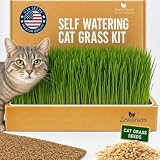
- EASIEST WAY TO GROW EDIBLE CAT GRASS FOR INDOOR CATS IN YOUR HOME. Water once at the beginning and that’s it! No need to use messy soil or have to calculate how much water to give on daily basis. Guaranteed to grow in just a few days with no green thumb required.
- BEAUTIFULLY STYLISH: Our Cat Grass Growing Kit system includes a dish washer friendly grass tray measuring 12” x 6” (one of largest Cat grass systems on Amazon!) and insert for continual use, a beautiful bamboo surround because we want it to look good in your home, 1 biodegradable hemp mat, full instructions and certified organic USDA non-GMO wheatgrass seeds with an incredible germinate rate.
- CONVENIENT REFILLS AVAILABLE SEPERATELY: Make growing your own grass for cats a healthy habit and hobby with our easy to use economical refill packs so you will never be without. One kit produces 72 square inches of grass for your purry love!
- WATCH THE MAGIC HAPPEN: No soil needed which means that no chance of your purry love pulling out seeds and dirty soil all over the place! Simply soak seeds, pour water over hemp mat, spread the seeds out and cover with the black out lid, for 3 days and then take the lid off and your wheatgrass will be ready in another 3 – 4 days!
- ZERO RISK SATISFACTION: Our seeds have an excellent germination rate and are guaranteed to grow. If you need any help, our US based ZestiGreens team would love to help you as we want you and your furry friends to love growing your own cat grass as much as we do. We offer full refunds if you are unhappy for any reason.
Cat-safer houseplant alternatives
ASPCA-associated guidance identifies spider plant (Chlorophytum comosum), rattlesnake plant (Calathea lancifolia), and parlor palm (Chamaedorea elegans) as safer houseplant choices for homes with cats and dogs. “Safer” means they are preferred over a ZZ plant in the cited guidance; it does not mean a cat should eat them. ASPCA cautions that consuming any plant material can still cause vomiting or gastrointestinal upset.
| Plant | Cat-safety classification in the cited guidance | Chewing access | Care and light requirements | If eaten | Name-confusion caution |
|---|---|---|---|---|---|
| Spider plant (Chlorophytum comosum) | Identified as a safer choice | Not stated; access depends on where the pot and hanging growth are placed | Not stated in the cited guidance | Any plant material can still cause vomiting or gastrointestinal upset | Use the scientific name when buying to confirm the identity |
| Rattlesnake plant (Calathea lancifolia) | Identified as a safer choice | Not stated; keep leaves away from a cat that chews | Not stated in the cited guidance | Any plant material can still cause vomiting or gastrointestinal upset | Confirm that the plant is Calathea lancifolia, not a different plant sold under a similar common name |
| Parlor palm (Chamaedorea elegans) | Identified as a safer choice | Not stated; placement still determines whether a cat can reach it | Not stated in the cited guidance | Any plant material can still cause vomiting or gastrointestinal upset | Verify the scientific name because common names can be applied inconsistently |
The safest selection process is to identify the exact species, check a current veterinary toxicity database, and then control access. A plant labeled “pet-friendly” is not a license for unrestricted grazing, and a common name alone is not enough to identify a species.
Independent reader supportYour contribution helps us test, update, and keep practical guides available for everyone.Common mistakes after a suspected bite
Waiting for severe signs
Drooling, pawing, or a changed voice can be the first evidence of painful exposure. Contact a veterinarian or poison service while the cat is still stable rather than waiting for breathing difficulty.
Assuming a tiny bite cannot matter
There is no authoritative dose threshold supplied for owners. A small visible bite may still release crystals into the mouth, and a missing amount cannot be measured reliably from the plant.
Recommended Free Tools
Treating “not systemically toxic” as “non-toxic”
The Pet Poison Helpline wording describes the type of toxicity; it does not say the plant is harmless. Local injury, vomiting, dehydration, and rare airway swelling remain possible.
Best Value

- 🌱 Grows in Just 3-7 Days – Fast & Foolproof: Our 100% wheat grass seeds germinate quickly and reach 4–6 inches tall in as little as 3–7 days. No green thumb required. Simply soak seeds for 6 hours, sprinkle on soil, water once, and place on a sunny windowsill. Watch your indoor cat grass kit sprout like magic – perfect for impatient cats and busy owners alike.
- 🌾 Premium Wheat Seeds – High Germination & Freshness This 3-pack contains high-germination wheat seeds, carefully selected for consistent, vigorous growth.
- 🐱 Helps Support Natural Hairball Management: Fresh wheat grass provides natural fiber that helps your cat expel hairballs and support healthy digestion. The tender greens act as a gentle internal aid, reducing hairball formation while satisfying your cat's instinct to chew on plants – keeping them away from toxic household flowers and your favorite blooms.
- 🐰 A Healthy Treat for Small Pets Too: Not just for cats! Rabbits, guinea pigs, hamsters, and even reptiles love this fresh wheat grass supplement. Unlike dry hay alone, our nutrient-rich greens provide essential vitamins, hydration, and natural foraging enrichment. Grow a living snack that supports oral health and overall well-being for all your small furry family members.
- 🎁 Complete 3-Piece Growing Kit—Everything You Need: Each kit includes 3 packets of wheatgrass seeds, 1 BPA-free container, 3 sheets of coconut coir growing medium, and easy-to-follow instructions. Just add water and watch it grow. Whether you’re a first-time cat owner or a seasoned “plant parent,” this kit is perfect for year-round indoor gardening. It makes an excellent gift for cat lovers everywhere.
Using a home remedy instead of an assessment
Only a veterinarian can decide whether observation, an oral examination, fluids, or other supportive care is appropriate. Do not give medication or force liquids, and confirm the suitability of any dairy suggestion before using it.
Leaving the plant in place after the first incident
A cat that returns to the plant can receive repeated crystal exposure. Remove the plant and all fragments, then replace it only with an identified safer option positioned beyond chewing access.
What to tell the veterinarian or poison specialist
Clear information speeds the risk assessment. Have these details ready:
Do these 3 things before closing this tab:
1Clear out junk files and repair common Windows errors2Fix the driver behind crashes, sound loss and screen glitches3Repair Windows errors before they cause bigger problems- The plant’s common and scientific name, if known: ZZ plant, Zamioculcas zamiifolia, or a named form such as Raven ZZ
- The time you noticed chewing or the last time the cat could have reached the plant
- Which leaves, stems, or stalks appear damaged and whether fragments were swallowed
- Your cat’s age, approximate size, existing illnesses, and current medications
- Every sign observed, including drooling, pawing, vomiting, diarrhea, appetite change, voice change, swelling, or breathing difficulty
- A photograph or sample for confirmation
Do not estimate certainty you do not have. Say “suspected exposure” if you did not see the bite, and report the earliest symptom you noticed.
Bottom line
ZZ plants are not cat-safe: their insoluble calcium-oxalate crystals can cause immediate mouth pain and gastrointestinal signs, while substantial exposures can rarely swell the airway. Most cases are low severity and not systemic, but the correct response is still prompt professional guidance, strict removal of the plant, and emergency veterinary care for swallowing or breathing problems. Spider plant, rattlesnake plant, and parlor palm are identified as safer alternatives, provided your cat cannot freely eat them.
Quick Recap
Product prices and availability are accurate as of the date/time indicated and are subject to change. Any price and availability information displayed on Amazon at the time of purchase will apply.





Leave a Reply