
Recommended Free Tools
Some links on this page are affiliate links: if you buy through them we may earn a commission, at no extra cost to you.
Dogs can prefer certain canine companions and build close social relationships, but there is no established evidence that they experience a human-like romantic “crush.” The safest way to understand an apparent canine romance is to describe what you can observe: who your dog seeks out, what happens during the interaction, whether the play is mutual, and whether either dog shows stress. Mounting, by itself, is not proof of love, sexual intent, or even friendship.
“Crush” is useful shorthand for an owner who notices a dog repeatedly choosing the same companion. It is not a veterinary diagnosis or a behavior category that can be confirmed from one gesture. The meaning of a behavior depends on the setting, arousal level, previous interactions and both dogs’ responses.
As an Amazon Associate I earn from qualifying purchases.
What’s actually slowing this PC down?
Pick the symptom - the matching free tool is one click away.
What a “crush” might look like in dogs
A dog may consistently seek out one particular dog, relax more quickly around that companion, invite play, follow the other dog, or choose to rest nearby. Those patterns can indicate social preference or compatibility. They do not tell us that the dog is imagining a romantic relationship in the human sense.
Dogs also differ markedly in their interest in other dogs. Some enthusiastically greet and play with many individuals. Others are selective, merely tolerant, fearful or uncomfortable. The American Kennel Club’s guidance on canine selectivity emphasizes that an individual dog’s comfort and boundaries matter more than an assumption that every dog wants to socialize. A dog that walks away from a greeting is communicating useful information, not missing out on romance.
Popular on Amazon

- New Smart Play Ball: Made from durable, chew-resistant, and pet-safe materials, keeps dogs joyfully active and mentally engaged, even when you’re away. It frees your hands to focus on what you truly enjoy.
- 3 Interactive Modes: Easily switch between Normal (blue light), Passive (green light), and Gentle (pink light) to match your dog’s play style and energy level. Simply press and hold the power button until the red light appears to turn off the toy.
- Ideal for Small-Medium-Large Breeds:This smart dog ball is designed for dogs of all sizes, so multiple pets at home can enjoy playtime together. Ensure safe and fun play by supervising your dogs and guiding them to interact with the toy, rather than just chewing it.
- Easy to Clean & USB-C Rechargeable: Keeping the smart dog toy ball clean is effortless—simply wipe away dirt and rinse the outer shell after ensuring it’s securely closed. With a single USB-C charge, the toy provides up to 4 hours of continuous playtime, keeping your dog entertained for longer.
- Versatile & Customizable Fun: Let your dog enjoy playtime indoors or outdoors. Swap out different outer shells to keep the toy fresh and exciting, ensuring your furry friend stays happy, engaged, and entertained during every play session.
Look for a relationship that is voluntary and balanced. A companion may be a good match when both dogs repeatedly choose to approach, take breaks, re-engage and remain loose in posture. If one dog is always pursuing while the other hides, freezes or tries to escape, calling it a crush can obscure a welfare problem.
Why mounting does not prove a crush
Mounting is the behavior most often interpreted as canine attraction, yet it has several possible explanations. Veterinary guidance from VCA notes that some dogs mount other pets or people during play, particularly when they are high-arousal dogs. The American Kennel Club likewise describes humping as a commonly seen response when dogs play together. Excitement, stress and over-stimulation can all be part of the picture.
Quick wins for a faster PC:
Fix the driver behind crashes, sound loss and screen glitchesFind Drivers →Repair Windows errors before they cause bigger problemsFix Now →Scan for outdated or missing drivers - takes under a minuteDriver Scan →Mounting can occur in dogs that are spayed or neutered, between dogs of the same sex, and in situations with no apparent reproductive opportunity. That range makes it unreliable as a stand-alone indicator of sexual motivation or affection. The surrounding sequence matters more than the movement itself:
| What you observe | What it may indicate | What to do |
|---|---|---|
| Brief mounting during loose, reciprocal play; both dogs disengage and return willingly | Play-related arousal or excitement is plausible | Monitor closely and give breaks before either dog becomes overwhelmed |
| Mounting starts when the dogs are crowded, noisy or highly stimulated | Over-arousal or stress may be contributing | Lower the intensity, create space and redirect calmly |
| One dog repeatedly mounts while the other turns away, stiffens, growls or attempts to flee | The interaction is unwanted and may escalate | Interrupt immediately and separate the dogs without punishment |
| Mounting is frequent, difficult to interrupt or directed at people and objects as well as dogs | A persistent behavior problem, excessive arousal or another issue may be present | Arrange qualified behavior help; seek veterinary advice if other signs occur |
Neither the VCA explanation nor the AKC play guidance establishes that dogs feel human-style romantic attraction. They describe observable mounting in particular contexts, so the claim should not be broadened beyond that evidence.
How to tell whether both dogs are comfortable
The other dog’s response is the most important safety clue. A social interaction should allow each dog to opt in, pause and leave. Watch the whole body rather than one tail position or a single wag.
Signs of a willing, balanced interaction
- Loose muscles and fluid movement rather than a rigid, forward-leaning posture.
- Play bows, curved approaches and frequent pauses.
- Role reversals, with each dog sometimes chasing and sometimes being chased.
- Both dogs choosing to re-engage after a break.
- Easy disengagement when a handler calls or guides a dog away.
Signs that a dog wants space
- Turning the head or body away, hiding behind a person or repeatedly moving off.
- Freezing, becoming stiff, pinning the ears back or keeping the tail tightly tucked.
- Lip licking, yawning or other appeasement signals in a tense context.
- Growling, snapping, air-biting or escalating attempts to escape.
- One-sided pursuit in which the same dog is trapped or unable to take a break.
A growl is valuable communication, not evidence that a dog is jealous or playing hard to get. Punishing warning signals can remove an early warning without solving the discomfort. Give the dog distance and manage the environment instead.
Free tools Windows power users keep installed
One-click scans. No signup required.
Does my dog actually like that dog?
Repeatedly choosing a particular companion can reasonably be described as a social preference when the choices are voluntary. You can gather better evidence by observing patterns across different days and settings:
- Note who approaches first and whether the approach is relaxed.
- Record whether both dogs initiate play, not just one.
- Watch what happens after a pause, interruption or change of location.
- Check whether either dog can move away, sniff, rest or interact with a person without being followed.
- Compare the pair’s behavior with your dog’s behavior around other dogs, since some dogs are generally social while others are highly selective.
A dog that settles near a companion, greets that dog with a loose body and repeatedly seeks shared activities may have found a compatible friend. That conclusion is useful for arranging safe play; it does not require assigning a romantic emotion.
What to do when one dog starts mounting
Calm interruption is safer and more effective than scolding, laughing at the behavior or allowing the dogs to “work it out” while one is uncomfortable. The AKC recommends interrupting and redirecting mounting, and seeking professional help when it becomes obsessive, contributes to fights or is difficult to stop.
- Interrupt early. Use a calm voice, call your dog away or guide the dog by a leash if one is already attached. Avoid grabbing between aroused dogs.
- Create space. Move the dogs apart behind a gate, into separate areas or on opposite sides of a room. Give the mounted dog a genuine opportunity to leave.
- Lower arousal. Pause the play session, reduce noise and crowding, and allow both dogs time to sniff or rest.
- Redirect to an appropriate activity. Offer a brief game, a cue the dog knows, a sniffing opportunity or another calm enrichment activity. A toy can occupy a dog, but it is not a cure or a diagnostic test.
- Resume only if both dogs are relaxed. Keep the next interaction shorter and supervise continuously. Stop for the day if the behavior returns or either dog objects.
Do not frame redirection as teaching a dog that affection is forbidden. You are managing arousal and protecting consent between animals.
When mounting may signal a health or behavior problem
Occasional mounting in an otherwise relaxed play session can be a normal behavior, but a sudden change deserves attention. Contact a veterinarian if mounting appears alongside body licking or chewing, visible distress or other unusual physical or behavioral changes. Medical discomfort can affect behavior, and only an examination can assess that possibility.
Also popular on Amazon
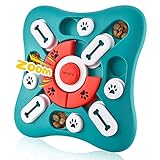
- 【PRODUCT SIZE】10 inch*10 inch*1.3 inch.
- 【3 WAYS TO PLAY, UPGRADE SLOW FEEDER】Our dog mental stimulation toys have a unique squeak button in the middle, which make it easier to attract the attention of dogs and cats. Three different difficulty designs and the 16-hole dog treat dispenser design maximize slow feeding time, even beyond 20 minutes.
- 【FUNNY STIMULATING TOYS】All kinds of dogs and cats love the puzzle game of Spin & Slide and the Seek & Hide with their smell sense and paw skills to find food. Combining circular orbit sliding game and linear orbit sliding game, smart dog and cat must move the slider correctly to get the food reward hidden in the maze.
- 【NON-REMOVABLE PARTS DOG PUZZLE】Our dog treat puzzle is made of non-toxic materials, very durable and suitable for pets to play for a long time. This dog toy has no removable parts because the design has built-in play parts that fold tightly and won't fall off easily.
- 【ANTI-SLIP & EASY TO CLEAN】: The four corners of the bottom are equipped with four anti-skid pads, which can be well fixed during the dog's slow food process; It is easy to clean, also dishwasher safe.
Arrange qualified behavior support when mounting is obsessive, repeatedly sparks fights, is directed at people, or remains difficult to interrupt despite careful management. Keep a short log of triggers, duration, targets and what successfully ends each episode; that information helps a professional evaluate the pattern.
Independent reader supportYour contribution helps us test, update, and keep practical guides available for everyone.How to introduce dogs that seem interested in each other
Do not force a greeting because two dogs look cute together or because one appears eager. Planned introductions with compatible dogs are preferable to repeated, pressured encounters. The American Kennel Club’s guidance on dog-to-dog greetings and selectivity supports allowing dogs to communicate and opt out.
- Choose a neutral, open area. Avoid narrow hallways, doorways and locations where either dog guards food, toys or a resting place.
- Start at a comfortable distance. Walk parallel with loose leashes, keeping far enough apart that both dogs can notice each other without lunging or freezing.
- Reward calm observation. Let each dog sniff the environment and look away. Do not pull the dogs into a face-to-face greeting.
- Allow a brief approach if both remain loose. Keep the leashes relaxed and let the dogs arc toward one another rather than collide head-on.
- Break before tension rises. Call each dog away, walk separately for a moment and reassess body language.
- End on a good choice. A short, successful interaction is preferable to extending the meeting until one dog becomes overwhelmed.
At home, remove high-value resources before a first indoor visit and provide separate resting areas. Supervise every interaction until the dogs have demonstrated a reliable ability to disengage.
Do these 3 things before closing this tab:
1Clear out junk files and repair common Windows errors2Fix the driver behind crashes, sound loss and screen glitches3Repair Windows errors before they cause bigger problemsCommon mistakes in interpreting canine “romance”
Equating persistence with affection
Following, staring or repeated mounting may reflect excitement, anxiety or poor impulse control. Persistence becomes meaningful only when the other dog can freely leave and still chooses to return.
Assuming every wag means happiness
Tail movement reflects arousal, not a single emotion. Read the tail together with muscle tension, facial expression, movement and the dog’s ability to take a break.
Letting dogs settle conflict without supervision
A dog that objects to mounting may escalate from avoidance to a snap. Intervene when the interaction is no longer mutual instead of waiting for a fight.
Using neutering as a guaranteed solution
Mounting can occur in neutered dogs and can be linked to play or arousal. A veterinary discussion can address an individual dog’s health and reproductive status, but surgery is not presented by these behavior sources as a universal fix for every mounting episode.
What science can and cannot currently tell owners
The available guidance supports statements about observable behavior, social preference and safety. It does not provide a validated way to measure a canine “crush,” a prevalence statistic for romantic attraction, or a direct expert conclusion that dogs experience romance as humans do. The American Veterinary Society of Animal Behavior’s October 28, 2015 discussion of appropriate play explains the value of observing play examples, but it does not answer whether dogs feel romantic attraction.
That evidence limit does not make your observation meaningless. It simply keeps the conclusion proportionate: your dog may have a favored playmate, may be more comfortable with one individual, or may become over-aroused around a particular dog. Those are actionable descriptions because they guide safer introductions, better breaks and more respectful handling.
A practical decision checklist
- Ask what happened immediately before the behavior: quiet greeting, vigorous play, crowding, conflict, separation or a new environment.
- Check both dogs, not only your own: is the interaction reciprocal, and can either dog leave?
- Interrupt mounting when it is unwanted, escalating or difficult to stop.
- Use calm redirection and shorter sessions rather than punishment or forced contact.
- Call a veterinarian for physical signs or sudden changes.
- Seek behavior help for persistent, unsafe or obsessive patterns.
The most accurate answer to “Can dogs have a crush on each other?” is therefore qualified: dogs can form meaningful social preferences, but mounting or attachment does not establish a human-like romantic experience. Treat the behavior as communication, protect both dogs’ boundaries and respond to the context you can actually observe.





Leave a Reply