
Quick wins for a faster PC:
Scan for outdated or missing drivers - takes under a minuteDriver Scan →Clear out junk files and repair common Windows errorsFree Scan →No—not in the sense that 20% of grocery-store milk contained live, infectious bird flu. On April 25, 2024, the FDA said approximately one in five samples from its initial retail-milk study tested positive for H5N1 genetic material. The test detected viral RNA fragments, not necessarily intact virus.
Follow-up testing found no viable H5N1 in the sampled retail products, and FDA studies found that standard commercial pasteurization inactivates the virus. The result did suggest that the H5N1 outbreak in dairy cattle was wider than official herd counts initially showed, but it was not a measure of infected cartons, cows, or all milk currently sold.
As an Amazon Associate I earn from qualifying purchases.
What the FDA’s 20% result actually measured
On April 25, 2024, the U.S. Food and Drug Administration (FDA) reported that approximately one in five samples in its initial nationally representative retail-milk study tested positive for genetic material from highly pathogenic avian influenza (HPAI) H5N1.
The Tool Desk
Outbyte Driver Updater FREEScan for outdated or missing drivers - takes under a minuteDriver Scan →Outbyte PC Repair FREEClear out junk files and repair common Windows errorsFree Scan →The crucial detail is that the test detected H5N1 viral RNA fragments using quantitative reverse-transcription polymerase chain reaction, or qRT-PCR. It did not establish that the samples contained intact, infectious virus. The result also did not mean that 20% of all milk sold in grocery stores—or 20% of individual cartons—was infected.
#1 Best Overall

- It is essential to ensure the safety of breast milk: the bottle body is made of food-grade borosilicate glass. While ensuring that it can be refrigerated, heated and stored at normal temperature, it does not contain any harmful substances, and there will be no plastic smell seeping into the baby's milk (the penetration of harmful substances will lead to plastic smell). There is no need to worry about the safety of breast milk. All parts can be disassembled for cleaning.
- Three-in-one wide-necked glass bottle is used for pumping, storing and feeding: the bottle is suitable for the Breast Pumps & Nipples, so mothers can pump, store and feed with the same glass bottle to reduce the transfer of breast milk and save precious breast milk.
- 100% leak proof and 10 ml fine measurement mark: silicone sealing disc is used, so there is no need to worry about leakage; The bottle has a 10 ml increment measurement mark. You know how much milk you produce. The ballpoint pen can be written on sealing disk to mark important matters. The mark can be erased and marked circularly.
- It can ensure the safety of infants and young children: The bottle has a strong resistance to falling. When used, it can not only guarantee the use time limit of the bottle, but also avoid the safety hazards brought to infants due to broken glass. Glass bottles are not only healthier for infants, but also easier to clean than plastic bottles, because glass bottles are unlikely to leave residue and odor scratches.
- Our commitment: be ready to become a fanatic. As parents, we know how important it is to only use the best products for our children, so all of our products have a problem-free refund policy. If you are not happy, neither are we. Just contact us and we will provide you with VIP services.
| What the headline suggests | What the evidence supports |
|---|---|
| One in five cartons contained live bird flu. | About one in five sampled retail-milk samples contained detectable H5N1 genetic material in the FDA’s initial testing. |
| Twenty percent of dairy cows were infected. | Retail milk sampling cannot calculate the percentage of infected cows or herds. |
| Pasteurization failed. | Follow-up testing found no viable H5N1 in the sampled retail products, and FDA process studies found that commercial pasteurization inactivated the virus. |
Why a PCR-positive result is not the same as live virus
qRT-PCR is highly useful for finding a particular genetic sequence. But it can detect pieces of viral RNA left behind after a virus has been damaged or destroyed. A positive result therefore shows that H5N1 genetic material was present in the sample; it does not, by itself, show that a complete virus was present or capable of infecting a person or animal.
To determine whether infectious virus remained, laboratories performed follow-up viability testing, including egg-inoculation tests on PCR-positive retail samples. In results reported by the FDA in May 2024, those tests did not detect live infectious H5N1. The agency’s published results ultimately covered 297 retail dairy samples collected in 38 states, and all tested negative for viable virus.
A later FDA survey of 167 retail samples also found no viable H5N1. Those findings are why “H5N1 genetic material” or “bird-flu viral fragments” is more accurate than saying that one in five cartons contained bird flu virus.
Why the finding suggested the outbreak was wider than official counts showed
The result was still important. H5N1 in U.S. dairy cattle had only been publicly identified in March 2024, and at the time of the early retail testing fewer than 0.1% of U.S. dairy herds had been officially reported as infected. Finding viral RNA in a notable share of retail samples suggested that infections were circulating more broadly than the confirmed-herd count indicated.
Rank #2

- SAFETY FIRST GLASS BREAST MILK STORAGE: Crafted from durable, lead-free glass that remains free of toxins and microplastics, these glass baby food jars and breastmilk storage bottles keep breast milk, baby formula, and purees safe, fresh, and ready for everyday use.
- AIRTIGHT FRESHNESS WITH SECURE LID: Comes with a removable silicone ring around the lid, providing an airtight seal to keep breast milk storage contents fresh and help prevent leaks, spills, and freezer burn in the refrigerator or freezer.
- SPACE-SAVING STACKABLE STORAGE DESIGN: No more cluttered shelves! These stackable glass milk storage jars make organizing easy and maximize storage space in your refrigerator or freezer while keeping breastmilk and baby food containers neatly stored.
- MULTIPURPOSE BABY FOOD & BREASTMILK STORAGE JARS: These reusable glass jars are versatile, easily converting from breast milk storage containers to feeding bottles by adding a Mason Bottle nipple. Dishwasher safe, easy to clean, and perfect for everyday use.
- PRECISE MEASUREMENT FOR FEEDING & STORAGE: Easily track intake and portion sizes with embossed 0.5oz incremental measurement markings, up to 6oz (180 mL) / 2oz (60 mL), with a full capacity of 8oz / 4oz for breast milk and baby formula storage
That inference makes sense because milk entering the retail system is pooled and processed in bulk. A positive retail sample may represent milk from many cows, farms, or collection routes. The sample can therefore reveal that viral material entered the supply chain without identifying which cow or farm contributed it.
Retail testing is consequently useful for detecting a broad pattern, but it has limited geographic resolution. The processing plant may be known while the individual farms of origin are not. A percentage of positive retail samples cannot be converted directly into a percentage of infected cows, dairy farms, or herds.
What later research found
A CDC-led study published in January 2026 provided additional evidence that the early outbreak was underdetected by passive surveillance.
Outdated Drivers Are Slowing You Down
One free scan finds every outdated or missing driver and matches the right update for your exact hardware.Free scan · exact hardware matchWindows Errors? Fix Them Before They Spread
Repair common Windows errors and clear accumulated junk for a smoother, more stable PC - no reinstall needed.Free scan · no reinstallFor an early sampling period from April 13 through May 3, 2024, researchers found influenza A viral RNA in 61 of 168 retail pasteurized-milk samples, or 36.3%. Positive samples came from products processed in five states where no infected dairy-cattle outbreak had yet been reported when sampling began. The study’s conclusion was that infections were probably widespread early in the outbreak and that relying on reported clinical signs or other passive methods had underestimated the scale.
Rank #3
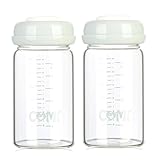
- It is essential to ensure the safety of breast milk: the bottle body is made of food-grade borosilicate glass. While ensuring that it can be refrigerated, heated and stored at normal temperature, it does not contain any harmful substances, and there will be no plastic smell seeping into the baby's milk (the penetration of harmful substances will lead to plastic smell). There is no need to worry about the safety of breast milk. All parts can be disassembled for cleaning.
- Three-in-one wide-necked glass bottle is used for pumping, storing and feeding: the bottle is suitable for the Breast Pumps & Nipples, so mothers can pump, store and feed with the same glass bottle to reduce the transfer of breast milk and save precious breast milk.
- 100% leak proof and 10 ml fine measurement mark: silicone sealing disc is used, so there is no need to worry about leakage; The bottle has a 10 ml increment measurement mark. You know how much milk you produce. The ballpoint pen can be written on sealing disk to mark important matters. The mark can be erased and marked circularly.
- It can ensure the safety of infants and young children: The bottle has a strong resistance to falling. When used, it can not only guarantee the use time limit of the bottle, but also avoid the safety hazards brought to infants due to broken glass. Glass bottles are not only healthier for infants, but also easier to clean than plastic bottles, because glass bottles are unlikely to leave residue and odor scratches.
- Our commitment: be ready to become a fanatic. As parents, we know how important it is to only use the best products for our children, so all of our products have a problem-free refund policy. If you are not happy, neither are we. Just contact us and we will provide you with VIP services.
That 36.3% figure should not be treated as a revised estimate of the percentage of all U.S. milk, cows, or herds affected. It came from a defined sample set, and retail milk was generally traceable to a processing plant rather than a specific farm. It does, however, reinforce the narrower conclusion that official herd counts did not capture the full early distribution of the virus.
Later surveillance showed a narrower pattern
The same study examined a later period, from December 27, 2024, through January 29, 2025. Of 477 retail milk samples collected from 25 states, 33—or 6.9%—contained influenza A RNA. All of the positive products were processed in California.
The researchers interpreted the difference as consistent with improved detection and control after new federal measures were introduced. The virus had not necessarily been eliminated from dairy herds, but the later distribution pattern suggested that surveillance was identifying affected areas more effectively and that spread through the wider milk-processing network had become more limited.
Two measures were particularly important:
- On April 24, 2024, the USDA required testing of lactating dairy cattle before interstate movement.
- On December 6, 2024, the USDA launched the National Milk Testing Strategy.
The National Milk Testing Strategy combines processing-plant silo monitoring, state-level surveillance, case investigation, and testing associated with interstate movement. Its goals include identifying affected states and herds, supporting biosecurity, and reducing risks to farmworkers and the broader food system.
Rank #4
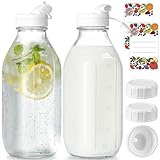
- Solid and durable, keep milk colder: Glass water bottles are more durable and make the milk colder compared to plastic jugs, fast pouring and easy to use. You'll get: 2 milk bottle & 3 leak-proof lids & 2 pour spouts & 2 stickers.
- Good Sealing and No Leaks: Glass juice bottles come with customized threaded lids and removable silicone sealing gaskets, lids are made of good quality materials, sturdy and durable, easy to open and close, strong airtight screw caps are reusable, good sealing and no leaks.
- With Scale Mark: Each glass milk jug comes with two scales: milliliters and fluid ounce. The glass pitcher is marked 1000ml / 32oz, max‑fill capacity reaches 33.8 fl oz. Great for measuring juice and water intake anytime to track your daily drinking volume for better health management.
- Save Space: You will get 2 glass milk storage containers with lids, 2 silicone pour spouts, 1 spare lid with silicone gasket, 2 stickers, meet daily needs, last longer. The square glass container can not only hold milk, cold beer, soy milk, oat milk, breast milk, nut milk, iced coffee, juice, but also store dry food, multi-purpose and space saving.
- Size Information: The Height of glass pitcher with lid is 9.1 inches, the width is 3.2 inches, perfect size to hold in one hand, the diameter of the mouth is 1.3 inches and is wide enough to put lemon slices and ice cubes.
Is commercially pasteurized milk safe?
Based on the available FDA testing, commercially pasteurized milk remains safe to drink. The FDA’s retail studies found no viable H5N1 in the tested products, and the agency conducted additional experiments using high-temperature, short-time pasteurization conditions representative of normal commercial milk processing. In repeated tests, those conditions completely inactivated H5N1.
This is an important distinction:
- Raw milk: Infectious H5N1 has been detected in research and outbreak investigations. The FDA advises consumers not to drink raw milk.
- Commercially pasteurized milk: Federal retail testing has not detected viable H5N1, and FDA process simulations found that standard commercial pasteurization inactivates the virus.
A PCR-positive result in a retail sample therefore does not demonstrate that pasteurization failed. It shows that viral genetic material can remain detectable even when the virus is no longer viable.
Consumers should follow the FDA’s practical advice: choose commercially pasteurized milk and avoid raw milk. There is no evidence in these findings that people need to discard ordinary pasteurized milk or buy home testing products, supplements, or special processing equipment.
What’s actually slowing this PC down?
Pick the symptom - the matching free tool is one click away.
What is the current public-health picture?
As of its March 6, 2026 situation summary, the CDC described the current public-health risk from A(H5) bird flu as low. The agency nevertheless reported continuing outbreaks in wild birds, poultry, and U.S. dairy cattle, along with sporadic human cases among people exposed to infected animals.
Best Value
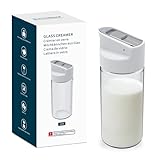
- Glass Creamer with Fresh-Keeping Lock Mechanism: Locking the opening by sliding the 304 stainless steel metal block, easy to operate. With a built-in silicone sealing plug, it further keeps cream or milk fresh and avoids contamination
- Drip-free spout for less mess and a controlled pour
- Elegant Borosilicate Glass and BPA-free Material: Our glass creamer pitcher is made of high-quality borosilicate glass, which is more elegant and safer. The whole product is made with BPA-free material
- Large Capacity: 12oz (355ml). Dishwasher safe
- Hassle-Free Customer Service: We are committed to providing exceptional customer service to ensure that every purchase meets or exceeds our customers' expectations. After the items are received, if there is any problem with the items (quality, function, etc.), please don't hesitate to contact us and we will provide a reliable solution
The CDC reported 71 total U.S. human A(H5) cases since February 2024: seven identified through national influenza surveillance and 64 identified through monitoring of people with relevant animal exposures. Those figures concern human infections and exposure surveillance; they do not change the separate conclusion that commercially pasteurized milk tested by federal agencies has not contained viable H5N1.
Timeline of the milk and dairy-cattle findings
- March 2024: H5N1 infection in U.S. dairy cattle was first publicly identified.
- April 24, 2024: USDA required testing of lactating dairy cattle before interstate movement.
- April 25, 2024: FDA reported that approximately one in five initially tested retail samples contained HPAI viral genetic material.
- May 1–10, 2024: FDA follow-up viability testing of PCR-positive retail samples found no live infectious virus.
- June 28, 2024: FDA and USDA reported that commercial high-temperature, short-time pasteurization inactivated H5N1 in process simulations.
- December 6, 2024: USDA launched the National Milk Testing Strategy.
- January 30, 2026: CDC-published research reported 36.3% positivity in an early-2024 retail sample set and 6.9% positivity in a later 2024–2025 set.
- March 6, 2026: CDC characterized the overall current public-health risk as low while noting that animal outbreaks and surveillance continued.
The accurate takeaway
The FDA’s April 2024 announcement did not show that 20% of grocery-store milk was infectious or that one in five cartons contained live bird flu. It showed that about one in five samples in an initial retail survey contained detectable H5N1 genetic fragments.
The finding mattered because pooled retail milk provided evidence that the dairy-cattle outbreak was more geographically widespread than official herd reports suggested. Later research strengthened that interpretation, while follow-up viability tests and pasteurization studies supported the safety of commercially pasteurized milk.
The Bottom Line
Bottom line: The 20% figure referred to H5N1 genetic material in an early sample of retail milk—not live virus in 20% of cartons. Follow-up testing found no viable H5N1 in the sampled retail products, and FDA testing indicates that standard commercial pasteurization effectively inactivates the virus. Avoid raw milk, but the evidence does not support treating ordinary pasteurized milk as unsafe.
Quick Recap
Product prices and availability are accurate as of the date/time indicated and are subject to change. Any price and availability information displayed on Amazon at the time of purchase will apply.





Leave a Reply