
Quick wins for a faster PC:
Scan for outdated or missing drivers - takes under a minuteDriver Scan →Repair Windows errors before they cause bigger problemsFix Now →Some links on this page are affiliate links: if you buy through them we may earn a commission, at no extra cost to you.
Short answer: Choose a well-fitted harness for a dog that pulls, has a sensitive neck or airway, or is difficult to manage from a collar. A flat collar can suit a dog that already walks reliably without pulling and is useful for identification. Neither device teaches loose-leash walking by itself, and no single restraint is right for every dog.
The safest choice depends on your dog’s behavior, health, comfort, escape risk, and the design and fit of the equipment. Use the comparison below to make a practical decision rather than treating “harness” or “collar” as a universal rule.
As an Amazon Associate I earn from qualifying purchases.
What a collar and a harness actually change
A flat collar places leash pressure around the neck. When a dog surges forward, the force can act on the throat and other sensitive neck tissues. A harness moves the leash connection onto the torso, so pressure is distributed away from the neck. That change can improve comfort and handling for some dogs, but it does not automatically stop pulling.
“Harness” is not one standardized design. A back-clip, front-clip, or Y-shaped harness can produce different handling and movement effects. Fit also changes the outcome: a loose harness may let a dog reverse out of it, while a tight one can rub, restrict movement, or cause discomfort.
Popular on Amazon
](https://m.media-amazon.com/images/I/41ji4lsxEIL._SL160_.jpg)
- [UPDATED VESION, EASY TO PUT ON & TAKE OFF] This dog harness has 3 buckles( One is on the neck with Lockable, two are on the chest), NO NEED go through dog’s head. This will let your dog loves to wear harness!
- [NO PULL WITH 2 HOOK LOOPS] There are 2 sturdy metal hook loops for leash attachment. If you use the front hook on the chest, it will reduce the pulling a lot and make going for a walk more enjoyable. As usual, most people like to use the back hook.
- [REFLECTIVE MATERIAL] The reflective material will be really nice when it gets dark. Also, your dog will be saw easily. This reflective material can make drivers have long time to react, which ensure your dog’s safety!
- [USEFUL & SOFT HANDLES] You will like this handle on the back,it is helpful in controlling dogs a bit closer to you when they are trying to lunge at something. Also, it is convenient to assist dogs into the car.
- [100% BEST CUSTOMER SERVICE] If any products quality really exits, a refund or replacement will be available.
The 2025 review of collars, harnesses, and head collars concluded that no single restraint works best for every dog. Its recommendations vary with the dog’s pulling behavior, movement needs, the handler’s control, and the specific device design. Read the review in Frontiers in Veterinary Science.
Collar versus harness at a glance
| Decision factor | Flat collar | Harness |
|---|---|---|
| Pulling behavior | Can be reasonable for a dog that already walks on a loose leash. A pulling dog can place repeated pressure on the neck. | Often considered for dogs that pull because the leash attaches to the body. It still requires training, and the attachment style affects handling. |
| Neck and airway pressure | Leash force acts on the neck and throat. Extra caution is warranted for brachycephalic dogs and small dogs with collapsing trachea. | Can relocate leash pressure away from the neck when fitted and used correctly. |
| Control | Simple and quick to put on. Control depends heavily on the dog’s response and the handler’s technique. | Can give a handler more body-based control, but a poor fit or unsuitable design can reduce control or permit escape. |
| Escape risk | Must be adjusted so the dog cannot back out without being uncomfortably tight. | A loose or poorly shaped harness can provide a route for the dog to reverse out. Check the fit while the dog moves. |
| Movement and comfort | Does not wrap the chest, but pressure may be uncomfortable during pulling. | Comfort depends on shape, adjustment, and whether the design interferes with natural movement or rubs. |
| Identification | Convenient place for identification tags. | Can be used for walking, but a separate collar may still be useful for tags, depending on your setup. |
When a flat collar makes sense
Your dog already walks without pulling
A flat collar may be a practical walking choice when your dog consistently keeps a loose leash, responds to your cues, and cannot back out of the collar. It is easy to put on and provides a convenient place for identification tags. A collar is not automatically unsafe; the concern rises when the dog repeatedly hits the end of the leash or the collar is used to overpower resistance.
Free tools Windows power users keep installed
One-click scans. No signup required.
Your dog needs identification on every outing
Many guardians keep identification on a collar even when a harness is used for leash attachment. If you do this, ensure the collar itself is fitted securely and does not hang loose enough for the dog to slip out. Tags should not substitute for a secure fit or a current microchip record.
How to check a collar’s fit
The American Kennel Club describes a general check of about one finger of room for a small dog and two fingers for a large dog. This is guidance, not a universal measurement: follow the collar maker’s instructions and judge whether the dog can back out, breathe comfortably, and move without rubbing. See the AKC’s guidance on dog harnesses and collars.
When to be cautious
A collar deserves extra caution when the dog pulls hard, lunges, or has a known airway or neck problem. Tufts Cummings School of Veterinary Medicine specifically flags concern for brachycephalic dogs and notes that collar pressure can aggravate breathing problems in small dogs with collapsing trachea. Its 2022 guidance is available at Dog Collars and Harnesses.
Also popular on Amazon

- No Pull, 2 Clips - With 2 sturdy metal hook loops for leash attachment. Use the front clip to create gentle redirection force, to reduce tugging during walks and training. While back clip is great for casual walks, jogging for well-behaved dogs
- Comfort, No Choke - Made from durable fabric with breathable mesh, this vest keeps them comfortable and cool during extended walks or active play. The pulling pressure is distributed evenly with soft padded —no rubbing, no irritation, just happy tails
- Easy to Wear & Adjust - Simply slip the harness over dog's head, snap the two quick-release buckles, and ready to go. 4 fully adjustable straps to create a perfect fit for your dog with room of growth. No worries about slipping out
- Built for Safety - Bright reflective strips ensure a safe walk both early morning walks or late night runs. The top handle helps to hold dog pulling immediatly, also can be used for car riding with safety
- Large Dog Harness - Chest: 17-33.4in. Recommended to Large Dogs, such as Labrador, German Shepherd, Siberian Husky, Schnauzer Giant, etc. Please measure your dog's neck and check girth carefully before purchasing
When a harness makes sense
A dog that pulls or lunges
A harness can move the leash connection from the neck to the chest or torso, which may be a better starting point for a dog that regularly leans into the leash. It can also make it easier for a handler to guide the dog without concentrating force on the throat. The harness is a management tool, not a replacement for teaching the dog how to walk on a loose leash.
A relevant neck or airway concern
If your veterinarian has identified airway sensitivity, a collapsing trachea, neck pain, or another condition affected by pressure, ask which restraint is appropriate before changing equipment. A harness may reduce direct neck pressure, but the dog still needs a comfortable design and careful handling. A harness that constricts the chest or rubs the skin is not a safe improvement.
A dog who is difficult to control
Body-based attachment can give some handlers more leverage and a larger contact area than a collar. That advantage disappears if the dog can reverse out of the harness, if the harness shifts toward the throat, or if the handler relies on sudden force. Dogs that are unusually strong, fearful, reactive, or unsafe to handle may need an individualized plan from a veterinarian or qualified reward-based trainer.
Harness designs: back clip, front clip, and Y-shaped
Back-clip harness
The leash ring sits on the dog’s back. This can be convenient for everyday walking and may feel less intrusive to some dogs. However, a back connection can allow a determined dog to put its body weight into forward motion. In a controlled 2021 study, dogs pulled more strongly and for longer in a back-connection harness than in a neck collar during a food-attraction test. That result came from a specific harness and a specific experimental task; it is not proof that every dog pulls more in every back-clip harness.
Front-clip harness
The leash ring sits toward the front of the chest. Turning the dog’s body slightly when it moves ahead can give the handler more steering influence, which is why front-clip designs are often considered for pulling. The 2025 review identified non-tightening front-clip harnesses as an apparent balance between reducing pulling and avoiding the discomfort associated with tightening devices. “Apparent balance” is a review-level practical conclusion, not a guarantee for an individual dog or product.
Also popular on Amazon
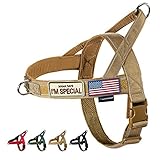
- [Premium No Pull Dog Harness] The wider soft padded inner is comfortable and friendly for dog's neck without dog's fur hurting. The back strap and chest strap inner is made of soft and breathable material that is comfortable for the dogs. And the front strap is better to prevent the dog from rushing forward. This design is maintain a long-time comfortable for walking,jogging,running,training,etc.
- [Reflective Strip] Reflective stitching along polyester webbing is not only add a sense of design to the safe for walking dog harness,but also increase a better visibility at dark under the light that it can keep the dog safe while walking.
- [Two Rings Design] The O-ring and D-ring is convenient and flexible to hang,they not only can connect well with dog leash,but also can hang ID tags,key,poop bag,etc.
- [Choose the Suitable Dog Harness] The no pull dog harness have FIVE sizes,XS is design 1 inch wide / S M L XL are design 1.5 inches wide for the small & medium and large dogs. PLEASE measure the size of the dog and refer the dimension chart to select the right one before buying.
- [Come with TWO Patches] There has a velcro area on the dog walking harness,and come with 2 patches, you can put the patches "MAMA SAY I'M SPECIAL" or the flag on the dog harness velcro area to make your dog unique.
Y-shaped and other body designs
Y-shaped harnesses and other shapes distribute straps differently across the chest and shoulders. The amount of freedom, stability, and contact depends on the exact pattern and adjustment. Do not assume that a Y shape, a front ring, or a back ring alone proves that a harness is comfortable or effective. Watch the dog walk, turn, sit, and accelerate, and follow the manufacturer’s fitting instructions.
Does a harness make dogs pull more?
The evidence is conditional, not a simple yes or no. Shih and colleagues studied 52 shelter dogs in 2021, comparing a neck collar with a back-connection harness while the dogs pulled toward food and a toy. During the food-attraction test, the harness condition produced greater maximum and average leash tension and more time spent pulling. During the toy-attraction test, the researchers found no significant difference in leash tension or stress-related behaviors.
Those findings concern one back-connection design, shelter dogs, and experimental attraction tasks. They do not show that all harnesses make all dogs pull more on ordinary walks. A harness may change the dog’s mechanical advantage or the handler’s ability to steer, while the dog’s motivation, training history, environment, and harness design determine what happens in practice. The study record is available through PubMed.
Training and equipment solve different problems. A restraint changes where force is applied and how the handler can manage movement. Loose-leash walking still has to be taught with reinforcement, appropriate distance from distractions, and consistent responses to leash tension. The 2025 review makes the same broader point: device effects depend on design and context.
Recommended Free Tools
How to fit a collar or harness safely
- Read the exact product instructions. Strap layouts and adjustment points differ. Start with the maker’s stated fitting method rather than relying on a generic picture or a previous product.
- Check contact points. Look for rubbing behind the elbows, across the chest, under the neck, or around the collar’s edges. The equipment should not pinch skin or sit over a vulnerable airway.
- Apply a practical finger check. The AKC’s general guidance is about one finger of space for a small dog and two for a large dog. Use this only as a starting check and confirm that the dog cannot back out.
- Test normal movement. Have the dog walk, turn, sit, lie down, and raise its head. Watch for shortened strides, repeated scratching, reluctance to move, coughing, gagging, or a change in breathing.
- Test the escape route. With the leash attached and slack, gently move backward while the dog stands. A dog should not be able to reverse out of the collar or harness. Do not yank to perform this test.
- Recheck after movement. Straps can shift as a dog runs, rolls, or pulls. Inspect the fit during the walk and after exercise, especially when using a new design.
- Stop if the dog shows pain or breathing difficulty. Remove pressure, return home safely, and ask a veterinarian whether the equipment or the dog’s health needs evaluation.
Handling and training that make either option safer
Teach slack before adding major distractions
Reward the dog while the leash is loose, begin in a low-distraction area, and increase difficulty gradually. If the dog reaches the end of the leash, reduce the distraction or distance rather than adding a sharper correction. The equipment should help you prevent rehearsal of pulling while the behavior is being taught.
Also popular on Amazon

- Helps Stop Pulling: Patented Martingale loop design puts gradual pressure on your dog's shoulders to safely and effectively stop pulling; a front leash attachment helps you guide your dog
- Legacy Of Trust: Created by a veterinary behaviorist in 2004, the Easy Walk harness is loved and trusted by a million pet parents and trainers
- Comfortable Fit: Easy Walk harness has less coverage than other harnesses making it lightweight and very breathable
- No Gagging Or Choking: Rests across your dog's chest instead of his throat to stop gagging and choking if he pulls
- Easy to Fit: Quick-snap shoulder straps and a different color belly strap make it simple to put the harness on your dog
Choose an attachment that matches your skill
A front clip may provide more turning influence, while a back clip may feel simpler for a dog that already walks well. Select the design you can fit correctly and handle calmly. A device that is theoretically suitable but repeatedly misadjusted is a poor practical choice.
Use gentle, predictable leash handling
Keep the leash as slack as the situation allows and avoid sudden jerks. If your dog is fearful, reactive, or powerful enough to pull you off balance, get hands-on coaching from a qualified reward-based trainer and discuss medical factors with your veterinarian.
Head halters are a different category
A head halter is not simply another body harness. It places control around the dog’s muzzle and head, so acclimation and handling are especially important. VCA Animal Hospitals warns that jerking or suddenly pulling the leash when a dog wears a head halter can cause serious neck injury. Use gentle guidance, follow fitting instructions, and seek professional help if the dog resists or the fit is uncertain. VCA’s overview of collar and harness options is at Collar and Harness Options for Dogs.
Do these 3 things before closing this tab:
1Fix the driver behind crashes, sound loss and screen glitches2Clear out junk files and repair common Windows errors3Scan for outdated or missing drivers - takes under a minuteA decision guide for common situations
| If your dog… | Reasonable starting point | What to monitor |
|---|---|---|
| Walks calmly and never reaches the end of the leash | A correctly fitted flat collar, with identification attached. | Any new pulling, coughing, rubbing, or ability to back out. |
| Pulls steadily toward smells, people, or other dogs | A well-fitted, non-tightening harness; consider whether a front attachment improves your steering. | Whether the dog can escape, whether movement is restricted, and whether training is reducing leash tension. |
| Has a brachycephalic airway or collapsing-trachea concern | Discuss a body harness with your veterinarian before regular use. | Breathing, coughing, discomfort, and any strap pressing near the throat. |
| Backs out of equipment | Stop using that setup until the fit and design are corrected; a professional can help assess escape risk. | Shifting straps, a loose neck opening, and the dog’s ability to reverse. |
| Is fearful, reactive, or physically difficult to control | Use the most secure comfortable setup your veterinarian or qualified reward-based trainer recommends. | Handler balance, sudden lunges, stress signals, and safe distance from triggers. |
Common problems and practical fixes
The dog still pulls in a harness
That does not mean the harness has failed. Equipment cannot teach the desired walking pattern on its own. Reduce distractions, reward slack frequently, and review whether the attachment style gives you enough control without tightening or rubbing.
The harness rubs or the dog moves oddly
Stop and inspect the strap path while the dog walks. Adjust only within the product’s instructions; if the harness continues to shift, pinch, or restrict the shoulders, choose a different design and obtain professional fitting advice.
Also popular on Amazon

- 【No Pull & No Choke Design】: This harness simply goes through the dog's head, snaps on the belly and that's the end of it. Besides, the D-ring on the chest strap is used for no pull dog training and guiding direction, and the O-ring on the back is used for daily dog walking. The triangular design on both sides of this no pull harness helps to distribute the pulling force, so you don't have to worry about the dog choking when suddenly pulling.
- 【Soft Velvet Padded & Durable】: With soft thicken and wider fleece pads used beneath the strap of neck, back and handle atop, this dog harness could reduce friction from movement and protect the health of the dog's skin. It also uses superior nylon material to ensure long-lasting use.
- 【Leash Double Handle & Elastic Band】: You can use the top handle for casual dog walking, and the center handle for controlling the direction of the dog, easily guiding it through crowded areas and preventing storming in case of accidents. And the springy design of the leash really absorbs the pull from large strong dogs without tugging on your wrist and shoulder.
- 【Neck & Chest Adjustable】: SlowTon dog harness is equipped with adjustable loop for both neck and chest girth, and the quick-release buckle allows for quick donning. No matter what kind of breed and shape, it provides proper length after adjusting to fit your dog's neck and chest, which is perfectly designed for walking, jogging, running, hiking and training.
- 【Tangle-free Leash & Reflective】: The heavy-duty 360°swivel metal hook ensures no tangle. Plus, it has an elastic bungee and 2 padded handles, which is great for walking training of city dogs, or wandering off in country. Furthermore, its super bright reflective strips ensure a safe walk both day and night. And it comes with 2 hook and loop straps, a regular one Support Dog and the reflective one DO NOT PET.
The collar causes coughing or gagging
Remove neck pressure and contact your veterinarian, particularly if the dog is small, brachycephalic, or has a known airway issue. Do not assume that repeated coughing is merely a training problem.
The dog freezes when the harness appears
Pair the harness with food or another positive activity before fastening it, and build duration gradually. If distress persists, ask a qualified reward-based trainer to evaluate the fit and the dog’s response rather than forcing the equipment on.
What’s actually slowing this PC down?
Pick the symptom - the matching free tool is one click away.
What the evidence supports—and what it does not
- The neck is a meaningful pressure point, so health history matters when choosing between a collar and a harness.
- A harness can relocate leash pressure, but fit determines whether it is comfortable and secure.
- Harness designs differ; back, front, and Y-shaped configurations should not be treated as interchangeable.
- The 52-dog 2021 study found more pulling with a back-connection harness during food attraction, but not during its toy test. It does not establish a universal “harnesses cause pulling” rule.
- The 2025 review found no single restraint that suits every dog. Equipment choice and loose-leash training should be planned separately.
Frequently asked questions
Can my dog wear a collar and harness at the same time?
Yes, many guardians use a harness for leash attachment and a collar for identification. Make sure neither device rubs against the other, and attach the leash only to the component designed for that purpose. Recheck both fits while the dog moves.
Should I switch equipment immediately if my dog starts pulling?
Consider the dog’s health, current fit, and escape risk before changing. A harness may reduce neck pressure, but the change should be paired with loose-leash training and introduced gradually so the dog is comfortable wearing it.
When should a professional assess the setup?
Ask a veterinarian about breathing, neck pain, coughing, or a diagnosed airway condition. Ask a qualified reward-based trainer for help when the dog is reactive, repeatedly escapes, or remains unsafe to handle despite a correctly fitted device.





Leave a Reply