
Recommended Free Tools
Enrichment helps meet dogs’ behavioral needs while they wait in shelter care. It can be as simple as letting a dog sniff on a walk, offering part of a meal in a supervised food puzzle, or spending quiet one-on-one time together. Choose activities for the individual dog, follow shelter protocols, and treat what you observe as context—not a diagnosis or a fixed label.
Why enrichment matters in shelter care
Dogs need opportunities to engage their senses, move, chew, explore, and interact—not only food, water, shelter, and medical care. The ASPCA describes shelter “capacity for care” as the point at which available resources meet animals’ physical and behavioral needs, and includes behavioral enrichment in its shelter-care guidance. This is an organizational care framework, not a legal standard. ASPCA: responsibilities of animal shelters
As an Amazon Associate I earn from qualifying purchases.
Enrichment should be flexible and individualized. It is one part of care, not a substitute for veterinary attention or qualified behavior support when a dog needs them. There is no single activity or schedule that suits every dog or every shelter.
What’s actually slowing this PC down?
Pick the symptom - the matching free tool is one click away.
Practical enrichment activities for shelter dogs
Make meals engaging
A food puzzle can slow a dog who eats quickly and add a chance to investigate and work for food. Low-cost options include putting kibble in a muffin tin, placing food in suitable boxes or paper rolls, or scattering it in a snuffle mat. Start with an option the dog can use successfully, and supervise improvised items closely. The ASPCA offers DIY canine enrichment ideas.
#1 Best Overall

- Four Challenges & Levels 1-3: Multiple games with a flip game and a linear track sliding game, all requiring dogs to learn steps and find treats. This puzzle is designed to be more fun and difficult, with more unique ways to play. It can enhance your dog's IQ and train their sense of smell
- Prolong the Feeding Time: The 14-hole food storage slow feeder has four ways to play, which is effective in slowing down the dog's eating speed. It is also beneficial to the dog's physical and mental health by increasing the time and difficulty of acquiring food, thus avoiding gastrointestinal issues caused by indigestion
- Safe Materials & Cleanable: Furry friends can safely play with this toy, which is made of food-safe and long-lasting materials. Additionally, it is easy to clean with warm water and soap after use
- Six Silicone Anti-Slip Pads: Six silicone anti-slip pads with high resistance ensure a firm grip and prevent the item from sliding to one side during feeding
- Warm Tips: When playing with the puzzle, please keep your dog with you to prevent any possible destruction of the toy. The toy has a tight design of built-in game components, so you don't need to worry about them being easily dislodged and swallowed by your dog
Food-based activities need to fit the dog’s dietary plan and the shelter’s food-handling and cleaning rules. A purchased toy is not required: household materials may work when they are safe for that dog and can be managed under the organization’s protocols.
Give dogs time to sniff and forage
On a suitable walk, allow time for the dog to investigate scents rather than making the outing only about distance or pace. You can also hide a small portion of the dog’s regular food in an appropriate, supervised search activity. Sniffing gives a dog a way to use its nose; the ASPCA describes it as stimulating and calming. Walks can also provide useful observations of a dog in a particular setting, but they are not a complete behavior assessment. ASPCA: shelter dog behavior assessments
Rank #2
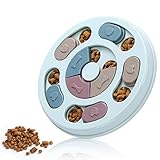
- 【Size】: L9.44" * W9.44"* H1.14" suitable for cats, puppies and small dogs.
- 【Interactive Dog Toys】This is a interactive puppy puzzle , which can easily become the closest companion and toy for your puppies and cats, and will release pressure for dogs. Find food by sliding parts to improve eating pleasure and IQ.
- 【Slow Feed Bowl】This encourages pets to eat at a slower speed, helps to slow down the feeding time to help the dog digest, and can provide your dog with a variety of healthy snacks.
- 【Slow Feede toys】 Use this educational game toy to exercise the dog’s brain, which will help meet the dog’s instinct needs, train the pet’s sense of smell, and let the dog enjoy feeding when using the nose or paw to move the slider, while providing spirit stimulate.
- 【Dog toys】No toy is indestructible. Do not leave toys with unsupervised pets. Remove and replace toy if damaged.
Offer one-on-one social time
A calm interaction with a staff member, volunteer, or adopter can be enriching. Let the dog’s response guide the activity: some enjoy petting or play, while others may prefer sitting near a person without being touched. Keep the interaction within the shelter’s handling rules and give the dog room to disengage.
Use playgroups selectively
Playgroups may enrich dogs who are suitable for dog-to-dog interaction and can offer information about how they interact in that setting. They are not appropriate for every dog. Follow the shelter’s screening, staffing, separation, and supervision procedures rather than treating group play as a routine requirement. The ASPCA discusses playgroups as one context for observation, not a universal activity.
Rank #3

- 【PRODUCT SIZE】10 inch*10 inch*1.3 inch.
- 【3 WAYS TO PLAY, UPGRADE SLOW FEEDER】Our dog mental stimulation toys have a unique squeak button in the middle, which make it easier to attract the attention of dogs and cats. Three different difficulty designs and the 16-hole dog treat dispenser design maximize slow feeding time, even beyond 20 minutes.
- 【FUNNY STIMULATING TOYS】All kinds of dogs and cats love the puzzle game of Spin & Slide and the Seek & Hide with their smell sense and paw skills to find food. Combining circular orbit sliding game and linear orbit sliding game, smart dog and cat must move the slider correctly to get the food reward hidden in the maze.
- 【NON-REMOVABLE PARTS DOG PUZZLE】Our dog treat puzzle is made of non-toxic materials, very durable and suitable for pets to play for a long time. This dog toy has no removable parts because the design has built-in play parts that fold tightly and won't fall off easily.
- 【ANTI-SLIP & EASY TO CLEAN】: The four corners of the bottom are equipped with four anti-skid pads, which can be well fixed during the dog's slow food process; It is easy to clean, also dishwasher safe.
Try short, reward-based training
Brief sessions can give a dog a mentally engaging activity and build useful, positively reinforced skills. The ASPCA describes humane training as relying primarily on rewards such as food, praise, petting, and play. Keep sessions suited to the individual dog and the shelter’s handling guidance. For serious behavior concerns, seek appropriately qualified support rather than trying to resolve them through enrichment alone. ASPCA: training aids and methods
Provide suitable chewing options
Chewing is a natural behavior, and an appropriate chew or toy can provide an outlet. Select items for the individual dog’s size and chewing style. The ASPCA cautions against products that are excessively small or that fragment; swallowed pieces can cause an intestinal blockage that may require surgery. It notes that larger, durable products are appropriate considerations for large breeds and aggressive or frenzied chewers who might quickly consume a toy or treat. These are selection considerations, not a guarantee that any item is risk-free. ASPCA: dog chews and treats
Rank #4

- Dog Puzzle Toy – Level 2 Intermediate: Perfect for beginners or smart pups, this Nina Ottosson dog puzzle offers a fun, interactive challenge
- Boredom Buster: 15 minutes of brain-engaging play equals 30 minutes of physical activity, giving dogs of all ages the exercise they crave
- Engaging Puzzle Play: Keeps pets entertained while encouraging problem-solving and interactive play
- Multiple Ways to Play: Pick up bones and spin layers to find hidden treats; Tips and Tricks included to adjust difficulty
- Mealtime Fun & Slow Feeding: Holds 1/2 cup of kibble or treats; doubles as a slow feeder to help slow down fast eaters and make mealtime more engaging
Make activities safe and workable
- Supervise DIY items actively. Stay close while the dog uses cardboard, paper rolls, or improvised toys. The ASPCA advises removing a DIY item immediately if the dog attempts to ingest it.
- Choose for the dog in front of you. Consider the dog’s size, chewing and eating habits, comfort with people or other dogs, and ability to engage with the activity.
- Follow shelter protocols. Use the organization’s rules for cleaning, food, handling, dog separation, and supervision. The sources do not establish one sanitation method or toy-rotation schedule for all shelters.
- Review and adapt. If an activity is not suitable or the dog is not engaging safely, stop and choose a different option. Rotate activities as staff capacity and the dog’s needs allow; no universal rotation interval is established.
- Keep materials practical. Durable, washable food puzzles and toys may be useful, but many enrichment ideas use household materials. Buying equipment is not a prerequisite.
What enrichment can—and cannot—tell you about behavior
A dog’s response during a walk, social session, or playgroup is an observation from that specific context. It may help staff understand what the dog appears to enjoy or how it responds in that setting, but it should not be turned into a fixed personality label or used alone to make an adoption decision.
Quick wins for a faster PC:
Scan for outdated or missing drivers - takes under a minuteDriver Scan →Repair Windows errors before they cause bigger problemsFix Now →Fix the driver behind crashes, sound loss and screen glitchesFind Drivers →The ASPCA cautions that behavior assessments can be biased or misleading. It says that, unless behavior is egregious, aggressive behavior observed during an assessment should generally be corroborated in another environment. Enrichment observations and formal behavior assessment are related, but they are not interchangeable.
Best Value
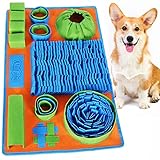
- SUITABLE FOR SMALL AND MEDIUM DOGS, CATS - The size of this snuffle mat is 26 x 16.5 inches, which is perfect for small dogs, medium dogs, cats and rabbits. It makes a wonderful gift for pet owners! NOT recommended for extra large and aggressive chewers dogs who could tear it up
- INTERACTIVE ACTIVITY MAT- If your dog always eat too fast, we recommend you try our enrichment training feeding mat. Dog snuffle mat simulate an environment for your dog to forage naturally, effectively slow down eating and prevent digestive problems
- 8 DIFFERENT PLACES TO HIDE TREATS - This sniff mat for dogs contains 8 different places to hide food or treats, increase the fun, challenge and training intensity of foraging. It allows you to enjoy the happy time of interacting with your dogs and avoid your dog destroys the furniture due to boredom
- SAFETY MATERIALS - The main material of the foraging mat is felt cloth, which is safety but not chewproof. When you receive this felt snuffle mat, machine wash it once to make the shape as good as the picture
- WASHABLE AND PORTABLE DESIGN - Easy to clean, hand wash and machine wash available. Two additional elastic straps can be fastened and easily wrapped around for storage
The wider U.S. shelter context
The ASPCA reports that 5.8 million dogs and cats entered U.S. shelters and rescues in 2025, 4.2 million shelter animals were adopted, and approximately 597,000 animals were euthanized in shelters. It also reports that dogs—especially large dogs—are staying in shelters longer than five years earlier. These figures describe the broader U.S. context; they do not show that enrichment by itself changes length of stay, adoption outcomes, or euthanasia rates. ASPCA: U.S. animal shelter statistics
Quick Recap
Product prices and availability are accurate as of the date/time indicated and are subject to change. Any price and availability information displayed on Amazon at the time of purchase will apply.





Leave a Reply