
Quick wins for a faster PC:
Scan for outdated or missing drivers - takes under a minuteDriver Scan →Clear out junk files and repair common Windows errorsFree Scan →Fix the driver behind crashes, sound loss and screen glitchesFind Drivers →Fish gills take oxygen gas dissolved in water into the bloodstream and release carbon dioxide into the water. They do not obtain oxygen by breaking apart water molecules. Instead, water flows across a large, thin network of gill tissues where gases diffuse between the water and the blood.
Fish gills take oxygen gas dissolved in water into the bloodstream and release carbon dioxide from the blood into the water. They do not split water molecules into hydrogen and oxygen. Instead, a fish continually moves oxygen-bearing water across a large, thin, highly supplied respiratory surface.

As an Amazon Associate I earn from qualifying purchases.
Water flow in a typical bony fish:
Mouth gill arches and filaments secondary lamellae opening beneath or behind the operculum
What happens when a fish breathes?
As a fish ventilates its gills, water passes over microscopic structures called secondary lamellae. Oxygen dissolved in that water crosses the very thin lamellar surface and enters nearby blood capillaries. At the same time, carbon dioxide produced by the fish’s cells leaves the blood and diffuses into the water.
#1 Best Overall

- Steady Output: Max Air Flow Rate: 64 GPH; Pressure: 0.016 MPa; Power: 4 W. Perfect for aeration in 10 - 100 gallon fresh water and marine aquariums.(The data is measured with experimental equipment and may deviate slightly from the actual data. The air volume may be insufficient due to the blocked air intake cotton. Please replace the cotton yourself if the air volume is insufficient.)
- Adjustable Air Flow: Feature a rotary knob to control the amount of air for dual outputs, allowing for your desired air flow to fully oxygenate your fish tank.
- Quiet Operation: The pump emits 25 dB sound under the “Low” mode and maximum 45 dB noise like the hum of a refrigerator under the highest air flow.
- 2 Air Stone Discs: Produce lots of dense medium bubbles bursting into the surface of water steadily. A great way to aerate your tanks and enliven the aquatic life.
- Pump Accessories: Include 2 air stones, 6.5-foot airline tubing, 2 check valves and 2 connectors. Complete accessories to build the basic aeration setup in your tank.
The process depends on four features working together:
- a large exchange area created by repeated branching and folding;
- a thin barrier between water and blood;
- continuous water movement over the gills;
- continuous blood flow through capillaries in the opposite direction to the water.
Together, these features allow fish to extract dissolved oxygen from an environment that contains much less readily available oxygen than air.
Fish gill anatomy: arches, filaments, and lamellae
The gill is not one flat organ. It is a branching structure designed to provide as much exchange surface as possible while remaining thin enough for gases to cross.
Free tools Windows power users keep installed
One-click scans. No signup required.
Gill arches
Gill arches are the supporting structures. In a typical bony fish, several arches are arranged on each side of the throat. They support the softer respiratory tissues and may also carry blood vessels and structures involved in feeding.
Gill filaments
Rows of delicate gill filaments project from each arch. The filaments are sometimes called primary lamellae. Water flows along and between them as it passes through the gill chamber.
Secondary lamellae
Tiny secondary lamellae extend from the filaments. These microscopic plates provide most of the immediate gas-exchange surface. Each lamella contains a dense network of capillaries, and the tissue separating the blood from the water is extremely thin. A short diffusion distance lets oxygen and carbon dioxide cross efficiently.
Rank #2

- Steady Output: Max Air Flow Rate: 50 GPH; Pressure: 0.013 MPa; Power: 1.25 W. The pump supplies steady air flow with low power consumption. Work great for fish tanks or buckets up to 60 gallons.
- Adjustable Air Flow: There is a rotatable knob on the top to manually adjust the air volume. Greatly meet your desired air flow to keep fish or roots healthy.
- Quiet Operation: With 4 shockproof rubber feet to minimize vibration, the pump greatly reduces noise to less than 30 dB like a soft speaking voice. No disturbance to your daily life.
- Reliable Construction: The fish tank pump is well constructed with a sturdy ABS shell and a heavy-duty inner structure. Really lightweight and space-saving.
- Pump Accessories: Contain 6.5-foot 3/16" airline tubing (ID: 4 mm), 2 small air stone cylinders, 2 connectors (straight & T-shape) and 2 check valves. All build the basic aeration setup in your fish tank.
The gills therefore combine the same broad principles found in other respiratory organs—surface area, thin barriers, and transport—but arrange them for oxygen uptake from moving water.
The operculum
In most bony fish, the operculum is the movable bony cover over the gills. It protects the fragile filaments and helps create the pressure changes that draw water through the mouth and across the gills. Water leaves through an opening beneath or behind the operculum.
How oxygen crosses from water into blood
Here is the process step by step:
- Water enters the mouth. The fish opens its mouth and draws in water containing dissolved oxygen.
- Water is directed across the gills. Movements of the mouth and, in many bony fish, the opercular cavity create a pressure difference that moves water through the gill chamber.
- Oxygen reaches the lamellae. The water passes over the filaments and their secondary lamellae.
- Oxygen diffuses into the blood. Oxygen concentration is higher in the incoming water than in the deoxygenated blood arriving at the lamellae. Oxygen consequently moves across the thin respiratory surface into the capillaries.
- Hemoglobin carries the oxygen away. Hemoglobin in red blood cells binds oxygen and transports it through the circulation to the fish’s tissues.
- Carbon dioxide moves in the opposite direction. Cellular metabolism produces carbon dioxide. Blood carries it back to the gills, where it crosses into the surrounding water.
- Water exits. In a typical bony fish, water leaves through openings associated with the operculum.
Gills do not work simply because they are wet. If the exchange surface were thick, poorly supplied with blood, or surrounded by stagnant water, diffusion would quickly become inadequate. The lamellae’s enormous effective surface, thin barriers, blood flow, and ventilation are all essential.
Why water and blood flow in opposite directions
The most important design feature of many fish gills is countercurrent exchange. Water flows across a lamella in one direction, while blood in the lamellar capillaries flows in the opposite direction.
Water:  high O2  ───────────────────────→  lower O2
Blood:  lower O2  ←───────────────────────  higher O2
At each point along the lamella, the blood encounters water that still has a somewhat higher oxygen concentration than the blood. That maintains a diffusion gradient over much of the lamella’s length. Oxygen can therefore continue moving from water into blood instead of reaching near-equilibrium early and stopping.
If water and blood flowed in the same direction, the two fluids would approach the same oxygen concentration relatively soon. The gradient would then become smaller, limiting further oxygen transfer. Countercurrent flow preserves the gradient more effectively.
Rank #3

- POWERFUL AERATOR PUMP & ENERGY CONSERVATION - AQQA fish tank air pump 3 watt equipped with a high-quality pump, the pump delivers stable output while conserving energy for optimal performance. Air volume for up to 80 gallon tank, the max pressure is 18Kpa and max air volume is 100GPH, can be easily connected to different type air stones, can be used for larger fish tanks, aquariums.
- NOISE REDUCTION ULTRA QUIET FUNCTION - The aquarium air pump features a sturdy double-layer structure with a built-in air pump and thickened casing, the bottom of the pump is designed with four soft rubber pads, which not only reduce noise, the max noise does not exceed 35dB but also prevent the pump from moving excessively during operation.
- DURABLE STAINLESS STEEL DUAL OUTLET DESIGN - The fish air pump designed with 2 stainless steel outlets, long service life, that can be used in multiple fish tanks or aquariums, making it suitable for both freshwater and seawater setups.
- ADJUSTABLE AIR FLOW SWITCH - The air pump aquarium is equipped with a knob on top, allowing you to easily adjust the air volume or switch without the need for frequent unplugging and plugging, making it more user-friendly.
- PACKAGE INCLUDED - 1 × Aquarium air pump with 5.91ft power cord; 2 × Air stones; 2 × 4.92ft Air tubes; 2 × Check Valves; 1 × User Manual. And you will get a 1-year after-sale product service and 7*24H lifetime customer service.
This does not mean every fish gill has one universal oxygen-extraction percentage. Performance varies with species, temperature, activity, water chemistry, blood flow, and gill structure. The accurate general point is that countercurrent exchange and the extensive lamellar surface make fish gills highly effective at extracting dissolved oxygen from passing water.
How fish pump water across their gills
Most bony fish: a two-pump mechanism
Many bony fish use coordinated movements of the mouth and operculum. The mouth or buccal cavity acts as one pump, while the opercular cavity acts as another.
In simplified terms, the fish:
- expands the mouth cavity to draw water in;
- closes or narrows the mouth opening while compressing the buccal cavity;
- uses pressure changes around the operculum to pull water across the gill surfaces;
- allows the water to leave behind the operculum.
Because this buccal–opercular pump can maintain flow while the fish is stationary or moving slowly, the claim that every fish must swim continuously to breathe is incorrect.
The Tool Desk
Outbyte PC Repair FREERepair Windows errors before they cause bigger problemsFix Now →Outbyte Driver Updater FREEFix the driver behind crashes, sound loss and screen glitchesFind Drivers →Many sharks and rays: greater reliance on ram ventilation
Many sharks, rays, and other cartilaginous fish rely substantially on ram ventilation. Forward swimming pushes water into the mouth and through the gill openings. Some species can also use active pumping, and ventilation strategies differ among groups and species.
Jawless fish such as lampreys and hagfish have still different arrangements involving gill pouches and their own water-flow mechanisms. These variations change the plumbing, but not the central principle: oxygenated water must contact a thin, well-supplied respiratory surface.
What else do fish gills do?
Gills are multifunctional organs, not just underwater lungs. Their direct contact with the environment makes them important for maintaining the fish’s internal chemistry.
Rank #4
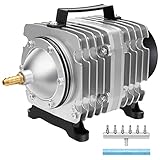
- HIGH PRESSURE, LARGE OUTPUT – This aquarium air pump delivers large output and high pressure of compressed air. Flow rate 600GPH, pressure 0.02Mpa, powered by a 18Watt electromagnetic motor.
- GREAT HEAT DISSIPATION - The housing of this air pump for aquariums is made of aluminum alloy with enlarged surface for the best heat dissipation. (Reminder – the air pump is highly recommended to be placed at a well-ventilated location. A cooling fan will help extend the life of the pump)
- EENRGY EFFICIENT, LONG LIFE – This air compressor is with lubricant free design. The high-quality cylinder and piston are made of wear-resistant materials to ensure the low consumption of power and long life.
- ACCESSORIES – Chrome coated metal air manifold. A 6-outlet manifold is provided for this pond aerator for easy access of oxygenation to anywhere you desire. The air output of each outlet is adjustable by simply turning the adjusting knob on the outlet.
- MULTIPLE APPLICATIONS – This commercial air pump is ideal for oxygenation of aquarium, pond, hydroponics, fish farm, and seafood restaurant, also great for compost tea brewing and air assist for laser cutting.
Ion and water balance
Fish must regulate ions and water because freshwater and seawater create different osmotic challenges. Specialized cells called ionocytes—also called mitochondria-rich cells or, in some older literature, chloride cells—help handle ions such as sodium, chloride, calcium, and bicarbonate. The exact transport processes differ between freshwater and seawater fish.
Recommended Free Tools
Acid–base regulation
Gills help regulate the fish’s acid–base status. Carbon dioxide, bicarbonate, and hydrogen ions are handled through linked chemical reactions and transport processes. The enzyme carbonic anhydrase is part of this system, helping convert carbon dioxide and related acid–base compounds into forms that can be moved across or managed at the gill surface.
Nitrogenous-waste excretion
Gills also contribute to the removal of nitrogenous waste, including ammonia-related waste products. This is particularly important because the gill surface is continuously in contact with the surrounding water, allowing certain waste products to move out while the fish maintains its internal balance.
Independent reader supportYour contribution helps us test, update, and keep practical guides available for everyone.Why water quality affects gill function
Because gills are thin, delicate, and exposed to the environment, water conditions can affect both breathing and the other jobs gills perform. Dissolved oxygen, temperature, salinity, pollutants, suspended solids, and acid–base conditions can all influence gill function or cause gill damage.
Temperature is especially important: warmer water generally holds less dissolved oxygen than colder water. At the same time, a fish’s oxygen demand may rise as temperature increases, depending on the species and circumstances. The combination can make warm, poorly aerated water a greater physiological challenge.
Common misconceptions about fish gills
“Fish get oxygen from the water molecule.”
No. Fish use oxygen gas dissolved in the water. The oxygen atoms chemically bound in H2O are not what fish extract through their gills.
“Gills work because they are exposed to water.”
Exposure alone is not enough. Effective gas exchange requires a large surface area, a very thin barrier, dense capillary networks, and continuous replacement of the water beside the lamellae.
“Every fish has to keep swimming or it will suffocate.”
That is too broad. Many bony fish actively pump water with their mouth and operculum and can ventilate while remaining relatively stationary. Many sharks and rays depend more heavily on forward swimming, but even cartilaginous-fish ventilation varies by species.
What’s actually slowing this PC down?
Pick the symptom - the matching free tool is one click away.
“Fish gills are simply more efficient than human lungs.”
That comparison is incomplete without specifying the fish, the environmental conditions, the measurement method, and what “efficiency” means. It is safer to say that fish gills are highly effective at extracting dissolved oxygen because of their large lamellar surface and countercurrent exchange arrangement.
“Gills are only breathing organs.”
Gills also help regulate ions and water balance, maintain acid–base balance, and remove nitrogenous waste. This is why gill disease or poor water quality can harm a fish even when a brief oxygen reading seems acceptable.
Further reading for visual learners
A physical illustrated fish anatomy guide can be useful after learning the basic sequence, especially for comparing arches, filaments, lamellae, and the operculum across fish groups. It is optional; the gill mechanism does not require any purchase to understand.
The Bottom Line
Fish gills work by moving water over thin, capillary-rich lamellae. Dissolved oxygen diffuses into the blood, carbon dioxide diffuses out, and countercurrent blood flow helps preserve the gradient that drives oxygen uptake. The same gills also regulate ions, acid–base balance, and nitrogenous waste, which is why both oxygen availability and overall water quality matter.
Quick Recap
Product prices and availability are accurate as of the date/time indicated and are subject to change. Any price and availability information displayed on Amazon at the time of purchase will apply.





Leave a Reply