Recommended Free Tools
Betta fish lay eggs, so “pregnant” is an informal way to describe a female carrying eggs—not a mammalian-style gestation. In a prepared breeding setup, spawning may happen within a few days of pairing; after eggs are laid, they generally hatch in about one to three days. Those are two separate timelines, and neither is an exact promise for every pair or tank.
Betta fish timeline: pairing, spawning and hatching
| Stage | What happens | Typical timing reported |
|---|---|---|
| Pairing to spawning | A male and female court; the male wraps around the female as she releases eggs, then moves fertilized eggs to the bubble nest. | Typically within 1–3 days in the University of Florida IFAS breeding containers; this is a managed-culture observation, not a guaranteed timetable for every pair. University of Florida IFAS, FA212 |
| Spawning to hatch | Eggs incubate in the nest before the larvae hatch. | About 24–72 hours across the cited sources. Animal Diversity Web reports 24–48 hours and notes that water temperature affects timing; a USJ Institute of Science and Environment protocol gives approximately 48–72 hours. Animal Diversity Web; USJ Institute of Science and Environment protocol |
| After hatch | The male tends the nest and newly hatched larvae for a short period. | The USJ protocol describes 48 hours of male care after hatching. IFAS describes moving larvae to grow-out tanks at about three days post-hatch, after yolk sacs are absorbed. These are different husbandry recommendations, not one universal transfer time. USJ Institute of Science and Environment protocol; University of Florida IFAS, FA212 |
The commonly repeated “1–3 days” refers to pairing before spawning in the IFAS culture account—not to how long a female is pregnant. The egg-incubation clock starts once spawning has occurred.
As an Amazon Associate I earn from qualifying purchases.
How long does a female betta carry eggs before spawning?
There is no reliable, universal number of days for how long an individual female carries developing eggs before spawning. The available timing of 1–3 days describes a particular breeding setup after pairing, not the length of time eggs develop inside the female. A female carrying eggs may not spawn on a predictable schedule, and that interval cannot be used to calculate a due date.
For context, IFAS estimates about 300 eggs per spawning in its described commercial culture account; that is an approximate figure for that account, not a guarantee for an individual fish. The National Fisheries Research and Development Institute gives a broader range of 300–1,000 eggs per spawning depending on variety and says spawning may recur every 3–4 weeks. Those figures describe reproductive output and frequency, not pregnancy duration. University of Florida IFAS, FA212; National Fisheries Research and Development Institute, 2023
#1 Best Overall

- Medium Hatching Box: With inner size of 7.86X4.72X4.32inch, it protects newborn fry from being eaten or attacked, improving the survival rate of newborn fish
- Must-have for pregnant : This fish is a Hatchery for viviparous fish, such as bettas, guppies, , , can protect new born fry from being eaten, improve the survival rate of juvenile fish
- Easy to Use: The incubator can be easily installed or disassembled for cleaning without any tool. And its side vents ensure optimum water , requiring no heater or air pump
- Acrylic Material: The highly transparent acrylic box allows you to watch the breeding process or fish fighting without any barriers, bringing you with endless enjoyment
- Floating Design: The balancing panel and 2 handles help keep the box floating in water, it can also be secured inside the tank with 2 suction cups. Space-saving during use
What affects how soon betta eggs hatch?
Sources give slightly different hatch windows: 24–48 hours in Animal Diversity Web and approximately 48–72 hours in the USJ protocol. Animal Diversity Web explicitly notes that water temperature affects timing, but the cited sources do not establish a dependable temperature-by-temperature hatch schedule. Treat one to three days as an approximate range, not a countdown to an exact hour.
For general betta care, the University of Illinois College of Veterinary Medicine recommends a tank temperature of 76–81°F and advises measuring it with a thermometer. This is general care guidance, not a validated egg-incubation schedule; temperature alone cannot predict a hatch time or show whether a female is carrying eggs. University of Illinois College of Veterinary Medicine
Rank #2
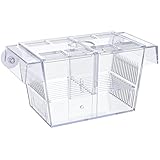
- Medium Hatching Box: With inner size of 5.3" L x 3.5" W x 3.9" H, it protects newborn fry from being eaten or attacked, improving the survival rate of newborn fish.
- Versatile Uses: 2 removable separators constitute 3 rooms. The bottom is the hatchery for baby fish, and another 2 rooms can be used to isolate aggressive or sick fish.
- Floating Design: The balancing panel and 2 handles help keep the box floating in water, it can also be secured inside the tank with 2 suction cups. Space-saving during use.
- Acrylic Material: The highly transparent acrylic box allows you to watch the breeding process or fish fighting without any barriers, bringing you with endless enjoyment.
- Easy to Use: The incubator can be easily installed or disassembled for cleaning without any tool. And its side vents ensure optimum water flow, requiring no heater or air pump.
What happens after the eggs hatch?
The male guards the bubble nest and tends the early larvae. In the USJ protocol, he remains with the larvae for 48 hours after hatching. IFAS instead describes transfer to grow-out tanks at about three days post-hatch, once the larvae have absorbed their yolk sacs. These are source-specific husbandry descriptions, so follow a coherent breeding protocol rather than treating either interval as a rule for every setup.
Free tools Windows power users keep installed
One-click scans. No signup required.
For initial live foods after hatching, IFAS names infusoria and brine shrimp nauplii. The cited care sources do not establish that newly hatched fry should be fed before their yolk sacs are absorbed.
Quick Recap
Best Value

- Give a peaceful home to your betta --- When fish are given a homely ambiance, they tend to grow stronger. By creating ideal water conditions, we assure that they can prosper. The Indian Almond leaves are considered to have beneficial properties and increase fish appetite.
- Have a breeding pet? Add catappa --- The tropical fishes create bubble nests using a floating leaf to anchor their bubbles. So, if your tank has a breeding tetra, guppy, platies, molly, cichlid or shrimps, just add these leaves and see them anchoring their eggs over IAL. That is a sight to behold.
- Benefits Other Fish and Snails Too --- The tea water has many advantages for fish like tetra, discus, and goldfish. It is good for rasboras and many dwarf cichlids too. Apart from that, snail owners can benefit from the magical leaves. Giving your fish this ambience calms them down. It imparts color to them and makes their scales firmer.
- Smaller leaves, easier portion control --- Each packet contains 50 leaves measuring around 2-inches high which is a great value for money. Smaller Catappa leaves make for easier portion control and a good way to slowly introduce your pet to a new surrounding especially for smaller fishes in smaller tanks.
- Adds beauty to nano tanks, small bowls and jars --- The Catappa leaves from SunGrow are unprocessed so you know what goes into your tank. They look pretty in a nano tank and add aesthetic beauty to your planted tank. You may even add these in individual betta jars or bowls.
Rank #4
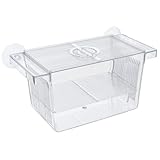
- Tiny Hatching Box: With inner size of 4.2" L x 2.7" W x 2.8" H, it protects newborn fry from being eaten or attacked. Suitable for feeding tiny fish or shrimp ONLY.
- Slotted Bottom Panel: It can effectively prevent soiling of the box by debris, food residues or excrement, and the slim slots in it keep the newborn fish from escaping.
- Floating Design: The balancing panel and 2 handles help keep the box floating on water, it can also be secured inside the tank with 2 suction cups. Space-saving during use.
- Acrylic Material: The highly transparent acrylic box allows you to watch the breeding process or fish fighting without any barriers, bringing you with endless enjoyment.
- Easy to Use: The incubator can be easily installed or disassembled for cleaning without any tool. And its side vents ensure optimum water flow, requiring no heater or air pump.
Rank #3

- Medium Hatching Box: 5.5" L x 3.6" W x 3.9" H. The aquarium fish breeding box protects newborn fry from being eaten or attacked, improving the survival rate of newborn fish.
- Versatile Uses: 2 removable separators constitute 3 rooms. The bottom is the hatchery for baby fish, and another 2 rooms can be used to isolate aggressive or sick fish.
- Floating Fish Breeding Box: The balancing panel and 2 handles help keep the incubator floating in water. It can also be secured on the tank wall with the suction cups. Easy to install or disassemble it without any tool.
- Acrylic Material: The acrylic fish isolation box allows you to watch the breeding process or fish fighting without any barriers, bringing you with endless enjoyment.
- Safe & Reliable: The fish tank breeding box comes with a double-sided suction cup. It securely fix the body of the box to prevent wobble. Effectively prevent fish from being caught between hatching box and glass wall. And its side vents can ensure optimum water flow.
Product prices and availability are accurate as of the date/time indicated and are subject to change. Any price and availability information displayed on Amazon at the time of purchase will apply.




