
Some links on this page are affiliate links: if you buy through them we may earn a commission, at no extra cost to you.
There is no reliable daily-minute target that fits every large dog. The right amount depends on the dog’s breed or mix, energy, age, temperament, health, fitness and comfort. A young, high-drive working dog may need substantially more activity than a calm adult, while an older dog or one with joint, heart or breathing problems may need less strenuous exercise. The safest plan combines suitable movement with mental enrichment and changes as the dog changes.
Why size alone cannot determine exercise
“Large dog” describes body size, not a single exercise requirement. The American Animal Hospital Association (AAHA) recommends exercise, mental stimulation and enrichment appropriate to a dog’s age, breed and temperament. The American Kennel Club (AKC) likewise says exercise needs vary with age, breed, health and energy. Neither source establishes one daily number of minutes for all large dogs.
As an Amazon Associate I earn from qualifying purchases.
Quick wins for a faster PC:
Scan for outdated or missing drivers - takes under a minuteDriver Scan →Clear out junk files and repair common Windows errorsFree Scan →Two dogs of similar weight can therefore need very different routines. A calm adult may be content with regular walks and brief play, whereas a high-energy herding or working dog may need additional movement, training and scent-based work to stay settled. Singapore’s Animal and Veterinary Service (AVS), in guidance updated September 25, 2026, notes that many herding dogs need more than daily walks and that insufficient stimulation can contribute to behavior problems. AVS also stresses that individual dogs vary.
Think of exercise as a flexible daily opportunity rather than a quota. Your goal is enough appropriate activity for this dog to remain physically capable, mentally engaged and comfortable, without forcing exercise that exceeds its development or health limits.
Popular on Amazon

- 【Enhanced Safety】: This upgraded treadmill features a fiberglass running belt, which is splinter-free and far more durable than traditional wooden belts—no more wood chips or tedious maintenance! Its innovative 3-level adjustable braking system allows for custom resistance, easy on-and-off access, and instant stopping, so you’re always in control and your dog’s workout is as safe and comfortable as possible.
- 【Weather-Proof Fitness】: Tired of weather disruptions to your outdoor plans? Say goodbye to unpredictable conditions affecting your dog's workout routine! Our dog treadmill for large dogs is the ultimate solution for frosty winters, scorching summers, or rainy days. Create a cozy workout spot at home, perfect for those without ample backyard space or energy to match their dog's exercise needs. Keep your dog active daily, regardless of external factors.
- 【Smart Design, Exceptional Quality】: Our slat mill for dogs features a robust carbon steel frame for years of dependable use. Clear acrylic panels offer a transparent view of your dog's movements, with seamless side panels ensuring paw safety. The lightweight aluminum rollers, and shock-absorbing silent wheels provide a comfortable workout. Its standout feature is the customizable incline, allowing you to tailor resistance with flexible feet to meet your dog's unique needs.
- 【Non-Motorized, Manual Treadmill】: Embrace natural exercise! Unlike motorized treadmills, your dog can exercise at their own pace—be it a leisurely walk, a brisk jog, or a spirited sprint—without being confined to the machine's speed, eliminating potential safety concerns. No more speed adjustment hassle; your dog can pause and rest whenever necessary, ensuring a safe and delightful workout. Compared to expensive electric alternatives, our dog treadmill also reduces routine maintenance costs.
- 【Top Choice for Multi-Dog Homes】: Tailored for medium breeds like Pit bulls, Belgian Malinois, Australian Shepherds, our 66”x20“x56” dog running machine is the ultimate exercise solution. With an adjustable forward-tilt frame, it caters to dogs of various sizes, making it perfect for multi-dog households. Recommended pre-purchase measurement for a proper fit. Invest in your pet's health today!
The factors that set your dog’s daily workload
Age and life stage
Puppies, adults and seniors do not have the same safe workload. A puppy’s bones and joints are still developing; an older dog may have reduced mobility or a medical condition that changes which activities are comfortable. The workload that suits a fit adult should never automatically become a puppy or senior target.
Breed purpose and natural energy
Breed history offers a useful starting point. Dogs developed for herding, retrieving, pulling or other demanding work often have a stronger drive for activity than breeds selected primarily for companionship. Breed or mix does not dictate an exact schedule, but it can signal whether a simple walk is likely to be enough or whether you should add purposeful play, training or nose work.
Do these 3 things before closing this tab:
1Clear out junk files and repair common Windows errors2Fix the driver behind crashes, sound loss and screen glitches3Repair Windows errors before they cause bigger problemsTemperament and individual motivation
Some dogs seek movement; others prefer exploring slowly, learning cues or solving food puzzles. AAHA includes temperament in age- and breed-appropriate care, and AKC lists training, puzzle games, scent work and learning new skills as useful mental stimulation. Observe what engages your dog rather than assuming that every large dog enjoys the same games.
Health, body condition and current fitness
Health can change both the amount and the type of exercise a dog should receive. AKC specifically recommends veterinary input when an adult dog has conditions such as hip dysplasia, heart disease or respiratory problems. A dog that is not currently conditioned may also need a more conservative start than a dog already accustomed to regular activity. If movement causes discomfort or your dog can no longer comfortably do its usual activity, contact a veterinarian instead of pushing through.
How to build an individual exercise plan
- Record the starting profile. Note your dog’s age, breed or likely mix, usual energy, temperament, current activity, body condition and any orthopedic, mobility, cardiac or respiratory diagnosis. Include medications or restrictions your veterinarian has already given you.
- Choose movement the dog can perform comfortably. Regular opportunities to walk, explore and play form the physical foundation. Match the intensity and surface to the dog’s life stage and health. A lower-energy dog may do well with walks, while a high-energy dog may need additional physical activity.
- Match activities to interests. Add retrieving, interactive play, training, scent work or other breed-relevant tasks when your dog enjoys them. A tug toy can be one optional play tool; AKC says tug may build muscle and support the human–animal bond. It is not a universal requirement or a substitute for an appropriate overall routine.
- Use frequent, manageable opportunities for young dogs. For a large-breed puppy, several short play and training opportunities are safer than treating the puppy like a small adult athlete. Let the puppy regulate the pace during ordinary play rather than requiring a prolonged, repetitive workout.
- Watch comfort and behavior. Reassess if the dog shows discomfort, cannot comfortably complete its familiar activity or develops behavior problems that may reflect inadequate stimulation. Do not increase impact or duration simply to reach a predetermined number.
- Ask for a veterinary plan when the margin for error is small. Veterinary guidance is especially important for growing large-breed puppies, dogs with pain or diagnosed disease, and seniors whose mobility is changing.
Large-breed puppies: protect developing joints
Why growth plates matter
Large and giant breeds mature later than toy breeds. Jerry Klein, AKC Chief Veterinary Officer, states that growth plates in large and giant breeds may fuse as late as 16 to 18 months, compared with 6 to 9 months in toy dogs. That is a possible late-fusion window, not a guaranteed age for an individual puppy and not an adult exercise prescription.
Klein warns: “Excessive, constant, percussive trauma, such as would occur in regimented running or jogging on hard surfaces such as concrete or asphalt, could affect the growth plates and are thought to cause harm to the developing joints of large dogs.”
What to do before closure
Favor self-regulated puppy play over forced, repetitive endurance work. Klein describes typical puppy play—where no single motion is extended for a long period and the puppy twists and turns—as preferable, particularly on softer surfaces such as grass or sand. Avoid making a large-breed puppy accompany you on regimented runs or jogs, especially on hard surfaces, before growth is complete.
Also popular on Amazon
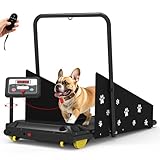
- 【Multifunction Display and Remote】The 360° rotatable display of the dog treadmill enables you to read speed, time, etc. from any angle without going to the front. You can control it via display buttons or the remote. When busy, use the remote to adjust from a distance. These features make it a must-have for owners concerned about their dog's exercise convenience.
- 【Keeping Fur Baby Safe】The side panels on the pet treadmill can effectively prevent your dog from straying off the track falling off the sides and getting injured while exercising. Also, there is a safety key that stops the treadmill immediately when disconnected, so owners don't have to worry about their dogs' safety whether they're doing housework or briefly leaving the room.
- 【Easy to Use & Save Space】The treadmill for dog has two wheels. Whether you want to change its position in the room for better watching your dog's workout or move it elsewhere, you can just tilt and roll it with ease. In addition, with the side panels and armrests removed, it can be neatly stored under a sofa or bed to save space in your room!
- 【Low Noise】Dogs have a very acute sense of hearing and are sensitive to noise. Low noise dog treadmill will allow your dog to focus more on running and not get annoyed or startled, and it also won't interfere with your family's daily activities. In addition, the remote control has a mute button, press it and there will be no beeping sound when adjusting the treadmill parameters.
- 【2 in 1 Treadmill】The mini treadmill is built with a 1.5 HP motor that provides 265 lbs weight capacity and 0.5-4.0mph speed range. Running belt measures 36.22"x14.17". Remove side panels and armrests can use as a small one-man treadmill. Whether it's your fur baby or yourself, both can use this treadmill to work out!
Running- and jumping-intensive sports require an individual veterinary discussion. Ask your veterinarian when a particular puppy is ready for those activities rather than using 16 to 18 months as an automatic clearance date. The veterinarian can account for breed, growth, orthopedic findings and the specific sport.
A practical puppy day
An appropriate puppy pattern might include exploratory play, brief training, rest and another short opportunity to move later. Keep sessions varied and allow the puppy to stop or change direction naturally. Training and scent games provide mental work without turning every outing into an impact-heavy exercise session. This approach does not mean withholding normal play; it means avoiding forced, repetitive adult-style workouts while the skeleton develops.
Adult large dogs: match workload to energy and health
Lower-energy adults
Some adult large dogs are satisfied by regular walks, exploration and modest play, provided they remain comfortable and mentally engaged. Their routine still needs consistency: a dog that receives little activity for long periods may not be well served by a single occasional burst.
Outdated Drivers Are Slowing You Down
One free scan finds every outdated or missing driver and matches the right update for your exact hardware.Free scan · exact hardware matchPC Slower Than It Used to Be?
A free scan shows the junk files, broken settings and background clutter dragging Windows down - then fixes them in one click.Free scan · Windows 10 & 11High-energy and working-line adults
High-energy breeds generally require more activity than lower-energy breeds. A herding or working-line dog may need movement plus tasks that use its nose, learning ability or problem-solving skills. AVS notes that many herding dogs need more than daily walks and that insufficient stimulation can contribute to behavior problems. If your dog remains persistently unsettled despite regular movement, consider whether it needs more appropriate physical and mental work rather than simply a longer forced run.
Adults with medical conditions
Hip dysplasia, heart problems and respiratory disease can make an otherwise familiar routine unsafe or uncomfortable. AKC recommends involving a veterinarian when these conditions are present. Follow the clinician’s limits on intensity, surfaces and activity type, and replace unsuitable impact with activities the dog can perform comfortably.
Senior large dogs: preserve comfort and mobility
There is no reason to use a young adult’s workload as a senior dog’s target. AKC advises adjusting senior activity to what the dog can comfortably handle. That may mean shorter or gentler outings, more rest between activities or a greater emphasis on low-impact exploration and mental enrichment.
Watch for a change from the dog’s established ability: discomfort, reluctance or an inability to complete familiar activity warrants veterinary advice. A senior plan should be individualized rather than based on age alone, because dogs of the same age can have very different mobility and health.
Also popular on Amazon

- 【UPGRADED PIN-HINGED SLAT RUNNING SURFACE】 Addressing core safety features, our track uses an innovative pin-hinged linkage system instead of traditional screws. This structural design prevents the belt from detaching, providing a secure, non-slip running surface that ensures stable footing during intense physical activity.
- 【3-LAYER SHOCK ABSORPTION & QUIET OPERATION】 Engineered with a 3-layer cushioning effect, utilizing a sound-absorbing belt and quiet slide rail wheels. This structural design not only minimizes operational noise but also provides a low-impact running experience, offering a comfortable surface for your dog's daily exercise indoors or outdoors.
- 【DISC BRAKE LOCK FOR HEAVY DUTY USE】 Built with a robust frame for medium to large breeds. It features a responsive disc handbrake with a locking buckle that secures the track in place once the run is over. This allows you to use both hands freely to remove your dog's harness without the track sliding. Straightforward assembly required.
- 【INDOOR AND OUTDOOR VERSATILITY】 Since this is a self-paced, motorless slatmill, it requires no electricity. You are not restricted by power outlets. Equipped with an ergonomic U-shaped handle and precision-bearing transport wheels, you can easily roll it to your backyard, patio, or garage so your dog can enjoy fresh air.
- 【FITNESS TRACKING WITH SPEED DISTANCE MONITOR】 Keep a close eye on your pet's activity levels with the integrated digital monitor. It accurately records your dog's running speed and total mileage, allowing you to quantify their exercise volume and maintain a consistent, trackable fitness routine for your furry companion.
Physical exercise and mental enrichment work together
Mental stimulation complements physical exercise; it does not replace the movement a dog needs. AAHA includes enrichment in life-stage care, and AKC identifies several options:
- Short training sessions that teach or maintain useful cues.
- Puzzle games that require the dog to work out a solution.
- Scent work and nose-based searching.
- Learning new skills suited to the dog’s ability.
- Breed-relevant tasks that give a high-drive dog a constructive outlet.
Choose enrichment according to the dog’s interests and physical limits. For a dog temporarily restricted by illness or an orthopedic problem, ask the veterinarian which games are safe. Mental work can make a routine more satisfying, but it should not be presented as a universal substitute for physical activity.
Activity choices by risk and purpose
Instead of ranking activities by a universal “best” list, evaluate each option against five questions: Is it suitable for the dog’s life stage? Does the breed or temperament make it engaging? Can the dog perform it comfortably? How much impact does it involve? Does it supply movement, mental work or both?
- Walking and exploration: Often a useful foundation, particularly for lower-requirement dogs. Adjust pace, surface and distance to comfort and conditioning.
- Self-directed play: Appropriate puppy play allows changing direction and stopping naturally. Softer surfaces such as grass or sand are preferable to repetitive impact on hard surfaces for developing large-breed puppies.
- Tug and interactive play: AKC says tug can build muscle and support the human–animal bond. Keep the game appropriate to the dog’s size, behavior and veterinary restrictions.
- Nose work and training: Useful mental enrichment, especially for dogs bred to work with people or their environment. These activities complement rather than erase physical needs.
- Running, jumping and organized sports: Treat these as higher-impact choices for a growing large-breed puppy. Consult the veterinarian before introducing running- or jumping-intensive sports.
Common mistakes to avoid
Using a universal minute rule
No reviewed veterinary guidance supplies a single daily-minute prescription for every large dog. Rules of thumb can mislead when they ignore breed, temperament, health, conditioning or age. Use an individualized routine instead.
Applying adult exercise to a puppy
A large puppy is not a miniature adult. Growth plates may remain open well into adolescence, and repetitive running or jogging on hard surfaces can expose developing joints to excessive impact. Use self-regulated play and seek veterinary advice before strenuous sports.
Stopping all puppy activity until a fixed birthday
The growth-plate caution does not mean a puppy must be kept inactive. Normal play, exploration and training remain valuable; the restriction is against forced, repetitive, high-impact work before the puppy is ready.
Counting mental games as a full replacement
Training, puzzles and scent work enrich a dog’s day, but AKC states that mental stimulation does not replace physical exercise. Use both, in proportions appropriate to the individual.
Also popular on Amazon

- IMPROVE YOUR DOG'S HEALTH: PawRunner doggy treadmill improves your pet's blood circulation and blood pressure. Our dog running machine helps dog lose weight. Taking care of your dog's health has never been easier without our pet treadmill for dogs.
- EFFECTIVE EVERYDAY EXERCISING: Remote control adjusts speed of dog exercise wheel - Even you are busy, your pet will not miss exercise. Whether it's too hot, too cold, or bad outside, support your pet's exercise routine with our dog exercise machine.
- POSITIVE EXPERIENCE: Dogs are extremely sensitive to sounds & vibrations. That's why special designed ultra-quiet motor in our dog treadmills is for in-home use so your dog has comfy experience. Let your pet enjoy our small dog trotter treadmill.
- SAFETY FIRST: PawRunner puppy treadmill is carefully designed to protect your dog. It features a safety key & an emergency stop button which helps your dog enjoy exercise safely. It is not a dog treadmill for large dogs but small & medium dogs only.
- SIMPLICITY & PEACE OF MIND: In just 10 minutes you can easily install the canine treadmill for small dogs. Sit back & relax or get your extra work done knowing you've taken good care of your dog's health with our dog treadmill for medium dogs.
Ignoring a change in comfort
When a dog develops discomfort or cannot comfortably perform its usual activity, do not simply encourage it to work harder. Pause the questionable activity and obtain veterinary guidance.
Illustrative routines, not prescriptions
Calm adult example
A calm adult might have a regular walk with time to explore, a brief play opportunity and a short training or scent session. If that dog remains comfortable and settled, there is no evidence-based reason to force a high-intensity workout merely because it is large.
High-drive adult example
A high-drive herding-type adult may need a walk plus purposeful training, scent work and interactive play. The owner should judge success by comfortable participation and appropriate behavior, then adjust the mix if the dog remains under-stimulated or shows discomfort.
Growing puppy example
A large-breed puppy may rotate short, self-directed play, brief training, rest and gentle exploration. It should not be required to complete a prolonged run or repetitive jumping routine. A veterinarian should advise on any plan involving organized running or jumping.
Senior example
An older dog may retain daily walks but at a gentler pace, with more rest and additional scent or training games. The exact pattern should follow what the dog can comfortably handle and any veterinary restrictions.
Recommended Free Tools
When to involve your veterinarian
Arrange individualized advice when your dog is a large-breed puppy and you are planning running, jumping or a sport; when an adult has hip dysplasia, heart or respiratory disease; when a senior’s mobility changes; or whenever activity produces discomfort. Your veterinarian can help distinguish a normal need for conditioning from a medical limitation and can recommend safe alternatives.
The central answer remains individual: large dogs do not share one correct daily exercise number. Build regular movement around the dog in front of you, add enrichment that fits its breed and temperament, protect developing joints during growth, and change the plan when health or comfort changes.





Leave a Reply