Recommended Free Tools
There is no single number of hours that suits every dog. A useful starting point is the American Kennel Club’s general guideline of at least two hours of dedicated social time each day with people or other dogs, divided into manageable chunks. That is time for companionship and interaction—not two hours of strenuous exercise. Your dog’s age, health, breed traits, energy, confidence when alone, toilet needs and ability to rest determine the routine that is actually appropriate.
What “time with your dog” should include
Dogs need more than a walk and a full bowl. Daily care combines social contact, movement, mental engagement, training, toileting, meals, grooming and uninterrupted sleep. Some of these happen together: a sniffing walk can provide exercise, exploration and companionship; a short training session can provide attention and mental work; calm time beside you can meet a social need without exciting an already tired dog.
As an Amazon Associate I earn from qualifying purchases.
The American Kennel Club (AKC) quotes board-certified veterinary behaviorist Dr. Vint Virga as suggesting at least two hours of dedicated social time per day with people or other dogs. The time can be split across the day. Virga also notes, “Some dogs will do better with more alone time than others,” and, “For a dog to spend all of their day alone is too much. Dogs are very social animals.” Treat the two-hour figure as a broad social-contact benchmark, not a prescription for two hours of hard exercise or proof that every dog’s needs are met.
Do these 3 things before closing this tab:
1Clear out junk files and repair common Windows errors2Scan for outdated or missing drivers - takes under a minute3Repair Windows errors before they cause bigger problemsHow to decide whether your dog needs more or less interaction
Age and life stage
Puppies do not have an adult dog’s stamina, bladder control or ability to regulate excitement. Their activity should be increased gradually, with advice from a veterinarian or responsible breeder rather than by applying an adult exercise target. Short play and training periods, frequent toilet opportunities and plenty of sleep are usually more useful than one long outing. Adolescents may appear tireless but can become overtired or impulsive when given too much high-impact activity.
#1 Best Overall

- [Treat Distribution] Our food dispenser has differently sized spheres at both ends. As dogs push the toy, it moves within a fixed area, allowing dogs to continuously chase and play with it. During movement, food is dispensed from the food holes on both sides of the toy.
- [Adjustable Switch] Each of the two spheres with a food dispensing switch, making it suitable for various sizes and types of pet dry food or snack. The switch can be adjusted according to the different sizes of dog food. It also allows control over the amount of food dispensed, extending or shortening the time it takes for pets to obtain food. It is more conducive to a healthy dog diet.
- [Increase Pet Intelligence] This dog treat puzzle toy combines intellectual training with food rewards. When pets push this toy, it will not only be to get delicious food, but it will also stimulate their intelligence and hunting instinct. This design not only meets the needs of pets but also encourages them to learn and grow in the game.
- [Prolonged Play] The dog enrichment toy is designed to limit the amount of treats your dog gets while encouraging more extended playtime. This is intended for effective playtime for dogs and is NOT a chewed toy. It is also dog boredom buster toys and best dog gift to keep them busy when dogs are left home alone, relief anxiety.
- [Attract Dogs' Attention] With barbell shaped design and bright color, the dog puzzle toy ball can attract your dog's attention, stimulate their curiosity and drive them crazy to roll it. Size: 6.1*3.44*3.44in/15.5*8.7*8.7cm.
Healthy adults often tolerate a predictable combination of walks, play, training and rest. Older dogs may still want social contact while needing shorter, slower outings, easier surfaces and more recovery time. Arthritis, heart disease, respiratory problems, obesity or sensory loss can all change what “enough” activity means.
Health, mobility and temperament
A high-energy working-type dog may need more opportunities to move and solve problems than a low-energy companion, but breed labels never replace observation. A fearful dog may benefit from quiet one-to-one interaction and controlled sniffing rather than a busy dog park. A dog recovering from illness or surgery needs a veterinary plan. If you are unsure whether panting, reluctance, stiffness or sudden withdrawal is normal, ask your veterinarian before increasing exercise.
How your dog behaves after an activity
Look for a dog that can settle, sleep and behave normally between activities. Constant pacing, destructive behavior, frantic attention-seeking or inability to rest can indicate unmet needs, stress, pain or a behavior disorder. The answer is not always “more exercise.” A dog that becomes wired after intense play may need shorter sessions, more decompression and help learning to relax.
Rank #2

- 【PRODUCT SIZE】10 inch*10 inch*1.3 inch.
- 【3 WAYS TO PLAY, UPGRADE SLOW FEEDER】Our dog mental stimulation toys have a unique squeak button in the middle, which make it easier to attract the attention of dogs and cats. Three different difficulty designs and the 16-hole dog treat dispenser design maximize slow feeding time, even beyond 20 minutes.
- 【FUNNY STIMULATING TOYS】All kinds of dogs and cats love the puzzle game of Spin & Slide and the Seek & Hide with their smell sense and paw skills to find food. Combining circular orbit sliding game and linear orbit sliding game, smart dog and cat must move the slider correctly to get the food reward hidden in the maze.
- 【NON-REMOVABLE PARTS DOG PUZZLE】Our dog treat puzzle is made of non-toxic materials, very durable and suitable for pets to play for a long time. This dog toy has no removable parts because the design has built-in play parts that fold tightly and won't fall off easily.
- 【ANTI-SLIP & EASY TO CLEAN】: The four corners of the bottom are equipped with four anti-skid pads, which can be well fixed during the dog's slow food process; It is easy to clean, also dishwasher safe.
Social time is different from exercise
Social time means being meaningfully connected with people or compatible dogs. It can include a walk in which you let your dog sniff, a calm grooming session, a training game, gentle play, or simply relaxing together while you are available. Exercise is physical work that raises movement and often heart rate. The two overlap, but they are not interchangeable.
There is no defensible universal number of exercise hours for every dog. The ASPCA’s separation-anxiety guidance mentions 30 minutes of aerobic activity in that behavior context; it is not a general daily prescription. Choose intensity and duration according to your dog’s veterinary advice, conditioning and response, and provide mental outlets as well as physical ones.
A practical daily routine
Use a repeatable pattern rather than trying to hit an exact stopwatch total. Consistency around meals and activity can help dogs feel secure, while gradually practicing short absences can prevent a routine in which the dog is never alone.
Rank #3

- 2 Levels in 1 Toy: start your pups off with a level 1 puzzle, add some treats in the base compartments and watch your dogs get their tasty reward by nudging the lids. For dogs who have mastered level 1, for added challenge in level 2, just put some treats in the top compartments, teach your dogs to press the top cover to dispense treats down into the base compartments and finally enjoy their reward
- Slow Feeder: The large capacity top transparent granary saves you the hassle to refill dog food frequently. The product can also be used as a slow feeder utensil for your dogs, which promotes healthy ingestion by slowing down eating speed by over 10x. Great for large and small dogs
- Not Easy to Tip Over: 4 non-slip rubber mats and weighted base hold the dog puzzle toy firmly in place when dogs eat and nudge and prevent the toy from tipping over
- We Prioritize Safety: the dog puzzle toys are designed with your pet’s health in mind, made of durable food-grade PP materials. Non-removeable parts make it safe and easy to clean. And you can give puzzles toy to your dog or directly out of the box, just no assembly!!
- Trains Dog’s Intelligence: interactive treat puzzle game challenges your puppies to get their reward of treats, works your dog's mind while reducing boredom and destructive behavior like chewing, digging and excessive barking. Size: 4.2 inch height
- Morning toilet break and movement: Start with a toilet opportunity and an age-appropriate walk or other movement. Let your dog sniff where safe; exploration is mental work as well as physical activity.
- Breakfast with engagement: Feed normally, or use part of the meal in a supervised food puzzle or food-dispensing enrichment toy. These tools add mental stimulation but do not replace companionship, exercise or toilet breaks.
- Brief training or play: Several minutes of reward-based cues, tug, fetching or a scent game can be more useful than one exhausting session. Stop while your dog is still successful and able to settle.
- Rest: Protect a quiet sleeping area. Dogs need substantial rest, and continually interrupting naps can create irritability and poor impulse control.
- Midday contact: If you are away, arrange a suitable toilet break, walk or visit according to your dog’s needs. A calm check-in may be better than an overstimulating group setting.
- Evening social time: Add another walk or movement session if appropriate, followed by calm interaction, grooming or training. Spread contact across the day instead of concentrating everything into one long block.
- Night routine: Offer a final toilet opportunity and a predictable wind-down. Dogs that spend nearly all their time with their owners should still learn, gradually, that short periods of separation are safe.
Meals, medication, grooming and toilet trips count as care, but do not assume that completing chores equals social connection. A dog can be fed and walked while still lacking relaxed, attentive interaction.
How long can a dog be left alone?
Published guidance differs, and neither figure is a universal rule. RSPCA UK advises that dogs should be left for no longer than four hours so they have opportunities to exercise, toilet and spend time with people. An AKC article quotes Virga recommending no more than six to eight hours without a chance to relieve themselves. The difference reflects different emphases and levels of strictness; do not average the numbers into an “official” limit.
| Guidance | What it says | How to use it |
|---|---|---|
| RSPCA UK | No longer than four hours alone | A cautious welfare benchmark that includes exercise, toilet and human contact opportunities. |
| AKC article quoting Dr. Vint Virga | No more than six to eight hours without a chance to relieve themselves | A quoted recommendation framed around toilet access; individual tolerance still varies. |
Age, medical conditions, toilet control, previous experience, household noise and separation-related distress can make a shorter period necessary. A dog that is quiet on a camera may still be anxious, so consider posture, pacing, panting, vocalizing, drooling, destruction and attempts to escape rather than assuming silence means comfort.
Rank #4
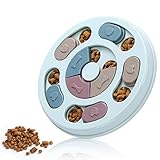
- 【Size】: L9.44" * W9.44"* H1.14" suitable for cats, puppies and small dogs.
- 【Interactive Dog Toys】This is a interactive puppy puzzle , which can easily become the closest companion and toy for your puppies and cats, and will release pressure for dogs. Find food by sliding parts to improve eating pleasure and IQ.
- 【Slow Feed Bowl】This encourages pets to eat at a slower speed, helps to slow down the feeding time to help the dog digest, and can provide your dog with a variety of healthy snacks.
- 【Slow Feede toys】 Use this educational game toy to exercise the dog’s brain, which will help meet the dog’s instinct needs, train the pet’s sense of smell, and let the dog enjoy feeding when using the nose or paw to move the slider, while providing spirit stimulate.
- 【Dog toys】No toy is indestructible. Do not leave toys with unsupervised pets. Remove and replace toy if damaged.
Building alone time safely
Do not test a dog’s tolerance by suddenly leaving for a full workday. Begin with an absence short enough that the dog remains relaxed, return without drama, and increase duration in small steps. Practice when the dog has toileted, had suitable activity and can rest. Keep departures and arrivals predictable, and use a camera if it helps you see what happens after you leave.
Dogs that panic, injure themselves, destroy doors or windows, howl continuously, or cannot tolerate even brief separation need an individual behavior plan. The ASPCA advises gradual alone-time conditioning for separation anxiety and recommends consulting a veterinarian or veterinary behaviorist before considering medication. More exercise alone is not a treatment for separation anxiety.
When your schedule creates a long absence
A dog walker, pet sitter or daycare can provide a break when work or other commitments leave a dog alone for an extended period. RSPCA material identifies these as possible services, not as universally suitable solutions.
Best Value

- 【Product Size】10 inch*10 inch*1.2 inch.
- 【Interactive Dog Puzzle Toys 】This is a fun interactive puzzle toy,which can encourage and train your dogs or cats to seek foods by sliding the slider, helping pets to increase IQ by learning sequential steps and the challenging play.
- 【Squeaky Dog Toys】This dog puzzle toys is designed with a sounding device in the middle of the toy,which is to attract the pet's attention.Also,you would enjoy the fun of dog squeak puzzle toy with your pets, greatly improve relations with your pets and get fun during interactive dog games.
- 【Mental Excecise&Boredom Buster】Our memory training puzzle toy can keep smart dogs busy and engaged in more thinking and activities.Therefore,clot stimulation toys are great for reducing dogs’boredom,anxiety and destructive behaviors.
- 【Food-Safe PP Material】This dog treat puzzle is made with toxic-free, food-grade PP material. It is durable for interactive play and mental enrichment but not designed as a chew toy. Always supervise your pet during use.Easily washable with water or in the dishwasher.Note: No toy is indestructible. Remove and replace the toy if damaged.
- Dog walker: Ask whether walks are individual or grouped, how dogs are transported, what weather policies apply and how toilet breaks are handled.
- Pet sitter: A home visit may suit dogs that are uncomfortable with groups or unfamiliar environments. Confirm visit length, medication procedures, emergency contacts and whether the sitter can recognize stress.
- Daycare: Evaluate supervision, group size, rest periods, screening, separation spaces and cleaning. Some dogs enjoy group care; others become overwhelmed or prefer a quiet home visit.
Match the service to the dog, not just the calendar. Consider the length of your absence, your dog’s comfort with unfamiliar people and animals, exercise and toilet requirements, transport, provider practices and what happens if your dog becomes ill or frightened.
Using enrichment without mistaking it for attention
Physical and mental stimulation are useful outlets. Sniffing games, scatter-feeding, simple trick training, safe chews and supervised food puzzles can make a routine richer. Rotate activities so novelty does not become frantic demand. Choose equipment that cannot be swallowed or broken into dangerous pieces, and supervise until you know how your dog uses it.
Enrichment is an addition, not a substitute for social contact, movement, toilet opportunities, rest or treatment of a behavior problem. A puzzle left on the floor cannot compensate for a dog routinely isolated beyond its coping ability.
Free tools Windows power users keep installed
One-click scans. No signup required.
Signs the routine needs changing
- Possible under-stimulation: persistent nuisance behavior, attention-seeking, destructive chewing, restless pacing or repeated attempts to initiate play.
- Possible overload: inability to settle, irritability, frantic zooming, avoidance, stress signals or worsening reactions after busy outings.
- Possible medical issue: a sudden change in energy, exercise tolerance, appetite, sleep, toileting, gait or sociability.
- Possible separation distress: panic during departure cues, vocalizing, drooling, escape attempts or destruction focused around exits.
Track when behavior occurs, what happened beforehand, how long it lasts and what helps. Share that record with your veterinarian or a qualified behavior professional. Persistent distress deserves an assessment rather than a simple instruction to add another walk.
What dog owners actually report spending
Dogs Trust reported in 2025 that surveyed UK owners estimated an average of “2 hours and 12 minutes per day” on essential dog-care activities, including walking, feeding, play, enrichment, training and grooming. This is self-reported owner time in a UK survey, not a recommended amount and not evidence that every dog needs exactly that duration. It also combines tasks that provide different kinds of benefit, so it should not be compared directly with the AKC’s two-hour social-time guideline.
A simple way to plan your dog’s day
Before setting a target, answer these questions:
- How old is the dog, and how much sleep and toilet support does that stage require?
- What health, mobility, weight or medication issues limit activity?
- How much movement and problem-solving leaves the dog content rather than overstimulated?
- How does the dog cope when alone, and what is the longest absence on a normal day?
- Where will meals, toilet trips, rest and calm social contact fit when plans change?
- Who can provide a break if the dog cannot comfortably manage the planned absence?
Then write a flexible schedule with several contact points, appropriate movement, enrichment and protected rest. Reassess after illness, a move, a new work pattern or any persistent behavior change. The right amount is the amount that supports physical health, emotional security, normal rest and safe behavior for this individual dog.
Quick Recap
Product prices and availability are accurate as of the date/time indicated and are subject to change. Any price and availability information displayed on Amazon at the time of purchase will apply.
The Tool Desk
Outbyte PC Repair FREEClear out junk files and repair common Windows errorsFree Scan →Outbyte Driver Updater FREEFix the driver behind crashes, sound loss and screen glitchesFind Drivers →



