
Quick wins for a faster PC:
Clear out junk files and repair common Windows errorsFree Scan →Fix the driver behind crashes, sound loss and screen glitchesFind Drivers →Repair Windows errors before they cause bigger problemsFix Now →For a routine goldfish water change, leave the fish in the aquarium, siphon out part of the water while removing some solid waste, then refill with tap water treated with aquarium conditioner and brought close to the tank’s temperature. Test the water rather than relying on how clear it looks.
What you need
- A gravel siphon or aquarium vacuum: It removes water while lifting trapped waste from gravel. Choose one that suits your tank and lets you control the flow without disturbing the fish excessively. Merck Veterinary Manual describes vacuuming solid waste from gravel during water removal; RSPCA NSW also recommends a gravel siphon (Merck Veterinary Manual; RSPCA NSW).
- A clean bucket or water-change container used only for aquarium care: Keep it free of soap and household cleaning products.
- Aquarium water conditioner: Check the label to confirm it treats the disinfectants in your local tap water and follow its dose instructions. Chlorine and chloramines can harm fish; chlorine can also damage beneficial filter bacteria. RSPCA UK puts it plainly: “Chlorine present in tap water is dangerous to both fish and bacteria” (RSPCA UK).
- Tests for ammonia and nitrite: These help show whether the routine is keeping water conditions suitable. RSPCA UK identifies both as key waste measurements (RSPCA UK).
- A thermometer: It can help you compare new water with the aquarium. RSPCA UK says a separate heater is not normally necessary for goldfish, so a heater is not a required water-change purchase (RSPCA UK).
How to change the water
- Check the tank and its readings. Note the aquarium temperature, check that equipment is working, and test water as appropriate. SPCA New Zealand advises at least weekly monitoring in established tanks and daily checks in newly set-up tanks (SPCA New Zealand).
- Leave the goldfish in the aquarium. For a routine change, there is no need to catch and move the fish. Removing a portion of water rather than draining the aquarium also preserves more of the established environment.
- Siphon out part of the water. Start the siphon according to its instructions and direct it into the aquarium-only container. If the tank has gravel, move the siphon over some of the substrate to lift out trapped solid waste as water drains. Do not treat a full drain and refill as normal maintenance: partial changes help preserve beneficial bacteria, which Scottish SPCA warns can be lost when all aquarium water is replaced (Scottish SPCA).
- Clean filter media carefully, if it is due. Swish sponge or other media in the aquarium water you just removed, not under a running tap. Tap water can harm beneficial bacteria; avoid stripping all biological media at once. RSPCA UK gives this filter-care advice in its aquarium guidance (RSPCA UK).
- Prepare replacement water. Treat tap water with aquarium conditioner according to the product’s directions before it goes into the tank. Match its temperature as closely as practical. SPCA New Zealand specifies keeping replacement water within 2°C of the aquarium water; other cited welfare guidance advises matching temperatures without setting a numerical tolerance (SPCA New Zealand; RSPCA UK).
- Refill gently, then keep monitoring. Add the prepared water without causing a sudden temperature change. Continue checking the aquarium, especially if it is new or test results have been poor.
How much water should you change, and how often?
Published recommendations vary, so no single percentage or interval can be presented as right for every goldfish aquarium. The amount and frequency depend in part on stocking and how quickly waste accumulates. Use a regular partial-change routine, then adjust it in response to water tests and the condition of the fish.
As an Amazon Associate I earn from qualifying purchases.
| Source | Published routine |
|---|---|
| SPCA New Zealand | Approximately 10–25% weekly (source). |
| RSPCA NSW | Weekly partial changes of 10–25% (source). |
| Scottish SPCA | A 10% change, preferably weekly (source). |
| RSPCA UK | Its aquarium guidance recommends weekly 30% changes to dilute waste; its siphoning procedure separately describes removing 10% (source). |
| Merck Veterinary Manual | A general schedule of changing water every two weeks; the amount depends on stocking level (source). |
Goldfish produce substantial waste, and both stocking and filtration influence how quickly water quality changes. If readings remain poor despite routine changes, seek help from an experienced aquatics professional or fish veterinarian rather than assuming that a larger percentage alone will solve the problem.
How to respond to ammonia or nitrite readings
Clear water is not proof that aquarium water is healthy. RSPCA UK lists 0 mg/L as the safe level for both ammonia and nitrite and advises more frequent corrective water changes with retesting when waste readings are higher. Scottish SPCA gives similar advice for readings above 0 mg/L (RSPCA UK; Scottish SPCA).
#1 Best Overall
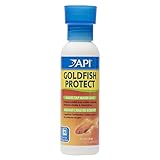
- Contains one (1) API GOLDFISH PROTECT Aquarium Water Conditioner 4-Ounce Bottle
- Makes tap water safe for fish
- Prevents tap water chemicals from causing gill destruction, tissue irritation and fish death
- Neutralizes chlorine, chloramines and other chemicals
- Use when adding or changing water and when adding new fish to goldfish aquariums
For elevated readings, RSPCA UK advises changing half the water daily and retesting until conditions improve; Scottish SPCA also recommends daily half-water changes when readings are above 0 mg/L. Treat this as corrective guidance for test results, not as a diagnosis of illness or a substitute for checking filtration. SPCA New Zealand publishes goldfish parameters including ammonia below 0.1 ppm and nitrite below 0.1 ppm, alongside other water guidance; those figures use a different stated threshold from RSPCA UK’s zero target and should not be treated as exactly interchangeable (SPCA New Zealand). If readings do not improve or your fish appears unwell, contact an experienced aquatics shop or fish veterinarian.
Quick Recap
Best Value
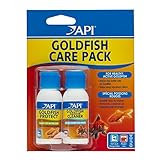
- Contains one (1) API GOLDFISH CARE PACK Aquarium Water Conditioner 1.25-Ounce Bottle
- Makes tap water safe for fish
- Helps keep goldfish aquariums clean by consuming sludge in the gravel bed, and adds beneficial bacteria
- Includes API GOLDFISH PROTECT and API GOLDFISH AQUARIUM CLEANER for optimal goldfish fish health
- Use weekly when changing water
Rank #4

- Contains one (1) API STRESS COAT Aquarium Water Conditioner 16-Ounce Bottle
- Makes tap water safe and protects fish with dual-action formula
- Removes chemicals from tap water that are harmful to fish
- Replaces fish’s protective coat damaged by handling or fish fighting with healing power of Aloe Vera extract
- Use when adding or changing water, when adding new fish and when fish are sick or injured
Rank #3

- Contains one (1) API TAP WATER CONDITIONER Aquarium Water Conditioner 4-Ounce Bottle
- Neutralizes chlorine, chloramines and other chemicals to make tap water safe for fish
- Prevents tap water chemicals from causing gill destruction, tissue irritation and fish death
- Super strength, high concentration formula
- Use when adding or changing water and when adding new fish to freshwater and saltwater aquariums
Rank #2

- Contains one (1) API TAP WATER CONDITIONER Aquarium Water Conditioner 16-Ounce Bottle
- Neutralizes chlorine, chloramines and other chemicals to make tap water safe for fish
- Prevents tap water chemicals from causing gill destruction, tissue irritation and fish death
- Super strength, high concentration formula
- Use when adding or changing water and when adding new fish to freshwater and saltwater aquariums
Product prices and availability are accurate as of the date/time indicated and are subject to change. Any price and availability information displayed on Amazon at the time of purchase will apply.
Independent reader supportYour contribution helps us test, update, and keep practical guides available for everyone.




Leave a Reply