What’s actually slowing this PC down?
Pick the symptom - the matching free tool is one click away.
Scientists usually cannot count every fish in a lake directly. Instead, fisheries biologists sample fish with methods suited to the lake and the species, then use those observations to estimate abundance. A catch is only the fish the chosen gear happened to capture—not a lake-wide count.
What does a lake fish estimate actually measure?
A survey may estimate the number of fish in a defined population, measure fish density in sampled areas, or report catch per unit effort—such as fish caught during a set amount of sampling. These results answer different questions. A site-level density or catch index does not automatically tell you the total number of fish in the lake; scaling it up requires a sampling design that makes the sampled places representative of the whole waterbody.
As an Amazon Associate I earn from qualifying purchases.
Every capture method misses fish. Capture chances vary with species, body size, habitat, depth, season, and survey conditions, so the catch can be biased toward some fish over others. Michigan Department of Natural Resources fisheries manual author James C. Schneider writes, “Estimating the actual numbers of fish in a lake is a difficult and time-consuming process for a number of reasons:” in the Manual of Fisheries Survey Methods II (January 2000).
Do these 3 things before closing this tab:
1Fix the driver behind crashes, sound loss and screen glitches2Repair Windows errors before they cause bigger problems3Scan for outdated or missing drivers - takes under a minuteHow mark-and-recapture estimates abundance
Mark-and-recapture estimates how many fish are present by comparing marked fish with unmarked fish in a later sample. In a basic Petersen-type approach, biologists capture and mark an initial group, release them, allow time for the marked fish to mix back into the population, and then capture a second sample. The share of marked fish in that later catch helps estimate the total population: if marked fish are a small share of the second sample, the estimated population is larger relative to the number initially marked.
#1 Best Overall
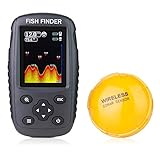
- It is a portable and castable fish finder that comes with a wireless sonar probe/sensor. The maximum distance between the sensor and the handheld unit is 262FT/80M. No need to drill hole in your boat hull to install the sensor any more. Two small holes on the sensor allow you to tether it with your fishing line and cast it onto water as far as you want.
- It detects and displays water depth, temperature, fish size (small/medium/big), fish depth, and bottom contour. It has Work and Simulation Mode. Measure units of depth and temperature can be converted. Sonar Beam Angle: 105 degree. Depth Range: 2.6-164FT/0.8-50M.
- It comes with clear color display (2 screen background colors selectable - black and white), which enables you to read the screen in bright sunlight or at night.
- It applies to lake, river, sea and other fishing environment. Suitable for fishing from a kayak or boat, fishing from shore or using for ice fishing.
- Warranty and Brand Support: The Venterior Portable Fish Finder is covered by a 2-year Warranty. Any issue of the fish finder after purchase, please don't hesitate to contact our brand support, we will response within 24 hours every day online.
The calculation is only as dependable as its assumptions. The estimate can be distorted if marked fish do not mix through the population, marks are lost or overlooked, fish move into or out of the study area, mortality differs, or marked and unmarked fish have unequal chances of capture. FAO guidance cautions that even small enclosed waters can be difficult to estimate reliably; see its Manual of Fisheries Science, Part 2.
A USGS summary describes one study using a single-census Petersen estimator in nine North Cascades mountain lakes smaller than 7 hectares. The study authors reported that the assumptions for unbiased estimates appeared satisfied in most cases. That finding applies to those study lakes and does not establish that the same design will work in every lake; see the 1997 USGS study summary.
Rank #2

- Wireless Control & Operation : Experience the ultimate freedom with the LUCKY portable fish finder, featuring a MASSIVE 853FT OPERATION DISTANCE—one of the longest ranges on the fishing market! No wires. No limits. Just cast your sonar sensor and unlock the secrets below from your boat, kayak, or shore.
- Precise Fish Depth & Location : Unlock the underwater world with the LUCKY portable fish finder. It doesn't just tell you the water depth—it reveals the exact depth of the fish and their location relative to structure, turning guesswork into guaranteed success. The sonar fish finder enables to scan schools of fish with wide 90°beam in a 3FT-147FT depth area.
- Readouts on a 3.5" Horizontal LCD Display : You could get a lot of fishing information by the LUCKY portable fish finder. The fish icons with depth numbers to show clear, intuitive symbols appear with their exact depth marked right next to them. Instantly know how deep the fish are holding. The screen scrolls from right to left, showing you a continuous history of what just passed under your sensor, allowing you to track fish movement and locate structure you've already floated over.
- Portable & Castable Design : The LUCKY sonar fish finder isn't just portable; it's pocket-sized powerful. The handheld display and floating sensor together are lighter than a 1-liter water bottle. No drilling, no brackets, no complex wiring. Truly "power-on and fish." Simply tie the sensor to your fishing line or the included safety tether and cast it like a bobber into promising water—over weed beds, near structure, or into deep channels you can't reach from shore. Fishing can’t be easier.
- All-Season, All-Water Ready : Take the portable fish finder from a summer bass lake to a frozen ice hole without changing a thing. Its compact design makes it the perfect companion for travel and spontaneous fishing trips. The LUCKY sonar fish finder is suitable for almost all kinds of fishing, such as shore fishing, kayak fishing, canoe fishing, boat fishing, pontoon fishing and ice fishing.
How capture surveys and electrofishing are used
Biologists may use electrofishing, nets, traps, trawls, or rod-and-line sampling, depending on the depth, habitat, target fish, and survey question. Electrofishing can support abundance or density estimates in suitable waters, but it does not catch every fish and can be selective. The New Zealand Department of Conservation describes a multi-pass backpack electrofishing method for estimating freshwater fish abundance or density at a site. A site protocol is not, by itself, a whole-lake census; applying it to an entire lake would require a defensible sampling design. See the department’s Freshwater fish inventory and monitoring guidance.
Gear choice changes what the survey can detect. UK Government and Environment Agency guidance lists electrofishing for shallow water, seine nets for larger and deeper waters, trawls for rapid coverage of large areas, traps where other gear is ineffective, and rod-and-line as a supporting method for checking presence or targeted capture. These are context-dependent tools, not interchangeable ways to count every fish. Nets and other passive gears can favor particular species or sizes. The guidance also notes: “Absence of a record does not mean there are no fish.” Read Fish: advice for making planning decisions.
Rank #3

- ✦ Fish Finder and Depth Finder : It is a portable fish finder that could display approximate fish location and water depth. The sonar transducer can be attached to the hull of kayak or boat in order to understand the changing of water depth when you are moving by. The water depth detection range is between 3ft(1m) and 328ft (100m) when the transducer is completely immersed in the water.
- ✦ Helpful Data Display : Besides fish depth and water depth, the handheld fish finder will also display short & tall weeds, sand & rocks on the bottom. Meanwhile, the measurement unit of the depth can be freely switched by feet or meter. The display is also visible in sunshine or darkness by turning on the back light.
- ✦ Handheld & Portable : The size of kayak fishfinder is designed for just one hand held. You will find a neck strap in the package which allows you to wear it around neck when you are busy on the kayak or boat. Meanwhile, 5 levels sensitivity adjustment makes fishing possible both in clear water or turbid.
- ✦ Fish & Fish Schools Alarm : Once the toss fish finder transducer into the water and turn on the display unit, you will get alarms when fish or fishing schools passing by. The portable fish finder can be working continuously for at least 4-5 hours with brand new battery. It can be working even longer by turning on battery save mode.
- ✦ Ideal for Fishing & Fishing Gift : It is easy to use LUCKY depth finder in boat fishing, ice fishing, shore fishing no matter in freshwater or in saltwater. If you are looking for a gift for your husband, father, friends or any anglers, then look no further, the LUCKY fish finder is now better than ever.
Can sonar tell how many fish are in a lake?
Scientific echosounders, often called hydroacoustics or sonar, detect fish-like targets in the water column and can survey along transects or across broad areas. They are useful for sampling deep water or fish that are difficult to catch with conventional gear, but an echo does not directly identify a fish’s species. Biologists generally interpret acoustic results alongside capture surveys or other information.
Acoustic surveys also have blind spots. Fish close to the bottom can be hard to detect or separate from the bottom echo, especially in deep water. The UK government says hydroacoustic counts are used in combination with other methods in deep waters. FAO’s Management of Asian Reservoir Fisheries discusses these identification and detection limitations.
Rank #4

- Clear Vu scanning Sonar shows you more of what is in the water around your boat; This high frequency sonar gives near photographic images with detailed representations of objects, structure and fish
- The power of simple offers a keyed interface with dedicated buttons; The device is easy to use and easy to install; Available in 3.5, 5 and 7 inch display sizes; Water rating IPX7
- Waypoint map: Use the way point map to easily view, mark and navigate to locations such as brush piles, stumps and docks; Maximum depth 1,600 feet freshwater, 750 feet saltwater; Current draw at 12 volt: 0.23 Ampere
- Chirp Sonar sends a continuous sweep of frequencies which provides a wider range of information; Chirp Sonar is able to create crisper fish arches with better target separation
- Built in flasher: View your sonar data in the classic flasher format; Ideal for ice fishing or vertical jigging. Display size: 1.9 x 2.9 inches (4.9 x 7.3 centimeter); 3.5 inches diagonal (8.7 centimeter)
The European standard EN 15910:2014, as summarized by the Estonian Centre for Standardisation and Accreditation, covers mobile hydroacoustic methods in pelagic and profundal waters with a mean depth over 15 m using vertical beams, and inshore or surface waters over 2 m using horizontal beams. Those figures describe the standard’s stated scope, not guaranteed survey performance or a rule that every lake must be sampled that way. See the EVS-EN 15910:2014 summary.
Which method fits which lake?
| Method | Useful when | Main limitation |
|---|---|---|
| Mark-and-recapture | Fish can be captured, marked, released, allowed to mix, and captured again; often considered for small or enclosed populations. | Mixing, mark retention, survival, movement, and comparable capture chances must support the estimate; even enclosed waters can be difficult to estimate reliably. |
| Electrofishing and other capture gear | Sampling suitable shallow or accessible sites, or targeting particular species and sizes. | Gear is selective, capture chances vary, and a local catch is not a whole-lake total. |
| Nets, traps, and trawls | The water depth, habitat, and target fish suit the gear; trawls can cover large areas quickly and traps can help where other gear is ineffective. | Each gear samples a different subset of fish; species and size biases mean some fish may not be available to it. |
| Hydroacoustics | Sampling fish targets through the water column or surveying deep-water areas and transects. | Acoustic targets are not directly identified to species, and fish near the bottom can be difficult to detect or distinguish. |
Why can a lake-wide estimate remain uncertain?
A lake may contain many fish while a survey samples only a small fraction. Repeatedly sampling for longer does not necessarily solve the problem: sampling itself can affect the fish population being estimated. The reliability of a reported number depends on what population was targeted, where and when sampling took place, how the gear performed, and whether the method’s assumptions held. A responsible result therefore identifies the fish and area covered, describes the sampling method, and explains uncertainty or likely bias rather than presenting an estimate as an exact census.
Best Value

- Dual Beam Sonar: Choose from a narrow and a wide beam for great detail or a generous coverage area, helping you identify fish, structure and contours.
- Tilt and Swivel Mount: Quickly adjust your viewing area angle.
- Portable Carrying Case: Take your fishing system on the go. The soft-sided carrying case protects your Humminbird for safe transport.
- Includes: PiranhaMAX 4 fish finder, portable carrying case, portable transducer, 7 Amp Hour battery and wall charger.
- 1-Year Limited Warranty
There is no single fish-per-acre figure or universal formula that can turn one net haul, fishing trip, or sonar reading into a lake’s total. Estimating a particular lake requires information about its species, target size range, season, and survey data, plus a design suited to that waterbody. Electrofishing and tagging are specialized survey activities; applicable rules depend on location, so they are not do-it-yourself counting methods.
Quick Recap
Product prices and availability are accurate as of the date/time indicated and are subject to change. Any price and availability information displayed on Amazon at the time of purchase will apply.




