
The Tool Desk
Outbyte PC Repair FREEClear out junk files and repair common Windows errorsFree Scan →Outbyte Driver Updater FREEFix the driver behind crashes, sound loss and screen glitchesFind Drivers →Some links on this page are affiliate links: if you buy through them we may earn a commission, at no extra cost to you.
Warmth comes before food. Newborn puppies can become dangerously chilled, and a chilled puppy may not digest milk safely. Move the litter to a controlled, partially heated nesting area, rewarm any cold puppy gradually, and contact a veterinarian promptly if a puppy is weak, unresponsive, or unable to suckle. Once the puppies are warm and stable, use a commercial canine milk replacer—not cow’s or goat’s milk—and follow the product label and your veterinarian’s feeding instructions.
A mother being away does not automatically mean the puppies must be hand-reared. If she is temporarily separated, ask a veterinarian how to reunite them safely or whether a healthy foster nursing dog is available. Hand-rearing is a demanding substitute for maternal care, especially for a chilled or weak puppy.
As an Amazon Associate I earn from qualifying purchases.
What to do first
- Check the mother’s situation. If she is away only briefly, call your veterinarian for advice about when the puppies can return to her. A veterinarian can also help assess whether a foster nursing dog is a safe option.
- Provide gentle, controllable heat. Puppies cannot reliably regulate body temperature during their first weeks. Set up warmth over only part of the nesting area so they can move away from it.
- Rewarm a chilled puppy before feeding. Merck Veterinary Manual advises slow rewarming over roughly 30–60 minutes and delaying tube feeding until the puppy is euthermic (properly warmed).
- Use canine milk replacer if nursing is unavailable. Prepare and warm it according to the label and veterinary directions.
- Feed slowly in a natural nursing position. Keep the puppy horizontal with the head neutral, and use a nipple that releases milk slowly.
- Record weight and condition every day. A weak, ill, or non-thriving puppy needs veterinary attention rather than repeated home adjustments.
Why newborn puppies need special temperature support
For early life, puppies have immature thermoregulation. Merck states that puppies and kittens lack effective thermoregulatory mechanisms until about four weeks of age, so the environment must support maintenance of a body temperature of at least 97°F (36°C). Hypothermia can reduce immunity, nursing ability, and gut movement. Slowed gut movement increases the risk that milk will remain in the stomach, be regurgitated, and enter the airways.
Do not assume a puppy is safe because the room feels comfortable to you. Observe the puppy’s warmth, vigor, and ability to nurse, and ask a veterinarian how to assess temperature safely. A cold, limp, very quiet, or poorly responsive puppy is an urgent case.
Popular on Amazon
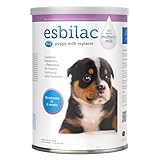
- PUPPY MILK REPLACEMENT — When mom can’t nourish them, Esbilac can. Scientifically the next best to mother’s milk, Esbilac provides all the nutritional elements necessary for puppies, newborn to six weeks old.
- COMPLETE, BALANCED NUTRITION — Our formula is closest to mother's milk in protein, fat, and carbohydrates. We’ve also added vitamins, minerals, and trace nutrients; plus prebiotics and probiotics to support healthy immunity and digestion.
- EASY TO DIGEST — Esbilac is highly palatable and formulated with a special fiber blend for easy digestion and improved gut health.
- EASY-TO-MIX FORMULA — Whisk or shake 1 part powdered Esbilac into 2 parts warm water. Do not mix more Esbilac than can be consumed in 24 hours. Do not use a blender. Must be kept refrigerated after reconstituting.
- ABOUT US — PetAg is a trusted leader in pet wellness, with science-backed formulas in our milk replacers, health supplements, and grooming products helping pet owners to proactively enhance the lives of their pets, for more healthy years together.
How to set up a safe warm area
Use heat that the puppies can escape
Merck describes an overhead heat lamp as an option when it is positioned far enough away to avoid overheating and burns. UC Davis recommends directing a lamp over only part of the whelping area so the mother can move away if she becomes too warm. Apply the same escape-space principle to puppies: heat one zone and leave a cooler zone beside it.
- Keep the heat source outside the puppies’ reach and secure it so it cannot fall into the bedding.
- Check the bedding and the puppies frequently rather than relying on the lamp’s setting alone.
- Leave enough unheated space for a puppy or nursing mother to move away from the radiant heat.
- Keep bedding dry and replace soiled material promptly.
Why heating pads are risky
Merck warns that heating pads can burn neonates because a newborn may be unable to crawl away from a hot surface. A pad can also create a concentrated hot spot beneath a puppy. Do not place a puppy directly on an unattended heating pad. If a veterinarian specifically instructs you to use one, follow that professional’s placement and monitoring directions.
Rewarm a chilled puppy slowly
Wrap or nest the puppy in a dry, warm environment and increase warmth gradually over approximately 30–60 minutes. Avoid sudden, intense heat. Do not attempt tube feeding while the puppy is hypothermic; Merck advises waiting until the puppy is euthermic because reduced gut movement can lead to regurgitation and aspiration.
Contact a veterinarian urgently if the puppy remains cold, weak, or unresponsive, or if you are unsure whether it is warm enough to feed. A heat product is not a substitute for assessment of a compromised neonate.
Decide whether hand-rearing is actually necessary
| Situation | Most appropriate next step | What you still need to monitor |
|---|---|---|
| Mother is temporarily away and otherwise able to nurse | Ask a veterinarian when and how to return the puppies to her. | Warmth, nursing vigor, weight, and the mother’s acceptance of the litter. |
| Mother cannot nurse, or milk is unavailable | Use commercial canine milk replacer under veterinary guidance. | Formula preparation, feeding interval, elimination, weight, and signs of illness. |
| A healthy foster nursing dog may be available | Have a veterinarian advise whether fostering is safe and how to introduce the puppies. | Each puppy’s ability to nurse and daily growth and condition. |
| Puppy is chilled, weak, or unable to suckle | Seek veterinary help before attempting tube or gavage feeding. | Temperature, breathing, responsiveness, and response to treatment. |
Maternal or foster nursing can supply milk and nursing behavior without a scheduled replacer routine, but it is not automatically safe. The mother or foster dog must be healthy, and introductions should be directed by a veterinarian.
What to feed when the mother’s milk is unavailable
Choose a canine milk replacer
VCA Animal Hospitals identifies a commercial canine milk replacer as the preferred substitute for a mother’s milk. Cow’s milk and goat’s milk are inadequate for orphaned puppies, particularly because their protein and fat content does not meet the puppies’ needs. Do not dilute, concentrate, or combine products unless a veterinarian tells you to do so.
Read the replacer’s label before the first feeding. Labels differ in concentration, preparation, storage, and recommended quantity. Your veterinarian may adjust the plan for a puppy’s age, size, health, or weight. There is no safe one-size-fits-all volume to guess from a general internet chart.
Prepare and warm formula correctly
- Wash your hands and use clean feeding equipment.
- Mix the replacer exactly as its label directs.
- Warm the prepared formula to about 100°F (38°C), the temperature VCA describes for feeding, while avoiding overheating.
- Test the formula and confirm that it is warm rather than hot before offering it.
- Discard or store leftovers according to the product label and your veterinarian’s hygiene instructions.
Cold formula, overfeeding, and feeding too quickly can contribute to regurgitation, aspiration, bloating, or diarrhea. If the puppy becomes sick or fails to thrive while using a milk replacer, FDA guidance says to stop the product and contact a veterinarian immediately.
How often to feed a newborn puppy
VCA’s orphaned-puppy guidance recommends frequent meals that become less frequent as puppies mature. Use the replacer label and veterinary directions for the amount at each meal.
Also popular on Amazon

- MILK REPLACER WITH PROBIOTICS: Suitable for up to 9 young animal species including puppies, kittens, calves, lambs, goats, foals, piglets, llamas, and crias; providing probiotics and balanced nutrition to support healthy growth and development.
- MADE WITH PROTEIN AND FAT: Contains 24% protein and 24% fat; supporting fast, healthy growth, strong muscle development, and overall vitality for young animals during critical early stages of life.
- ALL MILK FORMULA WITH PROBIOTICS: Made with high-quality all-milk protein; supporting healthy growth, proper development, and overall performance for young animals during critical early stages of life.
- SUPPORTS HEALTHY DIGESTION FOR YOUNG ANIMALS: Powered by Opti-Gut probiotics; promoting gut health, nutrient absorption, and digestive balance to support overall growth, vitality, and wellbeing for young animals.
- EASY TO MIX FORMULA: Designed for quick and convenient preparation; ensuring fast mixing, effortless feeding, and optimal consumption so young animals receive balanced nutrition efficiently for healthy growth and development.
| Age period | VCA feeding interval | How to use this information |
|---|---|---|
| First week | Every 2–4 hours | Set an overnight schedule as well as a daytime schedule; do not stretch intervals because a puppy sleeps quietly. |
| After the first week until weaning | Every 4–6 hours | Change the interval only as the puppies mature and your veterinarian or the product label directs. |
These intervals are guidance, not a replacement for an examination. A premature, undersized, ill, or poorly thriving puppy may need a different plan. Keep a written log of the time, the amount offered and taken, elimination, weight, and any coughing, regurgitation, diarrhea, or unusual quietness.
Bottle-feed in a position that protects the airway
Set up before bringing the puppy to the bottle
- Use a puppy nursing bottle with a properly sized nipple.
- The nipple should drip with minimal squeezing, according to VCA guidance.
- Milk should not pour freely from the nipple. Excessive flow can cause choking or aspiration.
- Warm the formula before positioning the puppy so the feeding is not interrupted.
Use the natural nursing posture
- Place the puppy horizontally, as it would lie while nursing from its mother.
- Keep the head in a neutral position rather than tipping it backward.
- Let the puppy draw milk from the nipple; do not force formula into the mouth.
- Keep the flow slow and pause if the puppy stops suckling, becomes distressed, or cannot coordinate swallowing.
- After feeding, follow the elimination-stimulation procedure described below.
A puppy that cannot suckle effectively may need tube or gavage feeding, but this requires proper equipment and technique. Ask a veterinarian to demonstrate the method in person. Attempting tube feeding without training can deliver milk into the lungs.
Help very young puppies urinate and defecate
Until approximately three weeks of age, puppies may not eliminate on their own. After each feeding, gently stroke the area between the anus and genital opening with a warm, moistened cotton ball or soft cloth, as VCA advises. Use a gentle motion and stop when the puppy has eliminated. Keep the puppy clean and dry afterward.
Record whether the puppy urinates and defecates. A change in elimination, persistent diarrhea, or a puppy that cannot eliminate should prompt a veterinary call rather than repeated stimulation.
Independent reader supportYour contribution helps us test, update, and keep practical guides available for everyone.Clean bottles and nipples between feedings
Milk residue supports bacterial growth. Clean bottles and nipples after use and follow veterinary hygiene instructions; VCA recommends cleaning and boiling them between uses. Allow equipment to cool before the next feeding, inspect nipples for tears or an enlarged opening, and replace damaged pieces. Prepare formula with clean utensils and keep the feeding area dry.
Free tools Windows power users keep installed
One-click scans. No signup required.
Track weight, vigor, and feeding response
Merck emphasizes daily examination for vigor and recording weight. Use an accurate small scale, weigh at the same time each day, and write the result beside the puppy’s feeding and elimination record. The trend matters more than a single measurement.
- Vigor: note whether the puppy is responsive, moves normally, and settles after feeding.
- Suckling: record whether the puppy latches and swallows without distress.
- Hydration and digestion: watch for repeated regurgitation, bloating, or diarrhea.
- Growth: call your veterinarian if weight stalls, falls, or the puppy fails to thrive.
- Breathing: treat coughing, choking, or breathing difficulty during or after a feeding as urgent.
FDA milk-replacer guidance advises stopping the product and calling a veterinarian immediately if an animal becomes sick or does not thrive as expected while using it.
Troubleshoot common problems
| What you observe | Why it matters | Action |
|---|---|---|
| Puppy feels cold or is unusually limp | Hypothermia can impair digestion and nursing. | Rewarm gradually over about 30–60 minutes and contact a veterinarian urgently. Do not tube-feed until properly warmed. |
| Milk flows freely from the nipple | Fast flow increases choking and aspiration risk. | Stop, replace or correctly size the nipple, and ask a veterinarian to check the setup. |
| Puppy cannot suckle | Weakness or illness may require an alternative feeding method. | Seek veterinary instruction before tube or gavage feeding. |
| Regurgitation, bloating, or diarrhea | Cold formula, overfeeding, or rapid feeding can cause gastrointestinal problems; aspiration is also possible. | Stop the feeding attempt and contact a veterinarian, especially if the puppy is weak or breathing abnormally. |
| Weight does not increase or condition worsens | Failure to thrive can signal inadequate intake or illness. | Arrange veterinary assessment and bring the feeding and weight log. |
When a puppy needs emergency veterinary care
Call a veterinarian urgently for a puppy that is chilled, weak, unresponsive, unable to suckle, repeatedly regurgitating, choking, having breathing difficulty, or failing to thrive. Do not keep changing formula concentrations, feeding volumes, or heat settings while waiting for a seriously ill puppy to improve. Tell the clinic the puppy’s age, weight, temperature assessment if available, last successful feeding, formula used, and any breathing or elimination changes.
A practical care checklist
- Confirm whether the mother can safely return or whether veterinary-approved fostering is possible.
- Create a warm zone and a cooler escape zone; avoid direct, unattended heating-pad contact.
- Rewarm chilled puppies slowly and delay tube feeding until they are properly warm.
- Use only commercial canine milk replacer when maternal or foster milk is unavailable.
- Warm formula to about 100°F (38°C) and follow the label for preparation and quantity.
- Feed horizontally with the head neutral and a slow-dripping nipple.
- Feed every 2–4 hours in the first week and every 4–6 hours thereafter until weaning, unless your veterinarian or the product label specifies otherwise.
- Stimulate urination and defecation after feeds until roughly three weeks of age.
- Clean and boil bottles and nipples between uses as directed.
- Record daily weight, vigor, intake, elimination, and any digestive or breathing problem.
Sources for veterinary guidance
The temperature, rewarming, and neonatal-monitoring recommendations above are from the Merck Veterinary Manual. Feeding position, formula choice, intervals, elimination stimulation, and equipment hygiene are described in VCA Animal Hospitals’ orphaned-puppy guidance. UC Davis provides guidance on positioning radiant heat over only part of a whelping area, and the U.S. Food and Drug Administration provides safety guidance for stopping a milk-replacer product and contacting a veterinarian when an animal becomes sick or fails to thrive. Product labels and an individual veterinarian’s examination take priority when they differ from general guidance.





Leave a Reply