
Free tools Windows power users keep installed
One-click scans. No signup required.
Some links on this page are affiliate links: if you buy through them we may earn a commission, at no extra cost to you.
The safest way to keep a dog calm around crowds, costumes, and loud sounds is to prevent overwhelming exposure, keep the dog below its fear threshold, and pair mild, controllable exposure with a reward the dog genuinely values. Create distance or leave when stress rises; never force a greeting, costume interaction, or continued sound exposure. For severe, new, persistent, or aggressive fear, involve a veterinarian and a qualified behavior professional.
What “calm” means and why the threshold matters
A calm dog can notice a trigger and still eat, move normally, respond to a familiar cue, and recover quickly. A dog over its fear threshold is no longer learning effectively; it is trying to make the frightening situation stop. The same dog may cope with a distant parade but panic when people move close, or tolerate a quiet recording but react to a sudden real noise.
As an Amazon Associate I earn from qualifying purchases.
Do these 3 things before closing this tab:
1Scan for outdated or missing drivers - takes under a minute2Repair Windows errors before they cause bigger problems3Fix the driver behind crashes, sound loss and screen glitchesCrowds, unfamiliar people, uniforms, hats, masks, costumes, unexpected touching, unfamiliar dogs, fireworks, thunder, alarms, and household bangs can all be triggers. A trigger is not automatically a training opportunity. If an event is likely to overwhelm your dog, management—avoiding it—is the correct choice, not a failure.
ASPCA guidance advises leaving a dog at home when it becomes stressed or panicked in crowds. That immediate decision protects the dog and the people around it while you build skills in controlled settings. ASPCA’s dog-bite-prevention guidance also emphasizes avoiding situations in which a dog is fearful or uncomfortable.
Popular on Amazon

- Lots of flavor, not fillers: Just three simple, all-natural ingredients mean low calories and high nutritional value, making a tasty but healthy treat that your pup will actually love
- Ready for training, wherever you are: The best training is consistent training. Our small treats are lightweight and perfectly sized for quick rewards so they are ready to go whenever there is a training opportunity
- Mess free treats: No oily, greasy, crumbly messes here, Pupford treats keep your hands and pouches clean. You can even keep some in your pocket for walks, classes, or mini adventures without worrying about them getting grimy or stale
- Motivate even the pickiest of pups: A wide range of flavors makes it easy to find the perfect fit for your pup’s tastes
- Pupford Promise: We strive to always provide simple, high-quality, healthy pup essentials. If you or your pup aren't happy with a purchase, let us know so we can help find the right fit!
Recognize the early signs of stress
Dogs often signal discomfort before barking, lunging, snapping, or trying to flee. Intervene at the first signs rather than waiting for a dramatic reaction.
| Possible sign | What it can mean | What to do immediately |
|---|---|---|
| Yawning or repeated lip licking | Stress or conflict, especially when unrelated to sleep or food | Increase distance, slow the situation, or end the session |
| Looking away, turning the head, or avoiding eye contact | The dog is trying to reduce social pressure | Stop the approach; give the dog an escape route |
| Raising a front paw | Uncertainty or anxiety | Pause and lower the trigger’s intensity |
| Refusing a normally desirable treat | The dog may be too frightened to eat | Do not force food; retreat until the dog can relax |
| Freezing, crouching, trembling, hiding, frantic pulling, barking, or lunging | The dog is over threshold | Leave or create substantial distance; do not continue the exercise |
These signs are described in VCA’s introduction to desensitization and counterconditioning and VCA’s guidance on fears and phobias involving animals and people. A frightened dog should not be treated as disobedient or asked to perform a new skill simply because a cue worked at home.
Decide whether your dog should attend an event
Leave the dog at home when the setting is unpredictable
Busy festivals, parades, parties, trick-or-treating, sporting events, and crowded sidewalks combine multiple challenges: dense foot traffic, sudden movement, noise, unfamiliar dogs, costumes, and people reaching to touch the dog. If your dog already panics in crowds, has tried to escape, or cannot take food at a generous distance, staying home is the safest immediate plan.
Arrange a quiet room, a trusted sitter, or another familiar care option. Do not rely on an event to “socialize” a fearful dog. Social exposure helps only when the dog can remain comfortable and has a choice about moving away.
Use a controlled plan for a dog that can cope at low intensity
A dog that remains relaxed around a few people may be able to practice near, but not inside, a busy setting. Choose an exit route and a low-traffic location. Work at a distance where the dog can notice the activity without staring, pulling, freezing, or refusing food. Keep the first visit brief and leave while the dog is still successful.
Also popular on Amazon

- ALL NATURAL INGREDIENTS: Real beef is the first ingredient in our bite-sized training treats. Jinx beef & banana tiny treats are low calorie for repeated rewarding. Made with all-natural ingredients you can trust, carefully selected to provide a wholesome and delicious snacking experience.
- SLOW SMOKED TREATS FOR DOGS: Jinx healthy dog treats are slow-smoked for 14+ hours, infusing each bite with an irresistible smoky flavor and soft and chewy texture dogs love. Use as a high value reward during training to teach new tricks and reinforce desired behaviors.
- LOW CALORIE DOG SNACKS: Each Jinx training treat is under two calories, so you can repeatedly reward good behavior while helping your dog maintain a healthy weight.
- REAL BANANA: Real fruit adds adds a touch of sweetness and fiber for healthy digestion. Beef liver added for a savory, craveable flavor
- NO FILLERS: All of the good, none of the bad. Jinx recipes never use corn, wheat, soy, or artificial preservatives.
Use a secure, well-fitted body harness and leash. Equipment helps you maintain safe control; it does not make an unsafe exposure appropriate. Avoid retractable leashes in crowded areas because they reduce precise distance control.
Recommended Free Tools
Ask people not to approach
Tell passersby that the dog is training and should not be petted. Prevent hands over the dog’s head, hugging, leaning over, direct staring, and surprise contact. The dog should be able to stand behind you, move away, or leave without being cornered. Never allow a child to approach a fearful dog without close adult control.
How desensitization and counterconditioning work
Desensitization presents a trigger at an intensity low enough that the dog does not show fear, then increases difficulty gradually. Counterconditioning changes the dog’s emotional association by pairing that mild trigger with something valuable, usually food or a toy. The two methods are commonly used together.
VCA explains the process in Overcoming Fears with Desensitization and Counterconditioning. The essential rule is simple: the trigger appears at a manageable level, the reward follows, and the level changes only while the dog remains comfortable.
Build a one-trigger training plan
- Define the trigger precisely. “Crowds” may actually mean fast-moving feet, strange dogs, people in hats, or being touched. “Costumes” may mean a mask, a cape, a person walking stiffly, or an unexpected sound. For noise fear, identify the sound and whether volume, unpredictability, vibration, or a particular location is the problem.
- Choose a reward. Use high-value dog training treats or a toy that this individual dog eagerly accepts. Test the reward in a calm room first. If the dog will not eat when the trigger appears, the exposure is too intense; do not push food into the dog’s mouth.
- Start below threshold. Present one controllable feature at a very low intensity: a person far away, a stationary hat on a chair, a quiet recording, or a still costume viewed through a doorway. The dog should be able to look away, eat, and move normally.
- Pair, then pause. Show or play the trigger briefly, deliver the reward, and remove or lower the trigger. Several easy repetitions are more useful than one prolonged exposure.
- Change one difficulty dimension. Increase only one of distance, sound volume, movement speed, duration, visual complexity, or number of people at a time. Keep the other dimensions stable so you know what the dog can handle.
- Watch recovery. After each repetition, the dog should return to normal breathing and body language promptly. If stress accumulates, stop for the day rather than trying to finish a preset number of repetitions.
- Progress in small increments. Move closer, raise volume, add motion, or introduce another visual element only after repeated relaxed sessions at the current level. There is no universal timetable; the dog’s behavior determines the pace.
- Record what happened. Note the trigger level, distance, reward, body language, and recovery time. A simple log prevents accidental jumps in difficulty and shows when professional guidance is warranted.
VCA cautions that flooding—keeping a frightened animal in an intense situation until it stops reacting—can worsen fear. If the dog reacts, retreat, lower intensity, or end the session. Do not “push through.”
Also popular on Amazon

- REAL BEEF FIRST: BLUE Bits dog training treats are made with delicious real beef as the first ingredient making them an ideal reward for your best friend’s best behavior
- SOFT TRAINING TREATS: For dogs that love a soft treat, BLUE Bits are tender, bite-sized morsels that are the perfect size for training; plus, with DHA to help support cognitive development, they’re an ideal puppy treat
- WHOLESOME INGREDIENTS: These dog treats don’t contain any chicken (or poultry) by-product meals and are free from corn, wheat, and soy; plus, they’re free from artificial preservatives like Propylene Glycol and colors like Red Dye 40
- HEALTHY DOG TREATS: Blue Buffalo natural dog treats feature the healthy, wholesome ingredients you’ll love feeding as much as they’ll love eating
- Contains: One (1) 11-oz bag of BLUE Bits Natural Soft-Moist Training Dog Treats, Beef Recipe
Training around crowds and unfamiliar people
Begin with distance and predictable movement
Start in a quiet place where one person can stand still at a distance. When the dog notices the person and remains relaxed, feed several small rewards. Have the person turn sideways, look away, or take one slow step only if the dog continues to eat and move comfortably. Increase proximity in tiny increments across separate sessions, not all at once.
Next, practice with one person walking slowly, then with two people, then near a lightly used path. Keep the dog outside the flow of pedestrians. A parked car, hedge, or other visual barrier can make the scene easier, but do not trap the dog between barriers and approaching people.
Do not require greetings
Your dog does not need to greet every person or dog. A successful session may consist of calmly watching people pass and then leaving. If a stranger wants to help, ask the person to ignore the dog and toss a treat from a distance rather than reaching toward it. Stop if the dog hides, stiffens, looks away repeatedly, or refuses food.
Plan for an emergency exit
Before entering any busier area, identify a quiet side street, vehicle, building lobby, or other retreat. Keep the leash short enough for control without holding it tight throughout the walk. If a crowd suddenly compresses around you, turn away, create distance, and leave rather than attempting an on-the-spot training exercise.
Introducing costumes, hats, masks, and uniforms
Unusual clothing can alter a familiar person’s outline, face, smell, movement, and voice. A dog may tolerate a person in ordinary clothes yet react to a hood, mask, reflective uniform, sunglasses, or a large coat. Treat each feature as a separate training component.
Also popular on Amazon
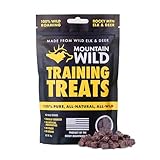
- Wild-Sourced Protein: Our treats are made from all-wild roaming elk and deer protein, sustainably harvested from the Rocky Mountains, offering your dog a unique and premium nutritional experience Wild-Sourced Protein: Our treats are made from all-wild roaming elk and deer protein, sustainably harvested from the Rocky Mountains, offering your dog a unique and premium nutritional experience
- Ideal for Training: With a wild protein source that dogs instinctively crave, these training treats are recognized as an extremely high-value reward, boosting your dog’s attention, focus and motivation
- Pure & Natural: Embrace the wilderness with dog training treats that are all-natural and all-wild, meeting your dog's ancestral dietary needs and cravings for a healthy and active lifestyle
- Eco-Conscious Choice: With every purchase, you support the full utilization of precious wildlife resources along with wildlife conservation and anti-poaching efforts to help maintain strong wildlife populations
- Clean Recipe: Free from nasty fillers, artificial preservatives, and grains, our treats ensure your dog enjoys the healthiest reward. Perfect for dogs of all sizes and puppies too
Use a gradual visual sequence
- Place the costume or hat on the floor while it is not being worn. Reward the dog for calmly looking at it from a distance.
- Move it to a chair or hang it where the dog can see it without being approached.
- Have a familiar person hold one item while standing still, keeping the face visible and the distance generous.
- Add one feature at a time: hat, coat, mask, hood, or unusual prop. Keep the person’s movement and voice ordinary.
- When the dog is relaxed, add slow movement, then normal walking. Delay waving, sudden gestures, loud voices, or touching until easier steps are consistently comfortable.
Never let a costumed person chase, corner, loom over, or surprise the dog. If the dog reacts, remove the item or increase distance immediately. A stationary costume viewed briefly may be an appropriate starting point; a moving, noisy, masked stranger at close range is a much harder exercise.
Independent reader supportYour contribution helps us test, update, and keep practical guides available for everyone.Managing loud sounds at home
Reduce exposure first
Close windows and curtains, move the dog to an interior room, and avoid scheduling unnecessary noise when you know a trigger is likely. Give the dog access to a familiar bed, crate, or hiding place if it already uses that space willingly. Do not force the dog out of a safe area or confine it in a crate if the crate increases panic.
Use sound masking as an optional aid
White noise, a fan, or steady background audio may muffle outside sounds. Masking can make the environment easier, but it is not a cure and should not be used to justify playing frightening sounds loudly. Keep the volume at a level that does not itself worry the dog.
Quick wins for a faster PC:
Fix the driver behind crashes, sound loss and screen glitchesFind Drivers →Repair Windows errors before they cause bigger problemsFix Now →Scan for outdated or missing drivers - takes under a minuteDriver Scan →Practice with recordings only when the dog is comfortable
For a controllable sound, use a recording at barely audible volume while the dog is relaxed. Pair the sound with food or play, then stop. Raise volume gradually over multiple successful sessions. Real sounds may differ in pitch, vibration, timing, and intensity, so recording practice does not guarantee that a dog will tolerate the live event.
Observe how quickly the dog recovers after a noise. Persistent panting, trembling, pacing, escape attempts, inability to settle, or refusal of food indicates that the exposure is too strong. VCA’s guidance on noise fear recommends reducing exposure where possible and seeking veterinary assessment for severe cases.
Also popular on Amazon

- ALL NATURAL: Single ingredient dog treat with no preservatives or artificial flavors. These beef dog treats are not only healthy dog treats but also grain free dog treats.
- NUTRITIONAL: Our high-protein, low-calorie beef lung dog treats make them lean treats & a great alternative to beef liver dog treats & lamb lung dog treats.
- RESPONSIBLY SOURCED: From locally grass fed free range cattle born and raised in the USA - no questionable sourcing means they make high value dog training treats.
- PREVENTS PLAQUE & TARTAR BUILDUP: Our natural dog chews clean your puppies teeth, making them functional dog treats for large dogs and puppies alike.
- MISSION: To make treating your K9 healthier
What to do when a session goes wrong
If the dog suddenly reacts
- Stop presenting the trigger.
- Turn and move to a quieter location or increase distance until the dog can orient to you and breathe normally.
- Do not demand a sit, eye contact, greeting, or treat.
- Once calm, end the session or switch to an easy, familiar activity.
- Review which variable changed—distance, volume, motion, duration, visual complexity, or surprise—and make the next attempt easier.
Refusing food is useful information, not stubbornness. Fear can suppress appetite, and forcing food can add pressure. Wait until the dog can willingly eat again.
If progress stalls
Common causes include starting too close, increasing two difficulty dimensions at once, practicing for too long, overlooking a secondary trigger, or exposing the dog between sessions to intense real-life events. Return to the last level at which the dog was relaxed, shorten sessions, and make the trigger more predictable. If the dog remains highly distressed or cannot stay below threshold even at a large distance, stop owner-led exposure and consult a qualified professional.
What’s actually slowing this PC down?
Pick the symptom - the matching free tool is one click away.
If fear gets worse after exposure
Do not repeat the same setup hoping the dog will “get used to it.” Poorly controlled exposure can strengthen the fear association. Use management to prevent further rehearsal and arrange professional help.
When to contact a veterinarian or behavior professional
Arrange veterinary advice for severe fear, fear that persists despite careful management, a sudden change in behavior, or new noise fear in a senior dog. Medical problems can contribute to behavior changes, and a veterinarian can assess the dog and discuss an individualized plan. Medication may be appropriate for some dogs, but only a veterinarian should determine whether it is suitable, how it should be used, and how it fits with behavior modification. VCA’s noise-fear resource outlines this veterinary role.
Seek a qualified behavior professional when the dog has bitten, attempted to bite, lunged aggressively, shows severe panic, cannot recover after a trigger, or makes no progress with carefully controlled low-intensity work. Aggression warrants help even when nobody was injured. VCA’s discussion of fears and phobias and its guidance on reducing veterinary-visit fear support early professional involvement for strong reactions.
Ask the professional how they will control trigger intensity, measure the dog’s threshold and recovery, use reward-based methods, and keep people safe. A plan should include management for unavoidable events as well as gradual training.
Quick Recap
A practical checklist for the next event
- Decide honestly whether the dog should attend; panic in crowds means staying home.
- Bring high-value treats, water, a secure harness, and a leash that allows precise distance control.
- Choose an observation point with room to retreat.
- Tell people not to approach, stare, touch, or offer food without permission.
- Start farther away than you think necessary.
- Reward relaxed noticing, not prolonged staring or forced interaction.
- Change one variable at a time and keep sessions short.
- Leave at the first reliable signs of stress.
- At home, reduce frightening sound exposure and use a fan or white noise only as optional masking.
- Contact a veterinarian or qualified behavior professional for severe, new, persistent, or aggressive fear.





Leave a Reply