
PC Slower Than It Used to Be?
A free scan shows the junk files, broken settings and background clutter dragging Windows down - then fixes them in one click.Free scan · Windows 10 & 11Crashes, No Sound, or Screen Glitches?
Random freezes, missing sound and display glitches usually trace back to one bad driver. Find and replace yours safely.Free scan · under a minuteSome links on this page are affiliate links: if you buy through them we may earn a commission, at no extra cost to you.
The safest way to make grooming easier is to stop treating it as a task to complete and teach it as a series of voluntary, reward-paired choices. Begin when your dog is relaxed, expose them to one tiny part of the process at a time, increase difficulty only while they remain comfortable, and pause as soon as stress appears. A sudden or localized fear can indicate pain, and grooming that cannot be done safely at home calls for veterinary or qualified low-stress professional help.
Why a dog may resist grooming
Brushing, nail trimming, ear cleaning, bathing, drying and clipping all involve restraint, unfamiliar sounds, sensitive body areas or a loss of control. A dog may dislike one part of grooming rather than the entire routine: a brush on the back may be fine while touching a paw is not, or the clippers may be the trigger rather than the haircut itself.
As an Amazon Associate I earn from qualifying purchases.
What’s actually slowing this PC down?
Pick the symptom - the matching free tool is one click away.
The goal is not to make a frightened dog endure a complete groom. It is to change the dog’s emotional response and give them a reliable way to opt out. Cornell’s cooperative-care guidance describes this as teaching a dog to participate voluntarily through gradual exposure at the dog’s pace, with choice, predictability and rewards at the center: Cornell Riney Canine Health Center, “Grooming – Cooperative Care – February 2026”.
Desensitization means presenting a trigger at an intensity low enough that the dog does not become fearful, then increasing the challenge gradually. Counterconditioning pairs that formerly unpleasant trigger with something the dog values, commonly food. VCA identifies grooming, brushing and nail trimming as handling-related fear triggers for which this approach can be used: VCA, “Overcoming Fears with Desensitization and Counterconditioning”.
Popular on Amazon

- DUAL-SIDED DESIGN: Our Undercoat Rake Dog brush is perfect for deshedding your pet's coat. Designed with a dual-sided design, start with a 9-teeth side to tackle stubborn mats and tangles, and finish with a 17-teeth side to thin out and deshed after.
- HEALTHY COAT AND REDUCED SHEDDING: Our deshedding brush for dogs is designed with sharpened but finely rounded teeth that allow you to easily and safely remove mats, tangles, knots, and loose hair without irritation or scratching.
- EFFECTIVE DESHEDDING TOOL: This dematting and deshedding brush gently removes loose hair and eliminates tangles, knots, dander, and trapped dirt. The perfect cat grooming tool solution for pets with thick fur or dense double coats.
- COMFORTABLE TO USE: Keep your pet clean and healthy with our dog and cat brush for grooming. Designed with a lightweight, comfortable handle and a non-slip rubber base to keep the brush from moving around as you brush your pet.
- PERFECT GIFT FOR PET LOVERS: Our dog comb brush is a must-have grooming products for dogs and cats. A great gift undercoat rake dog for pet lovers who want to keep their fur buddies clean, healthy, and well-groomed!
Check for pain before you train
If a dog that previously tolerated grooming suddenly objects, or reacts only when one body area is touched, arrange a veterinary examination before assuming the problem is behavioral. Skin irritation, an ear problem, a sore joint, a painful nail or another medical issue can make handling genuinely uncomfortable. Pain or anticipation of pain can also increase the likelihood of defensive aggression during handling, according to a peer-reviewed review of fear and aggression in veterinary settings: “A Review on Mitigating Fear and Aggression in Dogs and Cats in a Veterinary Setting.”
Until discomfort is assessed, avoid repeatedly testing the painful-looking area. Tell the veterinarian exactly when the reaction occurs, whether it is new, and what the dog does immediately before and after the touch. Do not give human pain medicine unless a veterinarian specifically prescribes a product and dose.
The Tool Desk
Outbyte PC Repair FREEClear out junk files and repair common Windows errorsFree Scan →Outbyte Driver Updater FREEScan for outdated or missing drivers - takes under a minuteDriver Scan →Learn the signs that mean “pause”
Do not wait for a growl, snap or bite. Stress often appears in quieter forms first. During handling, watch for:
| Signal | What it can mean | Immediate response |
|---|---|---|
| Lip licking or repeated yawning when the dog is not tired | Rising unease | Stop the movement, offer space and lower the next challenge. |
| Freezing or becoming unusually still | The dog may be overwhelmed rather than relaxed | Remove the tool or hand and allow the dog to move away. |
| Pulling away, turning the head or avoiding the hand | The current touch is too difficult | Return to a less intrusive touch, or end the session. |
| Showing the whites of the eyes | Fear or conflict about the interaction | Pause immediately and give a break. |
| Walking away | A clear choice not to continue | Do not follow, corner or restrain the dog; make the next session easier. |
These signs are described in Cornell’s cooperative-care material and its guidance on less stressful veterinary visits: Cornell grooming guidance and Cornell, “How to make veterinary visits less stressful for dogs.” A dog who walks away is communicating useful information, not being stubborn.
Prepare a low-pressure grooming environment
- Choose a calm starting time. Begin when your dog is already relaxed, not immediately after an exciting event or when they are desperate to escape for exercise.
- Use a stable, non-slip surface. A secure mat can make standing easier and more predictable. Never leave a dog unattended on a table, in a bath or near running equipment.
- Put tools within view but not in the dog’s face. Let the dog notice a brush, comb, nail tool, towel or clipper from a comfortable distance.
- Have rewards ready. Use small pieces of a food the dog genuinely values and that fit their diet. Deliver rewards frequently for calm looking, sniffing, standing near the setup or allowing a brief touch.
- Remove escape pressure. Close doors or gates only to prevent dangerous wandering, not to trap a frightened dog for grooming. Keep the dog’s retreat route clear whenever possible.
- Separate training from urgent grooming. If mats, overgrown nails or a medical coat problem require prompt attention, seek professional help rather than turning a training session into a wrestling match.
Letting a dog investigate grooming equipment and the bathing area at their own pace before using it is part of Cornell’s recommended cooperative-care setup. A brush is a tool category, not a universal solution: coat type, skin condition and the dog’s comfort determine whether a particular brush is appropriate.
Also popular on Amazon

- SAVE MONEY: Reduce expensive trips to the groomer. Our dog shedding brush works great as a dog brush for short haired dogs & dog brush for long haired dogs. It is an absolute essential for pet supplies, dog supplies, and a dog grooming kit.
- ALL HAIR & FUR TYPES: Our dog brushes for grooming safely removes loose hair without irritation. SleekEZ dog hair brush works great as a pet hair remover / dog hair remover for pets of all fur types and hair lengths.
- EASY AND FAST CLEANUP: SleekEZ also works great as a carpet rake, pet hair rake, & dog fur remover tool. It removes hair & fur from couches, cars, blankets, beds & more! Its innovative design ensures that hair is easily gathered and removed.
- PAINLESS AND ENJOYABLE: SleekEZ's patented design helps grab at the tips of the hair to extract from the skin without painful tugging. It is the perfect undercoat brush for dogs and deshedding dog brush. Works on all coat types and animal breeds!
- GREAT GIFT: A must have metal dog comb for any pet grooming kit. The perfect pet grooming metal comb for dogs & dog deshedding brush. Worlds best grooming brushes / dog grooming brush. Voted #1 dog brushes for shedding & deshedder brush for dogs.
Build cooperation in tiny steps
Think of each session as practice for one behavior, not a full grooming appointment. The following sequence is a template; move backward whenever the dog shows stress.
- Start with a consent check. Stand or sit near the dog and present your hand without reaching over them. If the dog stays loose or approaches, place your hand nearby. If they turn away or leave, stop.
- Reward orientation. Mark calm attention to your hand or tool with a food reward. You are teaching that the appearance of grooming equipment predicts good things.
- Add a brief touch. Touch an easy area, such as the shoulder, for an instant, then remove your hand and reward. Do not immediately repeat if the dog is moving away.
- Increase one variable at a time. Change only the body location, pressure, duration, movement or tool—not all of them together. For example, progress from a still hand on the shoulder to a single brush stroke, then stop.
- Give the dog an exit. After each repetition, allow the dog to move. If they return, that is information that the previous step was manageable; it is not permission to jump several levels harder.
- End while the dog is succeeding. Finish after a calm repetition and provide a final reward. Short, predictable sessions are easier to repeat than a long session that ends in a struggle.
Cornell summarizes the target this way: “With both cooperative care and counterconditioning, the goal is to start well below your dog’s stress threshold.” Read the full explanation at Cornell’s cooperative-care article.
Pair each grooming trigger with a valued reward
Counterconditioning works only when the dog can still eat, think and choose. Present the low-level trigger, deliver the favored reward, and remove or reduce the trigger before fear builds. If the dog refuses food, freezes, retreats or shows other stress signals, the exposure was too intense; make the next attempt easier rather than offering more food and continuing.
Examples of lower-intensity starting points include:
- Place the brush on the floor several feet away; reward looking at it, then remove it.
- Hold nail clippers still at a distance; reward calm observation before moving them closer.
- Turn clippers on in another room for a moment; reward only if the sound does not change the dog’s body language.
- Touch the outside of an ear briefly without inserting anything; reward and stop.
- Stand beside the bathtub without lifting the dog into it; reward investigation and leave.
These are examples of controlling intensity, not a timetable. Some dogs will need many repetitions at one level; others will progress quickly in one area and slowly in another. Increasing the challenge while the dog is already frightened can sensitize them and create a setback, so progress is measured by relaxed choices, not by how much grooming was completed.
Free tools Windows power users keep installed
One-click scans. No signup required.
Also popular on Amazon

- 【Easy Desheding】: Swihauk self cleaning dog brush for long haired dogs with release bottom helps effortlessly reduce shedding. A must have dog brush for short haired dogs, cat brush for indoor cats, cat brush for shedding, slicker brush for dogs.
- 【Safe Design】: Soft and protective plastic round head bristles creating a comfortable feeling while deshedding without hurting your pet. Ideal puppy brush for small dogs, dog brush for shedding and grooming.
- 【Sturdy & Durable】: Premium stainless steel metal and compact design make our product sturdy and durable for long term use.
- 【Ergonomic Design】: Press bottom for easy cleaning, high-quality & lightweight TPR handle make your grooming effortlessly.
- 【Effective to Remove Loose Fur】: Swihauk pet grooming brush is effective to remove loose fur, suitable for dogs, cat with long and short hair, perfect for your lovely pet like puppies, golden retriever, rabbit, kitten, bunny, yokie and more.
Apply the plan to common grooming tasks
Brushing and combing
- Let the dog sniff the brush while it remains still. Reward investigation, then put the brush away.
- Hold the brush near the body without touching. Reward a loose posture.
- Touch the coat with the back or side of the brush for one brief contact, reward and remove it.
- Try one gentle stroke in a tolerated area, avoiding tangles and sensitive spots.
- Build strokes gradually and stop before the dog begins to avoid the brush.
Do not pull through a mat. Painful brushing can teach the dog that the tool predicts discomfort. Have a groomer or veterinarian assess severe matting, skin changes or a coat that cannot be safely managed with the equipment you have.
Paws and nail care
Begin with a hand resting near the shoulder or leg, then progress toward the paw only while the dog remains comfortable. A practical ladder is: touch the upper leg, slide to the lower leg, briefly touch the paw, hold one toe, show the nail tool, touch the tool to a nail, and finally make one small trim. Reward every successful step and stop after a single manageable repetition. Never restrain a struggling dog to finish a nail.
Ears
Handle the outer ear first. Reward looking at your hand, a brief touch to the ear flap and a gentle lift only if the dog remains relaxed. Do not insert cotton swabs or cleaning equipment into the ear canal. If the ear is painful, has discharge, smells abnormal or the dog reacts strongly to one side, ask a veterinarian to examine it before training continues.
Bathing and drying
Teach the bathroom as a neutral place before adding water. Reward approaching the tub, standing on a dry non-slip mat and hearing water run at a distance. Add water in tiny increments only when the dog’s body remains loose. Keep the water temperature comfortable, prevent slipping and avoid spraying the face. Drying can be trained separately: show the towel, touch the coat, then introduce the dryer sound far away and increase proximity only when the dog remains calm. A dog who panics at the dryer may need towel drying or a professional plan rather than forced exposure.
Quick wins for a faster PC:
Repair Windows errors before they cause bigger problemsFix Now →Fix the driver behind crashes, sound loss and screen glitchesFind Drivers →Clippers and scissors
Clippers combine vibration, noise and close contact, so separate those elements. Reward the sight of the tool, then its sound at a distance, then the sound closer to the body, and only later a brief touch with the tool switched off. Scissors should remain closed while you train calm positioning; never wave sharp tools near a moving or frightened dog. For a dog who cannot remain comfortable around these tools, arrange a qualified groomer and discuss veterinary support.
Also popular on Amazon

- 【Professional Pet Grooming Kit 】3 Pet grooming tools selected by pet lovers, which can meet daily all the grooming needs of pets. Let you, as the groomer, personally give your furry friend a shiny and healthy coat. This is a must-have beauty product set for pet lovers! The Best Dog Gifts - Merry Christmas
- 【Why Choose Augwind 3PCS ?】 Augwind Pet Grooming Rake makes it easy to remove stubborn, tangled hair. Augwind Self-Cleaning Slicker Brush quickly removes loose hair, dander, and residual dirt. Augwind Flea Comb effectively remove small objects and Dandruff Flakes. Our 3-in-1 Pet Grooming Kit handles all your needs: detangling, hair removal and removes fleas and ticks – The Ultimate Pet Essentials
- 【Dematting and Deshedding Tools】 Augwind Pet Grooming Rake features a double-sided design: The 9-tooth bristle side detangles stubborn knots and mats. The 17-tooth bristle side trims excess pet hair. Augwind self-cleaning dog brush includes a push-button retractable mechanism – simply retract the bristles after use to remove loose hair quickly and effortlessly
- 【Flea Comb】Use this fine-toothed lice comb regularly to effectively remove small debris and dandruff, help keep away fleas and ticks, and maintain your pet’s coat tidy and healthy
- 【2-Year Warranty】We are a professional pet products company, committed to bringing the safest, practical and affordable pet products to pets and owners. We promise to solve it for you at any time if there is any quality within 2 years. We provide 7*24 hours after-sales service, if you have any questions, please feel free to contact us
Know when to lower the criteria
A successful repetition is one in which the dog can notice the trigger and remain able to choose, eat and move normally. Lower the difficulty if you see lip licking, yawning, freezing, eye-whites, pulling away or an attempt to leave. You can lower difficulty by increasing distance, reducing contact time, choosing a less sensitive body area, turning a tool off, reducing sound or returning to a familiar step.
Do not push past the comfort threshold to complete a grooming task. Cornell warns that doing so can make the next session harder or cause setbacks. The American Animal Hospital Association likewise emphasizes low-stress handling and planning for a pet’s signals during veterinary care: AAHA, “How can my pet have stress-free veterinary visits?”
Independent reader supportYour contribution helps us test, update, and keep practical guides available for everyone.What to do when grooming is urgent
Training is not a substitute for necessary medical or welfare care. Seek prompt professional help when nails are affecting walking, a coat is tightly matted, a wound or skin condition needs treatment, or hygiene cannot be maintained without restraint. Explain the dog’s triggers in advance and ask the provider to use a pause-based, humane plan.
Cornell suggests considering a Fear Free certified groomer when grooming exceeds what can be done comfortably at home. A veterinarian, veterinary behaviorist or qualified trainer who uses humane methods can design a cooperative-care plan. When comparing providers, ask:
- How do you recognize and respond to early stress signals?
- Will you stop or change the plan if the dog tries to leave?
- What experience do you have with cooperative care and fearful dogs?
- Should a veterinarian assess pain or prescribe a pre-appointment plan first?
- How will you prevent slipping, overheating, escape or injury during the appointment?
Verify credentials, local availability and the provider’s handling policy yourself. “Low stress” should mean the provider is willing to adjust, pause and avoid forcing a frightened dog, not simply that the appointment is advertised with reassuring language.
Also popular on Amazon
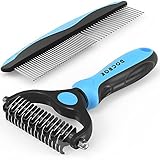
- 【Easy Dematting and Deshedding Tools】: Our Grooming brush and comb combo help effortlessly dematting and reduces shedding. A must have dog brush for shedding, pet supplies, cat supplies, dog supplies metal comb for dogs shedding.
- 【Safe Design】: Soft and protective edge brush and comb creating a comfortable feeling while detangling matted hair and deshedding without hurting your pet. Perfect metal comb for dogs, dematting comb for cats, undercoat rake for dogs double coat.
- 【2-in-1 Rake】: Our undercoat rake is perfect for medium and long-haired dogs and cats and other double coat pets. Wide side for easy dematting, dense side for deshedding. Well made deshedding tool, grooming brush and deshedder brush for dogs.
- 【2-in-1 Comb】: Wide sided for comb knot, smoothing and modeling your pet's hair, dense side for removal of loosen hair, you can use it on the legs, head or tail of your pets where the brush can’t. Perfect metal comb for dogs, dematting comb for cats deshedding tool for dogs.
- 【Sturdy and Comfortable Design】: Premium Stainless steel metal teeth and compact design make our product sturdy and durable. High-quality & lightweight TPR handle make your grooming effortlessly. High-quality undercoat rake for dogs double coat, metal comb for dogs, dematting comb for cats, dog comb for matted hair.
Basket-muzzle conditioning is a separate safety skill
A properly introduced basket muzzle can reduce bite risk during veterinary or grooming care, but it does not make forced handling acceptable. Cornell’s veterinary-visit guidance recommends conditioning a muzzle gradually: allow the dog to investigate it, reward placing the nose near or inside it, build wearing time in small increments and keep the experience positive. Read the safety guidance at Cornell’s veterinary-visit article.
Use a basket design that permits panting, drinking and treats when fitted correctly, and obtain professional fitting advice. Never put a muzzle on an unconditioned, panicking dog and then proceed with a difficult groom. A muzzle is a backup safety measure, not a way to override communication or conceal a bite-risk problem.
Recommended Free Tools
Troubleshoot common setbacks
| Problem | Likely training error | Adjustment |
|---|---|---|
| The dog takes treats but keeps backing away. | The trigger is still too intense, even if food is accepted. | Increase distance, shorten contact or return to tool-only exposure. |
| The dog was fine until the brush touched the coat. | Seeing the tool and feeling a stroke were treated as the same step. | Repeat stationary brush presentation, then add one light contact. |
| The dog tolerates one paw but not the other. | The second paw may be painful or simply less familiar. | Train each side separately and arrange a veterinary check if the difference is sudden or pronounced. |
| Progress disappears after one difficult appointment. | The dog was pushed beyond threshold. | Pause full grooming when possible and rebuild from an easier, well-rewarded step. |
| The dog growls when approached with tools. | The warning is being ignored or the dog expects restraint. | Stop the approach, create distance and seek qualified behavior and veterinary help before trying again. |
| A groom cannot be completed without a struggle. | The task exceeds current skill, equipment or safety limits. | Use a humane professional plan; do not escalate physical force at home. |
When to involve a veterinarian or behavior professional
Arrange professional assessment for a new fear, a reaction focused on one body part, signs of pain, repeated snapping or biting, panic that does not improve when the trigger is made easier, or any situation in which a person or dog could be injured. A veterinarian can look for medical causes and discuss whether medication or a referral is appropriate. A veterinary behaviorist or qualified reward-based trainer can break the grooming routine into safer steps and coach your timing.
For broader context on desensitization and counterconditioning, see VCA Canada, “Introduction to Desensitization and Counterconditioning.” The central rule remains the same: exposure must stay low enough that the dog can cope, and rewards must be paired with the trigger before fear takes over.
A practical decision rule for every session
- Relaxed and choosing to engage: repeat the same step or make one small change.
- Unsure but still loose and able to eat: reduce duration or distance and reward, rather than advancing.
- Stress signals, freezing or retreat: stop, allow an exit and make the next session easier.
- Growling, snapping, panic or suspected pain: end home handling and contact a veterinarian or qualified professional.
Repeated, voluntary practice changes grooming from an unpredictable restraint event into a sequence the dog can understand. The measure of success is not finishing every nail or removing every tangle in one sitting; it is preserving safety, trust and the dog’s ability to participate next time.





Leave a Reply