The Tool Desk
Outbyte Driver Updater FREEScan for outdated or missing drivers - takes under a minuteDriver Scan →Outbyte PC Repair FREERepair Windows errors before they cause bigger problemsFix Now →Set up a saltwater aquarium by choosing its location and livestock plan, preparing purified saltwater, installing filtration and circulation, then cycling the tank without fish. Add animals only after tests show zero ammonia and nitrite. The steps below help you build a suitable system before buying livestock—and make water tests, rather than a calendar estimate, the signal to move forward.
What should you decide before setting up a saltwater aquarium?
Start by choosing between a fish-only marine aquarium and a reef aquarium. The animals you plan to keep determine important equipment needs, including lighting and water movement. Also consider the available space, setup budget, and how much time you can devote to maintenance; the sources cited here do not establish a dependable current cost comparison.
Choose a strong, level support near power and a convenient place to perform maintenance. Avoid direct sunlight and heating or air-conditioning vents, which can destabilize aquarium conditions. A filled aquarium is difficult to move, so settle on its location before adding water. UF/IFAS saltwater aquarium setup guidance covers these placement considerations.
What equipment and materials are needed for a basic marine aquarium?
Use this as a starting checklist, not a universal shopping list. The equipment that fits your aquarium depends on its design and the livestock you intend to keep.
#1 Best Overall

- 13.5 gallon glass aquarium for saltwater fish
- Stylish honeycomb design conceals rear aquarium filter compartment and aquarium water line while looking ultra modern
- Powerful 3 stage filtration with oversized mechanical, chemical, and biological Fluval filter media
- Multifunctional canopy with easy feed door
- Sleek, all aluminum waterproof casing; convenient LED aquarium light touch start day & night illumination
- Aquarium and appropriately strong, level stand
- Filtration and biological media, such as live rock and live sand
- Heater and thermometer
- Lighting suited to the planned livestock, especially if keeping corals
- Powerhead or circulation pump
- Protein skimmer, if appropriate for the system
- Reverse-osmosis (RO) water and commercial marine salt mix
- Refractometer or another suitable instrument for measuring salinity
- Marine aquarium test kit for monitoring the cycle
UF/IFAS lists these kinds of materials in its aquarium setup project guide. Equipment needs vary: fish-only and reef tanks do not have identical lighting or circulation requirements.
How do you prepare saltwater?
- Start with purified water. UF/IFAS recommends RO water for the setup described in its guide.
- Mix in a commercial marine salt mix, following the salt maker’s directions.
- Measure salinity with a suitable, calibrated instrument—UF/IFAS lists a refractometer among the materials for the project.
- Check that the prepared water is appropriate for the animals you plan to keep before filling the aquarium or adding livestock.
There is no single salinity target established here for all marine species. Choose a species-appropriate value using current husbandry guidance, and measure rather than estimating from the amount of salt added.
Rank #2

- 🐠 EVERYTHING YOU NEED - Feature a compact and customizable filtration chamber that is already built-in to the back of the aquarium – easy to setup and maintain
- 🐠 GREAT FEATURES – Includes quiet submersible pump, dual intakes and adjustable return nozzle. Compatible with all existing BioCube accessories. Fish, corals, substrate and décor are sold separately.
- 🐠 SLEEK & MODERN – Biocubes feature a rounded edge design and is the perfect innovative all-inclusive aquarium for all needs!
- 🐠 VIBRANT LED LIGHTING - Low-profile hood contains vibrant LED lighting that is capable of sustaining and growing healthy, vibrant corals and live plants.
- 🐠 MAXIMIZE BEAUTY - 24-hour timer which makes it easy to control the three independent light channels for maximum beauty: bright white, sparkling blue and color enhancing LEDs.
How do you install rock, substrate, and equipment?
- Use aquarium-grade rock. UF/IFAS cautions that rock from other sources can pose hazards or bring unwanted organisms into the aquarium.
- Arrange the rock securely, then add the substrate. Live rock and live sand can provide biological filtration in the setup described by UF/IFAS.
- Install the filtration and heater, and place the thermometer where it can be used to monitor water temperature.
- Start circulation with a powerhead or pump. Adjust its position and flow so it moves water without displacing the sand.
How should a new marine aquarium be cycled?
Cycle the aquarium without fish. Beneficial biological filtration processes waste through ammonia, nitrite, and nitrate. Ammonia and nitrite are harmful to livestock, so using fish to create the cycle exposes them to those conditions. A marine aquarium cycling guide describes fishless approaches using pure ammonia with a bacterial source or mature media.
Do not use a fish-first cycling method. Although an older UF/IFAS project timeline describes using a fish to initiate the cycle, the fishless approaches in the specialist cycling guide avoid exposing animals to ammonia and nitrite.
Rank #3

- Aquarium: Approximately 25 Gallons | Outside DIMS: Length 23.6” Width: 19.7” Height: 11.8” | Display DIMS: Length 23.6” Width: 16.9” Height: 11.8” | Tank Package Weight: 62 lbs.
- Low Iron Glass Beveled and Polished Edges | Glass Thickness: 8mm | Signature Black Silicone | Pre-Installed Rubber Leveling Mat
- Filtration: Built-in Acrylic Overflow Wall | Integrated Emergency Overflow | (2) - Removable 200 Micron Filter Sock (2) - Adjustable 130 GPH DC Return Pump 5W/24V | Includes: Flexible hose, Return Elbow and Directional Flow Nozzle
Monitor the cycle with tests
Use a marine aquarium test kit to track ammonia and nitrite as the biological filter develops. Do not treat the passage of a certain number of days as proof that the aquarium is ready. The cycling guide notes that timing varies with live-rock condition and system circulation, temperature, and aeration.
How do you know the cycle is complete, and when can you add livestock?
Wait until ammonia and nitrite both test at zero. Those test results—not an estimated number of days or weeks—are the practical signal to begin stocking. Then:
Rank #4
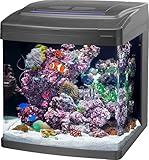
- ALL-IN-ONE SYSTEM: Everything you need for quick and easy setup. Includes a sleek and modern hood, white and blue LED lights, filter, quiet pump, dual intakes, adjustable nozzle and more.
- SMART LIGHTING: Control your aquarium from anywhere with the Aqueon BlueIQ app to toggle between white and blue LED, a programmable 24/7 schedule, feeding reminders and more.
- PERFECT FOR ALL LEVELS: Designed for both newcomers and seasoned aquarium keepers. Perfect for freshwater or saltwater environments.
- OPTIMAL GROWTH ZONES: Produces light and current within three distinct BioZones, providing the perfect light spectrum and intensity to sustain and grow different types of corals.
- PAIRS WITH BIOCUBE ACCESSORIES: Explore a range of BioCube accessories like the BioCube Protein Skimmer for advanced filtration or the Algae Cleaning Magnet and Pad for simple maintenance. Discover more options to enhance and tailor your ecosystem.
- Choose a small number of animals suited to the aquarium and its equipment.
- Acclimate them carefully.
- Continue testing the water and observe the aquarium after introduction.
- Increase the livestock load gradually, giving biological filtration time to adapt.
The cycling guide explains why testing and gradual stocking matter; no dependable fixed cycle duration applies to every setup.
Independent reader supportYour contribution helps us test, update, and keep practical guides available for everyone.How should fish-only and reef plans affect setup?
Use the animals you intend to keep to guide your equipment choices before purchasing or assembling the system.
Do these 3 things before closing this tab:
1Scan for outdated or missing drivers - takes under a minute2Repair Windows errors before they cause bigger problems3Fix the driver behind crashes, sound loss and screen glitchesQuick Recap
Best Value

- Contains one (1) API QUICK START Freshwater and Saltwater Aquarium Nitrifying Bacteria 4-Ounce Bottle
- Allows instant addition of fish when starting a new aquarium
- Reduces compounds harmful to fish when used routinely
- Helps prevent fish loss in freshwater and saltwater aquariums
- Use when starting a new aquarium, when adding new fish and when changing water and filter media
| What to compare | Why it matters |
|---|---|
| Planned livestock and husbandry requirements | Animals have specific care needs that influence the aquarium setup. |
| Lighting | Lighting requirements differ, particularly when the plan includes corals. |
| Filtration and circulation | System capacity and water movement should suit the aquarium and its livestock. |
| Maintenance and monitoring | Choose a setup that fits the time you can consistently give it. |
| Tank footprint and stand support | The aquarium must fit its location and have suitable support before it is filled. |
| Setup budget | Account for the equipment required by the chosen plan; no current, dependable cost comparison is established here. |
Product prices and availability are accurate as of the date/time indicated and are subject to change. Any price and availability information displayed on Amazon at the time of purchase will apply.




