
Some links on this page are affiliate links: if you buy through them we may earn a commission, at no extra cost to you.
Create two separate zones before the puppy and baby share a room: a baby-only area the puppy cannot enter and a puppy retreat the baby cannot access. Use a properly fitted barrier, puppy-proof the retreat, and make it rewarding. An adult must actively supervise every shared interaction; when that is not possible, separate them physically. A gate, crate, or friendly temperament is never a substitute for supervision.
Why separation and supervision matter
Babies cannot read canine body language or follow rules about food, sleep and personal space. Puppies are still learning bite inhibition, impulse control and household routines. Even a dog that has always been gentle can react differently when a baby cries, crawls, grabs fur or approaches a valued item.
As an Amazon Associate I earn from qualifying purchases.
The Tool Desk
Outbyte Driver Updater FREEFix the driver behind crashes, sound loss and screen glitchesFind Drivers →Outbyte PC Repair FREEClear out junk files and repair common Windows errorsFree Scan →The American Academy of Pediatrics’ HealthyChildren.org advises never leaving a baby or small child alone with a dog, including the family dog. The American Kennel Club (AKC) puts it plainly: “Never leave even the most trusted dog alone with a baby or small child!” That means supervision must be active: an adult is close enough, attentive enough and physically able to intervene immediately. Feeding the baby, answering a call, falling asleep, showering or stepping out of the room are all reasons to create physical separation first.
Dog-bite statistics show why this rule is not limited to unfamiliar animals. The American Veterinary Medical Association reported in an April 9, 2026 release that more than 4.5 million people are bitten by dogs each year in the United States, with children accounting for at least half of those injuries. HealthyChildren.org reports more than 4.5 million U.S. dog bites annually and says at least half of the 800,000 people who receive medical attention for bites are children; that page was last updated in 2018 and does not identify the underlying data year. Neither figure is a puppy-specific risk estimate, but both support strict adult supervision.
Popular on Amazon

- [Worry-Free Safety]: Our expandable dog gate is great for doorways and blocking off other indoor spaces to keep your pet safe and secure. This durable puppy gate is made of strong, appealing fieldstone gray plastic with adorable paw print accents.
- [Convenient and Portable]: This gate for dogs is 23" tall, fits a variety of openings 26" - 40" wide. Please measure carefully: it will not work in a wider doorway. It is easy to take down and install - which means you can use it anywhere you need it!
- [Perfect for Modern Homes]: Our portable, adjustable pet gate features rubber bumpers that protect your walls and are positioned higher than other gates to accommodate up to 4" molding. It's an ideal indoor dog gate.
- [Easy and Comfortable to Use]: The sturdy, curved handle allows for a firm grip, which makes mounting and disassembling a breeze!
- [Proud USA-Owned Company]: Our rigorously tested gates & yards bring peace of mind to your family. We stand for the highest safety & quality standards while creating the ideal products for your furry friends. This item is proudly made in the USA!
Plan two protected zones
Baby-only zone
Choose a room or defined area where the puppy is not allowed, such as a nursery, play space or section of the living room. The boundary should remain effective as the puppy grows, becomes more athletic and learns to push or climb. Keep the baby’s sleep and changing areas inaccessible to the dog, and reassess the layout when the baby begins rolling, crawling and pulling up.
Map every route into the baby zone, not just the main doorway. A puppy may enter through an adjoining room, around furniture or through a second opening that seemed unimportant before the baby arrived. Decide where an adult will stand during feeding, changing and floor play, and make sure a barrier can be closed with one hand while carrying the baby.
Puppy retreat
Give the puppy a private crate, bed, exercise pen or gated room where the baby cannot intrude. Place the retreat away from heavy foot traffic but close enough for the puppy to remain part of normal family life. Keep food bowls, chews, toys and other valued items there, and teach every child that the retreat is off-limits when the dog is resting, eating or chewing.
Make the retreat a genuine escape rather than a place the puppy sees only when something difficult happens. Offer meals, suitable chews and quiet rest there, and keep a clear path in and out for the dog. Never allow a baby to crawl into the crate or pen, reach through its bars or take an item from inside.
Do not rely on an open doorway. A puppy may push through, jump over, climb or chew a weak barrier. Keep medications, cleaning products, rubbish and other toxins out of the contained area, and cover or secure electrical wires. Remove small objects that could be swallowed.
Choose and install a barrier for the actual opening and dog
Measure every opening before buying a gate. Check the product’s stated width range, mounting method and use or weight limits, then compare those specifications with the puppy’s current size, expected adult size and behavior. The barrier must also fit the location: a stairway, doorway and irregular opening have different demands.
| Situation | What to compare | Guidance |
|---|---|---|
| Doorway or room entrance | Width range, attachment, latch, puppy size and pushing, chewing or jumping | Measure first and choose a sturdy gate that fits securely and cannot be opened easily by the dog. |
| Top of stairs or an energetic or large dog | Secure attachment and sufficient height | AKC identifies hardware-mounted gates as more secure for stair tops and energetic or larger dogs. |
| Temporary or unusual opening | Stability and resistance to pushing | Freestanding gates can create temporary barriers or enclose unusual spaces, but they are less secure. |
| Containment while direct watching is impossible | Crate or exercise pen, puppy-proofing and gradual acclimation | These are puppy-management options; they do not remove the need to separate the baby and dog. |
| Quiet puppy retreat | Privacy, accessibility to the dog and inaccessibility to the baby | A crate, bed or gated room can serve as the dog’s safety zone. |
Pressure-mounted, hardware-mounted and freestanding designs
Pressure-mounted gates are easier to relocate, which can help when room use changes. They are not the strongest choice for a determined, heavy or athletic puppy or for a stair top. Hardware-mounted gates attach to the surrounding structure and provide a more secure installation where a failure could cause a fall or allow a dog into a hazardous area. Freestanding designs are useful for temporary layouts and unusual spaces but can be moved or pushed by a persistent dog.
Also popular on Amazon

- WORRY FREE SAFETY: Our expandable dog gate is great for doorways and blocking off other indoor spaces to keep your pet safe and secure. This durable puppy gate is made of strong, appealing light gray plastic with adorable paw print accents.
- CONVENIENT AND PORTABLE: This gate for dogs is 23" tall, fits a variety of openings 26" - 40" wide. Please measure carefully: it will not work in a wider doorway. It is easy to take down and install - which means you can use it anywhere you need it!
- PERFECT FOR MODERN HOMES: Our portable, adjustable pet gate features rubber bumpers that protect your walls and are positioned higher than other gates to accommodate up to 4" molding. It's an ideal indoor dog gate.
- EASY AND COMFORTABLE TO USE: The sturdy, curved handle allows for a firm grip, which makes mounting and disassembling a breeze!
- PROUDLY MADE IN THE USA: Our rigorously tested gates, yards & pens bring peace of mind to the entire family. We stand for the highest safety, quality and operational standards while creating the ideal collection of products for your furry friends. This item is proudly made in the USA!
Consider what is beside the gate as well as the gate itself. A sofa, storage box or low table can become a launching step. A tall gate is ineffective if the puppy can climb nearby furniture, and a narrow gap can trap a paw or head even when the frame does not move. Recheck the surrounding furniture after rearranging the room.
Install the gate exactly as directed. Test the latch from both sides, push against the frame and observe the puppy’s attempts to reach it. The puppy should not be able to nose the latch open, squeeze through, trap a paw or put its head through an opening. Avoid horizontal bars or nearby furniture that create a climbing route; the gate should be tall enough that the dog cannot jump over it. Dr. Kelly Hood, DVM, an in-house veterinary expert cited by AKC’s gate guide, says, “The gate should be tall enough so that your dog can’t jump over it.”
Check the gate at the beginning of each busy day and after visitors move it. A latch that is technically closed but not fully engaged, or a pressure gate that has shifted by an inch, can create an opening. If the puppy repeatedly tests one section, treat that behavior as information: improve the attachment, increase distance or use a more secure design rather than waiting for a failure.
What’s actually slowing this PC down?
Pick the symptom - the matching free tool is one click away.
A dog gate is a management tool, not a child-safety device. AKC cautions that dog gates should not substitute for safety equipment intended for babies or toddlers. Follow the manufacturer’s child-safety instructions for any barrier used around the baby, and do not assume a baby gate is strong enough to contain a dog.
Make the puppy retreat safe and rewarding
Build comfort gradually
Introduce a crate or exercise pen in short, positive sessions while the home is calm. Feed suitable treats or meals there, offer a safe chew appropriate for that individual puppy, and allow the puppy to leave when the exercise ends. Increase the time in the area slowly rather than using it suddenly for the first time when the baby needs care.
Practice closing the gate for a few seconds, then opening it while the puppy is still relaxed. Build duration in small steps and vary the caregiver’s position so the puppy does not panic when an adult walks away. If whining, frantic scratching or repeated escape attempts appear, shorten the exercise and seek guidance rather than forcing a longer confinement.
Limit the puppy’s freedom until house-training and household habits are developing, then expand access in stages. A retreat should not function as punishment. Its value is that the puppy can reliably rest there while an adult handles feeding, bathing, visitors or other tasks.
Also popular on Amazon

- EXTRA WIDE DOG GATE FOR DOORWAYS & BOTTOM OF STAIRS: Fits openings 29–36.5" wide and stands 30" tall. Fits 29–32" without extension and 34–36.5" with the included 4" extension. DOES NOT FIT OPENINGS BETWEEN 32–34". Measure your opening before purchase to confirm fit.
- PATENTED SMALL PET & CAT DOOR: Features a patented small pet door that allows cats and smaller pets to pass through while helping keep larger dogs contained. Ideal for multi-pet homes and households with pets of different sizes.
- WALK-THROUGH PET GATE WITH DOOR: Features a 16.5" wide walk-through opening with a one-touch safety latch for convenient adult access between rooms without stepping over the gate.
- PRESSURE-MOUNTED FOR A SECURE FIT: Pressure-mount design uses wall cups and included mounting hardware to help create a stable fit in doorways, hallways, and at the bottom of stairs.
- DURABLE METAL PET GATE: Built with a sturdy all-metal frame for dependable everyday use. Provides a secure indoor pet barrier for doorways, hallways, and other areas throughout the home.
Teach a “go to place” cue
Place a bed or mat in the puppy’s retreat. Reward the puppy for stepping onto it, lying down and remaining settled, then add the cue “go to place.” Practice first when the home is quiet. Later, rehearse while a caregiver carries a doll, folds baby clothes or performs other low-intensity routines. The cue supports management, but it cannot replace a physical barrier when the adult cannot supervise.
Reward calm choices, not just perfect stillness. Looking toward the baby and then relaxing, turning away from the gate or choosing the bed are useful behaviors to reinforce. Keep sessions brief enough that the puppy succeeds, and provide a separate quiet period after stimulating activity.
Prepare the puppy for baby sounds, smells and routines
Before closer contact, introduce baby-related changes in low-pressure steps. Let the puppy investigate nursery furniture, blankets and other neutral scents without forcing interaction. Play recordings of crying or other baby sounds at a low volume while providing food, play or calm praise; increase intensity only while the puppy remains relaxed. Shift walking, feeding and rest routines gradually so the arrival of the baby does not make every familiar activity disappear at once.
Introduce one change at a time when possible. If the puppy shows worry, freezes, hides, pants, barks or cannot take a reward, the stimulus is too intense or too close. Lower the volume, increase distance or end the session and offer the retreat. The purpose is familiarity, not endurance.
Outdated Drivers Are Slowing You Down
One free scan finds every outdated or missing driver and matches the right update for your exact hardware.Free scan · exact hardware matchWindows Errors? Fix Them Before They Spread
Repair common Windows errors and clear accumulated junk for a smoother, more stable PC - no reinstall needed.Free scan · no reinstallContinue rewarding calm behavior near the baby-only boundary. If the puppy stares, barks, paws or repeatedly rushes the gate, increase distance and guide the dog to its retreat rather than allowing rehearsals of frantic behavior.
Use a controlled introduction
There is no universal number of days after which contact becomes safe. A gradual sequence lets the puppy adjust to the baby’s smell, sight and sound while the adult controls distance.
- Set up first. Install and test barriers, prepare the puppy retreat and remove food, chews and other valued items from the shared area.
- Start with separation. Let the puppy hear and smell the baby while the dog remains behind a secure barrier or on a leash held by an adult. Reward relaxed behavior.
- Keep the adult between them. For an initial visual interaction, hold the baby securely and keep the puppy at a distance where it can remain calm. Do not place the baby on the floor beside the dog.
- Allow choice. If the puppy chooses to approach, permit a brief, calm investigation without forcing contact. Keep the baby elevated and maintain a clear route to the puppy’s retreat.
- End early. Separate while both are calm. Repeat short sessions rather than allowing a long, exciting encounter.
- Adjust as the baby develops. Crawling, grabbing and pulling up change the risk. Move valued dog items out of reach, tighten barriers and increase separation whenever the baby’s mobility or the puppy’s behavior changes.
Do not use a leash to pull the puppy toward the baby or hold the dog in place for a photograph. A leash can support an adult’s control during a planned interaction, but the puppy still needs room to retreat and the adult must be able to separate immediately.
Also popular on Amazon

- Auto-Close Baby Gate: Designed with an intelligent self-closing system, this dog gate automatically swings shut at angle under 90°, providing reliable protection against accidental openings
- Dual-Lock Safety: This baby gate for stairs features a secure dual-lock mechanism, ensuring curious children and pets stay safely contained while allowing adults to open it effortlessly with one hand. Parents can pass through the baby gates for doorways with ease even while carrying groceries or a baby
- Tool-Free Installation: The pressure-mounted dog gate indoor provides a secure hold while protecting your walls or furniture from damage, ideal for renters and hassle-free setups. The dog gates for doorways offer a quick, temporary solution that's both safe and convenient. The attached sticky pads are provided to keep the wall cups in place, so you don't need to drill
- Stroller-Friendly Baby Gate for Stairs: Features an anti-stumble pedal, ensuring a seamless transition between the pet gate and the floor. This design reduces the risk of tripping and allows strollers to roll through the child gate effortlessly, making the pressure mounted baby gate ideal for families with elderly members and young children
- Adjustable Pet Gate Indoor: With an adjustable width from 29 to 40 inches, the baby gate with door fits most standard doorways and stair openings, creating a safety environment for your little ones and furry friends while giving you peace of mind. Please measure the width of the openings you want to place the child gate before installation
Supervise every shared moment
Active supervision means watching the dog and baby, not merely being somewhere in the house. Keep the interaction on the floor only when an adult can stay close and intervene instantly. If attention must shift, put a barrier between them or place the puppy in its prepared retreat before doing anything else.
- Never allow the baby to grab fur, ears, tail, collar or toys.
- Do not permit climbing on, hugging, riding or rough play with the puppy.
- Keep the baby away from the dog’s food, water, bed, crate, pen and chews.
- Give the puppy an uninterrupted escape route; do not corner it between furniture and a child.
- As children become old enough to understand, teach them not to disturb a dog that is sleeping, eating or inside its retreat. Babies cannot follow these rules, so the adult manages access.
Build separation into ordinary routines rather than treating it as an emergency measure. Close the gate before answering the door, start a bath, carry laundry upstairs or settle the baby for a nap. If another adult is visiting, assign one person to watch the dog and baby; do not assume that a roomful of adults means someone is paying attention.
A puppy’s friendly behavior does not remove the need for barriers. Excitement, chasing, jumping and mouthing can injure a baby without deliberate aggression, and a baby’s unpredictable movements can provoke a defensive response.
Independent reader supportYour contribution helps us test, update, and keep practical guides available for everyone.Recognize discomfort and respond early
The AVMA identifies turning away, stiffening, growling and trying to move out of reach as signs that a dog may be uncomfortable. Treat these signals as information, not disobedience.
- Calmly stop the interaction and move the baby away.
- Increase distance with a gate, leash or retreat; do not drag the dog toward the baby.
- Remove the source of pressure, such as a reaching hand, noisy toy or crowded corner.
- Do not punish growling or test whether the dog will “tolerate” another approach. Suppressing a warning can leave fewer visible signals before a bite.
- Record what happened and change the setup so the same situation is less likely to recur.
If fear, guarding or aggression is excessive or persists, contact a veterinarian and seek help from a qualified behavior professional. A sudden behavior change can also warrant veterinary assessment. Do not attempt forced exposure or unsupervised “tests” with the baby.
Recommended Free Tools
If a bite occurs
Separate the dog and child immediately and obtain medical advice. HealthyChildren.org advises washing the wound with soap and water and calling the child’s pediatrician; a severe bite requires emergency care. Gather the dog’s rabies-vaccination details and owner information for medical and public-health follow-up. These steps are emergency guidance, not a replacement for prevention and supervision.
Recheck the setup as both grow
A barrier that worked for an eight-week-old puppy may fail once the dog can jump or push. A puppy retreat that was private can become accessible when a baby starts crawling. Recheck latch security, gaps, climbing opportunities and the location of food and chews whenever either child or dog reaches a new developmental stage. Keep practicing calm settling and rewarding the puppy for choosing its retreat. The goal is not to make the dog and baby share more space; it is to make safe separation simple whenever an adult cannot watch.
Also popular on Amazon
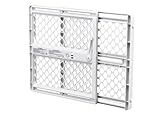
- WORRY-FREE SAFETY: Keep your pet contained and your home safe with the MYPET Universal 26" tall Pet Gate. This expandable dog gate fits a variety of openings from 26" to 42" wide. Made of strong, durable plastic and features two installation options.
- PRESSURE MOUNT FOR QUICK SETUP: Just expand gate in opening and engage pressure handle, it’s easy to install and take down! For extra security, use the included wall cups/door sockets, which provide extra holding power for pressure mounting.
- HARDWARE MOUNT FOR ADDED SECURITY: Use the included hardware mount to install as a swing gate or a gate for the top of a stairway. The door swings open for easy access, making it an ideal dog gate for stairs.
- STYLISH AND DEPENDABLE: Comes in an appealing gray finish and fits seamlessly in any of your standard openings. The durable, American-made plastic gate is sturdy and hard to climb! Perfect as a puppy gate or cat gate for doorway use.
- PROUDLY MADE IN THE USA: Our rigorously tested gates, yards & pens bring peace of mind to the entire family. We stand for the highest safety, quality and operational standards while creating the ideal collection of products for your furry friends. This item is proudly made in the USA!
Review the plan after visitors, furniture changes, illness, travel or a move. Confirm that every caregiver knows which area is baby-only, which is puppy-only and how to close the barrier. Replace or reposition equipment if the puppy chews it, the baby can reach its moving parts or the opening no longer fits securely.
Frequently Asked Questions
Can a gate or crate replace supervision?
No. A gate, crate or exercise pen is a management tool for physical separation when an adult cannot watch. It does not make it safe to leave a baby and dog alone together, and a dog gate is not a substitute for a child-safety device.
Free tools Windows power users keep installed
One-click scans. No signup required.
Which gate is best for the top of stairs or a powerful puppy?
Measure the opening and choose a properly fitted, tall gate with secure attachment. AKC identifies hardware-mounted gates as more secure for stair tops and energetic or larger dogs. Pressure-mounted models are easier to move, while freestanding models are more temporary and less resistant to pushing.
What should the puppy’s retreat contain?
Use a crate, bed, exercise pen or gated room that is private, puppy-proofed and inaccessible to the baby. Keep toxins and electrical wires secured, and place food, chews and other valued items there. Build the puppy’s comfort gradually and never let a child enter the retreat.
How should the first introduction happen?
Begin with separation and let the puppy adjust to the baby’s smell, sight and sound. Keep an adult between them, keep the baby elevated, reward calm behavior and allow the puppy to choose whether to approach. End while both are calm; never force contact or place the baby on the floor beside the dog.
What signs mean the puppy needs more distance?
Turning away, stiffening, growling or trying to move out of reach can indicate discomfort. Calmly separate, increase distance and provide the retreat. Do not punish a warning or test the dog’s tolerance. Persistent or excessive fear, guarding or aggression warrants veterinary and qualified behavior support.
Quick wins for a faster PC:
Repair Windows errors before they cause bigger problemsFix Now →Scan for outdated or missing drivers - takes under a minuteDriver Scan →What should I do if the dog bites the child?
Separate them immediately. Wash the wound with soap and water and call the child’s pediatrician; seek emergency care for a severe bite. Have the dog’s rabies-vaccination and owner information available for medical and public-health follow-up.
The Bottom Line
Give the baby and puppy separate protected zones, install a barrier matched to the opening and dog, and make the puppy’s retreat rewarding. Introduce baby-related sounds and routines gradually, watch for discomfort, and physically separate them whenever an adult cannot intervene immediately.





Leave a Reply