
The Tool Desk
Outbyte Driver Updater FREEScan for outdated or missing drivers - takes under a minuteDriver Scan →Outbyte PC Repair FREERepair Windows errors before they cause bigger problemsFix Now →Some links on this page are affiliate links: if you buy through them we may earn a commission, at no extra cost to you.
There is no single best bonding method for every cat. The most effective choice is the interaction your cat voluntarily seeks and continues to enjoy. Make shared play available regularly, offer touch only while your cat welcomes it, and use small food rewards when that individual cat values them. A cat that walks away, stiffens, swats, or otherwise signals “enough” is giving you useful information: stop and offer a choice instead.
Veterinary and welfare guidance treats food, petting, play, brushing, and social attention as possible rewards—not as a universal ranking. Your job is to notice which option produces relaxed, voluntary engagement, then keep that interaction safe, brief enough to remain pleasant, and free of pressure.
As an Amazon Associate I earn from qualifying purchases.
What actually makes a cat-bonding activity work?
Bonding is built through repeated, predictable experiences in which your cat can approach, participate, and leave safely. The activity matters less than the cat’s response. The American Animal Hospital Association (AAHA) advises identifying the reward an individual cat values most; possibilities include food, petting, play, brushing, or social interaction. That means a treat-loving cat and a touch-avoidant cat may form equally strong relationships through entirely different routines.
There is no population statistic showing that petting, play, or treats universally builds a stronger bond. The practical test is observable: does your cat choose to come closer, remain loose and engaged, and return for another interaction later? If not, change the activity rather than trying to make the cat tolerate it.
Popular on Amazon

- Two Play Mode: When you're busy at work/away from home, our suction cup cat feather wand and hanging cat toy can keep your cat entertained. When you want more interaction with your cat, our handheld cat feather wand can create a cozy time for you
- More Fun: Our feathered cat toys are made with natural feathers to unleash your cat's hunting nature. It includes 8 cat feather refills and 3 cat worm toy refills with bell, 2 door hanging cat toys, 2 cat mice toys, 2 cat feather wands and 1 suction cup
- Quality Materials: Our feather wand cat toys are made of high-elastic steel wire that is not easy to break, and the upgraded powerful suction cups can withstand 22 lbs of tension, so that your beloved cat can play with our cat teaser toy with no worry
- Lightweight and Comfortable: This wand cat toys for indoor cats are made with a handle that feels comfortable in your hand, and with a hand weight of 0.53 oz, you won't get tired of playing with your pet for long periods of time
- Flexible Usage: Our suction cup kitten toys are suitable for smooth panels. The doorway cat toy comes with a 78.7 IN elastic rope that you can adjust to your cat's needs. With our feather toys for indoor cats, your cat can get enough exercise at home
“Using the reward your cat values most is essential for effective learning,” AAHA says in its Cat training 101 guidance.
Petting, play, and treats compared
| Method | Best fit | How to use it | Main limitation |
|---|---|---|---|
| Petting | A cat that approaches and appears comfortable with touch | Begin briefly, watch the cat continuously, and stop at the first signs of irritation or withdrawal. | Touch tolerance varies widely; contact that starts pleasantly can become uncomfortable. See the ASPCA guidance on aggression in cats. |
| Interactive play | A cat that enjoys stalking, chasing, pouncing, or batting toys | Use a wand or other suitable toy, move it like prey, allow a successful catch, and never make hands or feet the target. | Duration and intensity must match the cat’s age, personality, activity level, behavior, and health. See Cats Protection’s play guidance. |
| Treats | A food-motivated cat or one learning a positive association | Give a small reward for voluntary behavior and include those calories in the daily food allowance. | Extra treats are optional; some cats prefer play or attention. See Cats Protection’s feeding advice. |
How to tell which reward your cat values
Start by watching what your cat initiates without being coaxed. Does it bring a toy, follow a moving object, lean into a hand, sit near you, or respond eagerly when food appears? Record those choices for several days instead of assuming that a favorite reward will remain constant. A cat may want play when alert, quiet company when tired, and food only during training.
Do these 3 things before closing this tab:
1Scan for outdated or missing drivers - takes under a minute2Repair Windows errors before they cause bigger problems3Fix the driver behind crashes, sound loss and screen glitchesOffer choices instead of testing tolerance
- Make one low-pressure option available, such as placing a wand toy on the floor or sitting quietly nearby.
- Wait for an approach or other voluntary engagement. Do not corner, hold, or repeatedly present the option after the cat declines.
- Continue only while the cat remains relaxed and involved.
- End on a calm, successful moment, then provide space.
- Try a different reward at another time and compare the cat’s willingness to return.
This process follows the humane-training principle that rewards and lures should do the work rather than force or punishment. The ASPCA’s position statement on training aids and methods lists food, praise, petting, and play among humane rewards.
When petting strengthens the relationship
Petting can be a quiet social ritual for a cat that solicits it. Let the cat close the distance, offer a hand for investigation, and begin with a few gentle strokes in the area the cat already accepts. Keep the first sessions short even if the cat appears enthusiastic; ending before irritation preserves the next invitation.
Read consent throughout the interaction
A cat can change its mind during a single petting session. Relaxed posture, remaining nearby, and leaning toward the hand suggest continued tolerance. Moving away, becoming tense, flicking the tail, pinning the ears, turning sharply toward the hand, vocalizing in protest, swatting, or biting are reasons to stop. The exact signal differs by cat, so learn that individual’s earliest warning rather than waiting for a scratch.
The ASPCA’s advice is direct: “When your cat signals you to stop petting, the best response is simply to stop.” Read the full context in Aggression in Cats. Do not punish a cat for warning you; respecting the warning teaches that communication works.
Also popular on Amazon
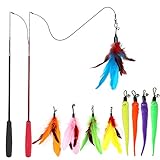
- 1. KEEP CATS VERY ENTERTAINED : Cats are crazy about chaser games! Combine string and feather into a great cat toys for indoor cats, this cat toy is an irresistible lure for cats! Swing the feathers " cat lure " will get your cats excited and stimulate their natural " hunt instinct ", making them run and jump like a wild animal, driving your cats crazy with joy! Even adult cat play like a kitten again!
- 2. CLASSIC PRACTICAL INTERACTIVE CAT TOY : This cat wand toy can really get your cats to do a lot exercise while entertainment, release their energy, feeling happy and relaxed. Also it's fun to watch cats go nuts for this cat feather toy . Spend some quality time with your feline friend, your companionship and interaction are the happiest things in their lives
- 3. CAT TOYS INTERACTIVE FOR INDOOR CATS : Pack includes: 2PCS Cat Wand + 9PCS Feather Worms Replacements + 2PCS Extra Strings with Clasp. This cat stick toy can be used for longer periods of time. The variety attachments can hook on other cat teaser toy and dangling toy. Feathers like bird and the worm cat toy like tail, are the cats favorite teaser. This is great cat toys for bored indoor adult cats and also kitten
- 4. TELESCOPIC CAT FISHING POLE TOY DESIGN : This cat toy wand extends from 15” in to 38.9”. Very lightweight, flexible, durable, portable and easy to store. The fully extend cat feather wand is extra long ( 38.9 in) plus the string (23.6in) which cover a large space for playing. Cat-teasing is no longer a tough job for you. You can even sit on the couch watching TV while teasing cats with this cat toys
- 5. HIGH QUALITY AND SAFETY : The feather cat toy made from Safe, natural feather. The telescopic cat feather wand made of new material with higher elasticity and hardness. Our clasp is easy to open and close for changing feathers
Keep touch optional
Never hold a cat in place to finish a cuddle, chase it to resume petting, or use food to lure it into contact it is avoiding. A cat that tolerates handling for grooming or veterinary care is not necessarily asking for social petting. If touch repeatedly produces avoidance, make proximity—not stroking—the goal: sit nearby, speak softly if the cat likes it, and allow the cat to decide whether to close the gap.
Why interactive play is often excellent bonding time
Shared play lets a cat perform parts of its predatory sequence—watching, stalking, chasing, pouncing, and catching—while you control a safe object. That combination gives the cat an outlet and makes you a predictable source of engaging activity. It is interaction, not merely exercise, so stay mentally present rather than waving a toy mechanically.
Choose a toy that keeps teeth and skin out of the game
A wand or fishing-rod toy creates useful distance between the cat’s mouth and your hands. Move the toy away, pause, let the cat stalk, and vary the direction and speed. Allow a real catch at the end of a sequence. Never wiggle fingers or toes under a blanket as a target and do not wrestle with the cat using bare hands; those games can teach the cat that human skin is prey.
If a cat ignores one toy, that is information about the toy or the timing, not proof that it dislikes play. Rotate suitable toys and change the movement. Cats Protection recommends rotation because novelty can maintain interest, but it also warns that toys that can be shredded, swallowed, or cause entanglement should not be left out unsupervised. Inspect toys regularly and put hazardous ones away after the session.
What’s actually slowing this PC down?
Pick the symptom - the matching free tool is one click away.
How long and how often to play
AAHA’s July 2, 2025 guidance on play frequency gives two or three 10–15-minute sessions per day as a general starting point. It explicitly says the right frequency depends on age, personality, activity, behavior, and health, so those figures are not a quota. A young, energetic cat may seek more activity; an older or unwell cat may need less intensity and more rest.
Cats Protection notes that very short games of one or two minutes can also be worthwhile. Several brief, successful interactions are preferable to one long session that ends in frustration, panting, overstimulation, or loss of interest. Stop while the cat is still able to disengage calmly.
Also popular on Amazon

- 360° Flying Bird Feather Motion & Self-Play – The automatic feather wand spins in a smooth 360° circle, sweeping the feather bird around the base to catch your cat’s eye. It gives bored indoor cats a moving target to follow and encourages kittens and adult cats to chase and swat. You can stay close and enjoy the action without having to wave the wand by hand.
- 8 cm Washable Suction Cup & Weighted Base – The 8 cm suction cup and weighted base help keep the toy steady as your cat reaches for the bird. Press the cup onto a clean, dry, smooth surface such as glass, glazed tile, or sealed wood, leaving enough space for the wand to turn freely. If dust builds up, detach the suction cup, rinse it, and let it dry completely before reattaching it.
- Flexible Cat Wand with a Protective Silicone Sleeve – The flexible rod of this cat wand toy is wrapped in a soft silicone sleeve that cushions your cat’s paws and limits direct contact with the rod. When your cat tugs on the feather bird, the rod bends. When your cat lets go, the rod springs back, bringing the bird back within its usual range of motion, where it continues to sway. This design suits kittens and adult cats that enjoy chasing, as well as senior cats that prefer a gentle swat.
- Replaceable Feather Bird & Ribbon Attachments – Clip on the feather bird for a feathered tail your cat can chase, or switch to the colorful ribbon for fluttering streamers to bat at. Both fit the same wand, so you can swap them between sessions to give bored indoor cats something new to follow. That variety makes this a practical cat enrichment toy for everyday play.
- USB-C Rechargeable for Everyday Play – Charge the built-in battery with the included USB-C cable, then unplug this rechargeable cat toy for cordless play. There are no disposable batteries to buy or replace, making short play sessions easier to fit into a busy day. Check the wand and attachments for wear before use, supervise play, and put the toy away afterward.
End play in a way that feels complete
Let the cat catch the toy before you put it away. A successful capture gives closure to the chase. Store the toy safely afterward, especially if it has string, feathers, detachable pieces, or material the cat can ingest. Do not leave a wand or fishing line accessible when no person is supervising.
When treats help—and when they are unnecessary
Food is a powerful motivator for some cats, particularly when you are pairing a voluntary approach, calm behavior, or a new routine with something positive. Offer a very small piece immediately after the behavior you want to reinforce. The timing should make the connection clear without turning every interaction into a demand for food.
Count treats as food, not as free extras
Include treats in the cat’s daily food allowance. Cats Protection warns that many cats value play or attention more than food treats and says those alternatives can strengthen the bond. If you use a puzzle feeder, the cat’s usual dry food can often supply the pieces rather than adding separate calories; follow the feeding plan appropriate for that cat.
Do not withhold meals to make a cat accept handling, and do not use hunger to force participation. A treat is a reward for a choice the cat has already made, not payment for enduring unwanted touch.
Use non-food rewards when they work better
For a cat that turns away from treats, try a short play bout, a preferred brushing session, access to a favorite resting place, or quiet social attention. AAHA’s list of possible rewards—food, petting, play, brushing, and social interaction—supports this flexible approach. The best reward is the one that increases relaxed, voluntary participation without creating a health problem.
A low-pressure plan for a shy cat
Shyness changes the order of operations: establish safety and choice before seeking touch. Cats Protection’s guidance for helping shy cats relax recommends sitting quietly nearby and allowing the cat to approach rather than forcing contact.
PC Slower Than It Used to Be?
A free scan shows the junk files, broken settings and background clutter dragging Windows down - then fixes them in one click.Free scan · Windows 10 & 11Outdated Drivers Are Slowing You Down
One free scan finds every outdated or missing driver and matches the right update for your exact hardware.Free scan · exact hardware matchAlso popular on Amazon

- Funny Interactive Cat Toys:2 difference most popular styles cat teaser wand are the best gifts for your lovely cats, Interact with your cats can make your cats feel happy,have a good time with your cats.
- Premium Quality Material:The cat ribbon wand toys for indoor cats are made of soft,colorful satin fabric and high-elastic wand, safe,100% non-toxic, durable Lightweight and easy to store; When not in use, wrap the cloth strip on the pole.
- Beneficial for Cat Healthy: The cat string toys for indoor cats helps your cat keep active and do more exercise.Say goodbye to the lazy and boring time, the cat of all ages can get a lot of fun.
- Nice Gift :the interactive cat wand is the best choice for sharing your love with your cats, you also can give it as a present to your cat lovers'friends.
- No Risk Purchase: Quality is our Culture, if you have any problems for our product quality and using, pls feel free to let us know at any time. We will would like to resend a new replacement one or refund money to you.
- Choose a quiet place where the cat can retreat and you will not block its route.
- Sit still at a comfortable distance. Avoid reaching, staring, or repeatedly calling the cat over.
- Let the cat decide whether to reduce the distance. A glance or step toward you is progress; do not rush to touch.
- When voluntary approaches become more confident, pair them with a small reward the cat values. That reward may be food, play, or calm attention.
- Only after the cat remains comfortable should you offer a brief stroke. Stop immediately if the cat withdraws.
- Use a wand or fishing-rod toy when close contact is too much. It allows shared activity while preserving distance.
A shy cat may need many repetitions, and some cats may never become lap cats. The goal is not to produce a particular style of affection; it is to build trust without removing the cat’s ability to opt out.
Match the approach to the cat in front of you
| If your cat tends to… | Start with… | Adjust by… |
|---|---|---|
| Approach your hand and remain relaxed | Brief petting with frequent pauses | Stopping at the earliest withdrawal signal and allowing the next approach to come from the cat |
| Stalk, chase, or pounce on moving objects | Interactive wand play | Varying movement, allowing a catch, and shortening sessions if interest or control drops |
| Respond eagerly to food | Small rewards for voluntary approaches or calm behavior | Using the normal food allowance, reducing added treats, and testing play or attention as alternatives |
| Stay distant or hide | Quiet presence and a long-distance toy | Increasing closeness only after the cat repeatedly chooses it |
| Become overstimulated quickly | Very brief interactions with clear pauses | Ending earlier, removing the trigger calmly, and avoiding hands as toys |
This is a starting framework, not a personality test. A cat can fit more than one row, and preferences can change with context, health, age, or the time of day.
Build a routine without making bonding a chore
A useful routine offers predictable opportunities while preserving choice. Put interactive play on the daily schedule, but let the cat determine how long it participates. Invite petting when the cat approaches, and reserve treats for moments when food genuinely helps.
A practical sequence
- Observe. Notice what the cat initiates and which early signals mean “continue” or “stop.”
- Offer one option. Present a toy, a still hand, or a small reward without closing off escape routes.
- Wait. Give the cat time to approach; do not escalate pressure because the first offer was ignored.
- Reinforce the choice. Continue the chosen play, provide accepted touch, or deliver the small food reward.
- Stop while it is going well. End before the cat has to protest.
- Record what worked. A short note about time, toy, reward, and response can reveal patterns that memory misses.
For many households, this means two or three play opportunities across the day, with each lasting anywhere from a very short game to roughly 10–15 minutes depending on the cat. That range combines Cats Protection’s allowance for one- to two-minute games with AAHA’s general starting guidance; neither organization presents a mandatory schedule.
Quick wins for a faster PC:
Scan for outdated or missing drivers - takes under a minuteDriver Scan →Repair Windows errors before they cause bigger problemsFix Now →Troubleshooting common bonding problems
“My cat bites when I pet it.”
Stop at the first warning and remove your hand without punishment. Shorten future contact, wait for the cat to initiate, or replace petting with nearby play. If biting is sudden, severe, or accompanied by a broader behavior change, arrange a veterinary assessment.
“My cat attacks my hands during play.”
End hand-targeted games and switch to a wand or fishing-rod toy that creates distance. Do not jerk your fingers around as a lure or reward a pounce on skin with more wrestling. Safe play requires a clear object between the cat and your body.
Also popular on Amazon

- -4-in-1 Cat Toy Set : 12pcs interactive cat toys pack are in a box,including 1 set enhanced suction cup cat toy,2 fishing pole cat toy,1 cat triangle clip door,2 cat mouse toys,2 long worm cat toys,2 medium worm cat toys,2 fur cat scratching balls,2 rotating windmill cat toy,2 cat feather toys,and additional 2 ropes,4 adhesive hooks.All cat toy replacements are universal, with a variety of cat toys and gameplay options that can bring more fun to your cat
- -4 Interactive Cat Toy Games: Door hanging toy can be clipped onto door frames or cat climbing racks.Cat string toy has adhesive hooks that can be attached to wooden boards, tiles, metal plates, etc,freeing up your hands. Enhanced suction cup cat toy and You can also hold a cat wand and interact with your cat happily, accompanying your kitten and making it no longer lonely
- -Windmill and Long Worm Cat Toy Replacement Heads: The 2 long worms feature richer color designs and more durable materials, your beloved cat will be more active, and the 2 windmill replacement heads will naturally rotate when shaken, which can stimulate your cat's hunting instincts even more
- -Enhanced Suction Cup and Removable Cat Wand: The cat toy base with a 2.7-inch large diameter suction cup has been upgraded to a strong adhesive with stronger suction and can withstand 22 pounds. Can be installed on smooth surfaces such as tiles, glass, smooth wooden floors, etc., equipped with 2 emovable cat wand toys,convenient and durable
- -Thicker Elastic Rope and Triangular Clip: Thicker and more durable elastic rope is 70 inches long, equipped with a bell and an improved adjustment buckle, which can be adjusted according to needs,and not easily damaged by cats. You can use a triangular clip to clamp onto the door frame or stick it to the door frame with a sticky pad, or clip it onto the cat climbing frame. Hanging cat toys act like swings, providing better exercise for kittens
“My cat loses interest in toys immediately.”
Try a shorter session, rotate suitable toys, and change the toy’s movement or timing. Allowing a catch can make the sequence more complete. If the cat consistently avoids activity or seems uncomfortable, consider health and age rather than assuming stubbornness.
“My cat only interacts when food is present.”
Use smaller rewards, count them within the daily allowance, and test whether the cat prefers its regular food, play, or attention. Do not keep increasing treat size or frequency. A food reward is one tool, not a requirement for affection.
“My shy cat never comes over.”
Increase distance, sit quietly, and stop reaching toward the cat. Offer a wand toy from far enough away that the cat can participate without entering your personal space. Reward voluntary approaches gradually; forcing contact can make the retreat pattern stronger.
When a behavior change needs a veterinarian
A previously relaxed, social cat that suddenly becomes fearful, hides, resists touch, or acts aggressively may be experiencing pain or illness. Cats Protection advises arranging a veterinary check when behavior changes recently rather than treating the problem only as a training issue. Medical causes should be considered before you increase rewards, alter handling, or label the cat difficult.
Seek professional advice promptly if the change is intense, persistent, associated with appetite or mobility changes, or creates a risk of injury. Until the cat is assessed, give it space, avoid provoking contact, and use only low-pressure interactions it chooses.
Bonding safety checklist
- Keep every interaction voluntary; provide a way out.
- Use toys—not fingers or toes—as chase targets.
- Let the cat catch a wand toy before ending play.
- Rotate toys, and remove anything that can be shredded, swallowed, or cause entanglement when unsupervised.
- Stop petting at the first individual warning signal.
- Count treats and puzzle-food pieces in the daily ration.
- Use the cat’s normal food, play, or attention when those are better rewards.
- Adjust session length and intensity for the cat’s age, personality, activity, behavior, and health.
- Arrange a veterinary check for a sudden fear or aggression change.
The bottom line for choosing between petting, play, and treats
Offer all three as options, but let the cat select the winner in each moment. Play is a valuable shared outlet when the cat enjoys chasing and pouncing; petting is bonding only while the cat welcomes touch; and treats are useful for food-motivated cats when their calories are managed. The strongest relationship comes from consistently honoring those choices, ending interactions before the cat has to defend its boundaries, and responding to behavior changes as possible health information rather than disobedience.





Leave a Reply