
No. Scallops are marine bivalve mollusks, not fish. They are invertebrates with two hinged shells, though they are commonly grouped with fish under the broader food term “seafood.” The part most often sold as scallop meat in the United States is the adductor muscle that joins the shells.
Are scallops fish or shellfish?
In biological terms, fish ordinarily refers to vertebrates; scallops have no backbone. They belong to Mollusca, the animal group that includes clams, oysters, and mussels. NOAA describes scallops as bivalves, meaning soft-bodied invertebrates with two hinged shells, and the FDA classifies them as molluscan shellfish.

As an Amazon Associate I earn from qualifying purchases.
“Seafood” is a broader food-market category than “fish.” It includes finfish as well as shellfish such as scallops, so calling scallops seafood is accurate even though they are not fish.
What part of a scallop do we eat?
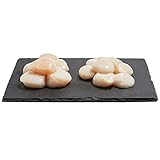
In the United States, scallop meat usually means the large adductor muscle. This muscle connects the two shells and contracts to close them. Some fisheries also land whole scallops in their shells, but the familiar pale, round portion sold by itself is the adductor muscle.
#1 Best Overall

- Responsibly Farmed or sustainable wild-caught
- Certain preservatives prohibited, including sodium bisulfite and STPP
- Traceable to farm or fishery
How do scallops live and move?
Atlantic sea scallops (Placopecten magellanicus) live in the Northwest Atlantic, from Newfoundland to Cape Hatteras. Adults gather in beds on sandy or gravelly ocean floors. On Georges Bank and in the Mid-Atlantic, they are generally found at roughly 100–300 feet; they can occur in shallower water in Maine and Canada. These range and habitat details apply to Atlantic sea scallops, not every scallop species. NOAA Fisheries’ Atlantic sea scallop profile describes their biology and habitat.
Scallops filter phytoplankton and other small organisms from the water. Unlike many familiar bivalves, sea scallops can also swim: they clap their shells together using the adductor muscle, jetting through the water and helping them escape some predators.
Rank #2

- Responsibly Farmed or sustainable wild-caught
- Certain preservatives prohibited, including sodium bisulfite and STPP
- Traceable to farm or fishery
NOAA says Atlantic sea scallops can live up to 20 years. They usually spawn in late summer or early fall, though spring spawning can also occur, especially in the Mid-Atlantic Bight. Their larvae remain in the water column for four to six weeks before settling. Females can produce hundreds of millions of eggs per year, but that large number does not by itself guarantee that eggs survive or replenish a population.
PC Slower Than It Used to Be?
A free scan shows the junk files, broken settings and background clutter dragging Windows down - then fixes them in one click.Free scan · Windows 10 & 11Crashes, No Sound, or Screen Glitches?
Random freezes, missing sound and display glitches usually trace back to one bad driver. Find and replace yours safely.Free scan · under a minuteScallop nutrition: what NOAA’s figures show
NOAA’s Atlantic sea scallop profile displays the following nutrition values per 100 grams:
Rank #3

- sustainable wild-caught
- Certain preservatives prohibited, including sodium bisulfite and STPP
- Traceable to farm or fishery
- No antibiotics, added hormones or land-animal products in feed
| Nutrient | Per 100 g |
|---|---|
| Calories | 88 |
| Protein | 16.7 g |
| Total fat | 0.76 g |
| Carbohydrate | 2.36 g |
| Sodium | 161 mg |
| Selenium | 22.2 mcg |
These are the values shown in NOAA’s profile, accessed in 2026. They are not universal figures for every scallop species, portion size, or preparation method.
Are scallops safe to eat?
Like other molluscan shellfish, scallops filter water. If bacteria, toxins, or other contaminants are present in their surroundings, shellfish can accumulate them, which is one reason raw molluscan shellfish may pose a risk. Follow current FDA guidance and local shellfish advisories rather than relying on smell or appearance alone to judge safety.
Rank #4
- This product is Marine Stewardship Council (MSC) certified. In order for a fishery to earn MSC certification, they’re evaluated by an independent third party in accordance with the MSC Fisheries Standard for healthy fish populations and ecosystems, and effective management.
- Certain preservatives prohibited, including sodium bisulfite and STPP
- Certain preservatives prohibited, including sodium bisulfite and STPP
- Traceable to farm or fishery
The FDA says cooked scallop flesh becomes firm, pearly, and opaque. That is a cooking cue, not a guarantee that scallops from an unsafe source are safe to eat. See the FDA’s consumer advice about eating fish and shellfish for safety guidance.
Are Atlantic sea scallops sustainable?
NOAA calls U.S. wild-caught Atlantic sea scallop a smart seafood choice under U.S. management. The 2020 stock assessment found the stock was not overfished and was not subject to overfishing. Those findings are specific to that assessment and fishery; they should not be generalized to every scallop species or scallop fishery.
Harvest methods also have environmental effects. Dredges and trawls can disturb bottom habitat and remove habitat-forming organisms such as tubeworms and sponges. Management measures include closures, rotating access areas, gear requirements, and bycatch controls. NOAA reports that 21.2 million pounds of Atlantic sea scallop meats, valued at $332 million, were landed in 2024 in the United States; that is a U.S. commercial landing figure, not global production or a current-year estimate. NOAA Fisheries’ commercial landing statistics provide the landing data.
Quick Recap
Product prices and availability are accurate as of the date/time indicated and are subject to change. Any price and availability information displayed on Amazon at the time of purchase will apply.





Leave a Reply