
Some links on this page are affiliate links: if you buy through them we may earn a commission, at no extra cost to you.
Separate the dog and kitten immediately. Put a closed door or another secure barrier between them, and give the kitten a room or area the dog cannot enter. Do not attempt another meeting while the dog is aroused, staring, growling or trying to pursue. If the kitten was bitten, grabbed, pinned or injured, contact a veterinarian promptly.
After the immediate risk is controlled, restart introductions slowly and only under active supervision. Growling is a warning signal to respect, while chasing can be predatory and may happen without the warning sequence people expect. A leash or gate can help manage a session, but neither makes unsupervised contact safe.
As an Amazon Associate I earn from qualifying purchases.
Do these 3 things before closing this tab:
1Fix the driver behind crashes, sound loss and screen glitches2Repair Windows errors before they cause bigger problems3Scan for outdated or missing drivers - takes under a minuteWhat to do in the first minutes
- Create distance without putting your hands between the animals. Use a closed door, a secure room or another physical barrier. Move the dog away from the kitten rather than trying to hold the kitten near the dog.
- Give the kitten a secure personal space. The kitten should be able to retreat behind a closed door or into an area the dog cannot enter. Do not rely on a kitten being fast enough to escape.
- End the interaction if the dog is aroused. Fixed staring, growling, lunging, barking, rushing or renewed pursuit are reasons to stop, not signs that the animals should “work it out.”
- Maintain separation whenever no adult is actively watching. A dog and kitten should not have loose access to one another while you are asleep, away from home or focused on another task.
- Check the kitten after an incident. If the dog bit, grabbed, pinned or otherwise injured the kitten, call a veterinarian promptly. The seriousness of an injury cannot be judged reliably from the absence of an obvious wound.
Do not punish the dog during or after the event. Scolding can increase conflict and may suppress the warning you need in order to recognize discomfort. Your first objective is physical safety and enough distance for both animals to settle.
What growling and chasing can tell you
Growling is a warning, not a diagnosis
A growl tells you the dog is uncomfortable, upset or otherwise objecting to what is happening. It does not, by itself, identify whether the cause is fear, guarding, frustration, excitement or predatory interest. Treat it as information that the current setup is too difficult and increase distance.
Popular on Amazon

- INDOOR DOG FENCE - This 54-inch-long puppy gate is an excellent way to limit your pet’s access to certain parts of the house, while maintaining a modern appearance. The black finish on this wood stair gate is sure to complement any home décor.
- FREESTANDING - Unlike traditional pet gates, this pet fence does not require installation that could potentially damage your home. With an accordion design, this tall dog gate is sturdy enough to barricade your small dog, puppy, or cat, without drilling.
- FOR STAIRS OR DOORWAYS - This versatile free standing pet gate keeps your pets out of any area of the home you would like to keep them away from, including at the top or bottom of stairways, hallways, doorways, or any openings 33 to 46-inches-wide.
- FOLDABLE - This essential dog gate for stairs is lightweight and easily folds together for compact storage. When folded, the portable dog fence is small enough to conveniently fit in a closet, under the bed, or take it with you in the car when traveling.
- PRODUCT DETAILS - Materials: Wood and Metal. Dimensions: (L) 54" x (W) 1" x (H) 24"; Folded: (L) 18" x (W) 3" x (H) 24". Recommended for Openings Measuring 33”-46” Wide. Door Gates for Pets Only. Color: Black.
The ASPCA’s general warning-signal guidance says: “If you are fortunate enough to have a dog who warns you before biting, never scold or otherwise punish her for this behavior.” That statement appears in its Dogs and Babies guidance. It is a general principle about preserving warning signals, not a prediction about what will happen in a particular dog–kitten pairing. Punishing a growl can remove an observable signal without resolving the underlying problem.
Chasing may be predatory behavior
Some dogs chase and grab fast-moving animals. The ASPCA notes that predatory behavior may not include the warning sequence owners expect before other forms of aggression. A dog that did not growl before running after the kitten is not therefore safe. Speed, grabbing and pinning can injure a kitten before an owner can intervene.
Do not infer motivation from one short episode
Playful-looking movement, fear, territorial conflict and predatory pursuit can overlap in appearance, especially to an untrained observer. A description such as “he only wanted to play” cannot establish that the kitten is safe. The useful question is whether you can reliably prevent contact and keep the dog calm, not which label best fits a single incident.
Set up safety before trying another introduction
Create a kitten-only area
Use a room with a door, or another arrangement that gives the kitten a genuinely secure retreat. The space should remain available whenever the dog is loose. The kitten needs a place where it can rest without being watched, followed or cornered. A barrier that the kitten can slip through but the dog cannot defeat may be useful, but inspect it from the animals’ perspective rather than assuming any gate is secure.
Choose barriers for containment, not reassurance
A closed door is the most straightforward separation. A suitably sized pet gate or other secure barrier can support controlled visual exposure or help define the kitten’s area. Check that the kitten cannot squeeze through an opening into danger, climb over it, and that the dog cannot reach around, jump over, dislodge or push it aside. If a barrier fails any of those checks, it is not adequate for that stage.
Also popular on Amazon

- INDOOR DOG FENCE - This 72-inch-long puppy gate is an excellent way to limit your pet’s access to certain parts of the house, while maintaining a modern appearance. The black finish on this wood stair gate is sure to complement any home décor.
- FREESTANDING - Unlike traditional pet gates, this pet fence does not require installation that could potentially damage your home. With an accordion design, this tall dog gate is sturdy enough to barricade your small dog, puppy, or cat, without drilling.
- FOR STAIRS OR DOORWAYS - This versatile free standing pet gate keeps your pets out of any area of the home you would like to keep them away from, including at the top or bottom of stairways, hallways, doorways, or any openings 45 to 60-inches-wide.
- FOLDABLE - This essential dog gate for stairs is lightweight and easily folds together for compact storage. When folded, the portable dog fence is small enough to conveniently fit in a closet, under the bed, or take it with you in the car when traveling.
- PRODUCT DETAILS - Materials: Wood and Metal. Dimensions: (L) 72" x (W) 1" x (H) 24"; Folded: (L) 18" x (W) 4" x (H) 24". Recommended for Openings Measuring 45”-60” Wide. Door Gates for Pets Only. Color: Black.
Use a leash only as an additional control
During a managed exposure, a leash can help prevent the dog from rushing forward. It does not turn an unsafe dog into a safe one, and it is not a substitute for a closed door when you are not supervising. Keep enough distance that you can end the session without wrestling with a lunging dog or placing yourself between the animals.
Set a supervision rule everyone can follow
Decide in advance who is watching, where the dog and kitten will be, and how the session will end. If the responsible adult must answer a call, leave the room or attend to another pet, separate the animals first. “They were fine for a few minutes” is not a safety plan; pursuit can begin in seconds.
How to reintroduce a dog and kitten gradually
Only begin when both animals are calm and you can keep them physically apart. The sequence below synthesizes guidance from the American Humane Society, Banfield Pet Hospital, VCA Animal Hospitals and veterinarian Jennifer Summerfield’s Petco veterinary Q&A. It reduces opportunities for rehearsal of chasing, but it cannot guarantee that the pair will eventually be safe together.
1. Start with complete separation
Keep the kitten in its secure area and the dog elsewhere. Let each animal return to ordinary behavior before adding a new challenge. If the dog remains fixated on the door, repeatedly patrols it or cannot disengage, do not move to visual contact.
2. Exchange scent without direct contact
Allow each animal to become aware of the other through scent while a door or another secure barrier remains closed. Keep the exchange brief and uneventful. If either animal becomes agitated, stop and restore more distance. Scent work is preparation, not proof that a face-to-face meeting is ready.
Windows Errors? Fix Them Before They Spread
Repair common Windows errors and clear accumulated junk for a smoother, more stable PC - no reinstall needed.Free scan · no reinstallOutdated Drivers Are Slowing You Down
One free scan finds every outdated or missing driver and matches the right update for your exact hardware.Free scan · exact hardware matchAlso popular on Amazon

- Freestanding Pet Gate: It can be placed anywhere and stands securely without the need for side wall support. Equipped with side panels to prevent tipping and safely enclose pets. It is lightweight and easy to move, yet sturdy enough that dogs cannot knock it over.
- Durable frame: The door is carefully crafted from sturdy solid wood and black metal railings. The solid wood surface is finished with a satin/semi-gloss coating that blends perfectly with any interior décor style.
- Outstanding Craftmanship: The bottom of the door is equipped with rubber pads to prevent scratches on hard floors. It is equipped with two high-quality knobs for easy length adjustment. Suitable for blocking stairways, doorways, wide openings, or temporary corners.
- Adjustable Width: It is high enough to prevent small pets from entering, but low enough for adults to easily step over (height 21 inches); the length can be extended from 39 inches to 67.5 inches (simply move the screws to other pre-drilled holes to easily adjust the size).
- Easy to Use: Easy to assemble in just a few minutes, with side panels that fold down for easy temporary relocation and storage. Suitable for small dogs weighing between 6.5 and 17.5 pounds.
3. Add brief visual exposure through a secure barrier
Let the animals see one another through a barrier that prevents contact. Begin at a distance where the dog can look away and the kitten can retreat. Keep the session short. Reward the dog for calm behavior, such as turning away or remaining relaxed, rather than luring it closer to the kitten.
4. End at the first signs of rising tension
Stop the session if the dog fixes its stare, stiffens, growls, lunges, barks obsessively or attempts to chase. Move the dog away and return to separation. Do not wait for a bite or a successful chase to tell you that the step was too difficult.
5. Progress in small increments
When repeated barrier sessions remain calm, make only one change at a time: a little more visual access, a slightly shorter distance or a brief managed movement. Keep the dog on leash for close, controlled exposure and maintain a route for the kitten to retreat. If behavior worsens, go back to the last arrangement that was calm rather than pushing through.
6. Keep supervision permanent unless safety is demonstrated
Even after several quiet sessions, do not assume the animals can be left loose together. Continue separating them whenever nobody is actively supervising. Some households require long-term management, and some dogs are not appropriate housemates for kittens.
How to decide whether a session is safe to continue
Judge the dog’s response at the current distance, not its behavior earlier in the day. The kitten’s ability to retreat matters just as much as the dog’s apparent calm.
Also popular on Amazon
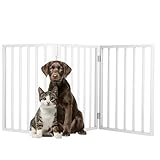
- INDOOR DOG FENCE - This 23.75-inch tall dog gate is an excellent way to limit your pet’s access to certain parts of the house, while maintaining a modern appearance. The white finish on this MDF stair gate is sure to complement any home décor.
- FREESTANDING - Unlike traditional pet gates, this pet fence does not require installation that could potentially damage your home. With an accordion design, this puppy gate is sturdy enough to barricade your small dog, puppy, or kitten, without drilling.
- FOR STAIRS OR DOORWAYS - This versatile free standing pet gate keeps your pets out of any area of the home you would like to keep them away from, including at the top or bottom of stairways, hallways, doorways, or any openings 33 to 46-inches-wide.
- FOLDABLE - This essential dog gate for stairs is lightweight and easily folds together for compact storage. When folded, the portable dog fence is small enough to conveniently fit in a closet, under the bed, or take it with you in the car when traveling.
- PRODUCT DETAILS - Materials: MDF and Plastic. Dimensions: (L) 54.75" x (W) 0.75" x (H) 23.75"; Folded: (L) 18.25" x (W) 2.25" x (H) 23.75". Recommended for Openings Measuring 33”-46” Wide. Door Gates for Pets Only. Color: White.
| Response during exposure | What to do |
|---|---|
| Dog can notice the kitten, look away and remain physically loose; kitten can move away or settle | Keep the session brief and controlled. Reinforce calm behavior, then separate before either animal becomes tired or tense. |
| Dog stares continuously, stiffens, tracks every movement or cannot disengage | End visual exposure and increase distance. Return to a closed-door setup if necessary. |
| Dog growls, barks obsessively, lunges or rushes the barrier | Stop immediately, secure the dog and kitten separately, and seek qualified behavior guidance before trying again. |
| Dog chases, grabs, pins or makes contact | Separate the animals and arrange prompt veterinary care for any kitten injury. Do not repeat the setup as a test. |
A quiet session shows only that the particular distance and duration were manageable on that occasion. It does not establish that the dog is safe in a different room, around a running kitten or without a barrier.
Independent reader supportYour contribution helps us test, update, and keep practical guides available for everyone.When to involve a behavior professional
Arrange an in-person assessment by a board-certified veterinary behaviorist or another appropriately qualified humane behavior professional if any of the following apply:
- The dog has killed, caught or seriously harmed small animals.
- The dog repeatedly chases the kitten or remains intensely fixated on it.
- The dog lunges, snaps, attempts to grab or cannot stay calm even with distance and barriers.
- You cannot create a setup that reliably prevents contact.
- Anyone in the household is unsure they can maintain the separation routine.
Jennifer Summerfield, DVM, CPDT-KA, described a high-prey-drive dog with a history of harming small animals as a potentially dangerous situation and recommended a veterinary behaviorist. Her answer was published in 2017; the Petco page displays a 2025 update. An in-person professional can observe the dog, assess the circumstances and help you decide whether management or a different living arrangement is realistic.
Quick wins for a faster PC:
Clear out junk files and repair common Windows errorsFree Scan →Fix the driver behind crashes, sound loss and screen glitchesFind Drivers →Repair Windows errors before they cause bigger problemsFix Now →The American Humane Society cautions that dogs that growl, lunge or bark obsessively at cats may be more comfortable in a cat-free home. That is not a failure of training or ownership; it is a recognition that safe coexistence is not guaranteed for every dog and kitten.
Equipment that helps—and what it cannot do
| Equipment | Useful role | Limit |
|---|---|---|
| Closed door | Provides the clearest physical separation and a kitten-only room. | Must remain closed whenever supervision is unavailable; a dog may still become distressed at the door. |
| Freestanding pet gate | Can define a kitten area or permit controlled visual access. | It is unsuitable if the kitten can squeeze through or the dog can climb, push or reach over it. |
| Leash | Helps prevent a rush during a managed session. | It does not replace a barrier, active supervision or professional assessment. |
Choose equipment based on the actual animals’ size, agility and persistence. A stronger product is not a substitute for stopping exposure when the dog is escalating.
Mistakes that increase risk
- Forcing proximity: Holding the kitten near the dog or placing them nose-to-nose removes the kitten’s escape option.
- Punishing a growl: This can suppress a warning without changing the dog’s discomfort.
- Testing with a running kitten: Fast movement can trigger pursuit, and predatory behavior may be sudden.
- Using a gate as a babysitter: Barriers can fail, and they do not make unsupervised contact acceptable.
- Advancing because one session went well: Calm behavior must remain consistent across short, controlled sessions before you change the setup.
- Assuming familiarity equals safety: A dog may tolerate a stationary kitten and still chase when it moves.
- Waiting for a bite before seeking help: Persistent fixation, lunging or repeated chasing are already sufficient reasons for an assessment.
Making a long-term household decision
The practical standard is not whether the dog can occasionally be quiet near the kitten. It is whether you can maintain a reliable system that prevents pursuit and gives the kitten a secure life every day. Consider the dog’s history, the intensity and frequency of chasing, the quality of the barriers, the layout of your home and whether every caregiver can follow the separation plan.
If the dog remains calm only when physically restrained, or if the kitten cannot move around the home without triggering pursuit, ask a veterinary behaviorist to help evaluate options. Some pairs can share a home with permanent management; others should not. No published statistic in the cited guidance can predict the injury risk for your particular dog and kitten, so decisions must be based on observed behavior and professional assessment rather than a percentage.
What’s actually slowing this PC down?
Pick the symptom - the matching free tool is one click away.





Leave a Reply