
What’s actually slowing this PC down?
Pick the symptom - the matching free tool is one click away.
Some links on this page are affiliate links: if you buy through them we may earn a commission, at no extra cost to you.
If your dog runs toward traffic, another animal, a drop-off, or any other hazard, prevent access first: keep hold of the leash, create distance, and use a physical or visual barrier. Only after the dog is safe should you work out what triggered the rush. Recall training can improve your options, but it is never a guarantee in a dangerous place, so physical control remains essential. The right long-term response depends on whether the behavior is driven by chasing, fear, overexcitement, or another motivation; rushing by itself is not a diagnosis.
What to do in the next few seconds
In an emergency, management matters more than obedience. A dog that normally returns in the yard may ignore a cue when a car, wildlife, a frightening person, or another dog captures its attention. Use the following sequence to reduce immediate risk.
As an Amazon Associate I earn from qualifying purchases.
- Secure physical control. Keep the leash in your hand and move the dog away from the hazard. Around roads, parking lots, railway crossings, cliffs, or other especially dangerous areas, keep the dog leashed even when recall is usually reliable. UC Davis places leash use at the center of recall safety guidance (Recall Training in Dogs, April 10, 2019).
- Increase distance. Walk away from the trigger rather than trying to make the dog pass close to it. Distance lowers the chance of another lunge and gives you room to use a familiar cue.
- Add a barrier when available. Put a car, fence, gate, hedge, or building between the dog and the trigger. Merck Veterinary Manual describes avoidance, distance, and physical or visual barriers as safety-management tools (Treatment of Behavior Problems in Animals, page updated September 2025).
- Use one practiced movement cue. If the dog is anxious about an approaching trigger, a hand target or a cue to come to your side can help you leave. Cornell recommends having an exit plan and rehearsing a simple behavior for moving away; treat this as planned management, not an emergency guarantee (Anxious behavior: How to help your dog cope with unsettling situations).
- Do not punish the return. Once the dog comes back, secure it and keep your voice and handling calm. Scolding after a delayed return can make the dog less willing to come next time.
After the immediate danger has passed, check whether the dog is hurt or has caused an injury. A collision, fall, bite, or other physical trauma warrants prompt veterinary advice, even if the dog appears settled.
Why dogs rush toward danger
The same outward action can have very different causes. A dog may chase a moving object, bolt toward a desired person or animal, rush because it is overexcited, or move aggressively or defensively when frightened. Pain, illness, a recent frightening event, and learned habits can also change how a dog responds. No single explanation can be inferred from “running toward risk.”
Popular on Amazon

- DIMENSIONS - This dog leash measures 3/4in wide by 30 feet long. Great for hiking, camping, training, hunting, backyard, beach, recall training, outdoor play with tennis balls, and swimming!
- LONG LEASH: This training leash is great for teaching your dog recalls. It has the length needed to allow them to wander and ensure your command to come! is obeyed.
- NYLON TRAINING LEAD - This durable, long, nylon dog training leash will outlast cotton leashes. All stitching is reinforced and the nickel plated clip swivels to resist twisting. Our long dog leash is great for medium and large dogs. You'll love using it as a backyard dog leash, for off leash dog training, and more.
- Allows you to teach your dog recalls and other obedience skills.
- Swivel-style bolt snap resists twisting
Write down what happened immediately before each episode: the location, visible trigger, distance, leash status, body posture, vocalization, and what stopped the behavior. Note whether the dog was loose, pulling steadily, freezing and then lunging, or trying to flee. These observations give a veterinarian or behavior professional useful information without committing you to a diagnosis.
Repetition can strengthen an unwanted pattern. Merck explains that behavior treatment begins with preventing and avoiding situations in which the problem is rehearsed. Until you know more, manage every setting in which the dog has previously rushed rather than testing whether it will “choose better” next time.
Build a safety plan before the next walk
Identify high-risk contexts
List the places and triggers that have produced a rush: road edges, open gates, wildlife, bicycles, unfamiliar dogs, crowds, water, or a particular person. Include the time of day and how close the trigger was. The goal is not to label the dog; it is to predict when extra control is needed.
Control access with leash, distance, and barriers
- Use a standard leash in traffic and other environments where a single missed response could cause severe injury.
- Choose routes and times that let you see triggers early and turn away before the dog is close.
- Cross the street, step behind a parked car, or use a gate or fence to create a visual break.
- Do not allow greetings or chase games that repeatedly end with the dog rehearsing a dash toward a hazard.
- Tell everyone who handles the dog which situations require a leash and which escape route to use.
The American Animal Hospital Association (AAHA) describes avoidance and safety as cornerstones of behavior treatment (Changing behaviors, May 10, 2019). Management is not giving up on training; it prevents a dangerous rehearsal while you teach a safer response.
Also popular on Amazon
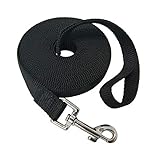
- Dog Leash Dimensions: training leash measures 3/4 inch width by 20 feet length, offering you dog for more wandering area and freedom.
- Nylon Long leash: long lead is made of strong wear-resistant nylon, available in Black, Blue, Red,Green color.
- Dog training leashes: suitable for teaching your dog/puppy recall and other obedience skills, great for small, medium, large dogs.
- Easy on and Easy off: Swivel-style bolt snap resists twisting. 360 degree tangle free swivel heavy duty clasp gives your dog best freedom.
- The dog training leash is built to last. If you have any question, please contact us, we will solve the problem until you are satisfied.
Teach a recall that works in stages
Recall is the skill of turning away from something and coming to you. UC Davis recommends building it where success is likely, rewarding the dog for turning and coming, and adding distance and distraction gradually. A recall should improve safety, never replace a leash in a dangerous location.
1. Make coming to you worthwhile
Choose a consistent cue and pair it with something the dog values, such as small food treats, a toy, or enthusiastic praise. Start indoors or in a quiet, enclosed area. Say the cue once, move away a short distance, and reward as soon as the dog commits to following you and again when it reaches you. This creates a history in which the cue predicts good outcomes.
Do these 3 things before closing this tab:
1Repair Windows errors before they cause bigger problems2Fix the driver behind crashes, sound loss and screen glitches3Clear out junk files and repair common Windows errors2. Practice below the failure point
Call only when the dog is likely to respond. If it is staring at a squirrel or already pulling toward a road, repeating the cue teaches the dog that the word can be ignored. Instead, reduce the distraction, shorten the distance, or wait for the dog to look back before trying again.
3. Add distance, then distraction
Change one difficulty at a time. Increase the space between you and the dog in a secure area, then introduce mild distractions. Reward every successful return generously at first. Move back to an easier setup if the dog stops responding; progress is measured by reliable repetitions, not by testing the hardest environment.
Also popular on Amazon

- Various Size&Dia. Long Dog Leash: 10FT, 16FT, 30FT, 50FT,and 100FT , various sizes can meet different training purpose. Our Dog Leash available in diameter 1/3 inch, 3/8 inch, 1/2inch. The diameter of 1/3 inch can meet small dogs, cats or other small animals. The diameter of 3/8 inch and 1/2 inch is the best choice for training leashes for large dogs or medium dogs.
- Dog Tie Out Cable: Both ends of our rope dog leash leash have a heavy duty stainless steel swivel hook that can rotate 360 degree. You can tie one end of this training leash to your body or trees etc.,so that you can free your hands when traning, hiking,walking,etc.
- Reflective for Night Safety: We’ve added a reflective stitching around this strong training lead to make sure it is visible in low light. Your pup’s safety is always our highest priority.
- Durable and Lightweight Dog Rope Leash: This training Lead is made of high strenth wear-resistant polyeste which is lightweight and environmentally friendly, not easy to pull off, and has strength, will not be entangled with trees, grass, etc.The pull is up to 8-10 KN by professional tensile test which allow for total control of your dog and also allow it the freedom to do its business.
- Excellent Outdoor Dog Leash: Great dog leash for outside sports such as hiking, camping, training, hunting, backyard, beach, mountain climbing, walking, running, and so on.Any problem don't hesitate to contact with us.
4. Protect the cue’s meaning
Do not call the dog only to end enjoyable activities, deliver medicine, or scold it. Occasionally reward a return and then release the dog to resume a safe activity. Never punish a dog for coming, even if it took too long or had just done something you disliked. A punishment history can weaken the behavior you need in an emergency.
5. Keep physical control in hazardous places
Even an excellent recall can fail when motivation, fear, or speed overwhelms the dog. UC Davis specifically supports keeping dogs leashed in especially dangerous areas. Use off-leash practice only in genuinely secure, enclosed spaces where a missed response cannot put the dog or other people at risk.
When fear or reactivity is driving the rush
A dog that lunges, barks, freezes, or tries to flee as a trigger approaches may be reacting from fear rather than seeking contact. Cornell’s guidance on reactive behavior emphasizes identifying triggers and avoiding close exposure while a behavior plan is developed (Managing reactive behavior).
Use an exit plan
Decide in advance where you can turn, which side of the path gives more space, and what cue will bring the dog beside you. At the first sign of tension, move away and use the hand target or side-position cue you practiced. Do not wait for barking or lunging if you can leave earlier.
Also popular on Amazon
- Dimensions - This dog leash measures 3/4in wide by 20 feet long. Great for hiking, camping, training, hunting, backyard, beach, recall training, outdoor play with tennis balls, and swimming!
- Long Leash: This training leash is great for teaching your dog recalls. It has the length needed to allow them to wander and ensure your command to come! is obeyed.
- Nylon Training Lead - This durable, long, nylon dog training leash will outlast cotton leashes. All stitching is reinforced and the nickel plated clip swivels to resist twisting. Our long dog leash is great for medium and large dogs. You'll love using it as a backyard dog leash, for off leash dog training, and more.
- Allows you to teach your dog recalls and other obedience skills.
- Swivel-style bolt snap resists twisting
Work at a distance the dog can handle
Training is productive only while the dog can notice the trigger and still eat, play, or respond to you. If the dog is already over threshold, increase distance or end the session. Cornell recommends avoiding triggers as a management step while a structured plan is established; forced close exposure can intensify the response.
Separate safety from behavior change
A practiced cue may help you move away, but it does not make an unpredictable situation safe. Continue using a leash and barriers while gradual behavior modification is underway. Ask a professional to design the exposure schedule if the dog is difficult to interrupt or has a bite history.
Use reward-based methods only
The American Veterinary Society of Animal Behavior (AVSAB) states: "Based on current scientific evidence, AVSAB recommends that only reward-based training methods be used for all dog training, including the treatment of behavior problems." Its 2021 position statement remains its authoritative position, and a 2025 board statement reiterated it (Position Statements and Handouts for the Public).
Reward-based training means arranging situations in which the dog can succeed and reinforcing the response you want. It does not mean allowing unsafe behavior or ignoring boundaries. Leashes, gates, distance, and visual barriers prevent access while rewards teach turning, staying with the handler, and returning.
Also popular on Amazon

- Dog Training Leash : Elevate your dog's recall skills with our dog waterproof leash. Ideal for outdoor activities like hiking, camping, and beach play, it fosters better obedience and a closer bond.
- Weatherproof Durability : Crafted from PVC coated nylon webbing, our dog waterproof leash remains lightweight and strong even when wet. It's weatherproof, easy to clean, anti-odor and perfect for all conditions.
- Strong and Soft leash : Experience a leash that's both strong and gentle. With a remarkable 600 lbs pull force resistance, it offers safety and comfort in various weather conditions.
- Adventure Ready: Designed for active outdoor moments, our dog leash stands up to play, training, and exploration. It's a reliable companion for all your escapades.
- Multi color and size: We provide different colors to choose from width 3/5 inch with length 5FT /10FT /15FT /30FT/ 50FT. Find the perfect fit for your dog's needs and your preferences.
Aversive corrections can add fear, frustration, or conflict around the very trigger that already causes the rush. Avoid trying to solve a dangerous problem by hurting, frightening, or repeatedly punishing the dog. If the behavior persists despite careful management, veterinary assessment is more appropriate than escalating corrections.
Independent reader supportYour contribution helps us test, update, and keep practical guides available for everyone.Equipment: what each tool can and cannot do
| Tool | Useful role | Important limits |
|---|---|---|
| Standard leash | Direct control near roads and other hazards; prevents a sudden dash. | It cannot identify the cause of rushing or teach a recall by itself. |
| Long training leash | Controlled recall practice in an open, secure area where the handler can manage slack. | It is not a substitute for close control and should not be used near traffic unless the handler can reliably prevent a run. |
| Physical barrier | Gate, fence, vehicle, or other object that blocks access or sight lines. | Barriers must be secure and high or solid enough for this particular dog. |
| Visual barrier | Interrupts staring at a trigger and buys time to leave. | It manages exposure; it does not change the underlying emotion without training. |
No specific leash length, brand, or model is established by the veterinary guidance above. Select equipment you can hold, inspect, and use safely, and practice handling it before relying on it around a real hazard.
When to involve a veterinarian or behavior professional
Arrange a veterinary assessment when rushing is new, escalating, hard to interrupt, associated with increased reactivity, or creating a realistic risk of injury. AAHA lists increased reactivity among behaviors that require assessment (Table 5: Concerning Behaviors that Require Assessment, June 28, 2019).
Bring your written observations and, when safe and lawful, a video recorded from a distance. Explain the first episode, how often it occurs, the triggers you have identified, equipment used, and what happens after the dog returns. Merck notes that treatment depends on diagnosis and prognosis; a veterinarian can determine whether a behavior plan, referral, or other intervention is appropriate. Do not give medication or supplements for rushing without veterinary direction.
Choosing outside help
For a trainer, ask what methods are used, how the person handles fear and aggression, and how safety is maintained between sessions. A veterinary behavior professional can assess behavior alongside medical considerations and discuss treatment options when the problem is severe or persistent. Credentials, scope of practice, experience with comparable cases, and willingness to use reward-based methods are more meaningful than a generic promise to “fix” the dog.
A practical routine for the next month
- Record patterns. Log each rush and the earliest sign you noticed.
- Remove preventable rehearsals. Change routes, add gates, and keep the dog leashed in every high-risk setting.
- Rehearse one exit behavior. Practice a hand target or moving to your side in a quiet place, then reward it.
- Train recall in small steps. Begin where the dog succeeds, add distance and distractions gradually, and stop before responses deteriorate.
- Review weekly. If the dog is not improving, the trigger distance is shrinking, or safety is becoming harder to maintain, contact your veterinarian rather than increasing pressure.
The safest outcome is not a dog that obeys perfectly in every situation. It is a handler who recognizes risk early, prevents access, and has a practiced, reward-based way to leave while qualified help addresses the reason for the rushing.
The Tool Desk
Outbyte PC Repair FREERepair Windows errors before they cause bigger problemsFix Now →Outbyte Driver Updater FREEScan for outdated or missing drivers - takes under a minuteDriver Scan →




Leave a Reply