
What’s actually slowing this PC down?
Pick the symptom - the matching free tool is one click away.
After you apply to adopt a shelter dog, expect a process designed to match the dog’s needs with your household—not a single national checklist. The organization may review your application, talk through your routine and experience, arrange a meeting with the dog, request introductions with resident pets, and, in some cases, schedule a home visit. Home visits are not universal, and the reviewed national guidance does not establish one standard inspection or pass/fail rule.
Read the shelter’s current instructions, ask exactly what its home visit involves, prepare a safe quiet area and basic supplies, and plan for a gradual adjustment once the dog arrives.
As an Amazon Associate I earn from qualifying purchases.
How a shelter dog adoption usually unfolds
Every shelter or rescue sets its own sequence, timing, fees and eligibility rules. Some organizations complete adoptions the same day; others require additional conversations, references, landlord confirmation or a waiting period. Treat any example from another organization as an example, not as a promise about yours.
1. Read the organization’s current requirements
Before submitting or completing an application, check the shelter’s website or ask staff about required identification, application steps, fees, housing documentation, resident-pet meetings, medical records, transport and pickup timing. Housing rules matter: confirm that your lease, building policy or local regulations allow a dog of the size and type you are considering.
#1 Best Overall

- Engineered for Ultimate Strength: Constructed from 1/2 inch diameter rock climbing rope, this heavy duty dog leash is distinctively durable and strong. It is designed to withstand the strongest pulls from large and energetic dogs, giving you peace of mind that your pup won't break free during walks
- Comfortable Padded Handle: Say goodbye to rope burn. Our soft, cushioned foam handle provides an amazing grip and protects your hands from sudden tugs. Enjoy longer walks and extended training sessions with total comfort, even if your dog is a puller
- Maximum Nighttime Visibility: Highly reflective threads are woven through the entire length of the rope (not just painted on), keeping you and your fur baby visible to passing cars and cyclists during early morning jogs or late-night strolls. Perfect for urban streets and low-light environments
- Tangle-Free 360° Swivel: Featuring a heavy-duty metal clasp that rotates 360 degrees, this ensures the rope never gets twisted or tangled, no matter how much your dog moves around. The zinc alloy hook is rust-proof and easy to clip onto any dog collar or harness in seconds
- Versatile for Any Activity: Park walks, trail hikes, or yard training. Offers ideal balance of freedom and control. Comes in 4ft, 5ft, 6ft lengths and 12 colors. 3/8" diameter suits small to medium dogs – lightweight and non-bulky. For medium and large dogs, choose 1/2" diameter
The ASPCA Adoption Center in New York City, for example, requires government-issued photo identification and offers same-day adoptions while advising adopters to check building pet policies. That is a local example, not a nationwide requirement.
2. Complete an application and conversation
Expect questions intended to identify a workable match. Best Friends Animal Society describes its own approach as open-ended and conversational rather than an interrogation. Staff may ask about your previous pet experience, work schedule, activity level, household noise, children, visitors, other animals, where the dog will stay and what qualities you want in a companion.
Answer candidly. A long workday, a small apartment, a young child, limited dog-training experience or a resident cat is not automatically disqualifying, but concealing it can lead to a poor match. Accurate information lets staff suggest a dog whose exercise, supervision and social needs fit your actual life.
PC Slower Than It Used to Be?
A free scan shows the junk files, broken settings and background clutter dragging Windows down - then fixes them in one click.Free scan · Windows 10 & 11Crashes, No Sound, or Screen Glitches?
Random freezes, missing sound and display glitches usually trace back to one bad driver. Find and replace yours safely.Free scan · under a minute3. Meet the dog and review available information
The shelter may arrange an interaction with the dog, explain the dog’s known history, and discuss medical or behavior observations. Ask what is known, what is uncertain and what support is available after adoption. A biography can describe personality and needs, but shelter observations cannot show every response a dog will have in a new home.
4. Complete any required introductions and paperwork
If you have another dog or other pets, ask whether they should attend a meet-and-greet and where it should occur. The organization may then finalize an adoption agreement, payment, records and pickup arrangements. Do not assume that every resident pet should come to the first appointment; follow the shelter’s directions.
What happens during a home visit?
First, find out whether a visit is actually required
Home visits are not a universal adoption requirement. Some organizations do not conduct them; others may use an in-person visit, video call or a discussion about your home. The available national guidance does not define one standard home-visit procedure or checklist.
Rank #2

- 【Professional Retractable Dog Leash】 The ultimate combination: 16 ft strong nylon reflective tape, impact-resistant ABS housing, and a stainless steel anti-chew cable. This design greatly reduces the risk of being bitten through, extending the leash’s lifespan. Augwind’s retractable leash is specifically designed for small to medium dogs under 50 lbs, offering the best value on the market
- 【Safe & Effective】16 ft Strong Reflective nylon webbing; Over 100,000 retraction times; Max anti-jerk tensile strength: 350 lbs; . Whether day or night, on the street or lawn, the Augwind retractable leash makes every walk safe and easy
- 【Quick Lock System】 Operate the pause, lock, and unlock buttons with a single thumb. Enjoy smooth braking and instant response. The Augwind retractable dog leash ensures the safety of both you and your pet on every outing
- 【2026 Equipment Upgrades】1. Reflective webbing 2. Chrome-plated, rust-proof 360° rotating clasp 3. Ergonomic soft silicone handle 4. Reserved slot for poop bag holder 5. Stainless steel anti-chew cable
- 【2-Year Warranty】 We are a professional pet products company committed to bringing the safest, most practical, and affordable pet products to pets and their owners. We promise to solve any quality issues within 2 years. We provide 24/7 after-sales service. If you have any questions, please feel free to contact us
When a shelter mentions a visit, ask these practical questions before scheduling:
Free tools Windows power users keep installed
One-click scans. No signup required.
- Is the appointment in person, by video or a conversation at the shelter?
- Who will attend, and approximately how long will it take?
- Which rooms, entrances, balcony or outdoor areas do you want to see?
- Should resident animals or all household members be present?
- Should I have identification, a lease, landlord approval, vaccination records or photographs available?
- Will the visit happen before I meet the dog, after a match is proposed or shortly before pickup?
These questions prevent surprises without treating one organization’s practice as a universal rule.
Topics staff may discuss
A home conversation commonly centers on how the dog will live with you. Best Friends’ adoption guidance gives examples such as the dog’s living area, household circumstances, experience, resident pets and what the adopter is seeking. Staff may ask about:
- Where the dog will sleep, eat and spend time when unsupervised.
- Your daily schedule, exercise plan and arrangements for toilet breaks or midday care.
- Children, frequent visitors, household noise and anyone who is fearful of dogs.
- Other dogs, cats or small animals and how you will separate them initially.
- Potential hazards, including unsecured doors or windows, accessible chemicals in a garage, toxic plants, loose cords and unsafe fencing.
- Whether a yard is secure if the dog is ever outside without a person.
- How you plan to use gates, a crate or another management method while the dog learns the home.
This is best understood as a fit and safety discussion. The sources do not support a universal pass/fail inspection, a required yard, or a single acceptable type of housing.
Questions the shelter may ask you
Prepare concise, honest answers to the areas below. If your circumstances are changing, explain the change and the plan rather than giving an idealized answer.
- Experience: Have you lived with dogs before? What worked, and what would you do differently?
- Routine: How many hours will the dog be alone on a typical weekday? Who handles walks, feeding, training and veterinary appointments?
- Household: Who lives in or regularly visits the home? Are there children, older adults or people with allergies?
- Other animals: What species and ages are present? How have they reacted to dogs?
- Living arrangements: Is the home rented or owned? Are there breed, size, number or stair-access restrictions?
- Expectations: Are you seeking a running partner, a calm companion, a family dog or a dog comfortable with other animals?
- Resources: Can you provide routine veterinary care, food, training, enrichment and emergency care?
Staff may use your answers to recommend a different dog or additional preparation. That is a matching decision, not necessarily a rejection.
Rank #3

- Small Retractable Dog Leash is Suitable for Dogs Under 35 lbs; Medium For Dogs Under 55 lbs; Large For Dogs Under 110 lbs; Retractable Leashes Not Suitable For Chewing
- 16 ft Tape Retractable Dog Leash With Easy-Adjust Retraction; 360 Degree Tangle-Free Inlet
- Quick Lock And Unlock Feature - Easy Roll-On and Roll-Off With Your Thumb
- Super Comfortable Grip For Those Long Walks! Ergonomic Anti-Slip Handle
- Heavy Duty Internal Coil For Consistent Retraction and Recoil
How to prepare your home
Create a quiet landing area
Choose a low-traffic space where the dog can rest and observe without being crowded. Set up a bed, water and food bowls, and a way to limit access to the rest of the home. A baby gate or crate can help when introduced positively and used as management rather than punishment.
Remove preventable hazards
- Secure electrical cords and small objects that could be swallowed.
- Check doors, windows, balconies and gates for escape routes.
- Move medications, cleaning products, pesticides, chemicals and unsafe foods out of reach.
- Review plants and household items for toxicity or choking risks.
- Keep trash, tools and garage materials behind closed doors.
Ask shelter staff whether the dog has particular medical, mobility or behavioral needs that change this setup.
Gather basic equipment
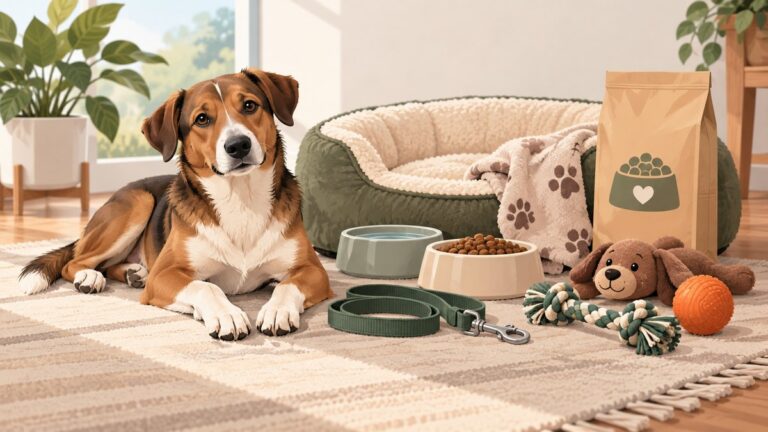
Have a dog leash, collar with an identification tag, food and water bowls, a bed, suitable toys and treats ready. A harness may be preferable for some dogs; ask the organization what equipment fits the dog and whether it is sending any supplies home. Do not buy equipment solely because it appears on a generic list if staff have identified a safer option.
Introducing the dog to resident pets
Tell the shelter about every animal in the home. Best Friends recommends meet-and-greets for resident pets in its guide, but the correct location and sequence depend on the animals. A neutral outdoor walk can work for some dog-to-dog introductions; other situations require a controlled indoor plan or separate appointments.
- Ask the shelter whether your resident dog should attend the first meeting and which handler should bring each animal.
- Use the location and distance recommended by staff; do not force nose-to-nose contact.
- Plan separate feeding, sleeping and resting areas at home.
- Supervise interactions and separate animals whenever you cannot actively monitor them.
- For cats and small animals, use physical barriers and gradual scent and visual introductions rather than immediate free access.
Do not interpret one brief meeting as proof that unsupervised cohabitation is safe. Ask for follow-up guidance if either animal shows fear, guarding, chasing or escalating tension.
Planning adoption day and transport
Confirm the pickup time, documents, payment method, medication instructions and who may collect the dog. Ask whether the shelter has restraint requirements for the trip. The ASPCA’s New York City center advises adopters to consider transport; that advice illustrates a practical concern but is not a universal rule.
Rank #4

- ENHANCED NIGHT VISIBILITY: Keep your dog safe during early morning or evening walks. The upgraded double-sided reflective stitching catches streetlights and car headlights brightly, ensuring you both remain highly visible to traffic in low-light conditions
- CUSHIONED ANTI-BURN HANDLE: A savior for hands when walking active dogs that pull. The soft, thick interior padding prevents painful rope burn and strain, providing a secure, comfortable grip for better control when your furry friend lunges. Includes a sturdy metal D-ring for clipping poop bag dispensers
- PERFECT 6FT BALANCE: The ideal length for urban walks, offering your dog enough freedom to sniff around while keeping them close enough for easy command in busy areas. Choose the 3/4'' width for small breeds, or the robust 1.0'' width for powerful medium to large dogs
- HEAVY-DUTY TANGLE-FREE CLASP: Features a strong metal spinning snap that allows 360° movement, preventing frustrating leash tangles so your dog can move freely around you. Built with high-density nylon webbing for reliable daily strength. NOTE: While tough for pulling, this nylon material is NOT chew-proof. Don't leave unattended with chewers
- COMPLETE THE LOOK: Available in vibrant colors tailored to match your dog's style. For the ultimate coordinated walking set, pair this leash with our matching Joytale reflective nylon collar
Bring a leash and collar or harness approved by staff, and use a secure vehicle arrangement. Keep the first trip quiet and direct. Avoid taking the newly adopted dog to crowded venues or introducing many visitors immediately after arrival.
The first days at home
A dog may be nervous or overwhelmed by unfamiliar smells, sounds, people and animals. Start with the prepared quiet area, a predictable feeding and bathroom routine, calm direction and plenty of opportunities to rest. Let the dog approach you; do not force petting, play or contact with children and other pets.
The ASPCA’s “3-3-3 Guideline” is a loose adjustment aid, not a guaranteed timetable. A dog’s past, health, age and previous experiences affect the pace. Some dogs settle quickly; others need substantially longer than three days, three weeks or three months. Increase freedom gradually as the dog demonstrates that it can relax and make safe choices.
How much should you trust shelter behavior information?
Use behavior notes as one source of information, not a prediction of every future response. The ASPCA’s position statement says shelter behavior assessments have not proved highly accurate or precise for predicting post-adoption aggression, and that scientific thinking remains inconclusive. Context and multiple observations matter.
Ask what staff directly observed, in what setting, how often, and whether the behavior changed with different handlers or environments. Also ask about medical issues, pain, fear triggers, resource guarding, separation concerns and recommended management. A calm kennel presentation does not guarantee calm behavior in a home, and a frightened shelter response does not automatically define the dog’s long-term temperament.
Do these 3 things before closing this tab:
1Fix the driver behind crashes, sound loss and screen glitches2Repair Windows errors before they cause bigger problems3Scan for outdated or missing drivers - takes under a minuteWhat to compare when considering organizations
Because there is no universal adoption pathway, compare each organization’s written policies rather than assuming one shelter’s rules apply elsewhere.
Best Value

- Upgrade: The product has been modified to use nylon thread directly sewing, very strong.All handles was sewn onto the leash instead of the cord ties.Package includes: frosted zipper bag,two handles dog leash.
- MAXIMUM TOUGHNESS AND DURABILITY: Nearly 2X thicker and stronger than standard dog leashes. 3mm thick and 1” wide with tightly webbed nylon for enhanced rugged construction.
- DUAL HANDLES FOR TOTAL CONTROL: Soft Neoprene and padded handle, comfortable than ever ;Equipped with an extra traffic handle for amazing control. Use the standard handle for those casual dog walks or quickly grab the built in traffic handle to guide your pup through crowded areas with ease.
- 360° Rotating Clasp: Swivel clasp prevents the leash from twisting and dog getting tangled. Heavy-duty metal clasp makes our training leashes last longer than most ones. Premium components for maximum strength
- BE SAFE AND VISIBLE AT NIGHT: Luminous reflective threading keeps you both safe and visible on your late-evening walks. Enjoy a large 2” heavy duty clip for added safety and thick D-ring to attach your favorite dog training clicker or dog poop bag holder.Packaging details:Frosted zipper bag,Dog leash with D ring
| Decision area | What to verify |
|---|---|
| Process and timing | Application stages, appointment availability, same-day decisions and expected wait. |
| Eligibility and documents | Photo identification, landlord or housing approval, references and household-member requirements. |
| Fees and coverage | Adoption fee, included vaccinations, sterilization, microchip, medications and follow-up obligations. |
| Home visit | Whether it is required, its format, who attends and what areas or documents are requested. |
| Resident-pet meetings | Which animals should attend, where introductions occur and what safety steps are expected. |
| Information provided | Medical history, behavior observations, known triggers, training notes and uncertainties. |
| After-adoption support | Return policy, behavior help, veterinary contacts, training referrals and emergency guidance. |
Common problems and practical responses
Your landlord has not approved the dog
Pause the application until you have written confirmation of the building’s pet policy, deposits, size limits and any breed or number restrictions. Ask the shelter which document it accepts.
The shelter wants a home visit but gives no details
Request the format, attendees, areas to be shown, resident-pet instructions, documentation and approximate timing. Prepare the safe area and hazard controls, but do not assume you need to remodel your home or install a yard.
Your resident dog reacts badly at the meeting
Tell staff exactly what happened and ask whether a different setting, distance, handler or candidate dog is appropriate. Do not proceed on the assumption that the animals will “work it out” unsupervised.
Recommended Free Tools
The adopted dog hides or will not eat
Keep the environment quiet, maintain a routine and avoid forced interaction. Follow the shelter’s medical instructions and contact the organization or a veterinarian if the dog will not drink, appears ill, has breathing difficulty, repeated vomiting or diarrhea, or shows another urgent symptom.
The dog behaves differently than expected
Record triggers and circumstances, increase management and seek the shelter’s post-adoption support. Behavior information is useful but cannot guarantee how a dog responds after the move.
Adoption preparation checklist
- Read the organization’s current application, fee, identification and housing rules.
- Ask whether a home visit is required and how it will be conducted.
- Discuss your schedule, household members, resident pets, experience and expectations honestly.
- Prepare a quiet room or gated area and remove cords, chemicals, unsafe foods and escape routes.
- Obtain a leash, collar and ID tag; confirm whether a harness, crate or other equipment is recommended.
- Plan secure transport and confirm pickup documents and medication instructions.
- Ask how and where resident-pet introductions should occur.
- Set a calm routine for the first days and allow adjustment at the dog’s own pace.
- Save the shelter’s contact information and ask about behavior and veterinary support after adoption.
Pet insurance can be considered later as part of budgeting, but policies may have waiting periods and exclusions for pre-existing conditions. Verify the actual terms before relying on coverage for a particular dog or treatment.
Quick Recap
Product prices and availability are accurate as of the date/time indicated and are subject to change. Any price and availability information displayed on Amazon at the time of purchase will apply.
The Tool Desk
Outbyte Driver Updater FREEScan for outdated or missing drivers - takes under a minuteDriver Scan →Outbyte PC Repair FREERepair Windows errors before they cause bigger problemsFix Now →



Leave a Reply