
PC Slower Than It Used to Be?
A free scan shows the junk files, broken settings and background clutter dragging Windows down - then fixes them in one click.Free scan · Windows 10 & 11Crashes, No Sound, or Screen Glitches?
Random freezes, missing sound and display glitches usually trace back to one bad driver. Find and replace yours safely.Free scan · under a minuteMany animals can detect and use Earth’s magnetic field for orientation, migration, homing, and possibly map-like positioning. The strongest evidence is behavioral: animals respond to magnetic direction, inclination, intensity, or regional field patterns. The weakest part of the story is the mechanism—researchers still do not have one universally accepted magnetic receptor or a complete account of how a field signal becomes a neural representation.
Humans unquestionably use the field through compasses. Whether people retain a biological magnetic sense is unsettled: laboratory EEG work and one unusual behavioral study reported magnetic-field-related effects, but neither establishes conscious perception of north or ordinary human navigation by an internal compass.
As an Amazon Associate I earn from qualifying purchases.
What the magnetic field can tell an animal
Earth’s field supplies more than a single north–south arrow. Its direction, the angle at which its field lines meet the ground (inclination), and its strength vary across the planet. An animal may therefore use magnetic information in two different ways:
| Type of information | Navigation question | Possible use |
|---|---|---|
| Magnetic compass | Which way should I travel? | Maintaining a heading during migration, dispersal, homing, or movement through unfamiliar terrain |
| Magnetic map | Where am I? | Comparing local combinations of field intensity and inclination with a learned or inherited regional pattern |
This does not mean animals carry a tiny GPS receiver or use one universal magnetic organ. Different species may detect different components of the field, combine magnetic information with vision, odors, the Sun, stars, polarized light, or landmarks, and rely on different biological mechanisms. Reviews of the field support magnetic orientation strongly at the behavioral level while emphasizing that the receptor and neural pathway are not yet settled. A review of magnetic compass and map senses and a review of magnetoreception mechanisms explain the distinction.
#1 Best Overall

- KEY FEATURES: This manual magnet compass consists of Acrylic Baseplate with Azimuth bearing and 360 degree rotating bezel. With the help of a magnetic needle which consists of a liquid-filled capsule (bubble free) helps to swing fast and freely point you towards north. The Magnifying Glass is used for reading and navigating geological maps. Along with this, it has the compass Ruler Scale of 1:24000 for precise route mapping
- PORTABLE & LIGHTWEIGHT: Boy Scout compass is small in size and an essential piece of survival gear to have in your pocket or hiking backpack. Both children and adults can use it, easy to carry during your trips especially for field trips. Portable Handheld Compass with magnetic needle and directional arrow, orienting lines compass and lanyard
- PROFESSIONAL, ADVANCE COMPASS NAVIGATION: Our orienteering compass is constructed for accurate directions and making it an ideal all-around land navigation kit for hikers, campers, girl & boy scouts and survivalists
- HIGH QUALITY: On every outdoor journey, a vital and high-quality compass keeps you feeling secure and can read topographic maps. Ideal for use with a kayak, camping trip, climbing expedition, or seeing animals outside
- IDEAL SURVIVAL GIFTS FOR HIKERS: During any emergency situation where you feel stuck or forget the way, this device can turn out to be a savior to make you out of depth. So, this BSA compass is an ideal gift for beginner cub scout and eagle scout, adults who love hiking, outdoors, girl & boy kids and fishermen's
Why Earth’s field is useful
A magnetic cue is available day and night and can remain useful when clouds hide the Sun or stars, water makes odors difficult to track, or a landscape offers few recognizable landmarks. The field also passes through clouds, vegetation, soil, and animal tissue. Those properties make it a potentially reliable background reference.
It is not perfectly stable or uniform. Field strength and inclination change with latitude and location, while local rocks, electrical equipment, vehicles, and other technology can create disturbances. The field also changes over time. This combination is both useful and difficult: broad geographic variation could provide map-like information, but local noise can complicate an animal’s signal. Research on the challenges of studying weak magnetic fields discusses why controlled experiments are demanding.
Magnetic information normally works alongside other senses rather than replacing them. A bird might use a magnetic compass on a cloudy night and visual or celestial cues when they are available. A sea turtle may use a heading mechanism during one phase of a journey and regional magnetic signatures during another. The scientifically defensible picture is a flexible sensory system, not a universal biological GPS.
Quick wins for a faster PC:
Clear out junk files and repair common Windows errorsFree Scan →Fix the driver behind crashes, sound loss and screen glitchesFind Drivers →Repair Windows errors before they cause bigger problemsFix Now →The three leading explanations for magnetoreception
Scientists have proposed three major mechanism families. They may not be mutually exclusive: different animals could use different mechanisms, and a single species could potentially use more than one type of magnetic information.
1. Magnetite-based sensing
Magnetite is a naturally magnetic iron-oxide mineral. In the magnetite hypothesis, microscopic crystals are arranged so that the geomagnetic field can exert a mechanical force on them. That movement could affect mechanically sensitive ion channels or nearby nerve cells, converting a change in the field into a biological signal.
Magnetite or magnetite-like structures have been detected or proposed in many organisms, but finding magnetic particles is only the beginning of the argument. Researchers must establish that the material is genuinely part of the animal rather than contamination, determine its precise location and geometry, show that it responds to relevant field changes, and connect the response to a nervous system and a behavior. Magnetite found in a tissue sample is not, by itself, proof of a magnetic receptor. The cellular and anatomical evidence is reviewed in this discussion of candidate magnetoreception mechanisms.
2. Radical-pair chemistry and cryptochrome
The radical-pair model is a light-dependent chemical mechanism. Light activates a reaction that creates two molecules with correlated electron spins. Earth’s weak field could slightly alter the relative chemical products formed by that reaction. If those products affect a sensory pathway, the animal could obtain directional information from the field.
Cryptochrome proteins are leading candidates in this model, especially in the eyes of migratory birds. A light-sensitive magnetic compass associated with the retina could allow the bird to perceive magnetic direction as part of its visual environment, although that does not mean the bird necessarily experiences a conscious compass needle or a visible overlay.
Rank #2

- High-Precision – Sportneer compass is engineered for superior accuracy, featuring a rear sight lens that magnifies the dial for precise and effortless readings. For optimal performance, keep the compass level to ensure the magnetic needle rotates freely and points accurately to magnetic north.
- Waterproof and Shockproof – Crafted with a durable metal base and cover, this compass is built to withstand years of rugged outdoor use. Its waterproof and shock-resistant construction ensures reliable performance in harsh weather and tough terrains.
- Perfect for Outdoor Adventures – This precision compass delivers reliable bearings and sighting for camping, hiking, hunting, and scouting. Its rugged navigation capabilities keep you on course in any terrain, making it an essential adventure companion.
- Easy Nighttime Visibility – After sufficient exposure to light, the north indicator and dial markings glow in the dark with a fluorescent coating, providing clear and reliable readings even in complete darkness. Ideal for night navigation or low-light conditions.
- Perfect Portable Gift for Explorers – This lightweight compass easily slips into any pocket or backpack, making it a must-have for outdoor adventures. With its simple navigation and handy lanyard, it's great for kids learning about the outdoors and perfect as a thoughtful gift for hikers, campers, and nature lovers of all ages.
The chemistry is physically plausible, and candidate cryptochromes have been identified, but a candidate protein is not the same as a demonstrated receptor-to-brain-to-behavior pathway. Scientists still need to connect the molecular reaction, the location of the relevant cells, the neural processing, and the observed navigation behavior.
3. Electromagnetic induction
An animal moving through a magnetic field can, in principle, experience induced electrical effects. This explanation is most plausible for aquatic animals that already possess specialized electroreceptors, including elasmobranch fishes such as sharks and rays. Water movement through Earth’s field could generate electrical signals that those organs detect.
Induction is a physical possibility, not a universal explanation. Directly demonstrating that it accounts for geomagnetic navigation in a particular species requires experiments that separate induced electrical signals from other cues and show that the proposed pathway predicts the animal’s behavior. The three mechanism families are compared in this magnetoreception review.
The Tool Desk
Outbyte Driver Updater FREEScan for outdated or missing drivers - takes under a minuteDriver Scan →Outbyte PC Repair FREERepair Windows errors before they cause bigger problemsFix Now →Animal examples: strong behavior, unfinished mechanism
Migratory birds
Migratory birds are among the clearest examples of animals that use geomagnetic information. Many can maintain headings over long distances, including when familiar landmarks are absent. Their orientation can change when researchers manipulate the magnetic field, alter lighting conditions, or apply magnetic pulses.
A light-dependent compass involving cryptochrome proteins in the retina remains a leading explanation. Magnetite-containing structures and pathways associated with the vestibular system have also been investigated. The safe conclusion is that birds possess a magnetic orientation system. It is not safe to say that scientists have identified one universally accepted bird magnetoreceptor or fully mapped the neural circuit. Current reporting on bird magnetoreception describes why the mechanism remains an active research question.
Sea turtles
Loggerhead sea-turtle hatchlings provide an especially useful example because researchers have tested them in artificial magnetic fields that reproduce conditions associated with different geographic regions. The hatchlings orient differently under some of those regional field signatures, supporting the idea that turtles can use geomagnetic information during oceanic navigation. The NOAA-hosted research report on sea-turtle magnetic navigation documents this line of work.
This case also clarifies the difference between a compass and a map. A compass response tells a turtle which way to swim. A learned or inherited response to a regional combination of inclination and intensity could help it recognize where it is along a route. Such a map would not need to resemble a human paper map; it could be a set of biological comparisons between the current field and remembered field signatures.
Recommended Free Tools
Bacteria, insects, worms, and mammals
Magnetic orientation is not restricted to long-distance vertebrate migrants. Magnetotactic bacteria align themselves with geomagnetic field lines using chains of magnetite-containing structures called magnetosomes. They are not animals, but they show that biological systems can exploit the field at a very small scale.
Rank #3
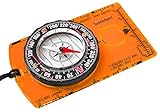
- KEY FEATURES: This manual magnet compass consists of Acrylic Baseplate with Azimuth bearing and 360 degree rotating bezel. With the help of a magnetic needle which consists of a liquid-filled capsule (bubble free) helps to swing fast and freely point you towards north. The Magnifying Glass is used for reading and navigating geological maps. Along with this, it has the compass Ruler Scale of 1:24000 for precise route mappin
- PORTABLE & LIGHTWEIGHT: Boy Scout compass is small in size and an essential piece of survival gear to have in your pocket or hiking backpack. Both children and adults can use it, easy to carry during your trips especially for field trips. Portable Handheld Compass with magnetic needle and directional arrow, orienting lines compass and lanyard
- PROFESSIONAL, ADVANCE COMPASS NAVIGATION: Our orienteering compass is constructed for accurate directions and making it an ideal all-around land navigation kit for hikers, campers, girl & boy scouts and survivalists
- HIGH QUALITY: On every outdoor journey, a vital and high-quality compass keeps you feeling secure and can read topographic maps. Ideal for use with a kayak, camping trip, climbing expedition, or seeing animals outside
- IDEAL SURVIVAL GIFTS FOR HIKERS: During any emergency situation where you feel stuck or forget the way, this device can turn out to be a savior to make you out of depth. So, this BSA compass is an ideal gift for beginner cub scout and eagle scout, adults who love hiking, outdoors, girl & boy kids and fishermen's
Nematodes, insects, and several mammals have also been studied for magnetic sensitivity or orientation. Taken together, these examples suggest either that magnetoreception has evolved multiple times or that several different physical mechanisms can produce similar behavior. They do not support the idea of one conserved magnetic organ shared by every species. The comparative evidence is summarized in this review of animal magnetoreception.
What this means for dogs and cats
Evidence that some mammals can orient to magnetic information does not prove that every household pet has a dependable magnetic compass or map. The research dossier does not establish that dogs or cats consciously sense north in ordinary life. A pet’s route, return home, or choice of resting place can also reflect smell, visual landmarks, memory, sunlight, learned routines, and local environmental cues.
For the same reason, a compass placed beside a dog or cat cannot show whether the animal detects the field. A change in the pet’s behavior would be difficult to interpret without carefully controlled field manipulation and controls for all the other cues. Pet owners should treat claims about a particular breed or species as requiring species-specific evidence, not as an automatic consequence of the animal being a mammal.
What’s actually slowing this PC down?
Pick the symptom - the matching free tool is one click away.
Can humans detect Earth’s magnetic field?
There are three separate claims, and they should not be blended together:
| Claim | Status |
|---|---|
| Humans can use Earth’s field with an instrument. | Established. A magnetic compass provides a bearing. |
| Human brains may respond to controlled, Earth-strength magnetic-field changes. | Supported by notable laboratory findings, but not settled. |
| Humans consciously feel magnetic north or routinely navigate with a biological magnetic sense. | Unproven. No identified human receptor or established everyday ability demonstrates this. |
What the human EEG evidence shows
A 2019 EEG experiment reported repeatable changes in alpha-band brain activity when participants were exposed to rotations of Earth-strength magnetic fields. The response depended on the orientation of the field’s vertical component. The study’s authors interpreted the result as consistent with a ferromagnetic transduction element, meaning a magnetic material might help convert field changes into a neural signal. The published EEG study is important evidence that a controlled magnetic stimulus can be associated with a measurable brain response.
That result does not show that participants consciously felt north, could name a direction, or could navigate without ordinary sensory information. A laboratory EEG response is not the same thing as a conscious sensation or a useful map sense. It also does not, on its own, identify the receptor, prove the proposed ferromagnetic element, or establish that the response affects everyday behavior.
What the behavioral food-orientation study reported
A separate 2019 study reported that starved men—but not women—oriented toward magnetic directions previously associated with food when tested under blue light. The reported effect disappeared when participants were blindfolded or exposed to longer-wavelength light. The study’s PubMed record provides the reported design and result.
This is a provocative finding rather than a settled demonstration of human magnetoreception. Its unusual conditions, sex-specific result, light dependence, and the inconclusive broader literature mean it should not be converted into the claim that people can normally feel magnetic north. A review of the human question makes the more cautious distinction between instrument-based compass use, possible neural responses, and an unproven consciously accessible sense. See the review of human magnetoreception evidence.
Rank #4

- Non-Magnetic Base Plate for Accurate Readings – Compass for kids the acrylic lens sits on a non-magnetic base plate that keeps the magnetic needle free from interference, so the needle settles quickly and points steadily. A rotatable bezel helps kids find true north more easily
- Magnetic Needle for Map Reading & Orienteering – Compass for kids magnetic needle points to magnetic north and settles fast, making this a practical orienteering compass for teaching map and compass skills. Works well for scout troop activities, homeschool geography lessons, and beginner map reading practice.
- Built for Everyday Outdoor Use – The acrylic lens and base plate handle regular hiking, camping, and backyard exploration. Keep it dry and store it away from strong magnets or electronics so the needle stays accurate. For heavy rain or extreme cold, we recommend storing it in a dry pouch between uses
- 1:25,000 Scale for Beginner Map Work – The base plate includes a 1:25,000 map scale that fits most USGS topo maps, so kids can measure distance directly on the map. One inch on the map equals roughly 0.79 miles on the ground — a simple way for parents to explain scale during a first map reading lesson
- Compact Size & Lanyard for Kids – The compass body measures about 4.33"L x 2.3"W and weighs 1.28 oz, a comfortable size for kids to hold. A neck lanyard is included so it stays close during hiking, camping, or orienteering practice.
Why the mechanism is so difficult to prove
Earth’s field is weak—on the order of tens of microteslas—so a biological signal may be small. A convincing experiment must change the magnetic field while keeping vibration, sound, heat, visual information, electrical artifacts, and experimenter expectations from changing with it. Otherwise, an animal or person may be responding to a correlated nonmagnetic cue.
Researchers also need to distinguish a compass response from a map response. An animal that chooses one of two directions in a test may be showing a directional preference, but that alone does not demonstrate that it can determine its geographic position. Likewise, a change in brain activity demonstrates a physiological response, not necessarily a useful navigational sense.
Anatomy adds another problem. Magnetic fields pass through tissue, so the relevant receptor could theoretically be in more than one body region. Candidate structures may be microscopic, difficult to locate, or vulnerable to contamination during dissection. Even when magnetic particles are found, researchers must establish their biological function rather than assuming it from their physical properties.
Free tools Windows power users keep installed
One-click scans. No signup required.
A consumer EMF meter or magnetometer can compare field readings, but it cannot directly measure magnetoreception. Consumer devices differ in sensitivity, calibration, frequency response, and whether they measure static magnetic fields at all. A reading from one device is therefore not a substitute for the controlled apparatus used in a behavioral or neural experiment.
Independent reader supportYour contribution helps us test, update, and keep practical guides available for everyone.A practical demonstration: use a compass, not your pet
Anyone can observe the same environmental field that animals may exploit by using an instrument. To make the demonstration meaningful:
- Take a magnetic compass outdoors, away from vehicles, large metal objects, speakers, power equipment, and strong magnets.
- Hold it level and let the needle settle. The north-seeking end aligns with the local horizontal component of Earth’s magnetic field.
- Rotate your body or walk in a different direction and observe that the compass continues to provide a reference bearing.
- If you are transferring a bearing to a map, account for magnetic declination—the local difference between magnetic north and geographic or true north.
- Repeat the observation in another location and look for differences rather than expecting every compass reading or field condition to be identical.
An orienteering compass is a practical choice because its transparent baseplate and direction-of-travel features make it useful for both observing magnetic direction and practicing map navigation. It demonstrates how humans externalize a magnetic compass; it does not test whether the user or a pet has a biological magnetic sense. The USGS guide to using a compass and understanding magnetic declination explains why a compass bearing and a map’s true-north grid are not automatically the same.
For advanced readers, a handheld magnetometer can be useful for comparing relative field strengths in different places, provided its specifications and calibration are understood. It still cannot reveal a receptor, prove that an animal is responding to the field, or reproduce a controlled magnetoreception experiment. Do not expose a pet to improvised magnetic or electrical tests and interpret a behavioral change as evidence; the necessary controls are much stricter than a home demonstration.
The most defensible conclusion
Animals provide compelling behavioral evidence for geomagnetic sensing. Birds use magnetic information during orientation, sea-turtle hatchlings respond to regional magnetic signatures, and magnetotactic bacteria align with field lines. Other insects, worms, and mammals show that magnetic sensitivity is biologically widespread enough to deserve serious study.
Best Value

- PROFESSIONAL GRADE: Trcosenp professional compass will always lead you in the right direction. The compass hiking survival are ideal for camping, military usage, emergencies, navigation and anywhere the beaten track takes you. It's also a good choice as the gifts for kids.
- PORTABLE: Boy Scout compass is small in size and an essential piece of survival gear to have in your pocket r hiking backpack , Portable Handheld Compass with magnetic needle and directional arrow, orienting lines compass and lanyard Both children and adults can use it, easy to carry during your trips especially for field trips
- EASY TO USE:Each orienteering compass features a magnetic needle that accurately points to magnetic north, Compass for kids ensuring you stay on track during your wilderness explorations, for teaching kids about navigation and map reading skills of compass for kids, fostering an appreciation for the great outdoors
- HIGH QUALITY: This is a high quality product that it is a waterproof compass made with acrylic materials to prevent interference with the magnetic needle and ensure accurate readings. It is durable, compact, and portable, that makes it perfect for every outdoor activity,The Magnifying Glass is used for reading and navigating geological maps. Along with this, it has the compass Ruler Scale of 1:24000 for precise route mapping
- VERSATILE GEAR: Whether you're backpacking, Camping, hunting, Kids hiking,or simply exploring nature, These compasses are an essential addition to your survival camping gear
What remains unresolved is how those signals are detected and processed. Magnetite, radical-pair chemistry involving cryptochromes, and electromagnetic induction are the leading mechanism families, but no single receptor or universal system explains all cases. Humans reliably use the field through compasses, and laboratory studies suggest that some controlled magnetic stimuli may produce neural or behavioral effects. That is not yet proof that people consciously sense north or navigate magnetically in everyday life.
Frequently Asked Questions
Can humans feel magnetic north?
Not in the ordinary, demonstrated sense. Humans can determine magnetic direction with a compass, and some laboratory studies have reported neural or behavioral responses to controlled magnetic fields. Those findings do not prove that people consciously feel north or can routinely navigate using an internal magnetic compass.
Does finding magnetite prove that an animal has magnetoreception?
No. Magnetite is a leading candidate material for some magnetic sensors, but simply finding magnetic particles in an animal does not establish that they are functional receptors. Researchers must rule out contamination, identify the structure’s location and geometry, show a field-dependent physiological response, and connect it to behavior.
Do dogs and cats use Earth’s magnetic field?
Not necessarily. Dogs and cats are mammals, and magnetic orientation has been studied in several mammals, but that broad evidence does not prove that household pets possess a reliable, consciously accessible magnetic compass or map. A pet’s behavior can also reflect smell, landmarks, memory, sunlight, and learned routines.
Does a compass point to geographic north?
A compass aligns with the local horizontal component of Earth’s field and gives magnetic bearings. Geographic or true north is a different reference, so map navigation may require correcting for local magnetic declination. The compass is an instrument-based demonstration, not a test of biological magnetoreception.
Can I use an EMF meter to test whether my pet senses magnets?
No. A consumer magnetometer may compare field strengths, but device sensitivity and calibration vary, and a field measurement is not a measurement of an animal’s biological response. Testing magnetoreception requires controls that separate magnetic changes from vibration, sound, light, heat, electrical artifacts, and other cues.
The Bottom Line
Bottom line: Many animals use Earth’s magnetic field as a compass-like or map-like cue, but scientists have not identified one universal magnetic receptor. Humans can use the field reliably with a compass; a biological human magnetic sense remains intriguing and unproven.
Do these 3 things before closing this tab:
1Clear out junk files and repair common Windows errors2Fix the driver behind crashes, sound loss and screen glitches3Repair Windows errors before they cause bigger problemsQuick Recap
Product prices and availability are accurate as of the date/time indicated and are subject to change. Any price and availability information displayed on Amazon at the time of purchase will apply.





Leave a Reply