
Fish swim when muscles move their bodies or fins against the water, creating forces that propel them. Many fish send a side-to-side wave down the body toward the tail; others rely more on strokes or waves from their fins. Fins can also help a fish steer and stay stable.
How does a fish move forward by wiggling side to side?
In a common swimming pattern, muscles along the two sides of a fish’s body contract in sequence. The contractions bend the body into a wave that travels from the head toward the tail. As the body and tail move, they push water backward; the water’s reaction pushes the fish forward. The tail contributes strongly to thrust, but it is part of a coordinated movement involving the body, not an isolated motor.
As an Amazon Associate I earn from qualifying purchases.
The University of Texas at Austin Marine Science Institute describes the process this way: “A fish swims by contracting a complex network of muscles along the sides of its body, known as myomeres.” How Fish Swim (August 26, 2012).
Do all fish swim with their tails?
No. Fish swimming varies: some rely mainly on body and tail movement, while others generate much of their propulsion with fins. These are broad patterns rather than exclusive categories; a fish may use more than one part of its body as it moves. Marine locomotion research describes a range of body and fin movements rather than one swimming method shared by all fish.
#1 Best Overall

- QUIET AQUARIUM FILTER: The Tetra Whisper IQ Power Filter with Stay Clean technology contains a sound shield for quiet filtration less than 40 dB.
- SELF PRIMING: Submerged motor starts up with no priming required.
- CAPACITY: The Tetra Whisper IQ 20 Power Filter works in filters up to 20 gallons (130 GPH).
- STAY CLEAN TECHNOLOGY: By maintaining healthy pH levels, creates easier maintenance for healthier fish.
- CARTRIDGE REFILLS: Change cartridges monthly; uses large-sized Tetra Whisper Bio-Bag Filter Cartridges (refills sold separately).
| Swimming pattern | Main movement | Example or use |
|---|---|---|
| Body-and-tail undulation | A side-to-side wave travels along the body toward the caudal (tail) fin. | Common forward swimming pattern. |
| Fin rowing or oscillation | Paired or median fins move back and forth to produce thrust. | Used by some fish that rely more on fins than body undulation. |
| Fin undulation | A traveling wave moves along a fin. | Rays and skates propel themselves with waves along their large side fins. |
| Lift-based fin propulsion | Fin motion generates lift that contributes to movement. | A distinct fin-based mode; its use depends on the fish and swimming pattern. |
These movement types are described in the UC San Diego Fluid Effects on Structural Systems Group overview and in George V. Lauder’s review, “Fish Locomotion: Recent Advances and New Directions” (2015).
What do fish use their other fins for?
Fins can provide thrust, but they can also help a fish steer, maneuver, or remain stable. Their roles depend on the species and how it swims. For example, the Florida Museum of Natural History notes that pectoral and pelvic fins can help stabilize rapidly swimming oceanic fish; that is an example, not a rule for every fish.
Rank #2

- QUIET AQUARIUM FILTER: The Tetra Whisper IQ Power Filter with Stay Clean technology contains a sound shield for quiet filtration less than 40 dB.
- SELF PRIMING: Submerged motor starts up with no priming required.
- CAPACITY: The Tetra Whisper IQ 45 Power Filter works in tanks up to 45 gallons (215 GPH).
- STAY CLEAN TECHNOLOGY: By maintaining healthy pH levels, creates easier maintenance for healthier fish.
- CARTRIDGE REFILLS: Change cartridges monthly; uses large-sized Tetra Whisper Bio-Bag Filter Cartridges (refills sold separately).
In short, fish move by coordinating muscle-driven body or fin motion with the surrounding water. The body-and-tail wave is one familiar solution, but fin-powered swimming is another, and fins may serve more than one purpose.
Do these 3 things before closing this tab:
1Scan for outdated or missing drivers - takes under a minute2Repair Windows errors before they cause bigger problems3Fix the driver behind crashes, sound loss and screen glitchesQuick Recap
Best Value

- WITH ROTATING BIO-WHEEL: Patented Bio-Wheel technology provides excellent wet/dry biological filtration.
- MULTI-STAGE FILTRATION: Delivers mechanical, chemical and biological aquarium filtration to maintain a clean aquatic environment.
- MARINELAND FILTRATION PRODUCTS: Count on Marineland brand for the most reliable, technically advanced aquariums and accessories on the market.
- COMPATIBILITY: Use with Marineland Rite-Size Filter Cartridges (see individual filter for sizing recommendations).
- FIVE SIZES: Available in 75 GPH, 100 GPH, 150 GPH, 200 GPH and 350 GPH sizes.
Rank #4

- Powerful Pump: 300 GPH water pump effectively filters 55-150 gallons; ideal for large aquariums, turtle tanks, and ponds.
- Enhanced Aeration: Equipped with an adjustable valve to increase oxygen levels, promoting healthier, more active fish and turtles.
- Double Deep Filtration: Dual-stage black biochemical sponge removes odors and impurities; keeps water clear and fresh.
- Dynamic Water Flow: Boosts wave size and surface movement; improves circulation for a healthier aquatic environment.
- Adjustable Body: The aquarium filter features a detachable design. For tanks under 15 inches tall, you can lay the filter flat or remove the lower half of the filter sponge for a better fit.
Rank #3
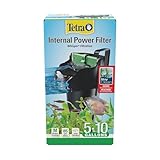
- INTERNAL POWER FILTER: Tetra Whisper Internal Power Filter for 5- to 10-gallon aquariums uses medium Whisper BioBag filter cartridges that are easy to change.
- QUIET 85 GPH MOTOR: The internal pump efficiently filters up to 85 gallons per hour.
- POWERFUL FILTRATION: Water flows through the cartridge floss, trapping debris and fish waste, while Ultra-activated carbon helps remove odor and discoloration.
- SPACE-SAVING DESIGN: Your aquarium can be 1” from the wall with the internal filter designed to clip directly on your aquarium wall and be hidden by décor.
- EASILY ADJUSTABLE: Adjustable clip allows for a variety of setups to easily adjust to high or low water levels.
Product prices and availability are accurate as of the date/time indicated and are subject to change. Any price and availability information displayed on Amazon at the time of purchase will apply.
Independent reader supportYour contribution helps us test, update, and keep practical guides available for everyone.




Leave a Reply